Lianjia's Zuo Hui: My Understanding of the Real Estate Industry | 2017 Code Conference

At Source Code Capital's 2017 Code Conference, Zuo Hui, chairman of Lianjia, shared the company's perspective and understanding of the real estate industry.
At Source Code Capital's 2017 Code Conference, Zuo Hui, chairman of Lianjia, shared the company's perspective and understanding of the real estate industry.
Zuo argued that analyzing the real estate industry should be built upon four dimensions:
First dimension: B2B. China's real estate industry is currently centered on consumer-facing (C2C) business, but B2B prospects are promising.
Second dimension: Population distribution. Anticipating future population distribution to position markets ahead of time.
Third dimension: Categorizing the real estate industry into manufacturing, trading platforms, post-sale services, and real estate financial services.
Fourth dimension: Online and offline. Every industry has opportunities where online drives offline. Real estate still has considerable potential offline, and online needs to connect with offline.

Below is the full text of Zuo Hui's speech at Source Code Capital's 2017 Code Conference:
Good morning everyone! Regarding the Context that Yiming Zhang just mentioned, I was thinking about how many years Yiming has been doing ByteDance, and when he shares this with everyone now, it must be in a specific context. I'm also very interested to know what kind of context he's sharing from? I guess he has his own management experience and management pressure.
Today, as I prepare to share with you, I'm also thinking about what my context should be? Because the industry we're in is rather special, and my own company is also quite special — we're still in the real estate services industry. Real estate is an industry where everyone can say a few words, and generally when you go out and talk with people, everyone can relate.
Today I'll share my perspective and understanding of the real estate industry with you all, for your reference.
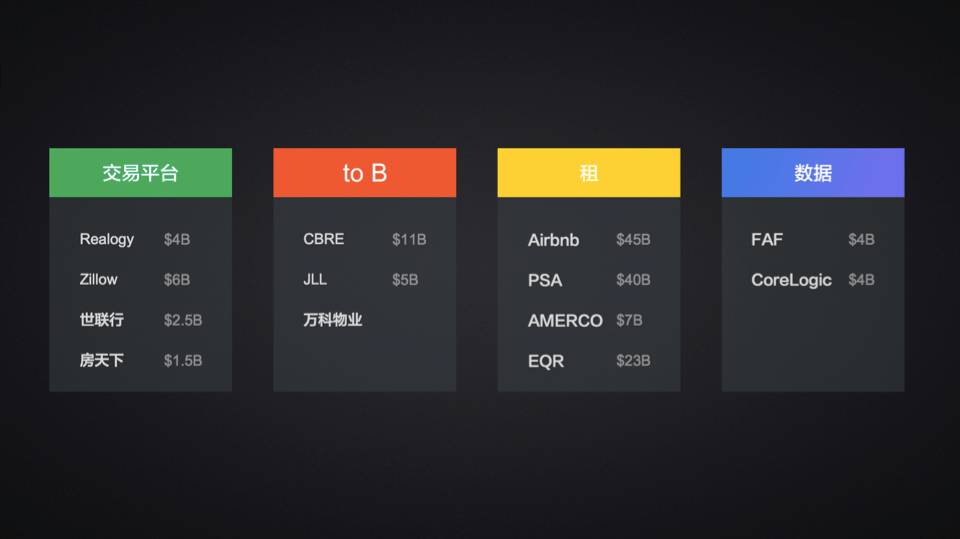
First, look at this chart. How do we understand the real estate industry? From how many dimensions do we view it?
1
China's Future B2B Real Estate Development Shows Promise
The first dimension is B2B. Lianjia has developed for 15 years doing B2C business, and today B2B business is also quite substantial. One of the larger companies in our entire industry is CBRE, which has relatively high valuation in the trading industry. We see that even in this single B2B area, there are many participants. The first is CBRE (Commercial Real Estate Services), which in the United States mainly does insurance and property rights — we categorize these as ultimately monetizing within B2B, which is what we see today.
From B2C to B2B, I think China today is still mainly C2C-focused, but B2B will increasingly see major development in the future, including commercial, retail shops, data, and so on — there are many opportunities today. Some of China's infrastructure is not fully developed, and the real estate industry also has infrastructure deficiencies. Our data scale and foundation are very weak. Given this, Lianjia hopes to master national property data, wanting to know C2C property data for all of China.
If anyone has experience buying a house in the United States, American data is excellent. With about 70 million property records nationwide, what do C2C properties in Chinese cities currently look like? What kind of floor plans? Including the floor plans used today, and so on — these situations are still quite weak. Including in office buildings, retail shops, and many areas where infrastructure is insufficient. Overall, the first major industry perspective today is to look from both B2C and B2B ends. The core is still in C2C, but B2B opportunities will also increase.
2
Understanding China's Future Urbanization Drives Lianjia's Strategic Layout
The second dimension is what we call cities, because China today has about 700 million urban residents, and will have 1 billion urban residents in the future. We ourselves believe that how will these 1 billion people be distributed in the future? Where will the business be? There are various arrangements. Ten years ago I saw a report that McKinsey & Company did at the time, which had four arrangements for future urban population distribution from densest to sparsest, each with a different shape.
Today I feel that urban populations are relatively more concentrated. From the perspective of the entire industrial economy, today's industrial policy encourages people to spread to more dispersed areas. My understanding of this matter is that in the future, all of China will have about 20 core urban clusters, each with roughly 30 million people, and within these 20 core urban clusters there will be 600 million core urban residents — this is our key understanding of this matter today. Because all of today's strategic layout basically revolves around this, I personally consider this very important. What will future population distribution look like? How do we choose our target markets? This is the second dimension.
3
Four Categories of the Real Estate Industry: Manufacturing, Trading Platforms, Post-Sale Services, and Real Estate Financial Services
Third, when we look at the real estate industry, we see roughly four main industries.
The first industry is called manufacturing — developers are generally called manufacturing.
The second category is trading platforms. Real estate most importantly needs liquidity. Trading platforms mainly provide liquidity for the entire market. Lianjia's main work is to provide relatively good liquidity for the entire market. Last year, the entire China C2C transaction volume was 17 trillion RMB, which is enormous. New homes were about 10 trillion, and second-hand homes were about 6 trillion-plus.
The third major category is collectively called post-sale services. Today you can also see many large industries like building materials, renovation, and home furnishings. But these industries today are very fragmented, including property management. For example, PRC that everyone sees does large-scale warehousing, and today has a $40 billion valuation. In post-sale services, I think there will be many opportunities emerging in the future. If you're doing investment, pay more attention to this.
Rental is an independent line. Rental can also be considered post-sale services, and today we call it large-scale self-management. We have a platform called Ziroom, which also divides between C2C and B2B. C2C has many needs: residential, warehousing. B2B has office buildings, retail shops, warehousing, and so on. We mainly do C2C, and within C2C rental there are also many opportunities: long-term stay, short-term stay, high-end, mid-range. Now there's a good company Airbnb doing short-term rentals within rental, and the U.S. short-term rental industry also emerges endlessly. In short, "rental" I imagine is a very large market. China's future rental market is about 1 trillion RMB, and will rise to 3 trillion in the future. Today's rental-to-sales ratio is very unbalanced — roughly a 17 trillion trading market corresponding to a 1 trillion rental market. In rental, whether online or offline, long-term or short-term, B2C or B2B, there are major opportunities in the future. Including what we see today with Airbnb, they also do warehousing business.
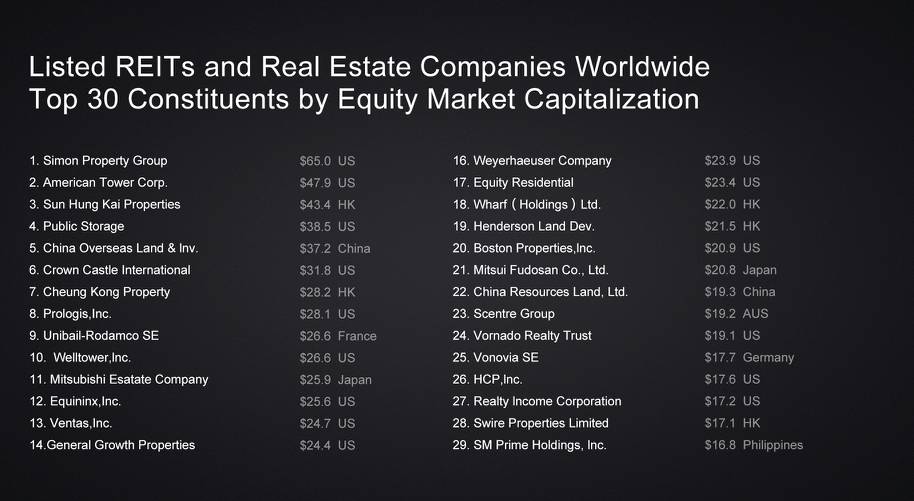
In this domain in China, there's significant correlation with REITs development. If with the development of REITs themselves, after data centralization, the impact on our development is substantial. Today the largest real estate companies in the United States are the players in the chart above, but they're actually not the large developers we see today — they're many large REITs, the most typical being roughly $50-plus trillion in scale. Ranked seventh is Cheung Kong Property, which isn't even the largest REIT. I think rental is a very large direction. Relatively speaking, the United States has developed faster in this aspect. If we look at the largest REIT in the United States, it's residential; the second largest category is trading. Including online there are also very strong data companies, they're all B2B, and their monetization methods all come from financial institutions — this is our future direction.
The three major categories I just mentioned: one is manufacturing, another is trading platforms, the third is post-sale services, and the fourth is the entire real estate financial services market.
In the United States there are also many new startups in this domain, for example one online company does online trading. This is what we see today in the entire real estate industry — there will be roughly these several major dimensions, and within different dimensions many companies will emerge.
4
How Online Startups Connect with Offline Is a Critical Question
The final dimension is online and offline. In various industries there will be some online startups, with opportunities to push offline. I personally feel the real estate industry will also have many situations. In recent years, many online startups have emerged in our industry, and later didn't do particularly well. There are always people putting a big hat on our heads, saying we defeated offline companies through online means. I particularly don't want to wear this hat. The reason? The reason is I think we defeated them from offline, not online. Actually the probability of true online companies defeating offline companies is very small. I'm wearing this hat and not many people are following. I think the real estate industry still has many offline opportunities, but real estate has this barrier. For example, today many B2B companies, the investment is very large, online is very unclear, and how to connect with offline is a question.
5
About Lianjia
I'll finally use a bit more time to introduce our company. Some friends are quite interested in this enterprise. Of the categories I just mentioned, today we're involved in three domains. One is trading platforms. Lianjia provides liquidity to the market. From our perspective, if houses have no liquidity, asset value is meaningless.
Lianjia's definition:
First, we provide relatively stable liquidity support for the entire real estate market;
Second, we do Ziroom self-management;
Third, we do real estate finance.
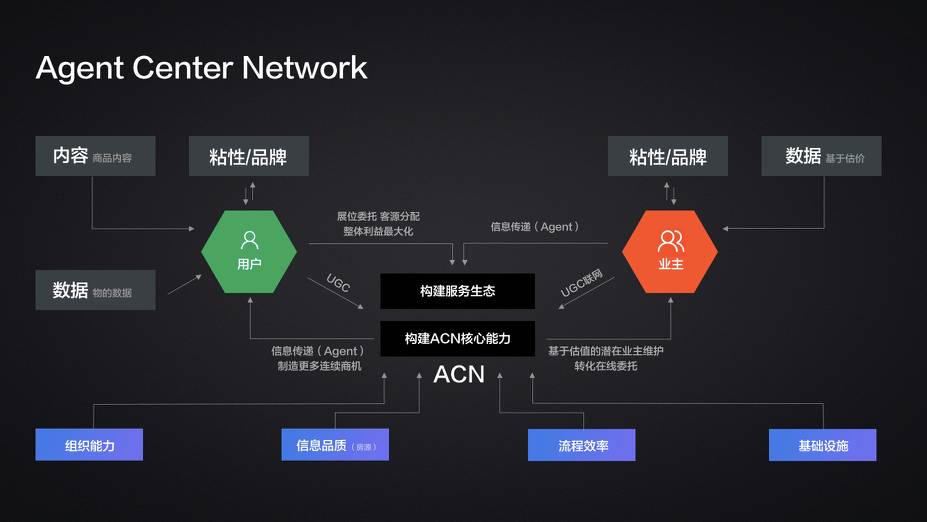
This is the core logic of our trading platform. Today we already have about 150,000 agents nationwide. From the first day we started this company, we were thinking: what exactly is the relationship between so many agents and us? Today we increasingly view agents as customers and products, rather than as our employees, although everyone signs labor contracts. We define ourselves as an agent cooperation network — how to bring together these hundreds of thousands of agents like a small society, this is roughly our core thinking. How do we bring agents together, let them use relatively stable rules to serve so many consumers, this is what we've been exploring for so many years. Whether through online methods or offline methods, as the host also just mentioned, we very early established a principle of making information sharing without differentiation. Today consumers' problem is information overload, which is quite difficult in a transaction process, and in this information overload process this is also the value that agents provide.
This is my sharing today, thank you everyone!