Code Moment | Zero2IPO Releases *2022 "Specialized, Refined, Distinctive, and Innovative" Enterprise Investment and Financing Research Report*

#MaHui Key Updates from Source Code Capital and MaHui Members
To guide SMEs toward high-quality development and enhanced core competitiveness, the Chinese government has been strongly supporting SMEs on the "specialized, refined, distinctive, and novel" (SRDN) path, with high expectations for these companies to strengthen industrial chains, tackle "chokepoint" technologies, and improve supply chain resilience.
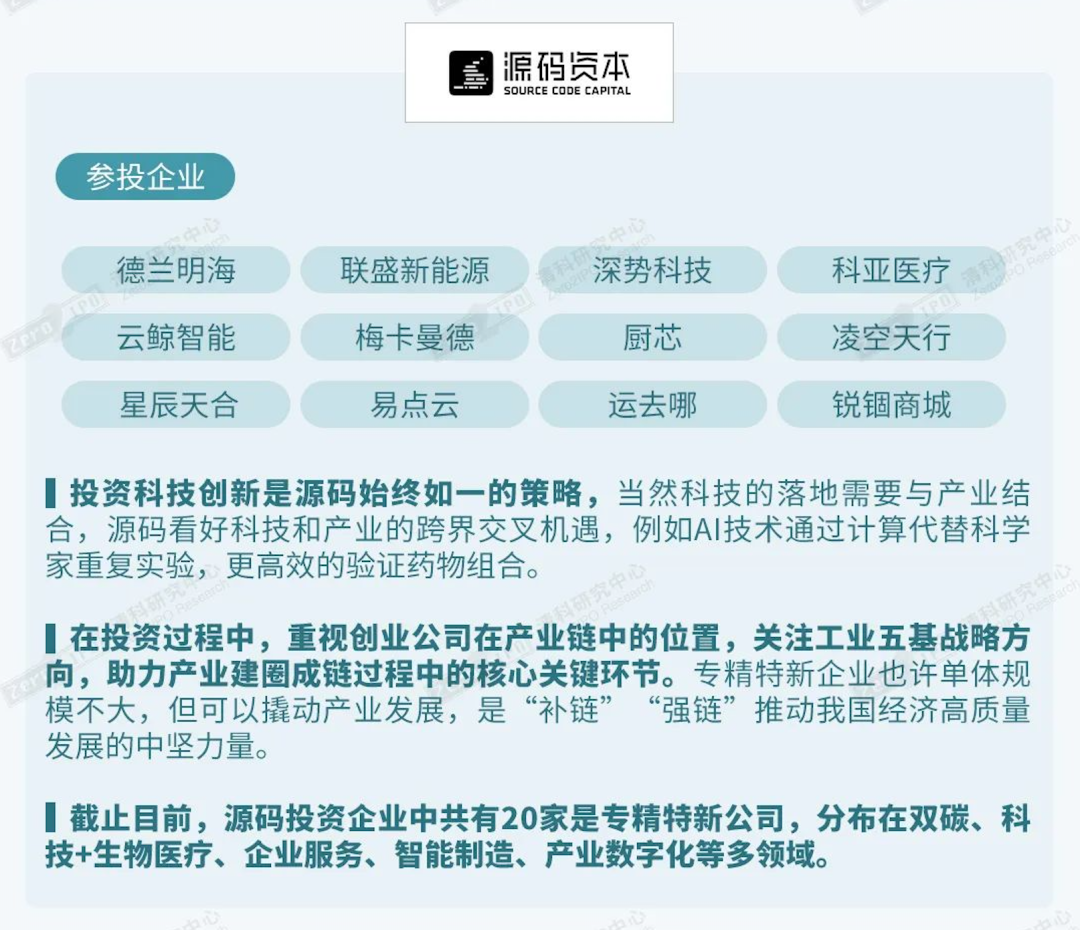
As one actor in driving socioeconomic development, Source Code Capital has consistently focused on national strategic priorities such as technological self-reliance and the "five industrial fundamentals," maintaining its commitment to technology-driven innovation and the creation of lasting, real value.
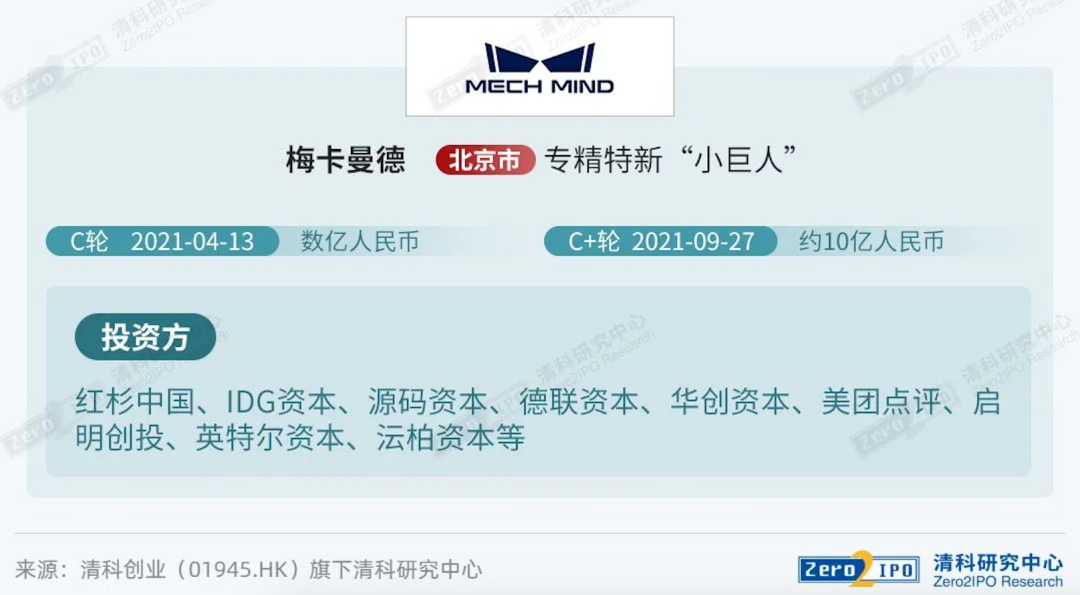
To date, over 20 MaHui member companies have been recognized as SRDN enterprises, primarily across dual-carbon initiatives, technology + biomedicine, enterprise services, and other sectors.
Source: Zero2IPO
Zero2IPO (01945.HK), through its Zero2IPO Research Center, has released the 2022 SRDN Enterprise Investment and Financing Research Report, offering in-depth analysis of SRDN development from multiple angles. Below is a brief summary of selected report findings.

01 Current Development
"SRDN" enterprises refer to high-quality SMEs characterized by specialization, refinement, distinctiveness, and novelty. Based on different evaluation criteria, they are classified into two tiers: SRDN "Little Giant" enterprises and SRDN SMEs, with "Little Giant" status further divided into national and provincial levels. This study covers both tiers, collectively referred to as "SRDN" enterprises.
- Policy intensity has increased significantly, guiding SMEs toward the SRDN development path
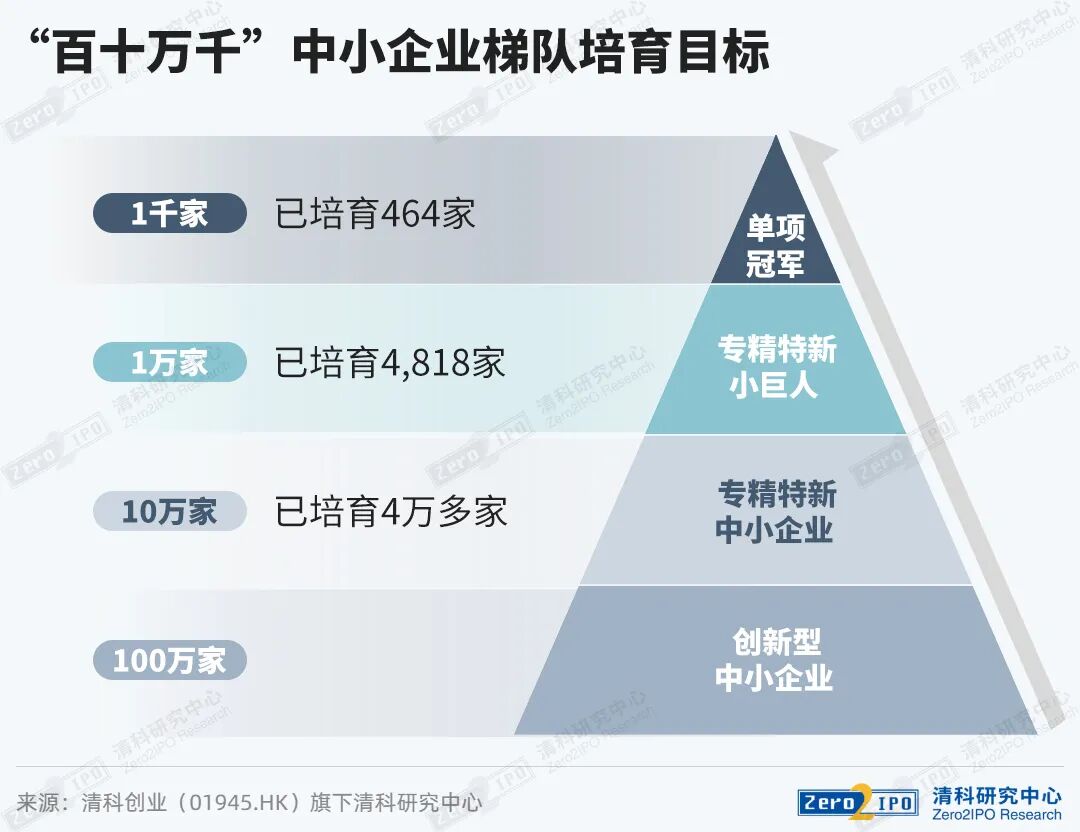
In recent years, policy mentions of "SRDN" have risen markedly, with explosive growth in 2021. In January 2021, the Ministry of Finance and the Ministry of Industry and Information Technology jointly issued the Notice on Supporting High-Quality Development of SRDN SMEs, announcing that from 2021 to 2025, central government subsidies would exceed 10 billion RMB to support over 1,000 national-level SRDN "Little Giant" enterprises in three batches, with the goal of cultivating around 10,000 SMEs to national SRDN "Little Giant" status. In July, the Politburo meeting for the first time linked "developing SRDN SMEs" with strengthening industrial chains and resolving "chokepoint" challenges. Subsequently, the 14th Five-Year Plan for SME Growth Promotion and the List of Practical Measures for SRDN SMEs were introduced, clarifying tiered cultivation targets and providing substantive support across taxation, credit, financing, and enterprise service systems — laying solid groundwork for SRDN enterprises to thrive.
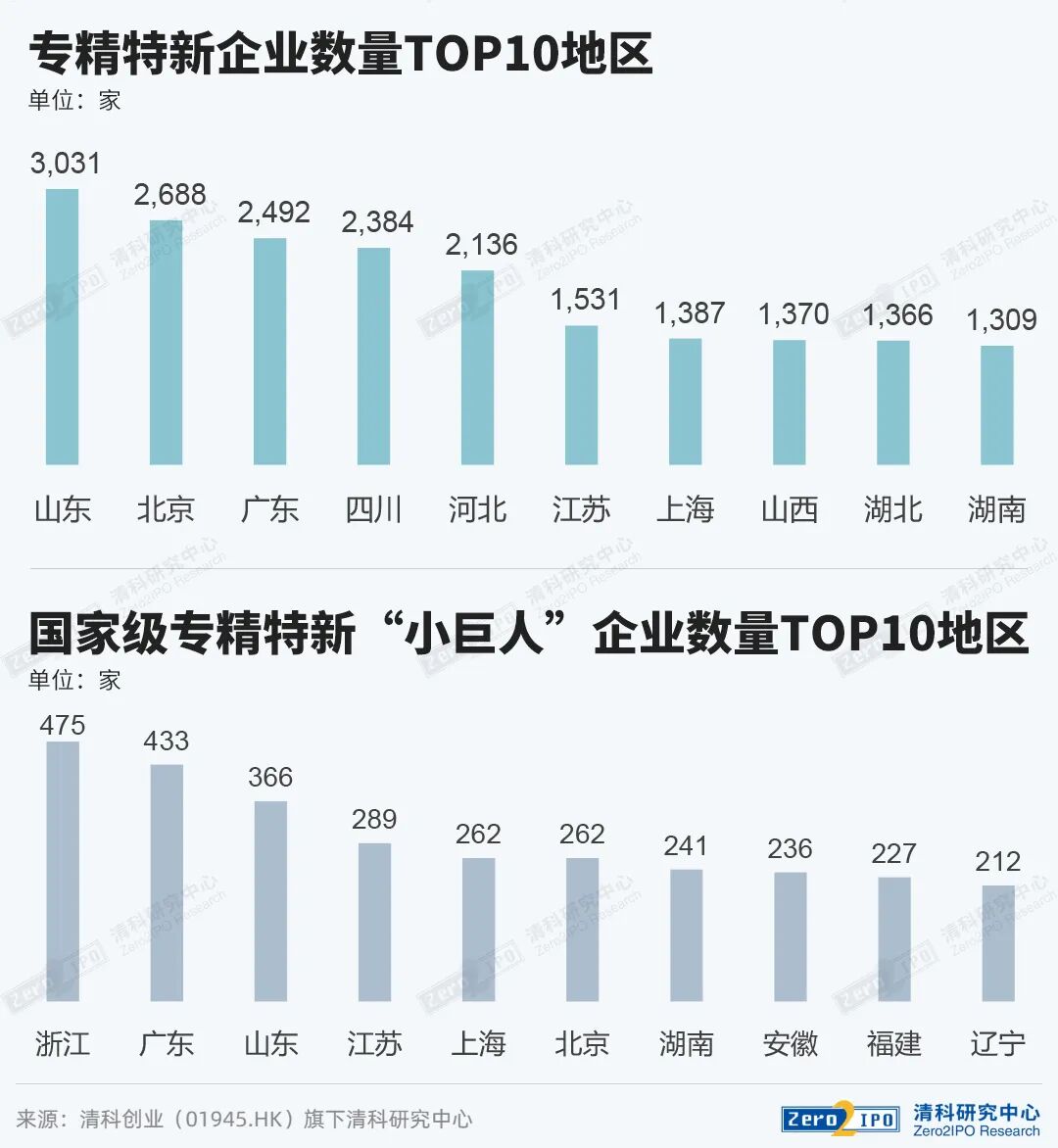
- Shandong leads in total SRDN enterprises; Zhejiang tops in national-level "Little Giants"
As of December 31, 2021, Zero2IPO Research Center had cataloged over 30,000 SRDN enterprises. By geographic distribution, Shandong — a traditional manufacturing powerhouse with a strong industrial base — ranked first in total SRDN numbers.
Focusing on national-level SRDN "Little Giants" (4,918 enterprises recognized by MIIT), eastern coastal provinces and inland traditional industrial hubs are the primary concentration areas. Zhejiang ranked first with 475 enterprises, benefiting from deep foundations in machinery processing, electrical equipment, manufacturing, and chemical products.
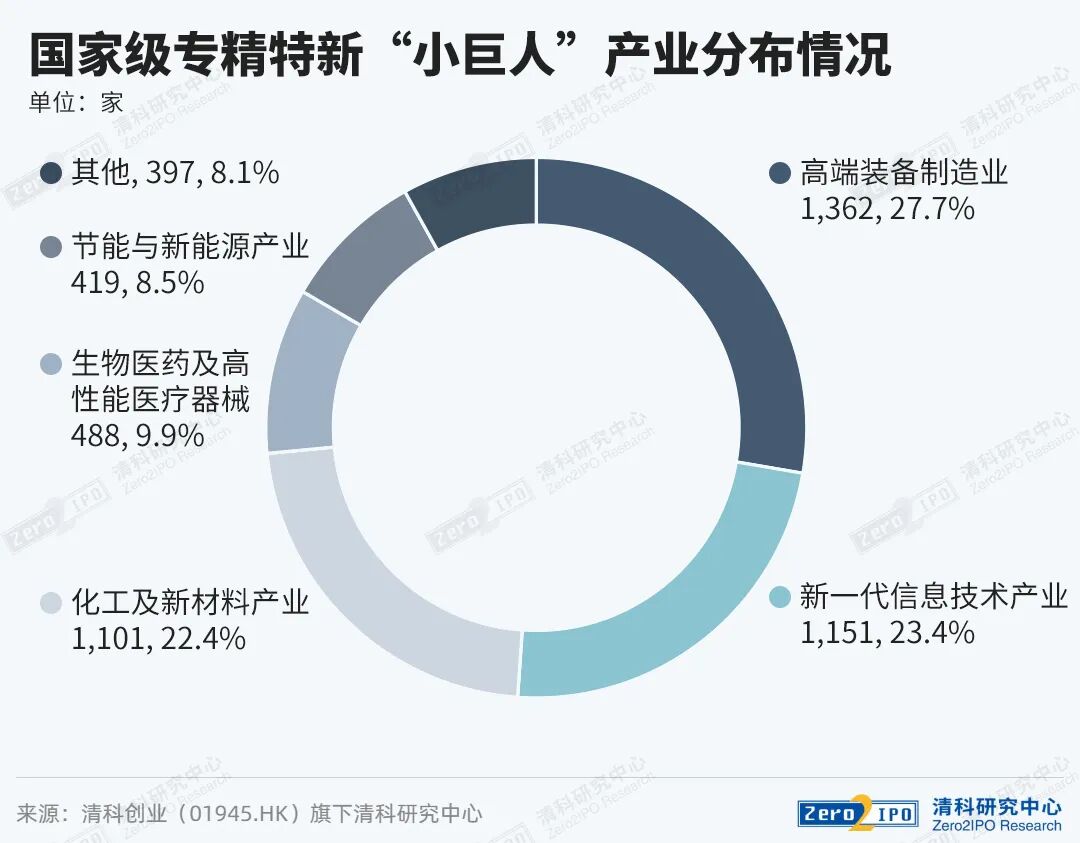
- National-level "Little Giants" concentrate in core manufacturing, with high-end equipment enterprises most numerous
National-level SRDN "Little Giants" cluster primarily in high-end equipment manufacturing, next-generation information technology, and chemicals/new materials. Equipment manufacturing, chemicals, and new materials — as China's industrial foundation — have early development timelines, large enterprise bases, and substantial technical accumulation, yielding relatively more enterprises meeting "Little Giant" criteria. Next-generation IT has built certain industrial foundations over two decades of rapid growth, though supply chain bottlenecks persist in some segments, making it a key cultivation area for "Little Giants."
02 Investment Landscape
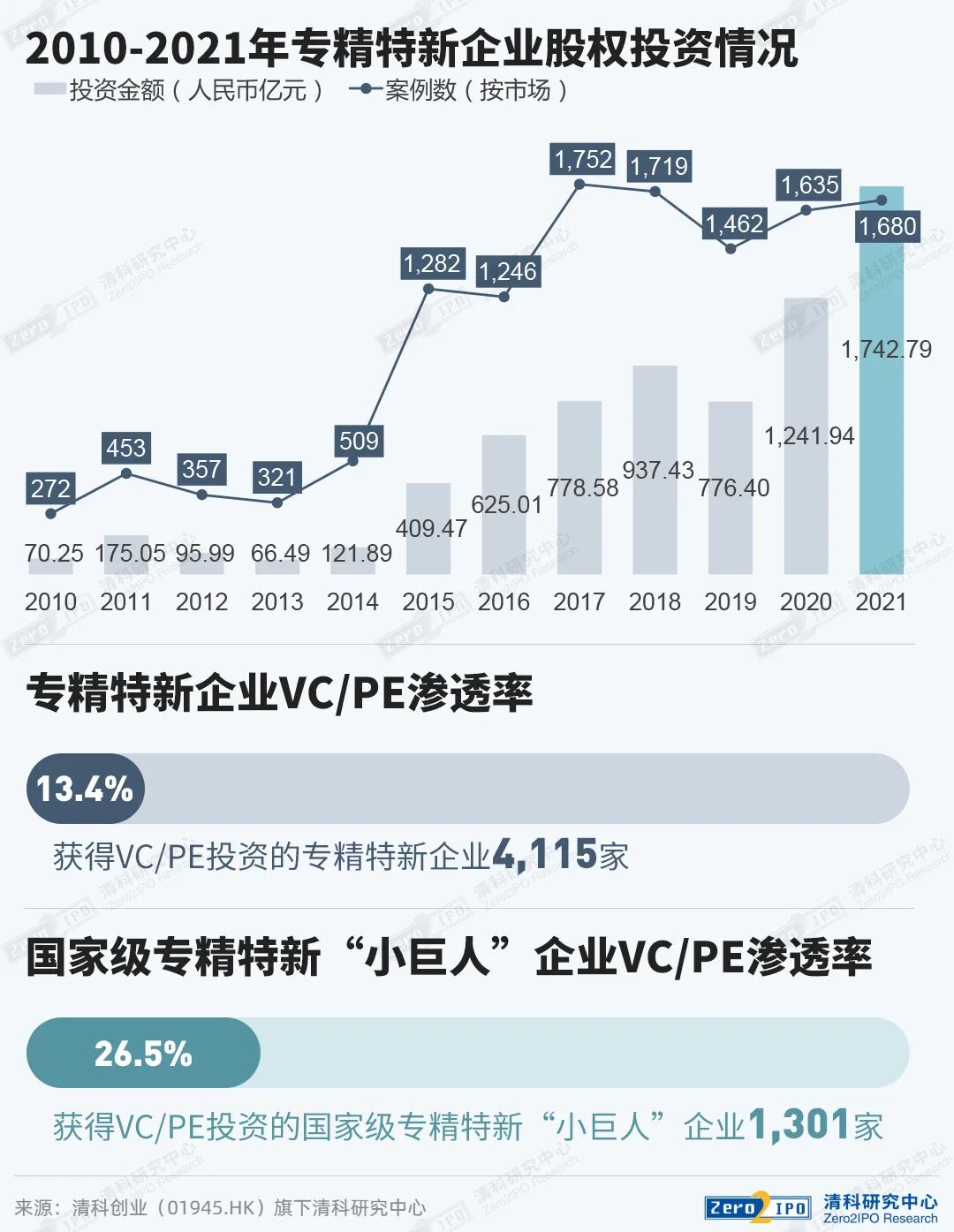
- Total equity investment continues climbing, yet VC/PE penetration remains low
From 2010 to 2021, investment activity in China's SRDN enterprises increased noticeably. As the country accelerated its transition toward manufacturing strength and policy support for SRDN grew, total equity investment rose substantially. However, equity investment institutions' penetration among SRDN enterprises remains modest at approximately 13.4%, leaving considerable room for discovering quality companies. National-level SRDN "Little Giants" — with higher specialization, stronger innovation capabilities, and more prominent industry positions — attract greater investor attention, achieving above-average penetration at 26.5%.
- Beijing leads in activity; multiple industrial provinces show surging investment interest
By investment case volume, Beijing, Shanghai, Jiangsu, and Guangdong — with their long-standing economic strength and numerous SRDN enterprises — account for 68% of total cases. Sichuan has seen rising SRDN investment activity driven by recent pushes for manufacturing digital transformation and booming next-generation IT industries. Hubei's equity investment concentrates in biomedicine and high-performance medical devices, next-generation IT, and chemicals/new materials. Shandong's rapid development in biomedicine, chemicals, and new materials has produced standout companies like Bloomage Biotech and SICC.
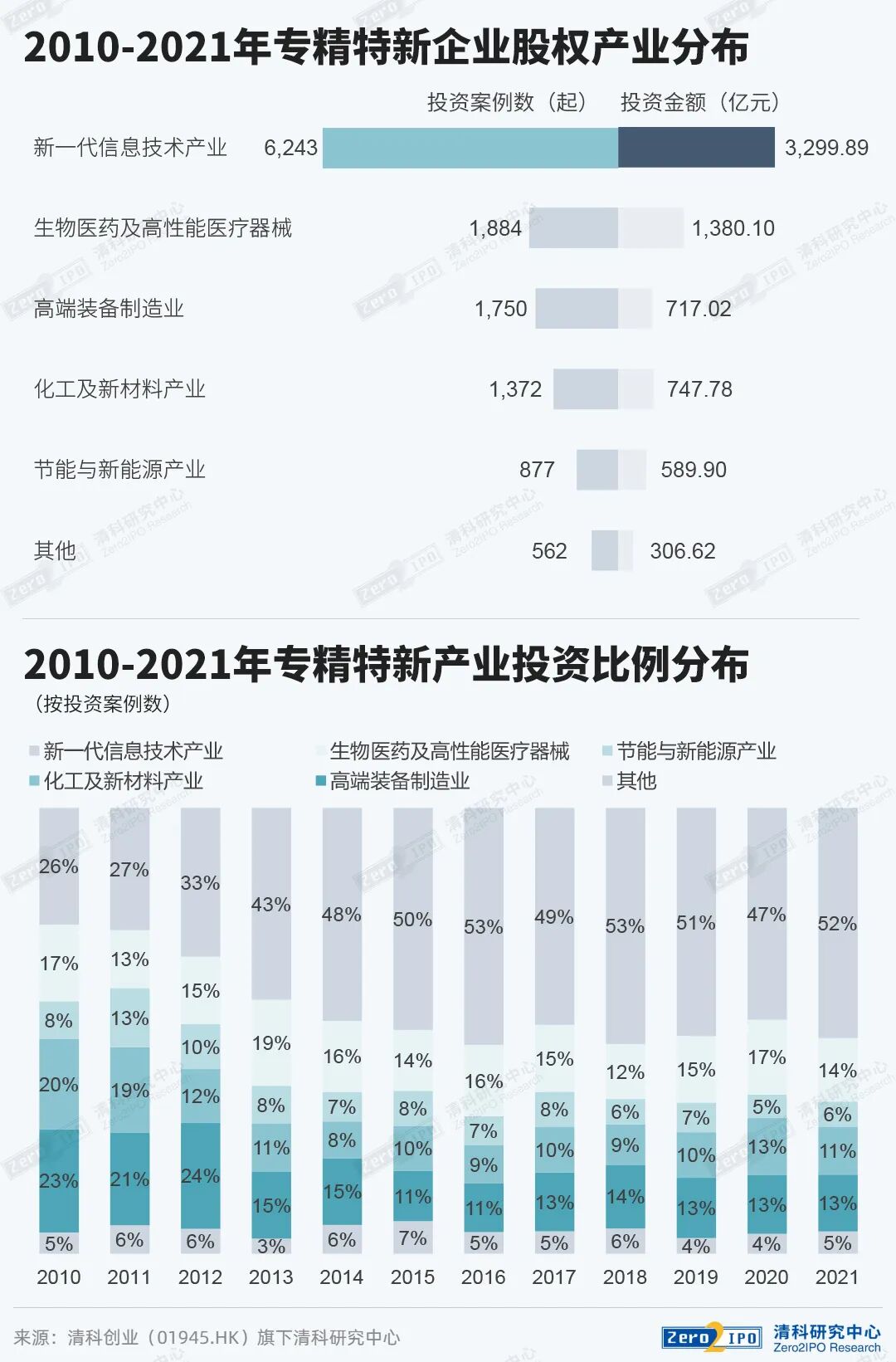
- Next-generation IT most favored by capital, though hot investment areas diverge from target industry distribution
From an industry perspective, next-generation IT attracts the most VC/PE interest, with nearly half of case volume and investment scale. Comparative analysis reveals significant divergence between popular investment areas and the actual industrial distribution of target companies. This stems from the past two decades' booming internet and IT sectors, which drew disproportionate attention to next-generation IT. However, as economic conditions and industrial structures have shifted, high-end equipment manufacturing's strategic importance has risen and import substitution has accelerated in certain areas — suggesting future investment share growth.

03 IPO Performance
- 701 SRDN enterprises listed; high-end equipment manufacturing leads
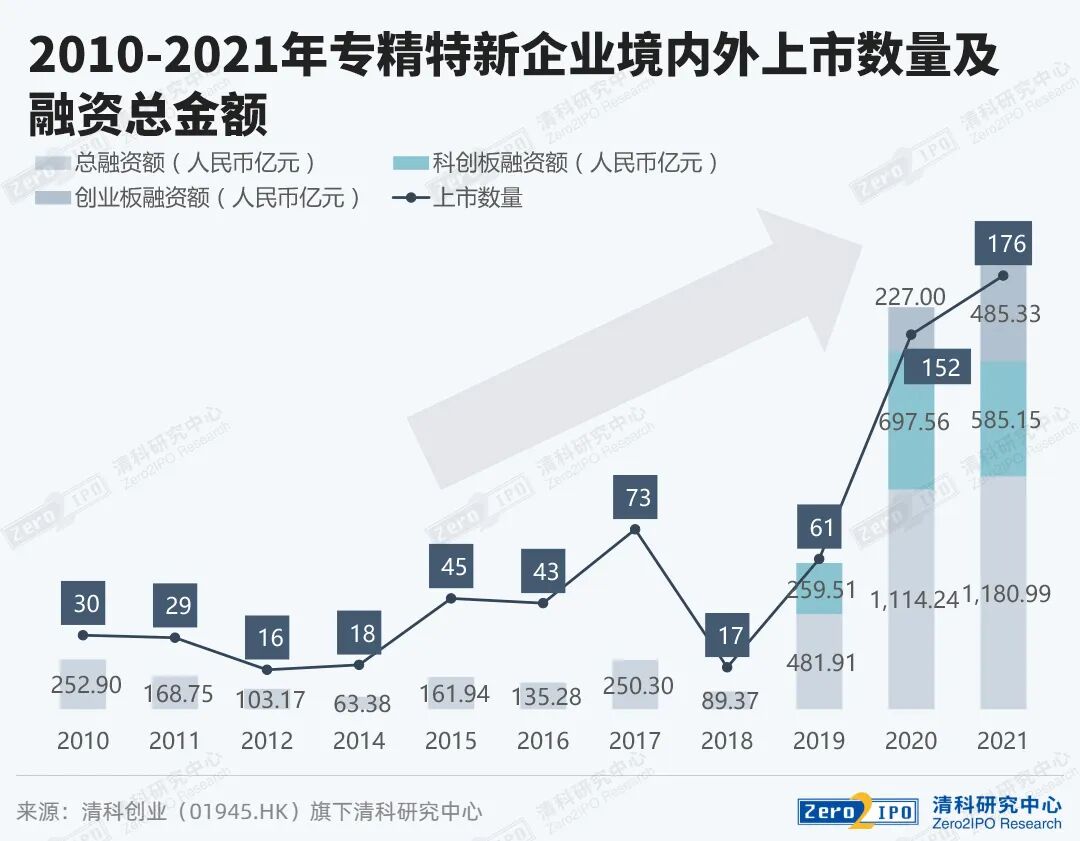
According to Zero2IPO Research Center statistics, by end-2021, 701 SRDN enterprises had successfully listed, including 368 national-level SRDN companies. With registration-based reform advancing and multi-tier capital markets maturing, SRDN listings have grown annually — a trend expected to accelerate following the Beijing Stock Exchange launch.
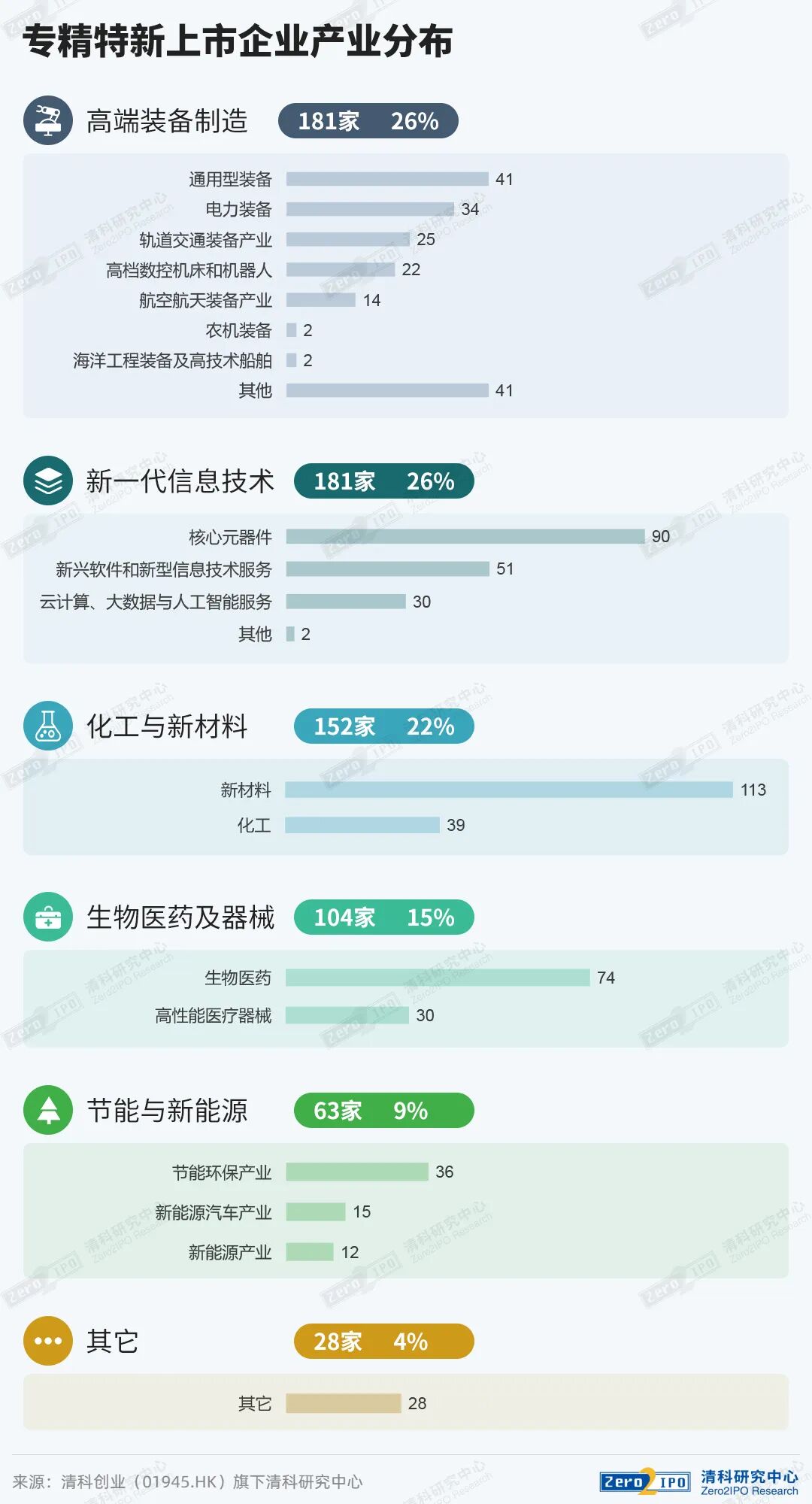
Listed SRDN enterprises concentrate in high-end equipment manufacturing, next-generation IT, and chemicals/new materials. Among secondary segments, new materials, core components, and biomedicine show the highest SRDN listing counts.
04 Conclusion
The SRDN sector remains in early development stages. Under the "hundreds, thousands, tens of thousands, hundreds of thousands" tiered cultivation policy, SRDN enterprise numbers will grow and covered segments will diversify, offering equity investors greater exploration and development space. For more details on SRDN enterprise development, investment and financing trends, listed companies, typical institutional strategies, and standout company analysis, click "Read More" to download Zero2IPO Research Center's 2022 SRDN Enterprise Investment and Financing Research Report.

[1] SRDN enterprise coverage: As of December 31, 2021, SRDN SMEs, SRDN "Little Giants," and national-level SRDN "Little Giants" publicly announced by provincial and municipal MIIT offices. [2] As of December 31, 2021, MIIT had cultivated three batches of national-level SRDN "Little Giants" totaling 4,922 enterprises; 4 enterprises in the third batch overlapped with the second batch; after deduplication, the statistical scope covers 4,918 enterprises.

- MaHui | Yungang Huang Named to "Top 10 Young Partners"
- MaHui | Source Code Capital Launches "Source Code Yisu" Focused on Seed-Stage Investment
- MaHui | Xingchen Zhang: Source Code Yisu, Investing in Your Leap of Faith
- MaHui | Source Code Capital Wins Multiple Awards at "2021 ChinaVenture Rankings"
- MaHui | Xingchen Zhang Named to "Cyzone 40 Under 40 Investors"
- MaHui Insights | Xingchen Zhang: Technology-Driven Innovation from Zero to One
- MaHui Insights | Yungang Huang: What Founders Need Most Is Resilient, Bold "Pioneering Spirit"
- MaHui | Source Code Capital Completes Fifth RMB Fund Raise: Advancing Technological Innovation, Empowering SMEs
- 2021: Original Aspiration Is the Future
Click "Read More" to view more MaHui members