Code Moment | Narwal's Acceleration Moment, Tides 2023 Industry Future Conference

Innovation and risk are two sides of the same coin.

Original text: "36Kr IR"
Innovation and risk are two sides of the same coin.
Recently, at the 36Kr Dark Current · 2023 Industrial Future Conference, Xiang Li, partner at Source Code Capital, Junbin Zhang, founder and CEO of Cloud Whale, and Lili Yu, lead writer at Dark Current, held a special conversation around Cloud Whale's breakthrough innovations over the years.
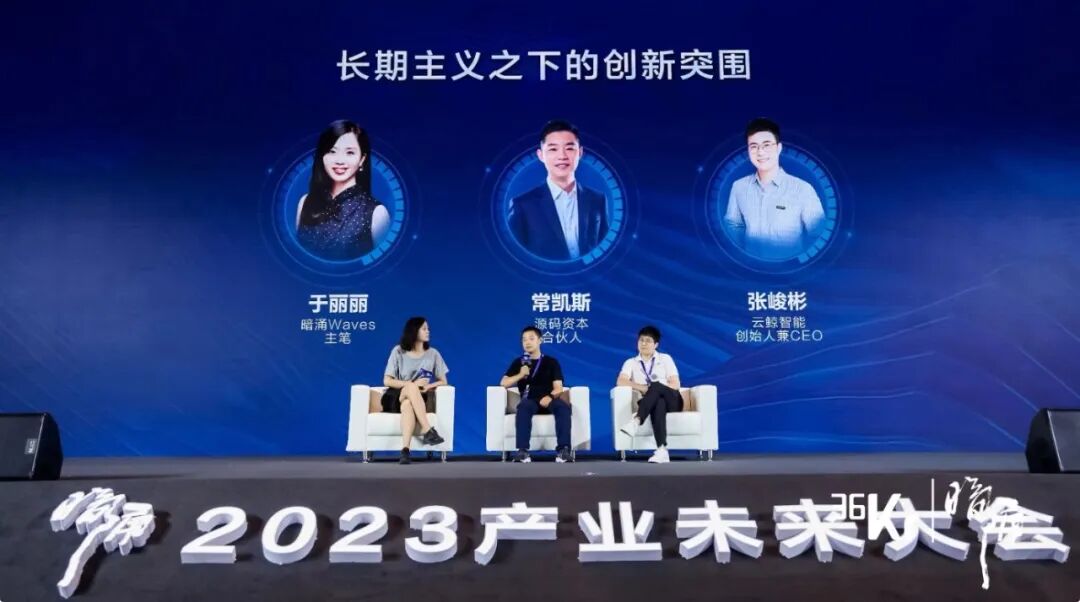
Breaking Through with Innovation Under Long-Termism
The following is the roundtable discussion:
Lili Yu: Kai-si is also an investor in Cloud Whale, so let's start by understanding how you two first met. Actually, in our recently published article "Unveiling Zexiang Li," we mentioned that Kai-si first came across Cloud Whale's product on Douyin. What happened in more detail?
Xiang Li: We talked quite a bit in that Dark Current article. We'd actually been following the home robotics space for a long time — we'd looked at all kinds of home robot products, including earlier form factors of robot vacuums and even cat-teasing robots.
One time while scrolling through Douyin, I came across this Cloud Whale product and it was a real eye-opener. Because this product form genuinely didn't exist before — it was defined based on Chinese consumer needs. The first product was already very polished, and at the time you couldn't even buy it anymore — the first batch had limited stock and sold out in about ten minutes. Later I bought one at a markup on Xianyu. After that I found Junbin and we talked for a long time, which really made us feel the power of original innovation, especially consumer-facing original innovation. For us it was a very fortunate thing.
Lili Yu: From discovery to reaching a partnership, there must have been some considerations in between. What do you think was key?
Xiang Li: For us, this decision was relatively easy. Before Cloud Whale, we'd already seen so many different robot products — Cloud Whale's product innovation was something we recognized at first glance. From the beginning, the Cloud Whale team demonstrated innovative capabilities in many areas, including product definition. Their entire algorithm didn't follow existing algorithm frameworks — instead they built new frameworks based on product needs. Even production — at the time still a small company — already had a self-developed ERP system. These innovative points permeated every aspect of the company.
Lili Yu: After three years of engagement, from an entrepreneur's perspective, how would you evaluate Junbin?
Xiang Li: We very much agree with Professor Zexiang Li's view that new engineering education needs talent who both understand technology and can combine it very well with innovative product definition. I think Junbin is a typical example — on one hand, he started participating in various robotics virtual teams in university, so he understands the possibilities of technology and every aspect very well. At the same time, he has very good grasp of product definition and consumer needs. We're very willing to support entrepreneurs like Junbin, and also hope China will have more and more such new engineering entrepreneurs.
Lili Yu: Junbin, based on what considerations did you decide to partner with Source Code Capital?
Junbin Zhang: Our first meeting was at the end of 2019. Kai-si came to our company to exchange ideas — we met once and the feeling was quite good. Later I went to Beijing and met with Kai-si and Cao Yi together. I remember that evening we talked about many things, including the resources Source Code could provide — whether capital injection, talent, funding, or the kind of mentorship that entrepreneurs particularly need. These were things we valued quite a lot at the time. There's also a story — he held me to sign the term sheet, wouldn't let me leave without signing. In terms of sincerity, resources, everything was quite good, so we chose to partner with Source Code at that time.
I've been working with Kai-si for several years now. I think he understands entrepreneurs, gets entrepreneurs — especially on organizational matters, including long-term choices, I think they can see things relatively clearly. So they've always supported us. Another point — Kai-si's team has always been very supportive of our doing innovation. The path of innovation is quite difficult to walk. Whether it's launching an innovative product in the short term, or building an innovative development system, it requires a long process. But if a company wants to go far, it definitely can't rely on one or two people to continuously output — it needs an organization that can output better. This is also some of the long-term support from Kai-si and Source Code, including helping without adding chaos — this point is also very important.
Lili Yu: In the past, Cloud Whale gave everyone the impression of being a very restrained, slow company — basically launching one new product per year. But this year you've already launched three. What happened in this process? Was it external pressure, or did you find an innovative rhythm?
Junbin Zhang: Let me talk about what happened after Cloud Whale's J1 came out, through 2021, 2022, and 2023. Actually in early 2021, our entire R&D team only had a few dozen people. At that point you realize your competitors might be ten times your size. The choice you faced was whether to quickly recruit more excellent talent.
In 2021, our team grew from 200+ people to 1000+ people — in just one year. Throughout 2022, we went through organizational磨合 and the initial construction of our entire innovation system. Based on this innovation system, we launched J3 at the end of 2022.
In 2023, that is this year, we've gotten increasingly smooth with this system, the team has磨合 more and more smoothly, so our entire development speed has been continuously climbing. Three products this year, possibly more next year.
Was it driven by external factors? There is definitely external pressure, but this pressure is definitely not the decisive factor. No company in market competition can be without pressure. But in the process of pressure, you have to think about whether you want short-term or long-term interests. I think Cloud Whale actually chose long-term organizational construction at that stage, in order to have better output this year and next year.
For example, our brand new J4 this year, across the three major e-commerce platforms, basically ranked first in total among new robot vacuum products during this period. This also validates that our entire innovation system is effective. In this process, we found that building the entire innovation system took a relatively long time — early construction was somewhat painful. But once you run more and more smoothly, your speed actually gets faster and faster.
Lili Yu: Kai-si once said that what amazed you about Cloud Whale was that it's original innovation, not micro-innovation. But everyone knows that doing original innovation in China has always been difficult. Where does this difficulty specifically come from? Are there some variables now?
Xiang Li: Looking at this from different angles — on one hand, I think from the perspective of innovation infrastructure and innovation soil, China is a very good place for original innovation. First, China has very large consumer base, and consumers are very willing to try new products. Taking robot vacuums as an example — robot vacuums may not be a particularly large market in the United States, but in China there's a huge consumer market that can support larger-scale technology investment.
Second, there's strong industrial chain support, especially for products that require simultaneous innovation in both software and hardware. We've also talked with many foreign entrepreneurs — for them, even making one hardware iteration might take months as the unit. But in China with very developed industrial chains, in the Yangtze River Delta and Pearl River Delta, iterations might take weeks or even days as the unit. So the infrastructure and soil itself I think is very good — it can support a lot of great innovation.
From another angle, why did people previously see mostly incremental or follow-the-leader innovation? I think it's an ROI issue. As Junbin just said about the other side of innovation — innovation and risk are two sides of the same coin. Innovation must bear risk — sometimes it works out, sometimes it doesn't. But in China, once something is made, there are too many followers, too fast. The ROI might not work out — this was a relatively big problem before.
This is also constantly changing. On one hand, China's intellectual property protection system is increasingly完善. And now follow-the-leader innovation has more or less run its course — to continue leading, there must be more original things. So we feel ROI is increasingly supportive of original innovation. Overall, we're very hopeful and see opportunity.
Lili Yu: Junbin, as someone who has personally experienced original innovation, what has it been like?
Junbin Zhang: I think first, original innovation itself is a difficult thing. What processes or systems can give birth to it — that's the first challenge, and something Cloud Whale has been thinking about over the past year or two.
The second challenge is what Kai-si just mentioned — when this original innovation comes out, are there better ways to protect this original innovation? This is actually quite important. If original innovation can be better protected, more people will be willing to do it. But this challenge doesn't necessarily come from the company itself — it's the broader environment.
If we return to Cloud Whale itself, I think when we were doing J1 early on, this kind of original innovation first requires finding like-minded people, because not many people understand you. Around 2018, we met with dozens of investors. On one hand, people didn't have very clear cognition or confidence about how much user value this innovation could bring — because there basically wasn't this product form in the market, or it differed quite a lot from mainstream products.
Second, I remember when starting the business, the most frequently asked question during fundraising was "What if Xiaomi does this?" This is actually a very realistic problem that entrepreneurs face. This is also a major challenge.
Further on, when we actually brought the product to market, I remember in 2019, because doing original innovation always involves some risks, these risks tend to gradually emerge later. At this point you have a choice: do you change or not? It's not about changing original innovation to non-innovative products — rather, original innovation has some flaws, and at this point the product might need delayed launch. You face a choice: do you prioritize doing better for users, or do you prioritize cash flow first?
So around 2019 we faced this choice. We ultimately chose to do better for users. So we delayed our entire product launch by 3 months to solve problems with our first product J1. These are also challenges we've encountered in doing original innovation all along. Looking back, these were roughly the challenges.
Lili Yu: Besides these, what other difficult moments has Cloud Whale experienced?
Junbin Zhang: Cloud Whale's journey — people think it's been smooth, but it's actually been quite波折. Starting out with original innovation, not many people understand you — team members might leave. Second, when fundraising, people might not fully understand, might not get you. Third, with original innovation, because you're taking an adventurous path, taking this adventurous path inevitably means encountering many problems. Like I just said, when launching in 2019, we found a design flaw that we had to solve. So this is a trial-and-error process — of course if you copy a product there's no problem, because that product already exists in the market, you've already more or less tested it out, everything is quite clear. You copy it, and nine times out of ten it'll be the same — there won't be unknowns. But when you do innovative things, there are many unknowns.
For example, when we launched this product at the end of 2019, the biggest problem we encountered was the pandemic. Right when Cloud Whale was about to scale up, the first Spring Festival encountered the pandemic. The challenge was actually enormous, because we have our own factory. The pandemic was very severe then, so on the second day of Lunar New Year we recalled all executives, and started stockpiling masks. So we actually stockpiled quite a lot of masks — not just for ourselves, but also for our upstream suppliers, otherwise entire production capacity would completely shut down.
In 2019, we were just starting out. We didn't expect to produce nearly 200,000 units in 2020 — this was unexpected. So when production capacity was just about to ramp up, hitting the pandemic was huge resistance — this was a major challenge for us.
In 2021, the biggest problem was organizational upgrading. When all energy in 2020 was focused on delivery, protecting production capacity, in 2021 you realize your talent density and scale are already nearly an order of magnitude behind your competitors. At this point you're very紧张 — this gap actually means your product iteration speed will definitely be slower in the long run, whether delivery speed or iteration speed.
So we made a major decision then — the entire company would relocate to Shenzhen. In 2020 we did a lot of ideological education, interviews, and exchanges. We moved the entire company to Shenzhen — not a single person left in the process, which was actually quite不容易.
So in 2021 we started large-scale recruitment. From 200 to 1000 people, different people from different companies, with different cultures, different work philosophies. There were definitely arguments, conflicts.
Some people might be genius radicals, some might be conservative system-types. You'll find different factions, different methods and approaches. At that stage your company also lacked good systems and organizational structures to integrate this talent, but you had to start expanding and recruiting more top talent — otherwise your later iteration speed would be very slow.
That stage for Cloud Whale meant not only achieving scale expansion, but also achieving team integration, and achieving system construction — including new platforms and new architectures for new products. So 2021 and 2022 were extremely high-pressure.
Lili Yu: Kai-si, what do you think has been the biggest change in Junbin and Cloud Whale over these three years?
Xiang Li: This is a good question. I think as Junbin said — the journey of entrepreneurship changes very quickly. In this process, whether you can adapt to such rapid change, and in rapid change whether you can continuously learn new things, unlock new "skill packs," and open up new "skill trees" — these are all very critical. Indeed, when chatting with excellent entrepreneurs, every month there are new insights, new realizations — whether internal or external, this learning ability and growth ability is the biggest change.
Another relatively big thing I can feel is optimism. Entrepreneurs indeed need to be very optimistic — a natural optimistic spirit is an essential mentality for entrepreneurs. Cloud Whale's first product started selling in 2019 and immediately hit the pandemic. These years have basically grown together with the pandemic. And it's not like a purely online thing — it requires online and offline coordination, and supply chain is also a long-chain matter, so it was actually very difficult. But throughout the process, whether Junbin or the team, not a single person complained. Everyone was very optimistic — problems were solved, various ways were found to create conditions to solve problems. I remember when there was one COVID case in Cloud Whale's office building, everyone quickly rented a venue outside and moved the entire team there to work together. It felt quite cheerful — no one complained why this happened to us. This optimistic spirit, this spirit of continuously solving problems, I think is very outstanding.
Lili Yu: Many robot vacuum companies, because of industry and cycle adjustments, have made major strategic adjustments. What might Cloud Whale grow into in the future?
Junbin Zhang: I think Cloud Whale is a user-centered, needs-driven technology company. We'll develop more products with differentiated value for users around home scenarios. So our mission and vision is actually to lead innovation, break through experience, and create a free and beautiful smart home for users. In the future we hope to layout more good smart home products, and also find a way to connect these good smart products together, then provide users with an even more极致 experience. So this is what Cloud Whale has always wanted to do and continues to do. We've had this初心 from day one of making products.
Lili Yu: Kai-si, as an investor, what are your expectations for Cloud Whale?
Xiang Li: I very much agree with what Junbin said about being user-centered. Whether original innovation or micro-innovation, I think the perspective for viewing innovation should be user-centered — what users like, what they want, using this angle to look at innovation.
If we're talking expectations, I recently re-read Made in Japan: Akio Morita and Sony. It was quite touching, because at that time Japan's entire industry — whether technology or industrial chain — had advantages globally. Entrepreneurs like Akio Morita could use such advantages to expand their product concepts worldwide, and make greater contributions to consumers worldwide — this is a very good thing. Now although globalization may have some [challenges], but overall I think for products that integrate software and hardware, China occupies a very unique position in the global industrial chain. In many areas, Chinese companies have unique advantages in talent, industrial chain, and technology reserves. I very much look forward to Cloud Whale and other Chinese companies together bringing such industrial advantages to the world, serving more consumers worldwide, and building more global companies originating from China.