Code View | Consensus and Non-Consensus: From Models to Applications, Looking Back and Ahead at 2024 AI Trends

Adapting to Change


Just off Highway 101 in Silicon Valley, less than ten minutes south of Google's headquarters, sits an unassuming museum. Look north from here and you can see Meta's blue logo; gaze south and there's Apple's spaceship ring.
Surrounded by tech giants, it stands like a silent elder, watching the ebb and flow of old and new around it, bearing witness to the most magnificent growth of human civilization.
This is the Computer History Museum. In its quiet galleries, an ancient abacus and a length of knotted rope tell humanity's most primal dream: to compute and to connect.
In 2024, these two threads finally intertwined completely in the wave of artificial intelligence. AI is no longer merely computing; it is creating. No longer merely transmitting information; it is understanding and transforming it. As machines begin to demonstrate human-like cognitive abilities, once-separate computation and connection have found new unity in large models.
It is a peculiar moment: computation has become conversation, data has become wisdom. The development of AI since ChatGPT's release has far exceeded human expectations.
Looking back at year's end, the market's focus has shifted from last year's improvements in base model capabilities to this year's model deployment and scenario-based applications. AI capabilities need to translate into actual products and services; meeting user demand is what matters most. Behind this lies the AI industry's transition from the "training era" to the "inference era."
This article details three key dimensions of AI development we see unfolding, shared here for your consideration:
One: The evolution of technical paradigms. As traditional Scaling Law hits bottlenecks, OpenAI's o-series models have forged a new path — from brute-force "fast thinking" to a dual approach combining training and inference with "slow thinking."
Two: The leap in multimodal capabilities. From Sora's video generation to the rise of native multimodality, to attempts at world models, AI is beginning to truly understand and simulate this three-dimensional world.
Three: The reconstruction of application forms. Breakthroughs in AI Agents have shown the industry new possibilities — new directions for robots to gain autonomous action capabilities, while advances in AI programming tools may herald a transformation in human-machine collaboration models.
2024 AI Key Developments Timeline
February
- OpenAI releases video generation model Sora, achieving high-quality text-to-video generation for the first time, opening a new era in AI video generation
March
- Suno releases V3, bringing AI music generation to a production-ready state
April
- Meta releases high-performance open-source large model Llama-3, lowering the barrier to entry for AI technology
May
- GPT-4 released
- Ray-Ban Meta smart glasses sales surpass one million
- ByteDance launches Dreamina AI
June
- Kuaishou releases Keling AI
- Apple Intelligence released
September
- OpenAI releases o1 preview
October
- Developers of Rosetta and AlphaFold algorithms awarded Nobel Prize in Chemistry for breakthrough contributions to protein structure design and prediction
- John Hopfield and Geoffrey E. Hinton awarded Nobel Prize in Physics for pioneering contributions to artificial neural networks and deep learning
- Anthropic's Claude 3.5 Sonnet gains "computer use" capability
December
- OpenAI releases o3 series models
1. The Evolution of Technical Paradigms
Scaling Law Hits Its First Bottleneck
The slowing of Scaling Law effects was a debate that ran through all of 2024.
Scaling Law refers to the phenomenon in model pre-training where, as long as three key factors — model size, data volume, and training time (compute) — continue to grow, model performance improves with steep, exponential gains. Sufficient scale brings about "emergence": the spontaneous generation of complex intelligence, the ability to reason through complex problems, and improved generalization under out-of-distribution conditions.
Belief in Scaling Law was the starting point of OpenAI's dreamlike development and this generation's dreamlike improvement in large model capabilities.
Yet throughout 2024, a debate hung over the AI world — Scaling Law is correct, but in reality, has it already hit a ceiling?
Compute demands have reached staggering scales; xAI is building a 100,000-GPU data center. Infrastructure can't keep pace with development speed; OpenAI's proposed 5-gigawatt data center plan would consume nearly one-fifth of New York State's residential electricity. Most critically, as former OpenAI Chief Scientist Ilya Sutskever has noted, high-quality data is nearing its limits. And the "inbreeding" problem of synthetic data training may lead to overfitting and long-term model capability degradation through incestuous training.
Yet OpenAI's o-series models brought a turning point.
A New Scaling Law — Slow Thinking and Fast Thinking
Humanity's pursuit of AGI is, perhaps more than anything, a mad fantasy of completely creating another "human." And to make a model "think," the most important thing is the "brain." Researchers believe that human thought is actually tiny electrical currents passing through neurons, so if there is an artificial neural network large enough and close enough to the human brain, it can achieve the brain's work — thinking.
In human psychology, Nobel Prize-winning economist Daniel Kahneman proposed the famous "System 1" and "System 2" theory: human thinking processes divide into fast, intuitive "System 1" and slow, deliberate "System 2."
Before the o1 model appeared, all large language models were essentially "fast thinking" systems. Their mode of operation was:
- One-shot generation: Input a question and directly generate an answer, similar to human intuition
- Reactive linear thinking: Process information according to preset patterns, lacking reflection and iteration
- Confidence blind spots: Difficulty judging the reliability of their own answers, unable to proactively correct errors
This "fast thinking" mode is like a widely-read scholar lacking deep thinking ability — erudite, quick to respond, but unable to engage in truly creative thought.
This mode works well for everyday conversation and simple queries. But when facing problems requiring deep reasoning, its limitations become apparent: lacking self-reflection, unable to conduct multi-angle analysis, without the ability to correct mistakes. Like Plato's prisoners in the cave, they are trapped in their own "cave of knowledge," able only to see shadows of phenomena.
The core breakthrough of OpenAI's o-series lies in achieving human-like "System 2" capabilities — a leap from intuitive reaction to deep thinking. Most research analysts believe that OpenAI, by combining Self-Play reinforcement learning with Chain of Thought, enabled the o1 model to demonstrate true reasoning ability for the first time. It is no longer a simple information processing tool, but a thinker capable of self-dialogue, multi-angle analysis, and self-questioning. Continuous breakthroughs on authoritative tests like MMLU confirm the effectiveness of this technical approach.
Technical experts generally believe two key technologies underlie this breakthrough:
Monte Carlo Tree Search (MCTS): Drawing on AlphaGo's success, optimizing decision quality through multi-path reasoning and evaluation.
Process Reward Model (PRM): Breaking through the limitation of traditional RLHF's exclusive focus on outcomes, achieving fine-grained training guidance for the thinking process.
The once-stunning AlphaGo and AlphaZero AI game-playing applications relied heavily on Monte Carlo tree search methods in their underlying approach.
Monte Carlo tree search works iteratively through four steps: Selection (choosing the most promising action from the root node), Expansion (adding new possible states), Simulation (random play from the new node until game end), and Backpropagation (updating node values by propagating results backward). In AlphaGo, MCTS combined with deep neural networks, using a policy network to guide search and a value network to evaluate positions, thereby finding optimal solutions more efficiently.
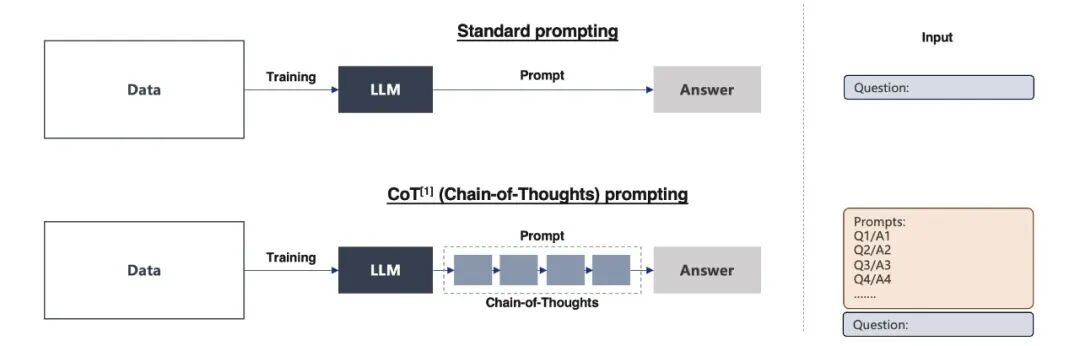
Translated to large language models, o1 likely works by having one large language model generate multiple reasoning angles simultaneously, while another large model serves as a reward model to provide scoring evaluations, updating the large language model's weights after a certain number of iterations to remember better reasoning approaches.
This model capable of scoring and evaluating is the Process Reward Model (PRM). OpenAI proposed "verify step-by-step," providing correct or incorrect feedback on each step of a large model's thinking. Compared to Reinforcement Learning from Human Feedback (RLHF), which only provides feedback on outcomes, this gives large models denser training signals.
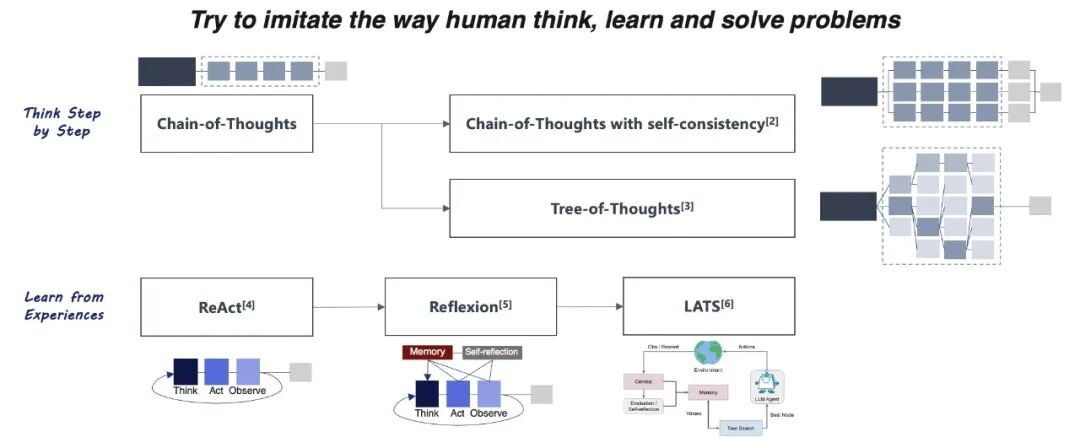
Additionally, technical experts speculate that OpenAI initially used human-annotated thinking process data, and later employed synthetic data methods for training. Combined with the aforementioned Monte Carlo tree approach, one possibility is: take a human-annotated problem, then use MCTS to fill in subsequent reasoning processes, running each segment multiple times, all becoming synthetic data to train the AI.
More importantly, the o-series models restructured the training paradigm, making more balanced allocation of GPU resources across pre-training, post-training, and inference — optimizing from the traditional 9:1:0 ratio to 1:1:1. This innovation not only improves compute utilization efficiency but also provides new ideas for breaking through the pre-training data ceiling (20-30T).
With the release of the o1 model, OpenAI also unveiled a new Scaling Law: as more reinforcement learning (training-time compute) and more thinking time (test-time compute) are applied, o1's performance continues to improve.
The rapid evolution from o1 to o3 proved the effectiveness of this new Scaling Law.
On the ARC-AGI benchmark, the o3 model achieved 87.5% accuracy, nearly matching human-level performance (85%). This means AI has developed capabilities approaching human-level performance in adapting to unknown tasks.
We couldn't achieve these results simply by throwing more compute at GPT-4. Merely scaling up what we did from 2019 to 2023 (using the same architecture and training a larger version on more data) wouldn't suffice. This time, OpenAI found an entirely new approach.
The o-series models can engage in self-dialogue, multi-angle analysis, and self-questioning, ultimately arriving at more reliable answers. It's no longer merely an information processing tool — it's beginning to exhibit something resembling "thinking consciousness." While this remains far from full self-awareness, it demonstrates the potential to evolve in that direction.
AI companies including Google have recognized the potential of this direction and are racing to catch up. And this path has at least another full year of rapid advancement ahead.
The Other End of the Scaling Law
Parameter Efficiency Breakthroughs
While attention focuses on the capability limits of large models, a crucial yet easily overlooked development in 2024 was the strong breakthrough in model parameter efficiency — that is, as models iterate across generations, capabilities that previously required the maximum-parameter version of an earlier model are increasingly being matched by "lightweight" versions of subsequent models. Typically, these "lightweight models" have 1-2 orders of magnitude fewer parameters than their "large model" counterparts.
In December, for instance, Google's Gemini 2.0 Flash directly matched or even partially surpassed Gemini 1.5 Pro on key benchmarks, while dramatically improving model speed.
OpenAI has also indicated that the next-generation o3-mini model's reasoning capabilities will rival those of the o1 model — currently considered the strongest available.
The generational leap in lightweight model capabilities likely stems from multiple factors, one frequently cited being the use of distillation techniques.
Using knowledge distillation training methods, the large model serves as the teacher model and the lightweight model as the student, with the lightweight model trained to imitate the large model's behavior. The lightweight model learns not only the true labels of tasks but also the soft labels generated by the large model, enabling it to "stand on the shoulders of giants."
The increasingly strong foundational capabilities of lightweight models mean that equivalent capabilities can be achieved faster and at lower cost — which could have significant implications for the AI application ecosystem in 2025.
Another notable development: in its December release, OpenAI introduced reinforcement fine-tuning, which enables easy creation of expert models in specific domains using minimal training data. With just dozens to thousands of high-quality examples, the fine-tuned o1-mini model improved its scores by 80%, directly surpassing the official o1 release.
Using reinforcement fine-tuning, lightweight models can directly outperform their same-generation large model counterparts through curated data training — which will also substantially impact future model applications in vertical domains.
2
Multimodal Capability Leaps
Video Generation Models Break Through: The Transformer Architecture Prevails
Beyond the o-series models, the most significant development at the model layer this year was video generation models. Sora's early-year demonstration was earth-shattering, spurring a wave of pursuit among model companies. By year-end, from ByteDance's Dreamina and Kuaishou's Keling AI to Google's Veo2, video generation has transformed from a distant fantasy into a standard capability for major model companies.
This breakthrough stemmed from Sora's ingenious combination of diffusion models and the Transformer architecture, pioneering the DiT (Diffusion Transformer) architecture and breaking through the limitations of traditional CNNs. If the traditional U-Net architecture resembles "local fine craftsmanship," relying on progressively expanding receptive fields to understand local features, then the new architecture incorporating Transformer is like an artist with "global vision," capable of simultaneously attending to and coordinating every detail in the frame.
The breakthrough in video models once again confirms the Scaling Law of the Transformer architecture — sufficient data and well-designed algorithmic models can break through bottlenecks.
A year later, Sora-class video models are no longer rare. Attention has turned to what's next for video models:
First, physical consistency. There will be no true solution to this until genuine world models can handle it well. Much like the "hallucination" problem in large language models, inconsistencies between video generation and the real world seem difficult to completely avoid. Looking ahead to 2025, the key may not lie in fully eliminating such inconsistencies, but in finding better ways to coexist with them — much as we've learned to control language model hallucinations using techniques like RAG.
Second, controllability and consistency challenges. To truly transform video generation into a productivity tool, it needs to become production-ready, requiring solutions to numerous problems: How to ensure a face remains recognizably the same person when turning? How to make multiple generated segments feel like the same character? How to make video generation follow instructions? In practice, the video generation experience still resembles the early days of image generation — requiring repeated "blind box" attempts to select a suitable video. Truly solving this requires fundamental model improvements.
Third, cost. Currently, generating a 5-second video costs approximately 1 RMB at minimum, meaning consumer-facing applications built on video generation remain constrained. This price point still limits the possibility of large-scale adoption.
OpenAI's sCM (Simplifying Continuous-Time Consistency Models), proposed in October, has already made academic progress in generation speed and cost. Whether video generation costs can drop by one or even two orders of magnitude in 2025 will directly determine the fate of the next wave of AI applications.
Native Multimodal Models: The Foundation for AI Applications Is Set
In 2023, few models emphasized native multimodality — with the exception of Google, which believed in this from the start and trained its first-generation large models as native multimodal systems from day one.
In 2024, native multimodality became the mainstream choice for AI architecture. From OpenAI's GPT-4V to Anthropic's Claude-3V and xAI's Grok-1.5V, the industry is moving from simple modality stacking toward genuine multimodal fusion.
Native multimodal models break through traditional modality isolation approaches. Unlike early methods that processed text, images, and speech separately before combining them, new-generation models adopt unified encoder-decoder architectures that complete deep fusion of multimodal information during the pre-training phase. This approach not only substantially improves model understanding capabilities but more importantly enables seamless conversion and complementary enhancement between modalities.
Models with multimodal capabilities can handle more complex tasks.
The evolution of GPT-4o's audio processing capabilities is particularly representative: when conversing with ChatGPT through voice mode, GPT-4 averaged 5.4 seconds of latency. The voice mode composed of three independent modes also lost substantial information, unable to directly recognize tone, multiple speakers, or background noise, and unable to output laughter, singing, or emotional expression.
But OpenAI's December update officially launched "video understanding" — now you can video call with GPT, and the model can directly read the sticky note in your hand and discuss its contents with you.
The development of multimodal large models opens new imaginative space for AI companionship, AI education, AI hardware, and the application ecosystem.
For companion applications, simply having the ability to interrupt at any time already represents an absolute experience upgrade. Add voice tone and inflection? Social interaction with AI is absolutely an unavoidable topic in future society.
AI glasses have heated up before multimodal models, with even Google restarting its glasses project. New camera capabilities, new chips, and new AI combined — when models can one day understand visual information in real-time and engage in smooth multimodal interaction with users, the "always-on AI assistant" becomes an real possibility.
World Models: The Possibility of Digital Mapping of the Physical World
Consider the difference between a painter and an architect: a painter can create beauty on canvas without obeying physical laws; every stroke an architect makes must account for gravity, material strength, and spatial structure. This is the essential difference between current video generation and world models.
Research on world models has a long history, particularly from Yann LeCun among the AI "godfathers." But this year, the first major progress people saw came from Fei-Fei Li's spatial intelligence debut — a single image generating a 3D world that follows physical rules and allows interaction.
Exactly how Fei-Fei Li achieved this remains not fully certain, but what is certain is that the industry made substantial progress in AI 3D generation throughout 2024. Gaussian splatting, One-2-3-45, and other works dramatically accelerated AI 3D generation progress. And by constructing worlds through 3D object generation, then performing dimensionality-reduced video generation, the generated videos naturally conform to physical world laws, and the generated worlds become interactive.
These developments carry revolutionary significance for the field of Embodied Artificial Intelligence. Like any AI training, Embodied Artificial Intelligence — that is, robot intelligence — requires substantial data to become smarter.
Traditionally, training robots requires collecting massive amounts of data in the real world, a process that is extremely expensive and inefficient. This data must be gathered from the physical world, such as using motion capture equipment to teleoperate and drive robot operations. The standard setup involves one to two people, one robot, one set of motion capture equipment, and one computer, plus substantial time investment.
World models open a new possibility: pre-training robots in virtual worlds. These virtual worlds fully conform to physical laws, can rapidly generate infinite scenarios, and support parallel training of multiple tasks. This will dramatically reduce trial-and-error costs. This not only accelerates robot learning but also opens possibilities for achieving more complex robot behaviors.
We may see Embodied Artificial Intelligence suddenly achieve leapfrog development in coming years, similar to what happened with language models and vision models after they obtained large amounts of data.
This progress is catalyzing new application possibilities: more natural human-machine interaction interfaces, safer robot control systems, more efficient virtual training platforms. In manufacturing, virtual reality, robotics, and other fields, world models may bring revolutionary transformation.
World models are also changing the fundamental ways AI understands and interacts with the world — from surface feature recognition to deep physical law understanding, from static judgment to dynamic prediction, from single modality to multi-dimensional perception. Models are beginning to truly understand and simulate how the world operates, which may be a crucial step toward genuine "humanoid robots."
3
Application Form Restructuring
Agent: The AI Art Closest to Magic
Agent has always been one of the most captivating concepts in the history of artificial intelligence. In 2024, Agent technology achieved a critical breakthrough from concept to practice.
Imagine saying to your phone: "Like my colleague's Moments post," and the AI identifies the screen, finds the corresponding button, and completes the action. This is no longer a simple voice assistant, but a digital companion that truly understands and executes complex commands.
This evolution is remarkable because it demonstrates that AI can not only "hear" but also "think" and "act." It analyzes tasks, plans steps, selects tools, and even adjusts strategies when encountering problems. This capability transforms AI from a passive response tool into an active problem-solver.
In 2024, such scenarios moved from concept to reality. Anthropic's Computer Use, Zhipu AI's AutoGLM, and Google's Gemini 2.0 all showcased breakthrough progress in AI Agents.
These capabilities are, in theory, not difficult to achieve. Large models can identify pixels on a screen, and with sufficient training data, can understand what a Moments like button looks like in the UI, call system tools, and perform the operation. But in practice, similar Agent capabilities in the past had low success rates and insufficient generalization.
Training a model to recognize only WeChat's UI is easy; getting it to recognize all apps' UIs is hard. At the same time, autonomous operation by the model is also challenging — either the model must successfully control countless standardized tools, or the model must completely take over system permissions and directly simulate clicks.
The core of this nearly mature, engineered Agent lies in advances across four key capabilities:
- Long-horizon task execution: Like a competent project manager, Agents can now handle more complex, longer-spanning tasks. They can not only break large tasks into manageable small steps, but also maintain clear goal orientation during execution and adjust strategies as needed.
- Multimodal understanding: Agents are no longer limited to a single mode of interaction. They can simultaneously understand text, images, and sound — understanding the world through multiple senses like humans. This all-around perceptual ability allows them to better understand environmental and task context.
- Memory and action: Through advanced memory mechanisms, Agents can accumulate experience like humans, learning from past interactions. They can not only remember previous conversations, but also remember operation steps and effects, making their actions more precise and efficient.
- Adaptive learning: Most remarkably, Agents have learning capabilities. They can absorb experience from each interaction, continuously refining their strategies. This progress is not simple data accumulation, but genuine "intellectual growth."
At the technical level, AI Agent development has followed two technical routes: one is the LLM control flow centered on autonomous decision-making, and the other is the tool integration system focused on workflow orchestration. The former represents the exploration direction toward AGI, while the latter accelerates AI application deployment.
Particularly noteworthy is MCP (Model Context Protocol) proposed by Anthropic. On its official website, Anthropic says 2025 will be the year of Agentic systems.
The essence of MCP is a universal interface protocol that attempts to solve a fundamental problem: how to enable AI models to interact with the external world in a standardized, scalable way. In traditional approaches, adding each new tool or data source requires redesigning interfaces and prompts. MCP provides a unified abstraction layer, abstracting all external resources (tools, APIs, databases, etc.) as "Context Providers," allowing models to naturally use various tools and access various data.
To understand this with an analogy: imagine someone who has just arrived in an unfamiliar city. They need to complete various tasks: find housing, handle paperwork, buy daily necessities.
The traditional approach treats each tool as an independent object requiring specialized learning. The newcomer must learn about each specific location, each department's specific procedures, each store's specific location in advance. This is like traditional AI systems, which need to predefine detailed invocation methods for each tool and each API, must remember fixed processes like "press A → select B menu → click C option," and need to relearn once the software and interface change.
The MCP philosophy is: tools should adapt to AI's cognitive patterns, not the other way around. Just as humans can use a unified cognitive framework to understand and use new things, AI should also be able to understand and use various tools in a consistent way. After saying "what I want to do," instead of teaching the AI "how to use the tool," let the AI understand "what needs to be done," then find suitable tools and methods on its own.
AI should not treat each tool as an isolated knowledge point, but should establish connections between knowledge pieces, draw inferences about other cases from one instance, accumulate experience, and improve efficiency.
This is MCP's core philosophy: making AI more like an assistant that can understand goals and think autonomously, rather than a tool that only follows fixed steps.
If the industry can further advance on generality, then AI Agents may arrive far faster than we imagine. Giving instructions to a phone to directly like a specific person's Moments post would completely restructure our software ecosystem.
The Revolutionary Breakthrough in AI Programming Tools
From Cursor to Devin
This year, the stylistic differences between investing in AI in RMB and USD have widened. Domestically, greater emphasis is placed on training efficiency for technical iteration (because resources are limited), while in the United States, the focus is on going all-out to explore unknown technological territories. Mapped to applications, domestically, the baseline is based on global SOTA open-source model technical levels, spending more time exploring applications with richer products, while in the United States, due to the completeness of the API ecosystem and user habits, products are more streamlined.
Overall, the commercialization speed of AI applications has exceeded expectations, but their valuations still far exceed commercialization revenue. The ensuing question is: will long-term development encounter competition from established players and user ceilings? Is there room for wrapper AI applications?
The key priorities for AI application deployment are mainly three: 1) How to build differentiated AI Native experiences that enable users to better interact or collaborate with AI, which requires deep insight into both AI capability boundaries and user scenarios; 2) How to continuously iterate products amid rapidly changing model capabilities, avoiding falling behind or being eliminated by foundation model iterations each time; 3) Building good model productization capabilities and corresponding infrastructure, enabling applications to continuously collect user data to iterate models.
In 2024, the AI programming tools field welcomed two epoch-making products: the explosively popular editor Cursor at year-end, and the横空出世的 AI engineer Devin. In their different ways, they jointly foreshadow a fundamental transformation in the software development paradigm.
In traditional IDEs, AI functionality was mostly limited to auxiliary features like code completion. But Cursor took a different path: traditional programming requires developers to precisely master syntax rules and API usage, while Cursor allows developers to describe requirements in natural language.
The core of this transformation lies in its deep contextual understanding capability. Unlike simple code snippet generation, Cursor can understand an entire project's structure and dependency relationships, performing cross-file semantic analysis. This means it is not just "writing code," but "understanding requirements and translating them into solutions." For example, when a developer describes a new feature requirement, Cursor can provide implementation solutions that match the project's architectural style based on the existing codebase.
At the engineering efficiency level, Cursor also provides intelligent code refactoring suggestions, can automatically diagnose and fix common errors, and can even automatically generate documentation based on code.
Developers can shift their attention from syntax details to business logic itself. This not only improves efficiency for professional developers, but also opens the door to programming for non-professional developers.
If Cursor represents the best practice of human-machine collaborative programming, then Devin, released by Cognition Labs, shows the future vision of AI-independent development. The latter can independently complete the full process from requirement understanding, solution design to code implementation, demonstrating unprecedented engineering capabilities.
Cursor requires real-time follow-up and high-frequency feedback, ultimately improving programming efficiency. Devin, meanwhile, is like a "self-directed intern" — it can independently complete tasks, autonomously plan development paths, handle environment configuration and dependency relationships, and when encountering problems, can autonomously diagnose and fix them.
In official testing, Devin successfully completed 82% of actual engineering tasks, a result far exceeding any previous AI system.
However, Devin is a Slack-based workflow, not an integrated development environment (IDE).
Perhaps combining Cursor's human-machine collaboration advantages with Devin's autonomous development capabilities may be the ideal form of future AI programming tools.
AI is no longer just a development tool, but is becoming an intelligent partner for developers, or even an independent development force. Starting from the most logical programming field, this transformation may occur across all industries.
But I'm not sure — compared to Devin's price starting at $500/month, perhaps humans would prefer a real intern. Maybe the question facing humans in the future is not how to create another "person," but how to face humanity's own situation.
During the writing and interviewing process for this article, multiple AI application developers and explorers expressed awe at AI capabilities and contemplation of the human condition in the post-AI era. Do androids dream of electric sheep? With complex macro factors superimposed, will the bell-curve distribution of human society trend toward polarization? For new technologies, between fear and excitement, we are good at wrapping expectations in enthusiasm — it's hard to say whether we understand the future better or the present better.
During this period, we also conducted random street interviews, asking ordinary people about AI in their eyes:
I am reminded of the poem by Portuguese poet Fernando Pessoa from 100 years ago:
All views of nature Never made grass grow or flowers bloom. All knowledge of things Never was like something that could be held in the hand; If science wants to pursue truth, What science is truer than the science of things without science? I close my eyes, lying on the hard earth The earth so real that even my back can feel it. I don't need reason — I have shoulder blades.
Special thanks to:
- Leyna Li, investor at Source Code Capital (WeChat: leynali_99)
- Luo Yi, investor at Source Code Capital (WeChat: luoyi_ohho)
- Yu Yi, AI evangelist, Tencent Qingteng AI and Globalization Project Manager
- Li Jigang, reader and prompt evangelist
- Chen Kun, founder of Xingxian Culture, producer of AI IP Shanhai Wonders
- And other anonymous AI explorers**