2026 MaHui | Source Code Capital's Zhang Xun: Growth Beyond Exponential — A Game With Fewer and Fewer Winners

The AI era has given us the longest slope and the wettest snow. Only one question remains — do we have the patience to keep rolling the snowball all the way down?

At the 2026 MaHui, Xun Zhang, Managing Director of Source Code Capital, delivered a talk titled "Accelerating Exponential Growth." In his view, AI is standing at the point where an exponential curve is about to go vertical — and the human brain, shaped by two million years of evolution, is wired to underestimate this kind of compounding explosion. Meanwhile, value is concentrating among a tiny handful of companies with ever more extreme power-law intensity.
Zhang traced a line from the continuation of Moore's Law to the industrial pattern where "general methods plus compute far surpass human craftsmanship," then to a power-law world where fewer than 1% of companies contribute net growth, and finally to a reframed understanding of compounding and long-termism. The question he really wanted to answer wasn't "Will AI arrive?" but rather: In an underestimated era, what is truly scarce? The answer — seeing it one step earlier, and having enough patience to stay with that tiny cohort of exceptional companies for the long haul.
Key takeaways:
- Every moment in hindsight looks like a limit; but pull back far enough, and the exponential never stopped — the later stretch is steeper than what came before.
- The human brain, optimized over two million years, is sensitive to ratios and blind to absolutes — so we always underestimate the exponential precisely when it matters most.
- More general methods, plus more compute, have again and again far outperformed human "craftsmanship."
- This is a world with fewer and fewer winners — perhaps less than 0.5% of companies truly contribute to net wealth creation.
- Before a pattern is falsified, treat it as truth — doubt it, and bet on it anyway.
- Compounding is also an exponential curve; like Moore's Law, we severely underestimate it in the early stages.
- The AI era gives us the longest slope and the wettest snow; only one question remains — do we have the patience to keep rolling the snowball?
Below is an edited transcript of Zhang's remarks, with some abridgments:

The title of my talk today is a bit unwieldy — "Accelerating Exponential Growth." It describes something that sounds simple but is deeply counterintuitive: we may be standing at the point where an exponential curve is about to go vertical, and our brains are almost destined to discount it.
1
Beyond Exponential: An Underestimated AI Era
First, look at this image: I took this photo of a Moore's Law visualization at the Computer History Museum in Silicon Valley. The horizontal axis is time, the vertical axis is the number of transistors on a single chip — a decent proxy for single-chip compute power.
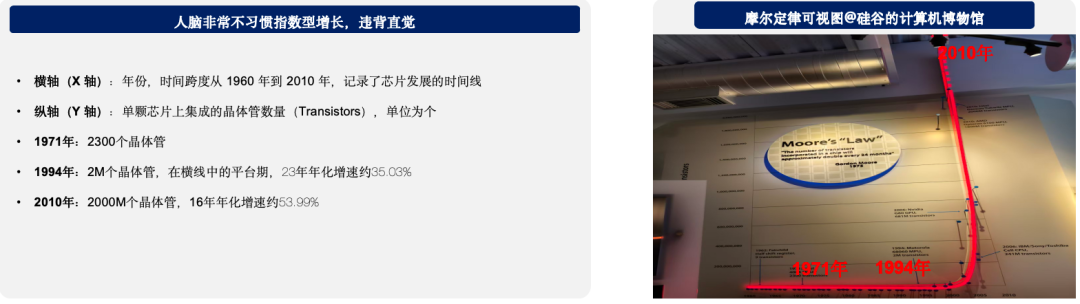
Let's look at a few key inflection points. In 1971, a single chip held roughly 2,300 transistors. By 1994, that had grown roughly 900x over 23 years, a ~35% annualized growth rate. If you were a sharp investor or seasoned semiconductor veteran in 1994, you would almost certainly have concluded: the past 23 years were already a period of extraordinary growth for semiconductors, especially advanced process nodes, and it would be hard to sustain that pace going forward.
But here's what happened next: from 1994 to 2010, over 16 years, the transistor count on a single chip reached 2 billion — roughly the level of Intel's flagship chip at the time, and Intel was then the world's largest semiconductor company. The annualized growth rate during these 16 years didn't slow; it accelerated to roughly 54%.
What's most telling is the chart itself. Its creator, for visual effect, placed the 2010 data point at the very top-right corner of the entire display — nearly bursting out of the frame, as if growth had peaked. But if you extend that same chart all the way to 2026, through the transitions from serial to parallel to accelerated computing, you see something striking: that 2010 "vertex" that once "couldn't fit on the board" has dropped back to the very bottom of the curve, almost hugging the floor. Because from 2010 to 2026, another 16 years, the industry grew another 168x, at roughly 37.75% annually.
This is what's most counterintuitive about exponentials: standing at any point in time and looking back, it always feels like we've hit the limit; but zoom out far enough, and the exponential never stopped — and the later segment is often steeper than what came before.
Dario Amodei, CEO of Anthropic, has a formulation: AI is a tsunami, and when it arrives, the public is profoundly lacking in awareness of "how close we are to the end of the exponential." Note that by "end of the exponential," he doesn't mean the curve's conclusion — he means the inflection point where it transitions from a plateau into a steep vertical ascent. We may be standing near this inflection point, and the vast majority of people's perception of it is severely inadequate.
Why do humans systematically underestimate it? This goes back to the origins of our brain.
For the past 2 million years, our ancestors looked up at the sun and down at prey like pigs, cattle, and sheep. The brain has been thoroughly optimized for addition and subtraction in the single digits and low double digits — more than sufficient for hunting and gathering. Later, two German scientists, Weber and Fechner, proposed the Weber-Fechner law; Kahneman expanded on this and won the Nobel Prize in Economics for it. The core insight: the human brain's perception of "ratio" vastly exceeds its perception of "absolute value." From 100 to 200, we automatically translate this as "doubled" and find it striking; from 10,100 to 10,200, we translate it as "up 1%" and feel almost nothing — even though the absolute increase in both cases is identical.
This perceptual system helped our ancestors survive in the age of hunting and farming, but it deceives us today. Because technology isn't linear — it's compounding, especially in the AI era. In the later stages of compounding, the accumulated effect of growth in each unit of time rapidly surpasses everything that came before it. Our intuition is natively illiterate about this curve, so again and again, at the very moments when it most deserves serious attention, we underestimate it.
This underestimation is equally visible at the company level. Plot the current largest companies by market cap on a single chart — horizontal axis is years since founding, vertical axis is revenue or ARR — and a clear generational slope emerges: compared at the same company age, the Mobile Internet generation (Google, Meta) shows a markedly steeper growth curve than the PC and software generation (Apple, Microsoft). Each generation's slope has risen.
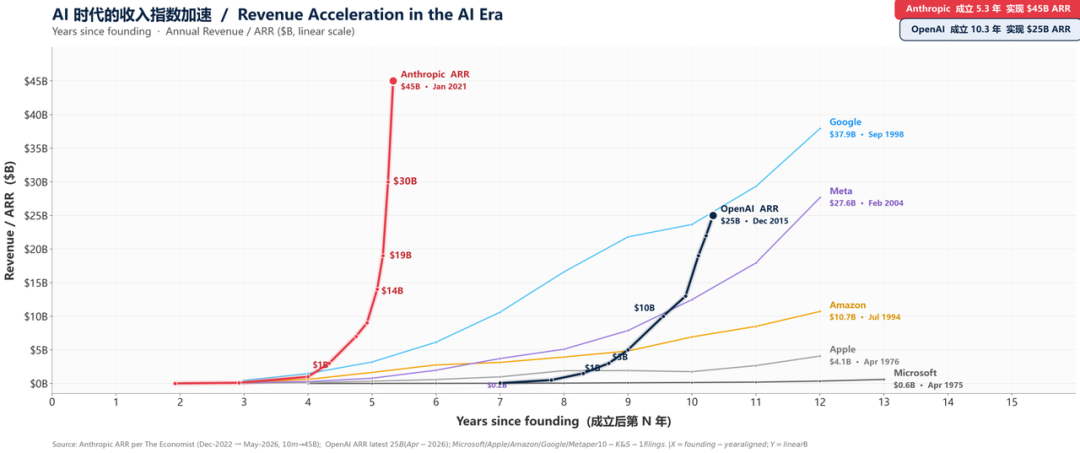
And the AI generation has stepped up another notch. Anthropic's last disclosed ARR was $4.5–4.6 billion, likely reaching $5–6 billion by May or June; OpenAI's current ARR is probably around $3–4 billion — and this curve is still accelerating, they're charging toward tens or even hundreds of billions at unimaginable speed. If we take them as the exponential benchmark for the AI era, relative to Mobile Internet, their second derivative, this "super-exponential" effect, becomes even more pronounced. The slope from zero to scale for this generation is unimaginable to the last.
Behind this acceleration, the industrial evolution of AI also repeatedly demonstrates another very general pattern. I'll string it together through a series of milestones.
In 1997, Deep Blue played chess — generations of carefully curated game records and opening theory lost to a machine with more compute for massive calculation. Then AlphaGo and AlphaZero: the contrast is telling. AlphaGo still learned from human game records; AlphaZero is called Zero because it started from scratch, completely independent of human data, teaching itself purely through self-play — and ended up stronger than AlphaGo.
Look at machine translation: old systems relied on linguists breaking down sentences and consulting phrase banks, often producing laughable results; after Transformer emerged, a neural network that knew no grammar rules at all crushed every linguistic school in translation quality. From ImageNet to AlexNet, to speech recognition, to AlphaFold solving the protein folding problem that had stumped biologists for fifty years — they're all telling the same story.

Kai Yu, founder of Horizon Robotics, has shared a similar angle. He said the essence of intelligent driving isn't learning from human drivers at all — because 99% of human drivers aren't worth learning from, turning too sharply, braking too hard. What intelligent driving needs to do is discard human driving habits and approach the truly most efficient way to drive. The kernel of this is exactly what AlphaZero and Tesla FSD are doing.
This chain of facts keeps making the same argument: more general methods, plus more compute, at least in the field of artificial intelligence, have again and again far surpassed all kinds of human "craftsmanship."
This statement has real impact on those of us in the middle of it. I was struck by an interview where Zhilin Yang, founder of Moonshot AI, was asked: "What was the biggest help to you personally from your time at Google?" His answer was — it made me realize that as a CEO, especially an AI-era CEO, you need to learn to liberate yourself from concrete details and abandon craftsmanship work. Because what this era rewards is betting on general methods and scale, not local fine-tuning.
2
Power Law: In the AI Era, Fewer and Fewer Winners
If the first part was about "how fast growth is," then what follows is about "who growth ultimately accrues to" — and it's equally counterintuitive.
Value creation follows a power law. And this power law is becoming ever more extreme.
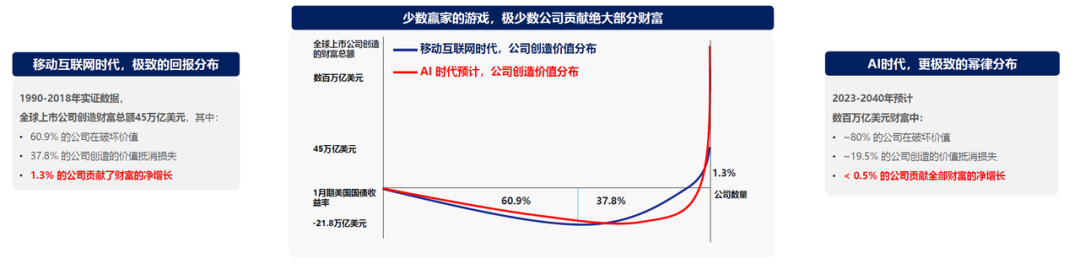
Over the past 30 years, the top 1% of companies in the US market contributed roughly 80% of public market value; in China, the top 1% contributed roughly 76%. Here's a more striking way to visualize it: horizontal axis is number of companies, vertical axis is total wealth created by global public companies, with the benchmark being US Treasury yields. According to empirical research by Bessembinder and others, from 1990 to 2018, global public companies created roughly $45 trillion in total wealth — but broken down, 60.9% of companies didn't beat Treasuries, destroying value; 37.8% of companies created returns that exactly offset these losses; only about 1.3% of companies truly contributed to net wealth growth.
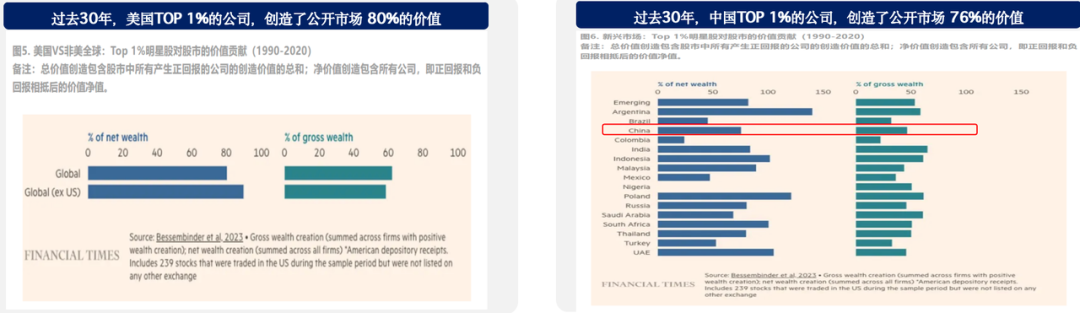
In other words, nearly all net wealth was created by an extremely thin tail — this was the reality of the Mobile Internet era.
In the AI era, this tail will almost certainly become thinner — this part is an opinion. If we count from 2023 (the year of ChatGPT), and if the world newly creates $200 trillion, $300 trillion, or even $500 trillion in wealth going forward, that blue distribution curve may be pushed into a steeper red curve: roughly 80% of companies underperform Treasuries and destroy value, 19.5% offset the losses, and perhaps only less than 0.5%, even 0.3%, of companies contribute virtually all net growth.
One immediate corroboration: the night before this talk (May 29), after US market close, the ten largest US companies by market cap were all technology companies — beyond the familiar "Magnificent Seven," there was also TSMC, Micron, and Broadcom. And if you look back through history — 1880, 1920, 1940, 2000, pulling the global top ten by market cap every decade or two — there has never been such a uniform picture.
Put plainly: this is a world with fewer and fewer winners, where a tiny number of companies contribute the vast majority of wealth increment.
Of course, even the strongest patterns must be honestly confronted with their boundaries. Karl Popper wrote in The Logic of Scientific Discovery: scientific theories cannot be verified, only falsified. Moore's Law is fundamentally a fit of past experience, not a scientific axiom; Newtonian mechanics holds within certain boundaries, but ceases to apply once you enter more microscopic scales. Power laws, this kind of super-exponential development pattern, likely also cannot be verified — only falsified.
But what's interesting is precisely here: before it is falsified, treating it as truth may be the more rational decision-making approach for this era. As Dario said — we believe scaling laws will continue to work, we doubt it every time, but every time we scale training by 10x, it still works. So every day we carry a kind of reverence, we bet on scaling: doubt it, and bet on it anyway. This may be a better mental model for navigating this power-law era.
3
Long-Termism: Crossing AI's Steep Curve
If you put the three preceding points together, you arrive at a conclusion critical for any long-term investor: on one hand, technology is accelerating super-exponentially, and the human brain natively underestimates it; on the other hand, value is concentrating among a tiny handful of companies with ever more extreme power-law intensity.
What does the combination of these two things mean? It means: the truly scarce capability in this era is identifying, early enough, when most people still underestimate it, that thin tail of a few companies, and having enough patience to stay with them long-term, crossing that steep curve.
Power law sounds like a cold story — most companies are destroying value. But flip the perspective, and it's precisely this era's greatest opportunity: because value is so concentrated, the returns from seeing it one step earlier and making a long-term bet on that tiny cohort of winners are unlike anything in any previous era. The steeper the curve and the fewer the winners, the more those who enter earlier and stay patient can capture.
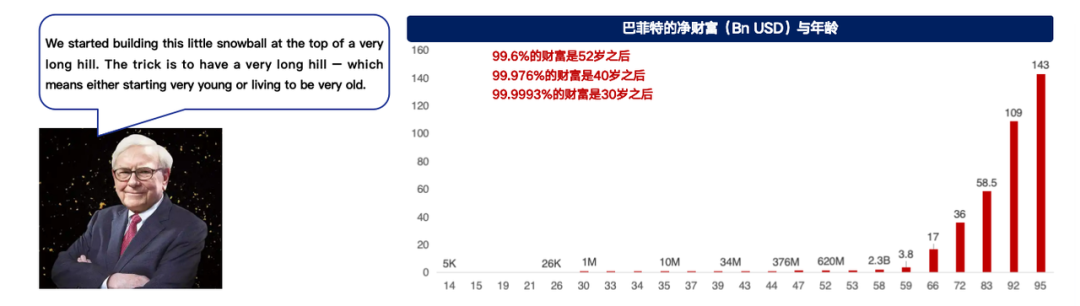
And long-termism itself is a severely underestimated force — Warren Buffett is the best illustration. There's a widely circulated data point: 99.6% of Buffett's wealth was created after he turned 52; 99.976% after 40; and 99.9993% after 30. In other words, virtually all his wealth came from the latter half of his life — not because he became smarter later, but because compounding takes time, and a snowball needs a long enough slope to grow to astonishing size. Compounding is also an exponential curve; and like Moore's Law, our intuition severely underestimates it in the early stages.
This is precisely what Source Code Capital has been doing for twelve years. Founded in the spring of 2014, from the beginning we have done the same thing — discover the best companies early, and stay with them for the long haul. The AI era hasn't changed the essence of this; it has only amplified both the payoff and the difficulty: the curve is steeper, so the value of seeing it one step earlier is greater; there are fewer winners, so the cost of being wrong is higher; and the cycles are longer, so patience is more valuable than ever.
In such an era, we increasingly believe a few simple things: respect the exponential, don't measure an accelerating world with linear intuition; bet on general directions and long-term trends, rather than obsessing over local craftsmanship; acknowledge the power law, concentrate your energy on that tiny number of truly important companies rather than spreading yourself thin across mediocre opportunities; and always maintain reverence for patterns, because even the strongest trends will eventually face the day they are falsified.
At bottom, this is a practice of patience. Buffett has a famous metaphor: investing is like starting to roll a small snowball from the top of a very, very long hill; the trick is finding a slope long enough, and snow wet enough.
The AI era gives us the longest slope and the wettest snow of any era. Only one question remains: do we have enough patience to keep that snowball rolling?