MaHui 2026 | Source Code Capital's Han Guang: Standing at 1769 of the Intelligence Revolution

The question isn't "Will AI arrive?" — it's already here. As an entrepreneur, the choice is whether to stand on the shore watching the ship depart, or jump aboard.

At the 2026 MaHui, Han Guang, Managing Director of Source Code Capital and head of growth-stage AI investments, delivered a talk titled "Standing at 1769 of the Intelligence Revolution." In his view, this wave of AI is not a continuation of the previous communications revolution, but another productivity revolution — one that industrializes "intelligence itself." The scaling law remains on a stable trajectory; "one year in AI equals three years in the human world." And with 68% of the world's 8.3 billion people still having never used AI, we are not standing at the crest of the wave, but at its very beginning.
From the front lines of Silicon Valley — where "three months is too long" and "wish-based work" have become the norm — to new evaluative frameworks like "tokens are not equal" and "to human or to agent," to organizational questions left for CEOs and Source Code Capital's own investment thinking, Han Guang sought to answer not "will AI arrive?" but the reality that it already has. The great ship of this era set sail three years ago; the question for founders is whether to stand on the old continent watching it leave, or to jump aboard.
Key points:
- Those who believed in the scaling law and those who didn't took completely different actions over the past few years — and reaped completely different returns.
- The CEOs of frontier labs aren't bragging; they're describing a fact.
- The Industrial Revolution commoditized mechanical energy; this time, we may be industrializing intelligence itself.
- We need to build a new world for intelligence.
- Tokens are not equal — there are tokens worth as much as diamonds, and tokens worth as little as water.
- We used to categorize companies as to C or to B; now that boundary is blurring — are you a to human or to agent company?
- The great ship of this era set sail three years ago. Will we stand on the old continent watching it leave, or jump aboard?
The following is an edited transcript of Han Guang's remarks, with some abridgments:

My talk today is titled "Standing at 1769 of the Intelligence Revolution," and I'd also like to exchange some views with you all: AI is not a continuation of the last communications revolution, but rather another kind of productivity revolution — the second time in human history, after James Watt's steam engine in 1769, that a fundamental factor of production has been thoroughly "industrialized." The Industrial Revolution industrialized "mechanical energy"; this time, it's "intelligence itself."
Over the past six months, voices saying "we've hit a wall," "it's a bubble," "time to cool down" have cropped up now and then. But my actual feeling is this: the scaling law has been steadily continuing all along. One year in AI equals three in the human world. We are not standing at the crest of the wave, but at its "very beginning." So what I want to talk about today is not "will AI arrive?" but that it already has — as entrepreneurs, will we stand on the shore watching the ship sail away, or jump on?
1
With or without the scaling law: two completely different worlds
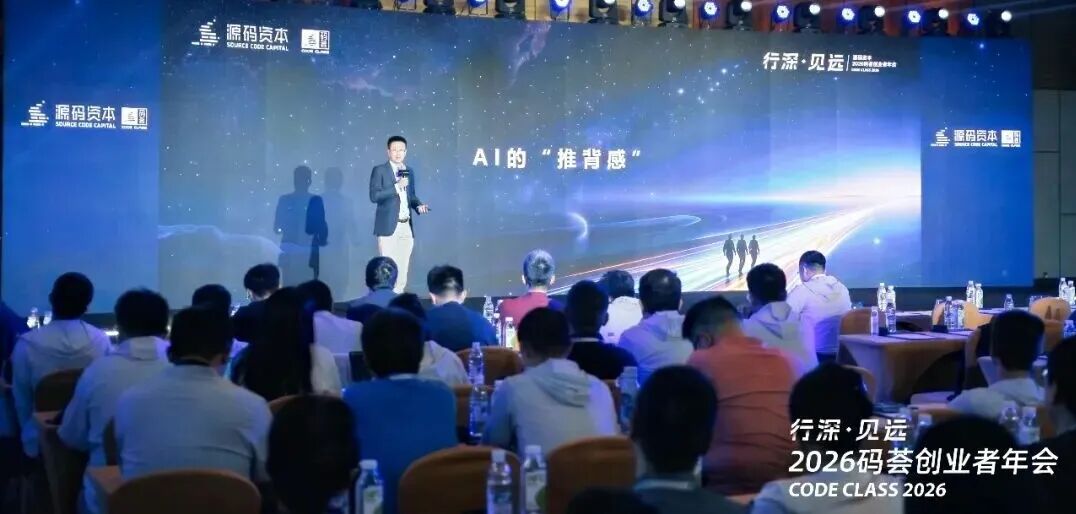
Let me start with the "push against your back" feeling of the past six months.
I believe you all feel, as I do, this sense of being swept along by a train of history — we're sitting in a car accelerating madly, the seatback pressing against us, making us instinctively hold our breath. All we can do now is grip the handrail tight and not let ourselves fall off.
If you ask what mattered most over the past few years, looking back, I think it was the scaling law.
A world with the scaling law and one without it are two different worlds; those who believed in it and those who didn't took completely different actions, and reaped completely different returns.
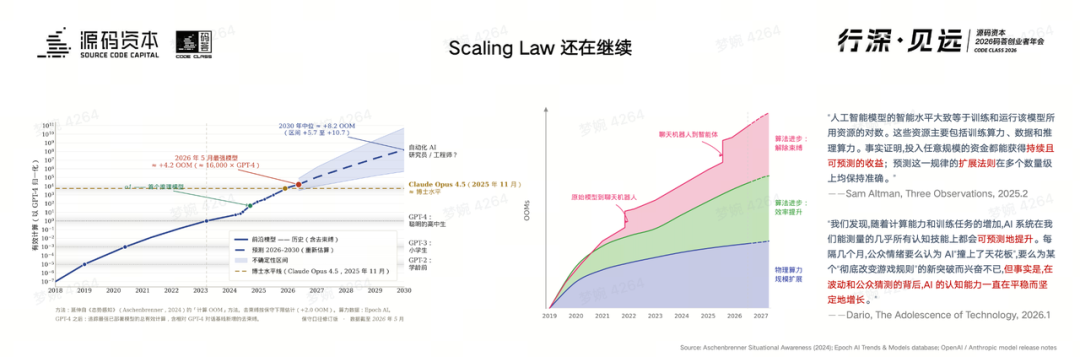
The scaling law has an academic definition, but also a simple understanding: the intelligence level of AI is roughly and predictably correlated with the logarithm of the resources you put into training and running the model. There are two key words here: first, the scale of investment is rising exponentially over time; second, the model's intelligence improves in a "predictable" way. "Predictable" is especially important — when we look at what Sam Altman and Dario have been saying recently, they more or less express the idea that "I roughly predicted this a few years ago."
Standing here now, a natural question is: has the scaling law hit a wall? How to judge? Actually the best way is to be inside a frontier lab yourself. How do we tell from the outside? There are a few methods.
First, listen to those who can see the truth directly — "only one person away from the truth." Information decays; if you're two people away from the truth, what you hear is less reliable. Closest to the truth are the CEOs and top researchers of frontier labs. Over the past six months they've been saying repeatedly: the scaling law continues. Their articles, blogs, interviews, speeches — all say this. Dario wrote The Coming Wave in January, saying the public either thinks AI has hit a ceiling in a few months or gets excited about some new breakthrough, but underneath, AI capability has been growing steadily and firmly; last month in an interview he said the current progress is roughly what he envisioned in 2017.
Second, look at the effective compute investment of leading models. If the scaling law had hit a wall, the effective compute investment of leading models would no longer be growing exponentially; if it's still expanding exponentially, that means they see the wall hasn't arrived yet. There's an organization called Situational Awareness; in 2024 they drew a chart of frontier models' effective compute investment, with time on the horizontal axis and effective compute on the vertical axis, on a logarithmic scale where each tick is an order of magnitude. At the time they drew it to the GPT-4 intersection point and made some predictions that seemed crazy and that no one believed. Two years on, those predictions have largely held up, shockingly. We updated this chart with AI assistance and were amazed to find the line still going straight up, and after the o1 model release, there was even a small acceleration inflection point. We are most likely still on the scaling law path.
Another interesting observation: the pace of AI progress is roughly three times that of human childhood intellectual development — one year in AI, three years in the human world. In 2019, GPT-2 was like a preschooler; in 2020, GPT-3 like an elementary schooler; in 2023 we had a smart high schooler; in the second half of 2025, suddenly like a PhD student. Basically a 1:3 ratio. Extrapolating, what kind of intelligence will we have by 2030? Maybe we only started to perceive AI's scariness late last year — not because its progress accelerated, but because it has been steadily growing and we just crossed the threshold of perception.
A year or two ago I always thought Dario, Sam Altman, and Demis were bragging, because what they described looked like science fiction. Now looking again, they're not bragging — they're describing a fact.
Dario says powerful AI will emerge, smarter than Nobel Prize winners in most relevant domains, within one to two years, most likely within a few years, constituting "a country of geniuses in a data center"; by the end of this year, half the world will be talking about AI; he recommends reading The Making of the Atomic Bomb because this is as important as the atomic bomb. Sam Altman says truly superintelligent early forms may be only a few years away, by his definition: capable of being CEO of a large company, or doing better research than top scientists. Demis is the most conservative of the three; in January he said there's a 50% probability of AGI within ten years, and his standard is much higher: give an AI all knowledge prior to 1911 and see if it can independently produce general relativity. Even a 50% probability is terrifying and exciting enough.
Have we already seen the first glimmer of an AI scientist? A few days ago, a general reasoning model from OpenAI without specialized training independently produced a proof of the unit distance conjecture posed in 1946, vetted by four mathematicians. The proof isn't super difficult — it's a constructive proof — but it lets us see the first glimmer of an AI scientist. The world they describe is possible.
2
The 1769 revolution produced mechanical energy; this time what's being industrialized is intelligence itself
1769 was the year Watt improved the steam engine, and human history hit an inflection point there. Before that, the mechanical energy embedded in all goods around us was provided mainly by human and animal power, plus a bit of wind and water power; after that, mostly by machines — first steam engines, then internal combustion engines, today partly electric motors. It took us two hundred years to reduce human and animal power from supplying 98% of mechanical energy to less than 1% today.
If this is truly a computation revolution, what happens?
Most of our cognitive activity is still provided by the human brain, with a little by mechanical computation, electronic computation (PCs, phones), and now a little by neural networks. If this is truly a computation revolution, will general-purpose cognitive activity conducted through the human brain be compressed? What will provide general-purpose human intelligence? Perhaps neural networks, perhaps other architectures, perhaps things we can't yet imagine — but the direction is certain.
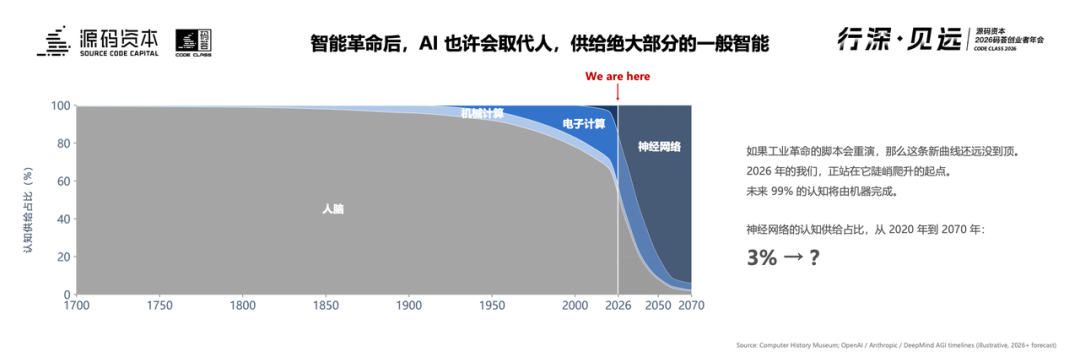
We were amazed to discover: the Industrial Revolution commoditized and industrialized mechanical energy; and this time, we may be commoditizing and industrializing general-purpose human cognition, or intelligence itself.
This may be the fastest wave in history. Apple and Microsoft took twenty years to reach ten or twenty billion dollars in revenue; Mobile Internet was much faster, reaching one or two hundred billion in twenty years; while those two upstart AI companies reached tens of billions and are heading toward a hundred billion in annualized revenue in just three or four years. This is a speed never before seen in human commercial history, far exceeding their predecessors.
So how big is this market?
One approach is substitution: global GDP is $110 trillion, of which roughly $60 trillion is wages; assume 50% to 80% can be substituted, and machine substitution always comes at a discount, assume a round number of $10 trillion. How much have we captured so far? Only $80 billion — a very small slice.
But is substitution really the right way to measure?
In 1700, before the Industrial Revolution, total global power from human and animal labor was 10 gigawatts; two hundred years later it increased to 500 gigawatts, a 50x increase. When the power loom was invented, the market it created was far more than just the hand-weaving it replaced — it vastly expanded the market. All our "substitution" calculations are likely limited by our own imagination.
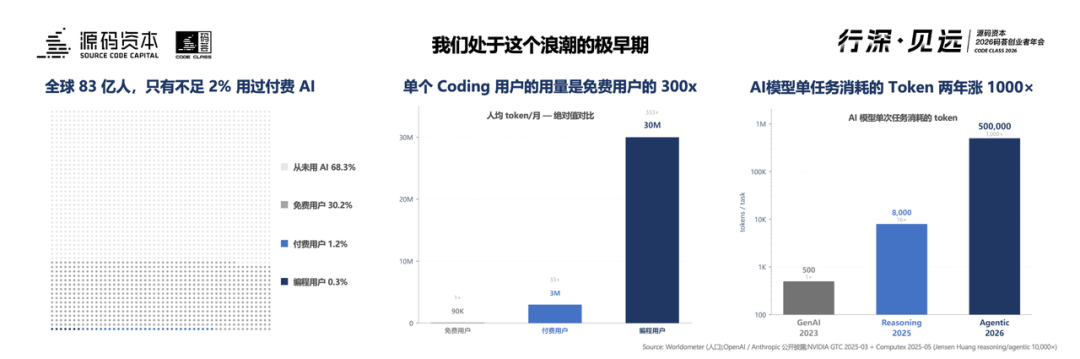
And we're still at the very beginning. Of the world's 8.3 billion people, 68% have never used AI; paying users are only 1.2%, programming users only 0.3% — but this small group uses it intensely: one programming user's consumption is 300x that of a free user, 10x that of a paying user, and still rising. Over the past two years, from chatbot to agent, token usage per task has increased 1,000x.
We need to build a new world for intelligence, and there are two layers to this.
First, we need to facilitate the production of intelligence, and this will run into the physical walls of energy and hardware. If you chart Dario's described compute demand for the AI industry, you'll find: in three to four years, if they want to get all the compute they need, the power required will reach 50% of average U.S. electricity generation. This is a systematic physical world — we need electricity, chips, storage, interconnects, long-distance interconnects, power electronics, liquid cooling, even civil construction, and everything is sold out. Essentially, obtaining compute, obtaining intelligence growth, requires exponential investment, while the physical world grows linearly.
Second, we need to build a world for agents. All infrastructure in the virtual world today — identity systems, payment systems, security review, authentication protocols — is built for humans. Agents have some of these, lack others. In the future they may have their own communication protocols, authentication, payment tools, perhaps even their own economic cycles and markets someday. That is a brand new, exciting and slightly anxiety-inducing world.
3
We are all beginners: today, did you personally use the computer?
In March we conducted field research in Silicon Valley, and being there in person brings a completely different physical and emotional experience. A few keywords to share.
First, "three months is too long." I asked a frontline researcher what would happen by year-end, and he replied: there's still nine months until year-end, so much will happen in that time, how would I know? In frontier labs, they no longer discuss things four months out, because time has been compressed. The time horizons we use to discuss things today probably all need to be re-examined.
Second, "making wishes." I asked another researcher, you're closest to AI, how do you usually direct AI to work? He said, how am I directing it? I'm learning from it — every day I go to work and make three wishes, "AI, please help me realize these three wishes today," and then it does. "Making wishes" — this is my favorite word recently.
Third, "results in two hours." One researcher said his boss's phrasing for assigning work has changed: "this is very promising, I want to see results in two hours" — not when you finish, not tomorrow. What is the baseline for our organization's blood circulation speed, our iteration speed?
So how to become a super-individual in the AI era? We gave ourselves a few keywords:
First, dive in. Don't stand on the shore watching at this point; jump in.
Second, unlearn. Forget previous judgment standards, metrics, familiar tools and procedures; start from facts, start from logic.
Third, be open. In this era we are all beginners; no one is born knowing more. Attitude determines action.
Fourth, enjoy. This is an era of material abundance and new things; the whole world is like a pupils' playground, and we should enjoy it.
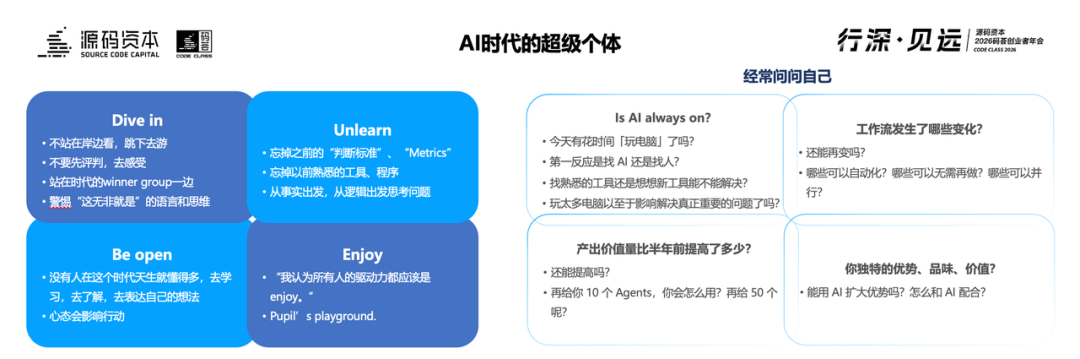
So I often ask myself: is AI always on? We're all managers, managing every day, but today did you personally use the computer? When you encounter a problem, is your first reaction to find AI, or to find a person? To find familiar tools, or to see if new tools can solve it? There's a downside too: after getting addicted to coding, addicted to tools, important things don't get solved and you exhaust yourself — have you fallen into a negative cycle?
We need to prepare for a new world of coexistence with agents. The length of tasks agents can complete doubles every four months. Two years ago with chatbots and tab completion, the human-to-agent ratio was 1:1; now some people go to work with 10 agents; after some time, perhaps one of these 10 can be promoted to "CEO" to manage your team for you, and you'll have an agent company, one person leading 50 agents; finally, we may not need to manage any agents at all, they'll run automatically — a "lights-out factory," a workforce in a data center that you don't manage, they just hand you a result. Ronald Coase wrote The Nature of the Firm in 1937; in this era, will there emerge some "nature of the firm in the agent era"? I'm somewhat looking forward to that moment.
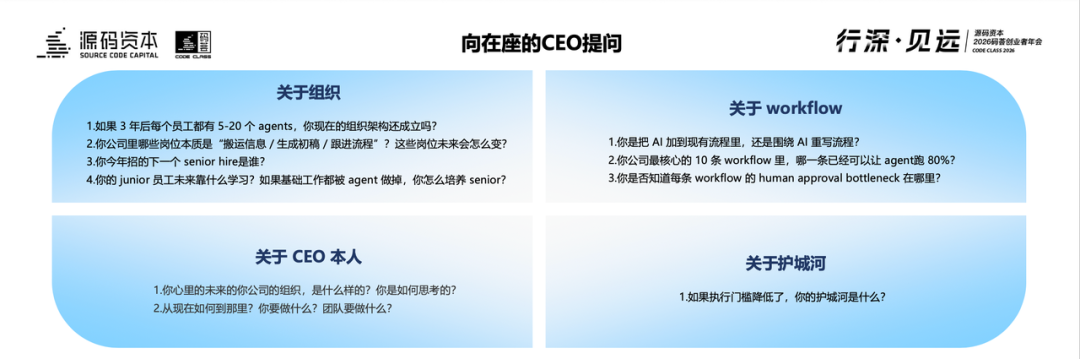
So I'd like the CEOs here to consider a few questions: if in three years every employee brings 5 to 10 agents, does your organizational structure still hold? Which positions in your company are essentially just moving information and pushing processes along? Who is your next senior hire? If junior work is all done by intelligence, how do you cultivate your seniors? Among your ten most core workflows, which one can already run 70-80% on AI, and where is its bottleneck? And if the barrier to execution is greatly lowered, what is your moat?
4
Tokens are not equal: from selling attention, to selling intelligence goods
The era is changing, and investment is changing too. Jensen Huang says AI is a five-layer cake: energy, chips, infrastructure, models, applications. Over the past three years, new startups have been rapidly filling this cake, and the cake is still enormous — this is a tens-of-trillions-of-dollars new opportunity, and we should go fight for it.
At the same time, we feel these are two different kinds of revolution. Most people here, including my own generation, have never actually seen a productivity revolution; what we've seen are communications revolutions. Communications revolutions accelerate the circulation and distribution efficiency of information; while the intelligent productivity revolution produces new intelligence goods, transforming "intelligence" from a precious, scarce, handcrafted state into an industrialized one. We need to put on different glasses to see this.
In the communications era, what we sold was attention — I'm a billionaire, he's an ordinary white-collar worker, our attention is roughly equivalent, "attention is more or less equal." We sold advertising, took commissions, hoped users would stay on the platform a little longer, not go do something else. But today, "tokens are not equal": there are high-value tokens worth as much as diamonds, and commoditized tokens worth as little as water; there are high-margin ones, sticky ones, and also use-and-leave ones.
So evaluative standards likely need to change too: in the communications era we looked at DAU, time spent, cohort retention; now we need to look at token volume, and in the future will we need to look at token "value density," or metrics we can't yet imagine? I think certainly.
We used to categorize companies as to C or to B; now that boundary is blurring — they're all used by people, so which usage counts as 2B and which as 2C? Correspondingly, people are already asking, "am I a to human company, or a to agent company?"
There's another question we also don't have an answer to: with model companies so strong, what happens to application companies? A few points to consider.
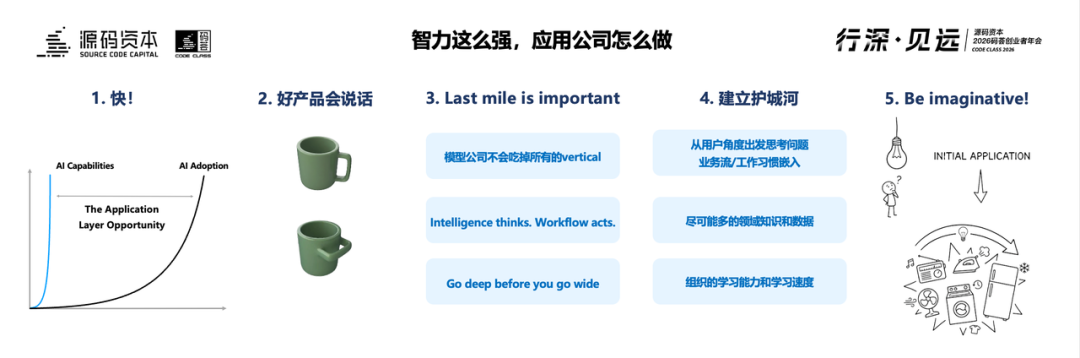
First, the AI capabilities line is rising almost vertically, unlocking new capabilities like a storm, while real-world adoption is a bit slower; the gap in between is the opportunity for application companies — whoever moves fast grabs it first.
Second, good products speak for themselves — a cliché, but still true: just as my two-year-old daughter knows to put four fingers through a mug handle and steady it with her thumb, a good product needs no explanation; turn the handle 90 degrees and users immediately know it's a bad product. There are many similar products, and users will know which is good.
Third, last mile is important — model companies will eat some verticals, but not all; in a tens-of-trillions market, there will always be some verticals where intelligence works and workflow acts — when starting a second venture, should you go deep before you go wide?
Fourth, how to build a moat is particularly hard to answer because things are developing so fast, all the parts are moving, but thinking from the user perspective rather than the technology perspective may matter more: how to embed in users' business flows, how to acquire domain knowledge, and soft capabilities like organizational learning speed may matter more than before.
Fifth, be imaginative. At the end of the 19th century when electricity first appeared, we could only think of the light bulb (1879) and the telephone (1876); who could have imagined that the next hundred years would be a world full of all kinds of electrical appliances? Today we can think of chatbots, coding agents — who can guarantee that fifty years from now won't be an era full of all kinds of intelligent applications? This is an era for adventurers, an era for genius product managers.
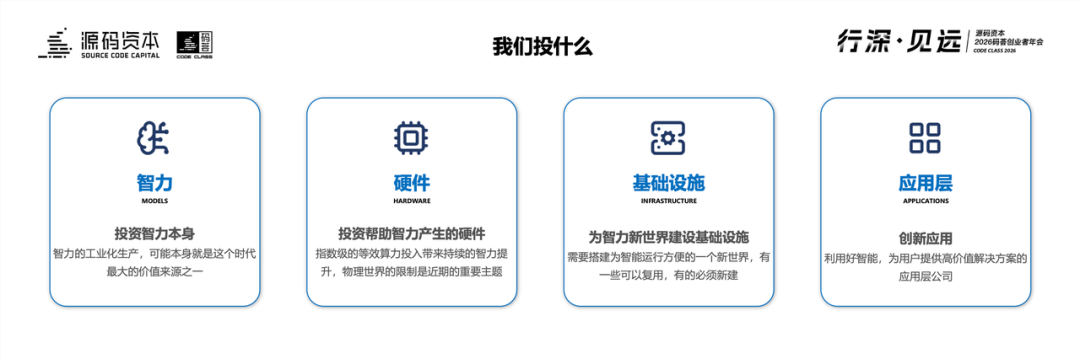
What do we invest in? Intelligence itself is one of the biggest winners of this round; the landscape in the United States is already becoming clear; hardware, because of the tension between exponential investment and linear growth, may be the most important theme in the near term; later there will be infrastructure for building intelligence, infrastructure for building a new world for intelligence; finally applications — these will emerge slowly, not a matter of a few years but of ten or twenty years, and we will continue searching for genius product managers who use intelligence well and provide high-value intelligence solutions to users.
The great ship of this era set sail three years ago; this is a fact. Will we stand on the old continent watching that ship leave, or jump aboard? The choice is in our own hands.