Convenience Stores: Where China's Homegrown 7-Elevens Go From Here | Source Code Capital Insights

The domestic convenience store market shows massive untapped potential amid the new retail wave — Source Code Capital presents its fifth *Source Code Capital Internal Reference* after analysis and research.
Source Code Capital Internal Brief
Issue 5
About the Author
Di Wu
Senior Investment Manager

Di Wu joined Source Code Capital in 2016, focusing on growth-stage investments and consumer sector deals. He has participated in key projects including Toutiao and Zhangshangkuaixiao. Prior to Source Code Capital, Wu worked at bda, serving top-tier USD hedge funds and private equity firms, accumulating extensive research experience in e-commerce, gaming, and internet advertising. He holds a Bachelor's degree in Management from the University of International Business and Economics. Contact: wd@sourcecodecap.com
[ Editor's Note ]
Convenience stores in mainland China have undergone more than two decades of development, and have finally caught the "tailwind" amid the new retail wave. How should we view this wave of rapid growth opportunities, and how should we understand the challenges facing the industry? After analysis and research, Source Code Capital presents the fifth issue of [ Source Code Capital Internal Brief ].
Perspectives
Convenience Stores: The Path for China's Homegrown 7-Eleven in the New Retail Era
Research by/Source Code Capital
○ Globally, East and Southeast Asia are the most suitable regions for convenience store development, while mainland China has the potential to birth several giants on the scale of 7-Eleven.
○ Convenience stores are easy to learn but hard to master. The so-called "invisible" capabilities are the true core competitiveness. Domestic brands must keep refining and iterating through the dark hours before dawn to have a chance to break through.
1
The Immense "7-Eleven" Opportunity
Since the Southland Company established the Tote'm store in Dallas in 1927 — selling eggs, milk, and ice cream — the convenience store industry has nearly a century of history. Yet the industry only truly began to flourish in the last four decades.
7-Eleven and Lawson, two brands born in the United States, failed to thrive in their homeland during their first half-century. Instead, they crossed oceans to East Asia and became regional dominators.
"There are only two kinds of convenience stores in the world: 7-Eleven, and all the others."
As of mid-2017, 7-Eleven had opened 19,588 stores in Japan, generating annual sales of 4.5 trillion yen. Moreover, 7-Eleven has aggressively expanded overseas. As of mid-2017, it operated 62,935 stores across 17 countries and regions worldwide, and was still growing at a pace of 3,000+ new stores per year — a veritable retail behemoth.
In developed countries like the United States and Europe, chain convenience stores have not become the dominant retail format. According to the National Association of Convenience Stores (NACS), as of year-end 2015, there were 154,000 convenience stores across the US, with a compound annual growth rate of merely 1.2% over the previous 13 years.
Among these, 63% of convenience stores operated as single-store businesses (i.e., non-chain).
More interestingly, 80% of gasoline in the US is sold through convenience stores (the vast majority of US convenience stores have fueling equipment), meaning the US model is primarily gas-station-type convenience stores.
Based on the development history of convenience stores in major countries and regions globally, East and Southeast Asia are the most suitable regions for convenience store development.
1. Four Critical Factors: Population Density, Economic Level, Culture, and Dietary Habits
Population density: Small-format retail generally requires high population density to sustain itself. Over half of US convenience stores are concentrated in the densely populated East Coast. Many countries simply don't meet this density threshold, while the highest population densities globally are found in East and Southeast Asia.
Economic level: Industry consensus holds that convenience stores flourish when per capita GDP exceeds $7,000. Convenience store products are on average more expensive than those in hypermarkets. In economically underdeveloped regions, consumption levels haven't caught up, and consumers are less willing to pay the premium for "convenience."
Culture: The cultural factors affecting convenience store development are primarily pace of life and vibrancy of nightlife (both typically manifesting in large cities). The faster the pace of life, the more consumers demand "convenience"; meanwhile, the more vibrant the nightlife, the more 24-hour convenience stores become the only option meeting consumer needs late at night. Both factors were well demonstrated in Japan and Taiwan in the late 1970s and early 1980s.
Dietary habits: Dietary habits have two dimensions — dietary structure and culture of eating out. One defining characteristic of modern convenience stores is that food sales (especially fresh food) account for a substantial portion of store revenue. The richer the dietary structure (especially snacks), and the stronger the culture of eating out (typically accompanying the development of megacities), the more conducive the environment for convenience stores.
2. Chinese Cities Meeting These Four Criteria
As China's urbanization continues to advance, McKinsey & Company predicts that China will form 22 urban clusters in the future, each centered around 1-2 core cities.
Through our research on numerous new retail projects, we have studied and conducted field visits to over a dozen core tier-1 and tier-2 cities. The vast majority of these cities already possess the four factors mentioned above, and some have already given birth to chain convenience store brands ranging from several dozen to over a thousand stores in scale.
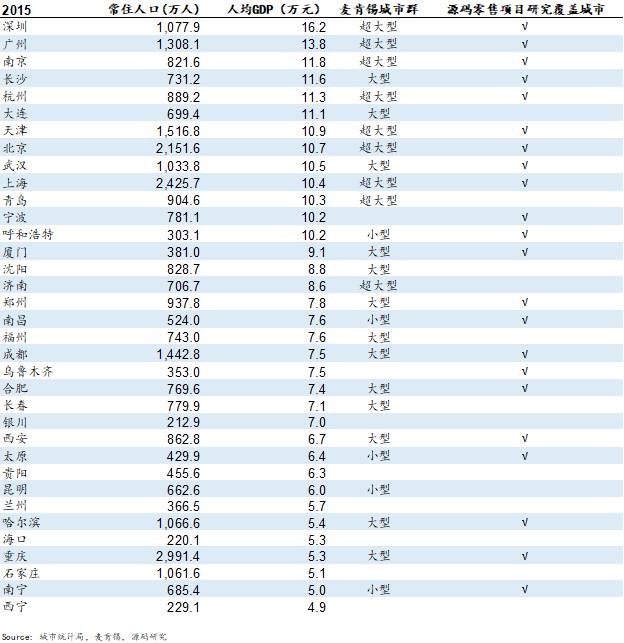
From macro statistics, central city populations are increasing year by year, and per capita GDP levels are rising annually.
From field research results, central cities (mostly provincial capitals) show clear demographic absorption effects on surrounding cities. The urbanization process has accelerated the pace of life, reduced cooking frequency among post-85s, and spurred the booming development of entertainment and out-of-home consumption — all favorable for the convenience store industry.
Mainland China is vast in territory, with population and land area several times that of Japan and Taiwan. Based on the experience of Japan and Taiwan, where every 2,000–2,500 people can support one convenience store, China's core tier-1 and tier-2 cities each have the capacity for thousands of stores — substantial market potential.
Following the principle of dense regional store placement, before national market consolidation occurs, every region has the opportunity to create its own "7-Eleven."
2
The Internal Capabilities of Domestic Convenience Stores
A good convenience store system should encompass at least three critical success factors: systems, supply chain, and franchise model.
Systems: Convenience stores are an extremely low-margin industry, with typical store operating profit margins around 3–5 percentage points — little room for error.
At the same time, convenience stores are a heavily operations-dependent industry. Product lifecycles are growing shorter, customer demands increasingly differentiated, and the sit-and-sell approach can no longer adapt to the changing environment. Fine-grained data-driven operations across people, goods, and place can significantly improve operational and management efficiency for convenience store systems.
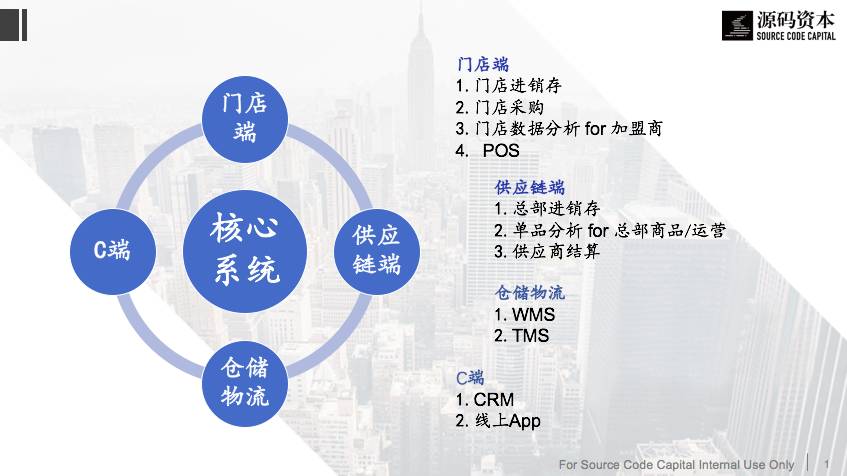
Convenience store information systems need to connect headquarters, store managers, suppliers, warehousing and logistics, and consumers — resolving product flow, logistics, capital flow, and information flow.
A good information system is the brain of a convenience store, coordinating tens of thousands of endpoint stores. Scalpel-precise operations can substantially improve system efficiency. From 1978 to the present, 7-Eleven's information system has iterated to its sixth generation, with cumulative R&D investment reaching the billion-dollar level — testament to 7-Eleven's emphasis on information systems.
C-side CRM is an area where traditional Japanese convenience stores have been relatively weak.
China enjoys a unique mobile internet environment. We have already seen CRM's impact in traditional industries like food and beverage. We believe 7-Eleven's current form may not represent convenience stores' final form — a model integrating online and offline traffic holds boundless imaginative possibilities.
Fine-grained data-driven operations across people, goods, and place can significantly improve operational and management efficiency for convenience store systems. "New retail" convenience stores will certainly be an online-offline integrated model, expanding the physical and category boundaries of convenience stores, better meeting user needs, and improving per-person and per-square-meter efficiency.
Supply chain: Convenience stores typically carry 2,000–3,000 SKUs, and must carefully select products with high turnover or strong margins.
Beyond regular merchandise, the most critical categories are fresh food and PB (private brand) products.
Good-tasting fresh food can bring stable foot traffic on one hand, and improve store gross margins on the other. Reviewing the history of Japan's three major convenience stores, a crucial part of competition was differentiation in fresh food categories, with each player pulling out all the stops to attract consumers. However, fresh food supply chains are far more complex than imagined. The most critical element is R&D capability. Consumer tastes are increasingly discerning; unchanging products quickly grow stale.
7-Eleven replaces 70% of its SKUs annually to meet ever-changing consumer demands.
R&D requires not just new menus and recipes, but sometimes new ingredients and processes. 7-Eleven Japan's fresh food R&D is led by the company, with ingredient suppliers and kitchen equipment suppliers also participating in development. The entire team must control all steps from product planning to implementation.
Localization is also a challenge in fresh food R&D. 7-Eleven Japan divides Japan into 9 regions, developing different products for regional taste differences. Mainland China is vast, and Chinese people are more particular and demanding about food, with significant taste variations. Our research has also found cases where Japanese convenience store bento boxes sell well in Location A but flop in Location B.
Many convenience stores are actively exploring fresh food supply chains, and considering building their own fresh food factories or central kitchens. We believe fresh food supply chains are indeed a core competitive advantage for convenience stores in the long run, requiring capital and effort to build.
Fresh food factories must achieve lean production on one hand, with zero tolerance for food safety issues; on the other hand, they must maintain strong R&D systems — no easy feat.
Core talent for fresh food factories is genuinely scarce. We recommend that companies determined to build fresh food supply chains increase investment in core talent.
Franchise model: Convenience stores are well-suited to franchising. Nearly 80% of 7-Eleven stores are franchises, and this proportion continues to rise year by year. On one hand, convenience stores require relatively large numbers of outlets, with substantial investment in renovation and equipment — a semi-heavy-asset industry — making direct-operated store expansion relatively slow. On the other hand, given thin profit margins, store managers need to exercise greater initiative, and franchisees tend to be more invested in store management than directly-operated store managers.
The relationship between franchisees and headquarters must be a good partnership to sustain long-term operations. A good franchise system can clearly delineate responsibilities between headquarters and store franchisees, thereby establishing a reasonable profit-sharing arrangement.
Although increasingly more franchisees are willing to enter the convenience store industry, overall, China's convenience store industry remains in its early stages, and franchisees generally lack extensive operational experience. How headquarters can effectively train and empower franchisees, exporting standards and operational capabilities, is also a major challenge for headquarters.
In recent years, offline retail formats have faced significant changes. Large-format stores have been continually disrupted, while chain small-format stores have seized a once-in-a-generation opportunity.
Various core cities have gradually developed regional chain convenience stores ranging from several dozen to several hundred stores in scale, gradually building reputation and brand locally, and progressively improving systems, supply chains, and beginning to experiment with franchise models.
The "tailwind" narrative for convenience stores has circulated for years, yet the wind never seemed to actually pick up.
Rome wasn't built in a day — systems and supply chain construction, franchise model refinement, all require substantial investment and rebuilding standards from scratch. Convenience stores are a hard business; the foundation must be solidly laid early on, requiring painstaking internal capability-building in the dark. 7-Eleven's first 1,000 stores took 6 years; now it can open 3,000+ stores annually. We believe that good convenience stores in various regions can easily accumulate first-mover advantages early on, capturing consumer mindshare, securing prime locations, and achieving the grand vision of a homegrown Chinese 7-Eleven.