A-share reform dividends far exceed expectations, making it the top choice for listings amid transformation

A-Share IPO Opportunities Under the Registration-Based Reform: An Investment Banking Perspective
Since the launch of registration-based IPO systems on the STAR Market and ChiNext, the A-share market has seen a surge in listings. Amid shifting international political and economic conditions, some Chinese concept stocks have rerouted their listing paths, opting for secondary listings in Hong Kong or returning to A-shares; meanwhile, the US stock market, with its mature capital market system, remains an attractive option.
To help Ma Hui growth-stage portfolio companies timely and comprehensively understand evolving capital market trends, Source Code Capital's post-investment energy center, from April to September this year, invited senior experts from top investment banks including CICC, Morgan Stanley, and Huatai International, as well as experienced practitioners such as renowned corporate CFOs and board secretaries. From multiple perspectives, they hosted six closed-door themed sessions for Source Code Capital's growth-stage portfolio company CEOs and executives covering A-shares, Hong Kong stocks, and US stocks.
We've distilled the key insights from these sessions into five articles, to be shared sequentially. We hope to learn and grow together with you through this collaborative learning experience.
Key Highlights Preview
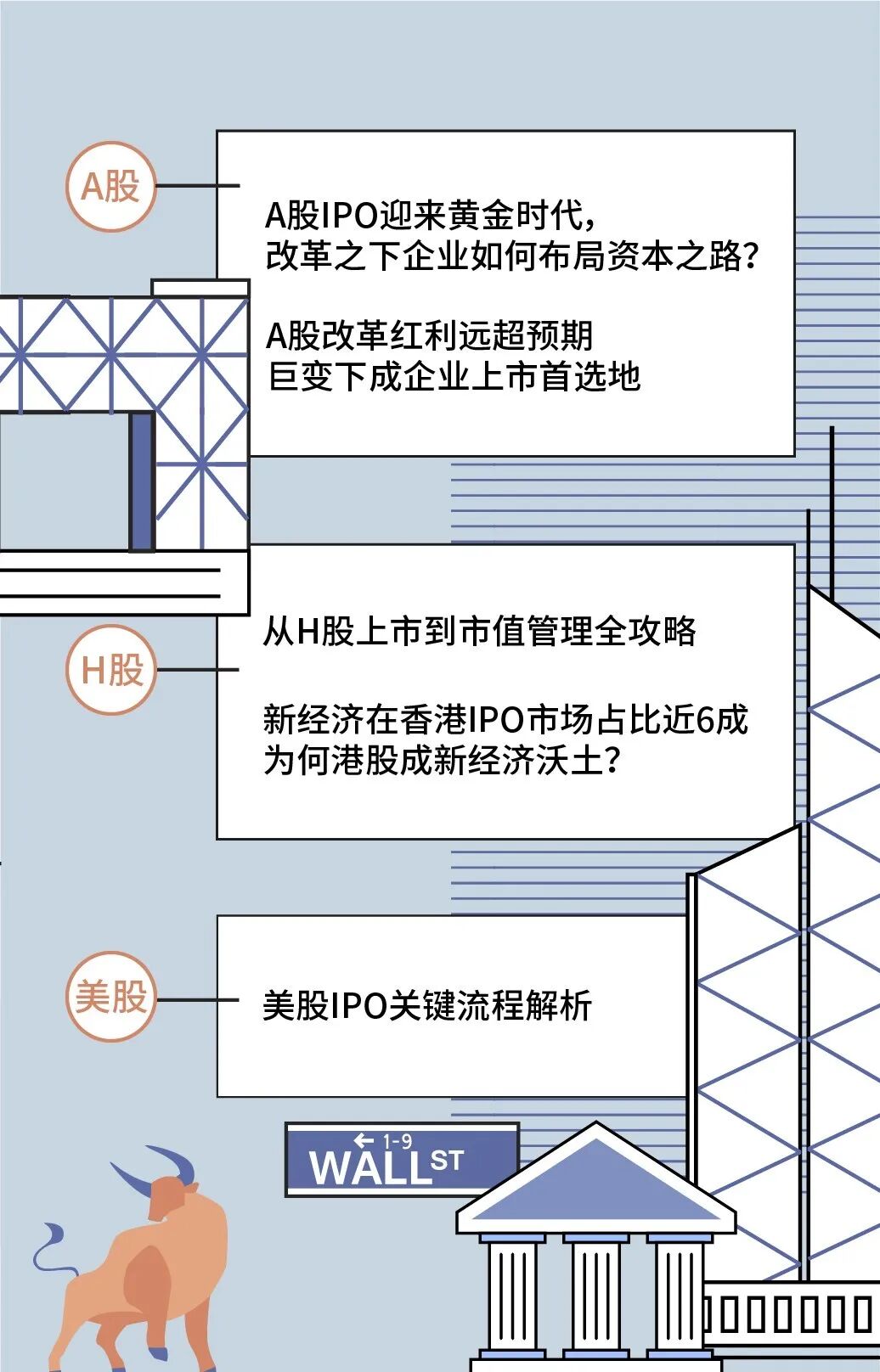
Since 2019, the China Securities Regulatory Commission has driven major reforms including the establishment of the STAR Market with pilot registration-based IPOs and the registration-based reform of ChiNext, gradually implementing these landmark measures and mapping out a comprehensive blueprint for capital market reform. These efforts have further boosted market confidence and created an excellent historical opportunity for "hardcore technology" companies and innovative, entrepreneurial growth companies. What new opportunities will registration-based reform bring to startups?
Code Brain invited Zhong Jin, Managing Director and Head of TMT Investment Banking at CICC, and Shiyan Xu, Managing Director, Sponsor Representative, and TMT Industry Group at CICC Investment Banking, to share from an investment banking perspective on "A-Share Listing Opportunities Under Registration-Based Reform," delving into STAR Market and ChiNext listing requirements, advantages of registration-based reform, and exploring A-share listing opportunities in this new era.
Selected highlights from the session below:
Speaker One: Shiyan Xu, Managing Director, Sponsor Representative, TMT Industry Group, CICC Investment Banking
STAR Market Positioning
In November 2018, the establishment of the STAR Market with pilot registration-based IPOs was announced at the first China International Import Expo. On March 1, 2019, the STAR Market's main institutional rules were formally released. On July 22, 2019, the first batch of 25 STAR Market companies began trading. From announcement to first listings took just over nine months — remarkably efficient.
Based on reform outcomes, market feedback and operations have achieved relatively good results and met expectations. The STAR Market is oriented toward the global technological frontier, the main economic battlefield, and major national needs. It primarily serves technological innovation enterprises that align with national strategy, break through core technologies, and enjoy high market recognition. It prioritizes support for new-generation information technology, high-end equipment, new materials, new energy, energy conservation and environmental protection, and biomedicine — high-tech and strategic emerging industries. The government's establishment of the STAR Market with pilot registration-based IPOs has enhanced the capital market's inclusiveness toward the real economy, better serving enterprises with core technologies, industry leadership, and good development prospects and reputation, while further improving capital formation mechanisms that support innovation through reform.
The STAR Market reform is not merely a new board; more importantly, it upholds the market-oriented and rule-of-law direction of capital market reform. The reform's core lies in institutional innovation across issuance, trading, information disclosure, and delisting, establishing and improving an issuance and listing system centered on information disclosure, leveraging the STAR Market as a reform testbed to create replicable and scalable experiences.
The CSRC adhered to the principle of "strict standards, steady launch," refining relevant institutional arrangements, improving risk response plans, strengthening investor education, and maintaining balance across markets to ensure the smooth launch and implementation of the STAR Market with pilot registration-based IPOs.
With the advancement of registration-based reform, the A-share market as a whole has undergone significant changes. Once registration-based reform is fully rolled out, investment banks' abilities to craft investment narratives, identify investment highlights, and price and sell offerings will become increasingly important, and the A-share IPO market will more closely resemble overseas mature capital markets. Meanwhile, listed companies in the secondary market will diverge: quality companies will command premiums and enjoy better liquidity, while some companies will trigger delisting conditions and gradually exit the market.
STAR Market Listing Requirements — Companies Without Weighted Voting Rights or Red-Chip Structure
STAR Market enterprises should be oriented toward the global technological frontier, the main economic battlefield, and major national needs. The STAR Market prioritizes support for technological innovation enterprises that align with national strategy, possess key core technologies, and enjoy high market recognition, with emphasis on new-generation information technology, high-end equipment, new materials, new energy, energy conservation and environmental protection, and biomedicine — high-tech and strategic emerging industries — while driving the deep integration of internet, big data, cloud computing, and artificial intelligence with manufacturing, leading mid-to-high-end consumption, and promoting quality, efficiency, and momentum transformation.
According to the "Shanghai Stock Exchange STAR Market Stock Issuance and Listing Review Rules," non-red-chip companies without weighted voting rights applying for STAR Market listing must meet at least one of the following market capitalization and financial criteria:
-
First standard: expected market cap of no less than RMB 1 billion; net profits positive for the most recent two years with cumulative net profit of no less than RMB 50 million; or expected market cap of no less than RMB 1 billion, net profit positive in the most recent year with operating revenue of no less than RMB 100 million.
-
Second standard: expected market cap of no less than RMB 1.5 billion, operating revenue in the most recent year of no less than RMB 200 million, and cumulative R&D investment over the most recent three years accounting for no less than 15% of cumulative operating revenue over the same period.
-
Third standard: expected market cap of no less than RMB 2 billion, operating revenue in the most recent year of no less than RMB 300 million, and cumulative net cash flow from operating activities over the most recent three years of no less than RMB 100 million.
-
Fourth standard: expected market cap of no less than RMB 3 billion, and operating revenue in the most recent year of no less than RMB 300 million.
-
Fifth standard: expected market cap of no less than RMB 4 billion, with main business or products subject to approval by relevant national authorities, large market space, and currently achieved phased results. Pharmaceutical industry enterprises must have at least one core product approved for Phase II clinical trials; other enterprises meeting STAR Market positioning must possess clear technological advantages and satisfy corresponding conditions.
To date, among STAR Market listed companies, over 85% have adopted the first standard, while Zai Lab was the first company to list under the fifth standard.
STAR Market Listing Requirements — Red-Chip Companies or Companies With Weighted Voting Rights
Red-chip enterprises meeting relevant provisions of the "Notice of the General Office of the State Council on Forwarding the CSRC's Several Opinions on Carrying Out the Pilot Program for Domestic Issuance of Stocks or Depository Receipts by Innovative Enterprises" (Guobanfa [2018] No. 21, hereinafter the "Notice") may apply to issue stocks or depository receipts and list on the STAR Market. According to the CSRC's "Announcement on Related Arrangements for Innovative Pilot Red-Chip Enterprises' Domestic Listing," red-chip enterprises applying for domestic stock or depository receipt issuance are subject to the Notice, the "Implementation Measures for the Supervision of Domestic Stock or Depository Receipt Issuance and Listing by Pilot Innovative Enterprises" (CSRC Announcement [2018] No. 13), and other regulations.
Among these, the market cap requirements for already overseas-listed red-chip enterprises are adjusted to meet one of the following standards:
-
Market cap of no less than RMB 200 billion;
-
Market cap above RMB 20 billion, with independent R&D and internationally leading technology, strong technological innovation capability, and relatively advantageous position in peer competition.
For red-chip enterprises not yet listed overseas with rapidly growing operating revenue, independent R&D and internationally leading technology, and relatively advantageous position in peer competition, applying to issue stocks or depository receipts and list on the STAR Market, market cap and financial indicators must meet at least one of the following listing standards: 1) expected market cap of no less than RMB 10 billion; 2) expected market cap of no less than RMB 5 billion, and operating revenue in the most recent year of no less than RMB 500 million.
For issuers with weighted voting right arrangements applying for initial public offering of stocks or depository receipts and listing on the STAR Market, their voting right arrangements must comply with the "Shanghai Stock Exchange STAR Market Stock Listing Rules" and other relevant rules, and the issuer must meet at least one of the following listing standards: 1) expected market cap of no less than RMB 10 billion; 2) expected market cap of no less than RMB 5 billion, and operating revenue in the most recent year of no less than RMB 500 million.
Standards Regarding Sci-Tech Innovation Attributes
In March this year, the CSRC issued the "Guidelines for Evaluation of Sci-Tech Innovation Attributes (Trial)," further clarifying the connotation and extension of enterprises with sci-tech innovation attributes and proposing a specific evaluation indicator system. The sci-tech innovation attribute evaluation indicator system adopts a structure of "routine indicators + exception clauses," comprising 3 routine indicators and 5 exception clauses. If an enterprise simultaneously satisfies all 3 routine indicators, it is deemed to possess sci-tech innovation attributes; if it does not simultaneously satisfy all 3 routine indicators but satisfies any 1 of the 5 exception clauses, it may also be deemed to possess sci-tech innovation attributes. This indicator system design ensures relatively high operability in the evaluation process while retaining certain flexibility, reflecting the reform orientation of enhancing the capital market's inclusiveness toward technological innovation enterprises.
The above 3 routine indicators are:
-
R&D investment accounting for more than 5% of operating revenue over the most recent three years, or cumulative R&D investment amount exceeding RMB 60 million over the most recent three years.
-
More than 5 invention patents forming main business revenue.
-
Compound growth rate of operating revenue reaching 20% over the most recent three years, or operating revenue amount in the most recent year reaching RMB 300 million.
Enterprises applying for STAR Market listing using the fifth standard under Article 22 of the "Shanghai Stock Exchange STAR Market Stock Issuance and Listing Review Rules" are not subject to the above provision regarding "operating revenue" in indicator 3; the software industry is not subject to the above requirement for indicator 2 regarding invention patents, with R&D investment ratio required to be above 10%.
In addition to the 3 routine indicators, the sci-tech innovation attribute evaluation indicator system includes 5 exception clauses:
-
The issuer's core technologies are recognized by national authorities as internationally leading, playing a guiding role, or of major significance to national strategy.
-
The issuer, as a main participating unit, or the issuer's core technical personnel, as main participating individuals, have received the National Science and Technology Progress Award, National Natural Science Award, or National Technological Invention Award, and have applied relevant technologies to the company's main business.
-
The issuer independently or as lead has undertaken "National Major Science and Technology Special Projects" related to main business and core technologies.
-
The issuer's main products (services) formed relying on core technologies belong to key equipment, key products, key components, or key materials that the state encourages, supports, and promotes, and have achieved import substitution.
-
A total of more than 50 invention patents (including defense patents) forming core technologies and main business revenue.
STAR Market Listing Review Key Points and Process
STAR Market listing review key points mainly include issuance conditions, listing conditions, and information disclosure.
Regarding issuance conditions, the exchange's review of issuance conditions focuses on: whether the issuer meets the issuance conditions stipulated by the Registration Measures and the CSRC; whether securities service institutions such as sponsors and law firms have issued clear opinions item by item on whether the issuer meets issuance conditions in documents such as the issuance sponsorship letter and legal opinion, with sufficient grounds and basis.
Regarding listing conditions, the exchange's review of listing conditions focuses on: whether the issuer meets the listing conditions stipulated by STAR Market listing rules and relevant exchange rules; whether securities service institutions such as sponsors and law firms have issued clear opinions on the listing standard selected by the issuer and whether the issuer meets listing conditions in documents such as the listing sponsorship letter and legal opinion, with sufficient grounds and basis.
Regarding information disclosure, in information disclosure review, the exchange focuses on whether the issuer's information disclosure meets requirements of truthfulness, accuracy, and completeness, and whether it meets the requirements of prospectus content and format standards; whether the issuance and listing application documents and information disclosure content include information that would significantly affect investors' investment decisions, and whether the disclosure level reaches what is necessary for investors to make investment decisions. This includes but is not limited to whether information regarding the issuer's business, technology, finance, corporate governance, investor protection, and the current issuance is fully and comprehensively disclosed, and whether all factors that may significantly affect the issuer's operating and financial conditions are adequately disclosed; whether the issuance and listing application documents and information disclosure content are consistent, reasonable, and internally logical, including but not limited to whether financial data is reasonably cross-referenced and consistent with the issuer's actual circumstances, whether non-financial information and financial information corroborate each other, whether sponsors and securities service institutions have sufficient basis for verification, and whether they can reasonably explain financial data fluctuations or differences from peer companies; whether the content disclosed in the issuance and listing application documents is concise and easy to understand, and accessible to general investors. This includes but is not limited to whether plain language is used, whether the presentation is concise, focused, and logically clear, and whether disclosure is targeted and tailored to the enterprise's own characteristics.
The exchange makes approval or disapproval opinions on the issuer's public stock issuance and listing according to prescribed conditions and procedures. If approving the issuer's public stock issuance and listing, it submits the review opinion, issuer's registration application documents, and relevant review materials to the CSRC for issuance registration procedures. If disapproving, it makes a decision to terminate the issuance and listing review.
After receiving the review opinion, issuer's registration application documents, and relevant review materials submitted by the exchange, the CSRC carries out issuance registration procedures. Issuance registration mainly focuses on whether there are omissions in the exchange's issuance and listing review content, whether review procedures comply with regulations, and whether the issuer meets relevant provisions regarding issuance conditions and information disclosure requirements in major aspects. If the CSRC believes further explanation or implementation matters are needed, it may request further inquiry from the exchange. The CSRC makes a decision to approve or disapprove the issuer's registration application within 20 working days.
STAR Market Issuance, Underwriting, and Related Aspects
More Targeted Reform
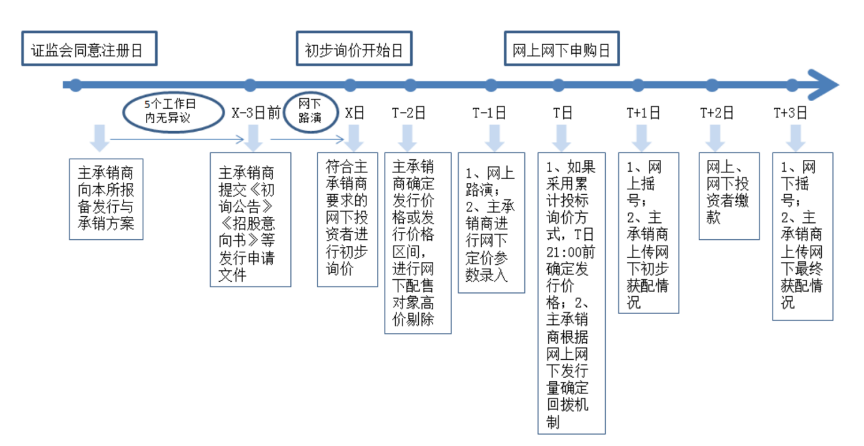
Stock issuance application, preparation, and process flowchart
First, market-oriented issuance and underwriting mechanism.
STAR Market initial public offerings use inquiry-based pricing with offline investors to determine the stock issuance price. Pricing may be determined through preliminary inquiry, or through a preliminary inquiry to establish a price range followed by cumulative bidding inquiry to determine the final price. The STAR Market's average issuance price-to-earnings ratio far exceeds 23x.
According to the "Shanghai Stock Exchange STAR Market Stock Issuance and Underwriting Implementation Measures," initial public offerings may allocate shares to strategic investors.
For initial public offerings of more than 100 million shares, the total shares allocated to strategic investors in principle shall not exceed 30% of the total public offering; for offerings below 100 million shares, the total shares allocated to strategic investors shall not exceed 20% of the total public offering.
The issuer's senior management and core employees may establish special asset management plans to participate in strategic allocation for the current offering. The shares allocated to such special asset management plans shall not exceed 10% of the initial public offering shares, and must commit to a holding period of no less than 12 months for the allocated shares.
According to the "STAR Market Issuance and Underwriting Business Guidelines," the STAR Market implements a sponsor-related subsidiary follow-on investment system. Relevant subsidiaries established by the issuer's sponsor institution in accordance with law, or other relevant subsidiaries established by the securities company that actually controls the sponsor institution in accordance with law, participate in strategic allocation for the current offering, subscribing to 2% to 5% of the issuer's initial public offering shares at the issuance price. The sponsor-related subsidiary participating in the allocation must commit to a holding period of 24 months from the date of the issuer's initial public offering and listing.
Second, stock reduction.
According to the "Company Law," shares issued before the company's public offering may not be transferred within one year from the date the company's stock is listed and traded on the stock exchange.
According to the "Shanghai Stock Exchange STAR Market Stock Listing Rules," a listed company's controlling shareholders and actual controllers may not transfer or entrust others to manage their directly or indirectly held pre-IPO shares within 36 months from the date of the company's stock listing, nor propose that the listed company repurchase such shares; core technical personnel may not transfer the company's pre-IPO shares within 12 months from the date of the company's stock listing and within 6 months after leaving the company, and within 4 years from the date when the lock-up period for their pre-IPO shares expires, the annual transfer of pre-IPO shares shall not exceed 25% of the total pre-IPO shares held at the time of listing, with reduction ratios that can be accumulated. If the company is not profitable at the time of listing, before the company achieves profitability, controlling shareholders and actual controllers may not reduce pre-IPO shares within 3 full fiscal years from the date of the company's stock listing; in the 4th and 5th full fiscal years from the date of the company's stock listing, the annual reduction of pre-IPO shares shall not exceed 2% of the total company shares, and must comply with relevant provisions on share reduction in the "Shanghai Stock Exchange Implementation Rules for Share Reduction by Listed Company Shareholders, Directors, Supervisors, and Senior Management Personnel."
If the company is not profitable at the time of listing, before the company achieves profitability, directors, supervisors, senior management personnel, and core technical personnel may not reduce pre-IPO shares within 3 full fiscal years from the date of the company's stock listing; those leaving during the aforementioned period must continue to comply with this provision.
According to the "Shanghai Stock Exchange STAR Market Listed Company Shareholders' Implementation Rules for Share Reduction Through Inquiry Transfer and Allocation to Specific Institutional Investors," shareholders may reduce their holdings of pre-IPO shares of STAR Market companies through inquiry transfer or allocation methods.
The minimum transfer price stated in the inquiry transfer subscription invitation letter may not be lower than 70% of the average trading price of the STAR Market company's stock in the 20 trading days prior to sending the subscription invitation letter. The allocation price is determined through consultation among shareholders participating in the allocation, but may not be lower than 70% of the average trading price of the STAR Market company's stock in the 20 trading days prior to the first announcement of the allocation; shares allocated in the same allocation must be at the same price.
The STAR Market has added inquiry transfer and shareholder allocation reduction methods, with pricing flexibility allowing a 30% discount. This not only enriches reduction methods but also provides more pricing flexibility for reductions, benefiting PE and VC investment institutions.
Third, equity incentives.
The total scale of post-listing equity incentives has increased, the scope of incentive recipients has expanded, and equity incentive pricing has become more flexible. According to the "STAR Market Listed Companies Continuous Supervision Measures (Trial)," the total number of underlying shares involved in all equity incentive plans within their validity period for STAR Market companies shall not exceed 20% of the company's total share capital. Shareholders or actual controllers individually or collectively holding more than 5% of STAR Market company shares, and their spouses, parents, and children, serving as directors, senior management personnel, core technical personnel, or core business personnel, may become incentive recipients.
Issuers are permitted to file with unexercised options. According to the "Shanghai Stock Exchange STAR Market Stock Issuance and Listing Review Q&A," if an issuer has established an option incentive plan before initial filing to be implemented after listing, the exercise price of options is determined through negotiation among shareholders, but in principle should not be lower than the most recent year's audited net asset value or valuation. The total number of shares corresponding to all option incentive plans within their validity period in principle shall not exceed 15% of total pre-listing share capital, and no reserved rights may be set. During the review period, the issuer may not add new option incentive plans, and relevant incentive recipients may not exercise options.
STAR Market Listing Case Study
Hillstone Networks was a STAR Market IPO in September 2019. Hillstone Networks belongs to the network security industry, with firewalls as its main product. In the year before listing, 2018 revenue was RMB 562 million with net profit of RMB 68.91 million. From industry, business, and scale perspectives, it was a relatively typical STAR Market company.
Timeline-wise, Hillstone Networks began IPO preparation in the first half of 2017, with CICC leading lawyers, accountants, and other intermediaries in comprehensive due diligence and developing restructuring plans; by end of 2017, intermediaries assisted Hillstone Networks in terminating VIE agreements and completing VIE entity acquisitions; in November 2018, Hillstone Networks completed equity structure adjustment and Pre-IPO financing; in December 2018, the company completed shareholding reform and obtained its joint-stock company business license; on April 2, 2019, the company formally submitted complete STAR Market application materials to the Shanghai Stock Exchange; after multiple rounds of inquiry, on July 30, 2019, it passed the Shanghai Stock Exchange Listing Committee hearing; on September 3, 2019, it completed CSRC registration; and on September 30, 2019, it was formally listed.
During the review process, regulatory review focused mainly on issuer actual controller determination, cleanup of overseas options, repurchase and partial transfer to domestic, equity structure adjustments involved in red-chip dismantling, and financial matters under channel sales models.
ChiNext Reform Enhances Capital Market Inclusiveness Toward Innovative Enterprises
On April 27, 2020, the CSRC released draft regulations for ChiNext reform with pilot registration-based IPOs for public comment, signaling the imminent implementation of ChiNext registration-based reform. Post-reform, ChiNext is positioned to deeply implement the innovation-driven development strategy, adapt to the trend of greater reliance on innovation, creation, and ingenuity, primarily serve growth-oriented innovative and entrepreneurial enterprises, and support the deep integration of traditional industries with new technologies, new industries, new business forms, and new models. Based on board positioning and characteristics of innovative and entrepreneurial enterprises, ChiNext IPO conditions have been optimized with more diverse and inclusive listing conditions. Qualified enterprises with special equity structures and red-chip enterprises are permitted to list on ChiNext, with space reserved for unprofitable enterprises to list.
Regarding pilot registration-based arrangements, following the STAR Market approach, the review and registration process is divided into two interconnected segments — exchange review and CSRC registration — while maintaining standards, transparency, and public oversight with strict quality control. The CSRC supervises the Shenzhen Stock Exchange's review work.
This reform improves ChiNext's market infrastructure:
First, building a market-oriented issuance and underwriting system, with no administrative restrictions on new share issuance pricing, and establishing inquiry, pricing, and allocation mechanisms with institutional investors as the main participants.
Second, improving ChiNext trading mechanisms, relaxing price fluctuation limits, optimizing securities lending and borrowing mechanisms, and intraday temporary trading halt systems. Third, building a continuous supervision rule system aligned with ChiNext listed company characteristics, establishing strict information disclosure rules and rigorous enforcement, improving the relevance and effectiveness of information disclosure. Fourth, improving the delisting system, simplifying delisting procedures, and optimizing delisting standards. Improving the ChiNext company delisting risk warning system. The CSRC will advance ChiNext reform and STAR Market development in a coordinated manner according to the principles of differentiated development and moderate competition.
According to the "Shenzhen Stock Exchange ChiNext Stock Listing Rules," for domestic enterprises without weighted voting right arrangements, market cap and financial indicators must meet at least one of the following standards:
First standard: net profits positive for the most recent two years, with cumulative net profit of no less than RMB 50 million.
Second standard: expected market cap of no less than RMB 1 billion, net profit positive in the most recent year with operating revenue of no less than RMB 100 million.
Third standard: expected market cap of no less than RMB 5 billion, and operating revenue in the most recent year of no less than RMB 300 million.
For red-chip enterprises applying to list on ChiNext, compared to the STAR Market, there is an additional requirement for positive net profit in the most recent year. Additionally, ChiNext has made relatively quantified provisions for "rapidly growing operating revenue" in standards for unlisted red-chip companies. Rapidly growing operating revenue must meet one of the following three standards:
-
For operating revenue in the most recent year of no less than RMB 500 million, compound growth rate of operating revenue over the most recent three years above 10%;
-
For operating revenue in the most recent year below RMB 500 million, compound growth rate of operating revenue over the most recent three years above 20%;
-
For industries affected by cyclical fluctuations and other factors where the industry as a whole is in a downward cycle, the issuer's compound growth rate of operating revenue over the most recent three years is higher than the average growth level of comparable companies in the same industry during the same period. Red-chip enterprises in the R&D stage and red-chip enterprises of significant importance to the national innovation-driven development strategy are not subject to the above "rapidly growing operating revenue" provision.
For issuers with weighted voting right arrangements applying for initial public offering of stocks or depository receipts and listing on ChiNext, compared to the STAR Market, ChiNext has an additional requirement for positive net profit in the most recent year.
Additional coverage was provided regarding the ChiNext negative list, listed company refinancing system, trading mechanisms, and existing share reduction.
Speaker Two: Zhong Jin, Managing Director and Head of TMT Investment Banking, CICC
A-Share Market Highly Attractive
A-share policy dividends far exceed market expectations. In terms of time efficiency and openness, a large number of companies will choose domestic listings in the next three to five years, including many already listed overseas.
In the near term, US investors have become more cautious about Chinese enterprises, SEC scrutiny has tightened, and internal procedures at intermediaries have been strengthened. From an investment perspective, companies with direct investment value have not been significantly affected so far. Overall, US investors prefer larger companies to list, so-called larger meaning valuations above $1 billion. If a company's valuation is too small, investors will be wary of potential liquidity risks.
Currently, Hong Kong investors' acceptance of new models and the new economy has improved significantly. Compared to before, Hong Kong investors' acceptance of listed companies and listed company valuations have become more aggressive. However, overseas markets have timing window issues; if black swan events occur in the market, the impact on the entire overseas market can be severe, and after missing the timing window, reassessment based on market conditions is needed.
Overall, major global capital markets are actively competing for quality Chinese companies. After A-share registration-based reform, valuations and liquidity still maintain certain advantages, while review times are gradually approaching those of overseas capital markets, so currently the A-share market is more attractive to new economy companies.

[Comment to Interact] We welcome your thoughts and exchanges with us on startups' path to listing. The top 5 most-liked comments will receive a copy of Civilization, Modernization, Value Investing, and China from Code Brain.
"About Code Brain"
Code Brain is a key component of Source Code Capital's systematic, productized post-investment service system, and a star post-investment service product that Source Code Capital has developed to fully serve Ma Hui entrepreneurs' cognitive upgrading. At each stage, we deeply understand and continuously explore entrepreneurs' needs, iterating Code Brain at any time, so that entrepreneurs at different stages receive continuous nutritional input, achieving the important goal of post-investment services that "truly help," and creating unique value for entrepreneurs.