MaHui Member AI-Native Community Nie Ta Raises Over $10M in Pre-A+ Round, Existing Investor Source Code Capital Continues to Increase Stake

Everyone gets to make their own "Disney"

Building IP universes used to be the exclusive privilege of The Walt Disney Company and Nintendo. Nie Ta is turning it into an individual capability.
Recently, MaHui member and AI-native community "Nie Ta" announced the completion of a Pre-A+ funding round exceeding $10 million, led by Jiukun Venture Capital, with Baidu Venture following on, and existing shareholders Source Code Capital and MiraclePlus making additional investments beyond their pro-rata rights. Source Code Capital led Nie Ta's angel round.
This round of funding will be directed toward three priorities: recruiting top talent for global expansion, technology R&D investment, and new product line development. Nie Ta is rolling out an upgraded creation tool for global audiences, targeting communities ranging from Comic-Con to AO3. The company is currently focused on hiring product designers and cultural strategists with a global perspective. The demand for fictional worlds is universal — from Japanese ACG culture to Western fantasy, virtual world creation has attracted large numbers of young, native, and passionate creators across the globe. Nie Ta founder Xiuhann Hu stated: "Building a Disney-caliber virtual world used to take decades and billions of dollars. What we're proving is that when AI lowers the creative barrier far enough, anyone with imagination can build their own theme park — and AI characters will actively live, perform, and build within it. Together with creators, we're defining the standard for this. This form of expression naturally transcends cultural boundaries, and we're bringing it global while looking for people who truly understand world-building and want to help define the rules."
01
Nie Ta: From "Creating Characters" to "Building Worlds"
Launched in March 2024, Nie Ta began as a platform focused on AI character creation. Users could create virtual characters through natural language, then produce images, comics, short films, and interactive experiences around them.
Founder Xiuhann Hu graduated from Peking University and Columbia University, and previously led technical architecture for short-form video content distribution platforms at Meta. Team members hail from companies including ByteDance, Bilibili, and X.D. Network's TapTap, bringing deep expertise in AI multimodal technology, product growth, and global community operations.
Currently, the platform has accumulated over 12 million users, with active users spending more than 110 minutes per day on average. Creators on the platform have constructed 5.84 million virtual characters and launched 400+ virtual worlds and community spaces encompassing scenes and rules. On the commercial front, Nie Ta's domestic revenue already covers customer acquisition and compute costs, achieving positive unit economics.
As AI technology iterates, user bases grow, and gameplay deepens, themes have expanded to include traditional cultures such as Dunhuang and intangible cultural heritage. With tens of thousands of users participating in unified-style creation within the same world setting, the Nie Ta platform is evolving from "creating characters" to "building worlds."
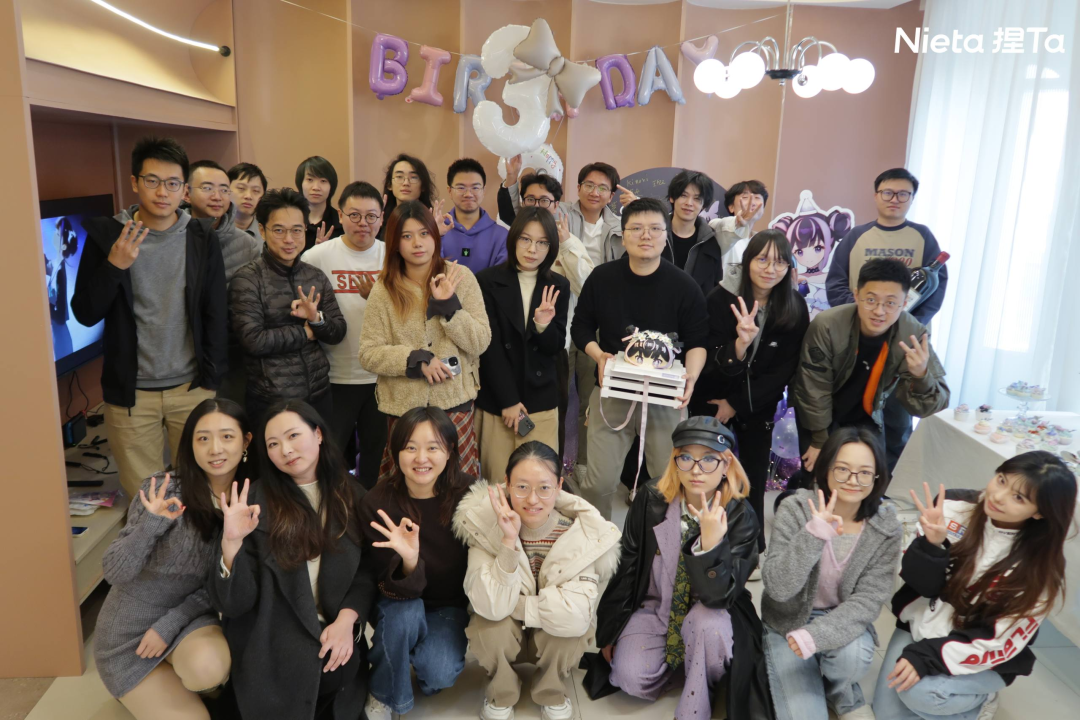
Nie Ta team photo
02
Defining the Underlying "World Expression Protocol Layer"
The creation of "worlds" can be divided into three stages.
Stage One: The PGC Era. Represented by The Walt Disney Company and Marvel, building a universe spanning characters, settings, rules, stories, and social dimensions required tens of millions to hundreds of millions in costs, teams of thousands, and timelines exceeding a decade. Stage Two: The UGC Era. Represented by Minecraft and Roblox, the right to build worlds was delegated to users, but tools remained relatively primitive, lacking character depth, narrative rules, and visual quality. This proved that the desire for "everyone to build worlds" was real, but supply-side capabilities couldn't keep up. Stage Three: The AI Era. Represented by Nie Ta, AI further lowers the barrier to world creation, fundamentally restructuring the complete cost structure. AI enables an ordinary person with creative desire to achieve full world expression through the presentation layer (characters, objects, visuals) and the rules layer (interactions, gameplay). Compared to the Disney and Marvel era, the cost of "world-building" is now one ten-thousandth of what it was. As model capabilities mature and users' creative skills improve, AI-era world creation will redefine content consumption experiences and build entirely new business models and technical advantages. Nie Ta's technical capabilities have expanded from image and text generation to interactive gameplay and video creation. The platform supports natural language generation of virtual characters, multi-character interactive comics, and video content creation. Its open-source Neta series models topped the Hugging Face text-to-image model leaderboard in 2025, drawing attention from the global developer community.
Unlike most AI applications that rely on single-model capabilities, Nie Ta has built a "world expression protocol layer" on top of models, defining asset standards and interaction rules for characters, objects, and scenes within virtual worlds.
This means that regardless of how underlying models evolve — from image-text generation to video models, and eventually to world models — the world assets and creator ecosystem accumulated on the platform will continue to strengthen rather than becoming obsolete with technological generations.
The platform continuously integrates the latest model capabilities and is building the first application scenario for sustainable real-time dynamically interactive world models, creating core gameplay and virtual world infrastructure that enables multi-user participatory co-creation.
A Source Code Capital investor commented: "What's impressive about Nie Ta isn't just their accurate and far-sighted grasp of models and technology direction — it's that they truly understand 'world expression' and have precisely captured the needs of young global users and communities. At a time when AI multimodal interaction has become the prevailing trend, the community they're building is inherently suited to continuously spawning AI-native creators. Turning creation from the privilege of a select few into a capability accessible to everyone — we're very much looking forward to bringing great experiences to more users."