Code View | Yungang Huang: How Does AI4S Land in Different Stages, Industries, and Markets?

#MaGuan
Source Code Capital invests in technology-driven innovation,
and in the creation of lasting, real value.
The 2022 Zhongguancun Forum series event — "AI for Science: Co-creating the Future" Scientific Intelligence Summit was recently held. Source Code Capital joined with several MaHui members, industry entrepreneurs, and Source Code Capital investors to discuss the opportunities and challenges of AI4S industrialization. For this entirely new paradigm and concept, what do industrial customers need? How do investors view it? How should entrepreneurs approach it? What difficulties will practitioners in the field face? Below is the sharing from Yungang Huang, Partner at Source Code Capital.
Partner, Source Code Capital | Yungang Huang
The following is the full text of Yungang Huang's speech:
Why is AI4S so important?
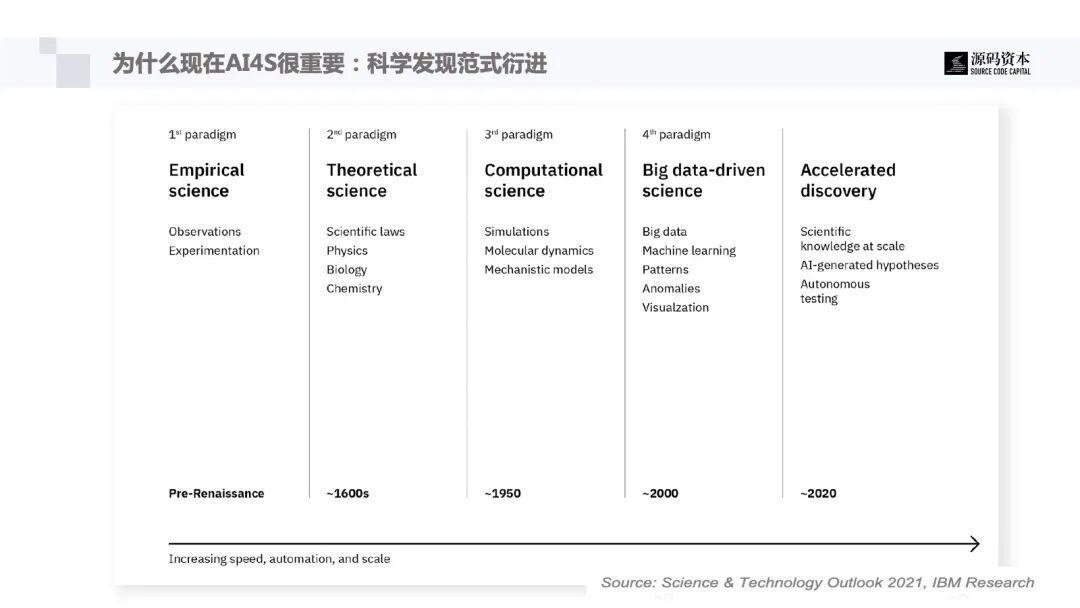
Image source: IBM Research
AI4S matters because it represents the evolution of scientific paradigms — from the fourth paradigm to the fifth paradigm, where AI will play a crucial role. This image is from an IBM Research report. You're likely familiar with these paradigm shifts, from pure theoretical scientific research to computer science, then to big data-driven approaches, and now to AI-driven deep learning and machine learning. The bottlenecks that the fourth paradigm encounters in micro-scale domains can be transformed through AI, empowering science to achieve broad practical application.
AI is the catalyst for converting science into business. From a commercial perspective, we've seen substantial business applications of AI in various scenarios. For example, the rapid development of e-commerce over the past decade — precise recommendation mechanisms for products, information, and content — all leverage AI technology. Additionally, in intelligent decision-making, facial recognition, and security, AI solves problems across multiple dimensions. In this space, many outstanding companies have emerged over the years, including MaHui member ByteDance. From a scientific perspective, we believe AI for Science can accelerate scientific discovery, thereby driving commercial conversion. For example, MaHui member DeepWise is dedicated to developing AI4S tools to drive the commercial transformation of scientific research, thereby generating tremendous value.
How does AI4S land in practice?
AI4S implementation mainly involves different types, industries, and target markets.
By type, there are three main categories. First, services for scientific research — directly providing interdisciplinary, cross-functional tools and arsenals for research. By supplying software, computing power, and other resources to researchers, cross-disciplinary integration enables more scientific problems to be solved. Companies in this space include Schrodinger (NASDAQ: SDGR) and DeepMind.
Second, R&D commercial services for B2B. AI4S can play an enormous role in commercial R&D services for enterprise clients, for example by directly providing services in drug discovery or becoming commercial service providers for B2B. Among MaHui members, Foreseen Biotech and Chemical.AI exemplify this: Foreseen Biotech helps pharmaceutical companies identify better targets for drug screening, while Chemical.AI uses AI to accelerate chemical synthesis.
Third, direct innovation of products, such as drugs and materials. With powerful tools, it becomes possible to directly develop new materials and new drug pipelines in the biomedical field. For example, Relay is a precision medicine company at the clinical stage that integrates tools and pipelines. In other industries — new materials, new energy, semiconductors, and more — there will also be massive applications.
From a market perspective, AI4S represents a new global scientific research paradigm, needed by both China and the world. Chinese entrepreneurs can start with China's industrial chain and gradually develop global capabilities to support worldwide technological innovation.
Rooted in China's industrial chain, positioned for global technological innovation
Global investment in scientific research continues to grow, and there remains enormous room for improving research efficiency. Looking at drug R&D costs and timelines, for instance, the trend is toward greater difficulty, higher expense, and longer timelines — the efficiency of industrial conversion urgently needs improvement.
The chart below shows patent data for leading countries in pharmaceuticals and related fields. While China's overall position is solid and growth has been rapid in recent years, there remains a gap in core patents compared to countries like the United States and Switzerland. The bottlenecks in China's biomedical research fields are still quite pronounced, creating substantial demand for AI4S.
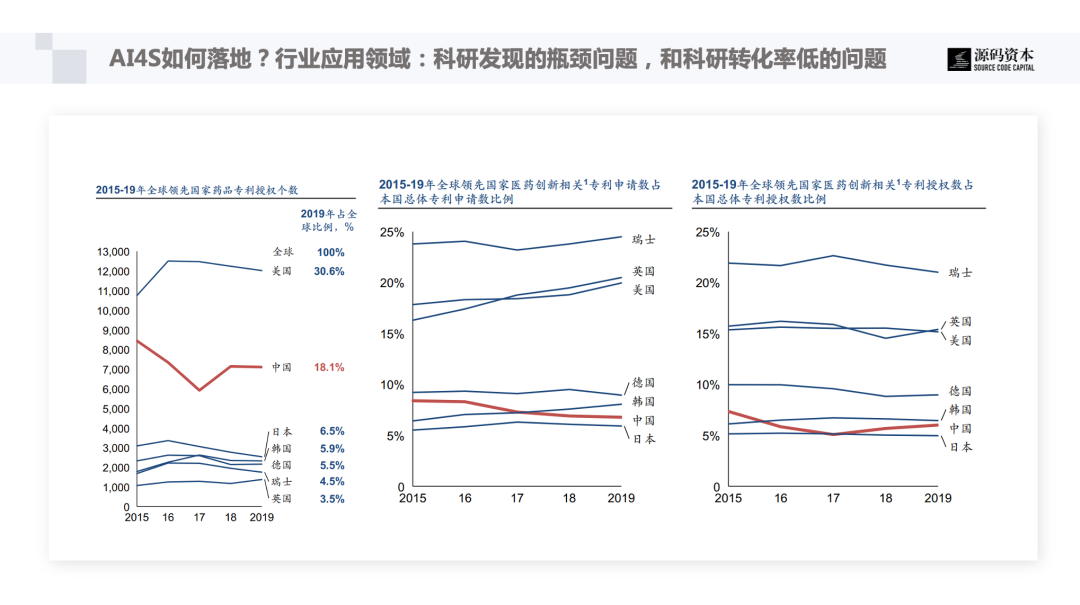
Image source: Source Code Research
China needs more innovation from zero to one, and better tools to accelerate that innovation. Being rooted in China's industrial chain while influencing and positioning for global technological innovation — this is what competitive products in the new paradigm require.
Venture capital and AI4S integration
How should we view the role of venture capital in AI4S and commercialization as a whole? For Source Code, when we invest in biomedicine, we particularly focus on interdisciplinary intersections. We've found that an increasing number of entrepreneurial projects emerge from multidisciplinary crossovers — multiple functions, multiple domains, multiple industries converging.
The more interdisciplinary and integrative a field is, the less likely it is to spawn entrepreneurial projects confined to a single knowledge domain or research area, and the greater the challenge of commercial conversion. The key lies in the fusion of scientists and entrepreneurs during commercialization — how they learn from each other, respect each other, and achieve win-win cooperation.
We believe there are three main models for scientist-entrepreneur integration: First, the scientist transforms into an entrepreneur and business leader, taking full responsibility from research to corporate strategy to company operations. Second, the entrepreneur brings together scientists, who in turn integrate various research functions, building the company from there. Third, scientists and entrepreneurs each focus on their strengths — scientists handle research, entrepreneurs manage business operations. Regardless of the model, the end result is thorough integration.
As a venture capital institution, one of our responsibilities is to smooth the path from AI for Science to AI for Business. Through investment and research, VC firms have accumulated extensive experience and case studies in converting research to commerce, including how a company built on disruptive technological innovation moves from technology to productization, from productization to market competition, to finding a second growth curve, and how to develop organizational capabilities and identify the right strategy along the way. We've also helped many scientists convert research achievements through systematic entrepreneurial services.
As more large companies emerge in the industry, they will in turn reinvest in scientific research. Industrial capital and venture capital institutions will jointly empower research investment, forming a closed-loop flywheel that takes the AI4S paradigm from research to commercial conversion to ultimately successful business and services; when this flywheel spins, it creates a virtuous cycle from industry, academia, and research through to commercialization.
Source Code Capital has committed to being entrepreneurs' partners, systematically empowering entrepreneurs and scientists to together create excellent products that generate tremendous value for humanity. Our entrepreneurial service is "Full Code Power for You," representing wholehearted service to startups and research conversion, creating lasting, real value.


- MaGuan | Yungang Huang, Source Code Capital: "Cross-disciplinary Integration" Driving Innovation in Healthcare
- MaGuan | Source Code Capital: The Most Needed Capability for Investing in Carbon Neutrality is Multi-level Cognition
- MaGuan | Source Code Capital Wu Fan: Opportunities and Advantages of China's New Energy in a New Cycle
- MaGuan | "Carbon Neutrality" Technological Innovation in Sustainable Development
- MaGuan | Is 41 the Optimal Age for Innovation?
- MaGuan | Source Code Capital: Focusing on Energy Cleanization and End-use Electrification
- MaGuan | Yungang Huang, Source Code Capital: Maintaining a Long-term, Stable Pace of Tech Investment Through Peaks and Valleys
- MaGuan | Source Code Capital: Technological Change Reshapes Moats, Tech Entrepreneurship Breaks Boundaries
- MaGuan | Xingchen Zhang, Source Code Capital: Technology-driven Innovation from Zero to One
Click "Read Original" to view more MaHui members