MaHui Portfolio | AI Metal New Materials R&D Firm DeepMaterial Closes A+ Round Led by Existing Investor Source Code Capital

Source Code Capital was an angel and Pre-A round investor in J&T Global Express, and led this round.


MaHui member DeepMaterial, a leading AI for Science company in metallic materials, recently announced the completion of a nearly RMB 100 million Series A+ funding round. The round was co-led by existing investor Source Code Capital and new investor Jolmo Investment Management Co.,Ltd., with participation from Yichen Capital and others.
Source Code Capital was the company's angel and Pre-A round investor; its continued investment in this round marks its third investment in DeepMaterial.
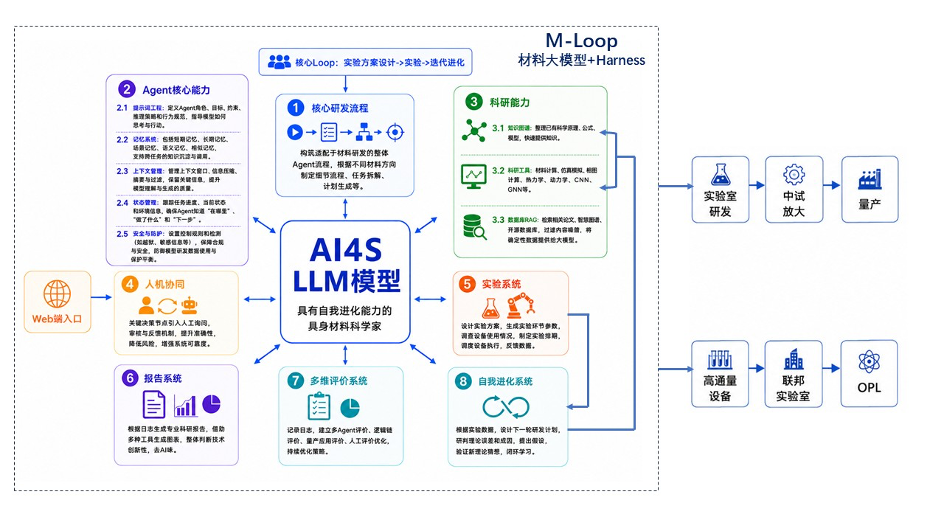
The company has already built the industry's first complete closed-loop system for AI-driven materials R&D, releasing nearly 20 new high-performance materials, several of which have already reached mass production. The new funding will primarily support continued R&D of its core intelligent system M-Loop, replication and scaling of its automated high-throughput experimental platform M-Lab, continued accumulation of high-quality materials datasets M-Data, construction of a distributed self-driving laboratory network OPL (One Person Lab), and recruitment of top interdisciplinary talent — extending its AI R&D capabilities to more materials domains and further expanding its industry-leading advantage.
1
AI4S Enters Deep Waters: Industrial Deployment Becomes the New Competitive Focus
Over the past few years, AI for Science has steadily gained momentum, but industry attention is shifting from "model capabilities" to "industrial deployment." Early markets prioritized computing power and single-point experimental efficiency; today the core question is whether technology can enter real industrial scenarios, shorten R&D cycles, reduce trial-and-error costs, and reliably advance lab results through process development, manufacturing, and delivery.
Behind this lies the rapid escalation of global AI4S competition — from model competition, to data competition, to experimentation competition, and now to "infrastructure competition." Models are becoming increasingly accessible, while real scientific data — particularly high-dimensional data encompassing experimental conditions, process parameters, failed results, and process feedback — is becoming a scarce resource. Future winners will be the infrastructure organizers capable of connecting data, models, experimental systems, computing power, and industrial demand.
Policy is also accelerating this transformation. The State Council's Opinions on Deepening Implementation of the "AI+" Initiative (Guofa [2025] No. 11) explicitly sets targets for AI4S application penetration rates of 70% by 2027 and over 90% by 2030. Beijing and Shanghai have successively issued dedicated AI4S implementation plans, elevating autonomous laboratories and scientific datasets to local strategic priorities. In the United States, the Department of Energy's "Genesis Mission" has committed $5 billion to connect 17 national laboratories, while the NSF-led NAIRR Pilot integrates computing power, datasets, and models into national research infrastructure.
Meanwhile, overseas tech giants are accelerating their positioning: Anthropic has launched Claude Science for research scenarios, and OpenAI continues to ramp up resource allocation toward scientific research. This reflects a global reassessment of next-generation research and advanced manufacturing capability foundations. With China and the United States simultaneously increasing investment, the competitive focus has shifted from technology validation to the construction of systematic infrastructure. Metallic materials — core foundational materials supporting human civilization for millennia — represent an industry exceeding $1 trillion in scale, directly determining the capability ceiling of strategic industries including aerospace, new energy, semiconductors, and high-end equipment. Compared to biopharma's lengthy validation cycles, metallic materials offer inherent advantages in faster validation, clear metrics, and complete industrial chains, making them the optimal direction for AI-empowered R&D deployment.
2
How Far From an Embodied, Self-Evolving AI Materials Scientist?
Propose a new material's performance requirements, and within days receive several experimentally validated formulations, alongside new theories and methods — this "wish-fulfillment" R&D represents the ultimate form of AI-driven materials development. To reach this goal requires building a self-evolving (RSI), physically-world-capable AI materials R&D intelligent system. This system rests on four foundational pillars: large models and agents, tool-class algorithms and specialized small models, automated high-throughput laboratory closed loops, and large-scale high-quality multimodal data adapted for AI training.
DeepMaterial has established significant technological leadership and industry moats across all four dimensions:
M-Cortex Large Model and Agent: As general-purpose large models continue advancing, DeepMaterial leverages its exclusive self-developed full-process multimodal experimental data to train materials-specific vertical large models, significantly enhancing causal reasoning, scientific thinking, and extrapolation/generalization capabilities — building agents truly suited for materials R&D. M-Cortex serves as the R&D process orchestration and intelligent scheduling hub. Based on literature review, company historical data, and R&D knowhow, the system automatically generates scientific hypotheses, candidate formulations, and R&D playbooks; collaborates with M-Science to complete scientific computing and candidate screening; schedules M-Lab to conduct real experiments; and continuously rewrites R&D strategies and memory based on experimental and delivery feedback.
M-Science Tool-Class Algorithms and Specialized Small Models: Materials-specific algorithms divide into small-scale and large-scale categories. Small-scale algorithms represented by DFT excel in fields like pharmaceuticals focused on molecular interactions, with long development histories, high technical maturity, and extensive open-source availability. However, when facing meso- to macro-scale interactions such as functional groups and metallographic structures, small-scale algorithms fail due to atomic scale limitations and chaotic effects. Large-scale algorithms then become essential for macroscopic materials R&D, and their deployment heavily depends on real experimental data. With industry-leading datasets in both scale and quality, DeepMaterial has achieved significant technical leadership in large-scale algorithms.
M-Lab Laboratory Closed Loop: The self-evolution of materials agents manifests not only in performance iteration but in continuous breakthroughs and accumulation in knowledge graphs, tool algorithms, and logical thinking. Thus, building automated high-throughput wet-dry closed-loop laboratories is crucial. DeepMaterial began forward-looking deployment in 2021, independently developing high-throughput equipment and establishing its automated laboratory M-Lab. Now in its 3.0 iteration, M-Lab has achieved full automation, high-throughput capability, and standardization — improving experimental data production efficiency by hundreds of times, reducing costs by tens of times. M-Lab's proprietary real-world data exceeds 400 dimensions, with individual raw data storage exceeding 10GB. With this substantial lead, M-Lab's integrated solutions have gained broad recognition and procurement from top domestic and international universities and research institutes. Going forward, the company will drive industry standard formulation and, through integration and upgrading, build a federated laboratory and OPL (one-person lab) for the metallic materials field, leading industry development.
M-Data AI-Adapted Materials Data: Industry-specific data represents the largest source of performance variation for intelligent agents. Traditional materials data is typically knowledge-type data: low feature dimensionality, poor consistency, scarce quantity, and high cost — unsuitable for AI training fitting or deep understanding. Leveraging M-Lab, DeepMaterial has built the industry's most AI-adapted materials dataset M-Data, currently exceeding 100,000 entries with unified format, rich dimensions, and coverage of complete experimental processes including failed results. Over the next two years, high-throughput laboratory total scale will expand fivefold, continuously amplifying technical leadership at the data level.
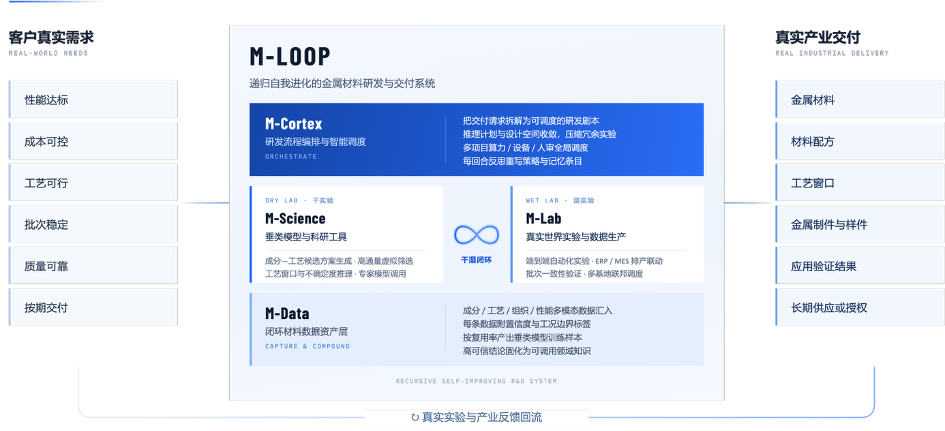
DeepMaterial takes an end-goal-oriented approach to AI4S, actively deploying full-chain technology with industry-leading capabilities and substantial moats at each critical link.
3
Deployment Progress: The Core Differentiator in AI4S Industry Competition
AI4S is in the early stages of mining a massive gold deposit; the real opportunity lies not merely in "selling shovels" but in using the best shovels to dig for gold oneself. Across the full chain from requirements definition, laboratory R&D, pilot scale-up, to mass production delivery, the value created by AI amplifies at each stage. DeepMaterial has pioneered complete打通 from "requirements input" to "actual delivery" — transforming customer material requirements into computable, verifiable, optimizable, and deliverable material and component results, forming a positive flywheel of "real experiments generate data → data drives system evolution → system evolution improves delivery certainty → delivery results feed back into next-round R&D."
The company has currently shortened materials R&D and testing validation cycles from 5–10 years to 2–3 months, reduced costs to 1/10, and released dozens of fully independent intellectual property new materials. All have been tested by CNAS-certified institutions and downstream customers, with performance far exceeding world-leading levels. The company is collaborating with industry leaders across sectors to advance deployment:
① With a global top 3C manufacturer, advancing deployment of anodizable aluminum alloy exterior components, ultra-high-strength/tough stainless steel connectors, and ultra-high-strength titanium alloy exterior components;
② With a domestic leading controlled nuclear fusion company, conducting R&D and testing of refractory high-entropy alloy first walls, low-activation steel blankets, and lithium-based tritium breeding materials;
③ With a global top golf brand, advancing deployment of ultra-high-strength/tough stainless steel striking faces, integrated titanium alloy shells, high-strength aluminum link connectors, and high-entropy alloy weight blocks;
④ With a leading commercial aerospace company, advancing deployment of high-temperature alloy engine nozzles and high-strength aluminum support structural components;
⑤ With a global leading tire mold company, advancing deployment of high-strength heat-resistant aluminum alloy inserts and high-strength mold steel materials;
⑥ With China's largest titanium ore mining company, developing technology for producing high-performance titanium alloy materials from multi-impurity low-grade raw ore;
⑦ With a leading quantum computing company, exploring next-generation AI4S core algorithms.
Delivery forms encompass material formulations, process windows, metal components and samples, application validation results, and long-term supply or licensing — multidimensionally validating the M-Loop system's versatility and reliability in real industrial scenarios.
4
Outlook: Freeing Humanity From Materials Constraints
Materials are the underlying code through which humanity transforms the world. For millennia, this creation has relied on trial-and-error and serendipity — a new material's journey from imagination to reality has typically meant traversing vast uncertainty. AI is changing this: it liberates materials discovery from uncertainty into a path that can be walked. People can touch it, test it, put it into products. This is not a tool upgrade but a transfer of creative power.
In the past, materials innovation belonged to a few institutions with massive resources. When "laboratory feasible" and "factory manufacturable" no longer stand separated by a chasm, when R&D, process, and supply chain are incorporated into a unified decision framework, materials innovation evolves from an experience-dependent mystique into an engineering discipline that can be systematically organized. Creative power is transferring from a handful of scientists and large institutions to every creator driven by real problems.
The performance boundaries of materials will no longer be drawn by historical experience but directly defined by present needs. Eventually, materials capability will become as plug-and-play as electricity — every creator trapped by a materials problem will be able to cross the chasm from imagination to reality, and touch that once-distant answer.
The following are excerpts from Hard Kr's interview with DeepMaterial founder Xuanze Wang:
Hard Kr: In your process of doing AI materials R&D, why was it essential to build your own high-throughput automated laboratory? What problem does data actually solve?
Xuanze Wang: Data is arguably the biggest bottleneck in AI for Science right now, and also one of the most critical problems to solve — it's also one of our core advantages.
We work on macroscopic materials: metals, ceramics, inorganic non-metals, polymers, and composites. For this type of materials R&D, you absolutely need real physical experimental data. Relying solely on simulation introduces significant errors.
Additionally, traditional experimental data has several problems. First, the dimensionality is low — typically only a dozen or so numbers, like composition and process mapping to properties. And what's recorded tends to be mostly successful data; failed data, because there's so much of it, is difficult to analyze and understand.
Second, data is hard to obtain because it's core intellectual property — companies typically won't provide it. Even if you get data, different companies use different equipment, so data consistency is poor. Change the equipment and the deviation can be quite large, which can actually pollute the entire data pool when used for AI training. Third, the cost is too high and production efficiency too low. A single data point might cost tens of thousands of RMB — completely unacceptable for AI.
So we started building our own laboratory and generating data in 2021. We've now iterated to version 3.0 and are working on 4.0. We can now achieve 720 dimensions per data point, with storage reaching 10GB — over 1GB after compression. The cost per data point has dropped to a few hundred RMB, and single experimental line data generation rate exceeds 1,000 entries per second. An important goal of this funding round is deploying 5–10 additional experimental lines to further expand our data advantage.
Hard Kr: Compared to other AI for Science companies, where does your core advantage lie?
Xuanze Wang: First, our team is very interdisciplinary. From day one, we established dedicated AI and materials teams. We've now developed nearly 20 new materials, all with independent intellectual property. For example, our ultra-high-strength aluminum has fatigue performance reaching more than twice the world-leading level, with other performance metrics also leading to varying degrees. Meanwhile, our cost is roughly 1/10 of foreign competitors and about 1/3 of domestic ones.
Additionally, we're more deployment-oriented. Most importantly, we've actually made the materials and are now mass-producing the new materials we've R&D'd. End customers are using our raw materials to make components — 3C components, golf components, commercial aerospace and robotics components — currently in testing phases. Once testing passes, many products people use in the future, like phones, may incorporate our materials.
Hard Kr: How do you view the current stage of the entire AI for Science industry? What's next for DeepMaterial?
Xuanze Wang: For AI for Science overall, I believe we're on the eve of an explosion. The next milestone is not far. The next industry consensus is materials developed with AI actually appearing in products around us — phones, computers, cars, various daily-use products — achieving true mass production.
At least from our progress, this point is very near. We've already pioneered completion of the entire R&D closed loop, from zero to delivery. Next is finding more real needs and larger application scenarios, then rapid replication.
Simultaneously, on the technology front, we're building an All in One service platform called M Loop (Material Loop). This platform aims to truly achieve All in One: from data production and algorithms, to materials R&D, testing and characterization, to scale-up, and even partial mass production — all within one platform. M Loop version 1.0 is planned for release by year-end.