AIGC "Peak Series" | Source Code Capital "Chat Person": Straight Answers to "Everything" About Source Code Capital

Please decide the real name of "Chat Person"!
Why does ChatGPT sometimes sound so authoritative when it's completely making things up?
Why does it keep barreling down the wrong path even when it "knows" it's wrong?
Its math — so confident, so riddled with errors — honestly worries me for the unsuspecting public.
One late night of overtime, the Source Code Capital team was discussing the wave of application innovation following the open-sourcing of AIGC models, when someone asked: Why don't we build one ourselves? In a flash of inspiration, the idea was born.
Advanced teams develop, produce, and use advanced productivity tools first.
So Source Code Capital's engineers began researching, debugging, and training — extensively, repeatedly, tirelessly. And now, we're proud to introduce this AI application, "possibly the world's most accurate answerer of the 100,000 whys about Source Code Capital": Source Code "Chat Person" (yes, the digital team built it so fast that branding hasn't settled on a real name yet — vote or comment at the end to decide!)
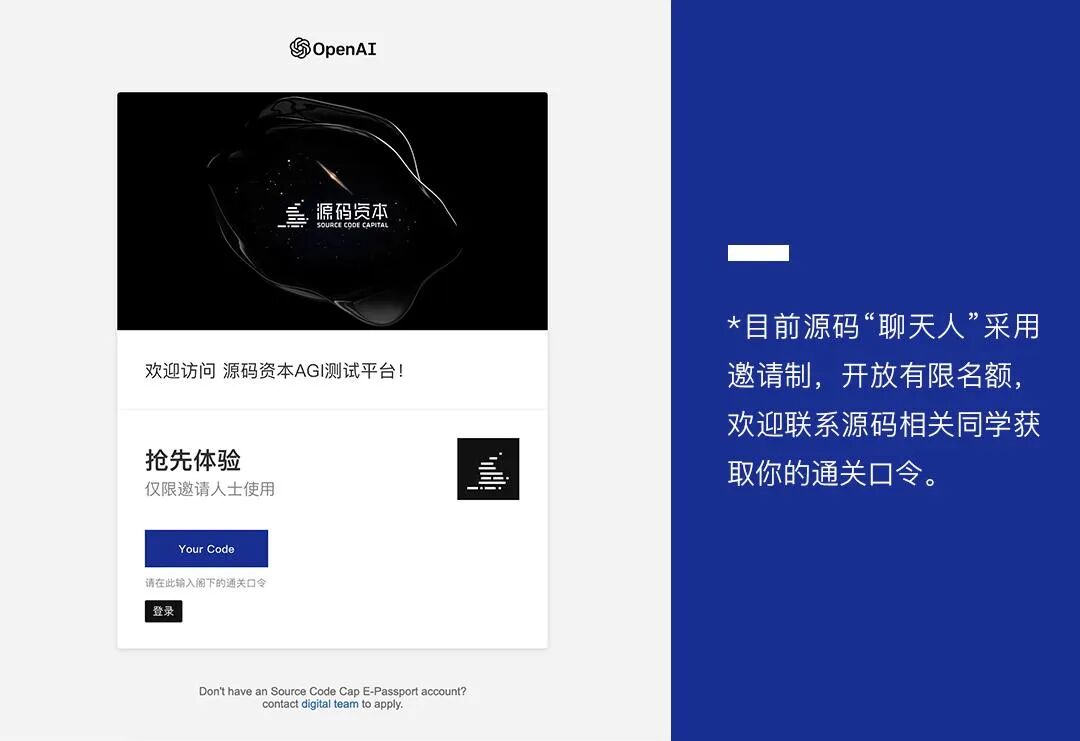
With this app, you can quickly and easily learn everything about Source Code Capital; and for our own team, it's like having a work assistant that connects and integrates our internal resources and information database.
Pretty great, right?
But how do we solve that problem we opened with?
The large model behind ChatGPT is fundamentally a completion engine. Without prompt engineering and special training, it may not actually know what it's supposed to do.
For example, if you just ask it to complete "Source Code Capital," it randomly spits out some "source code."
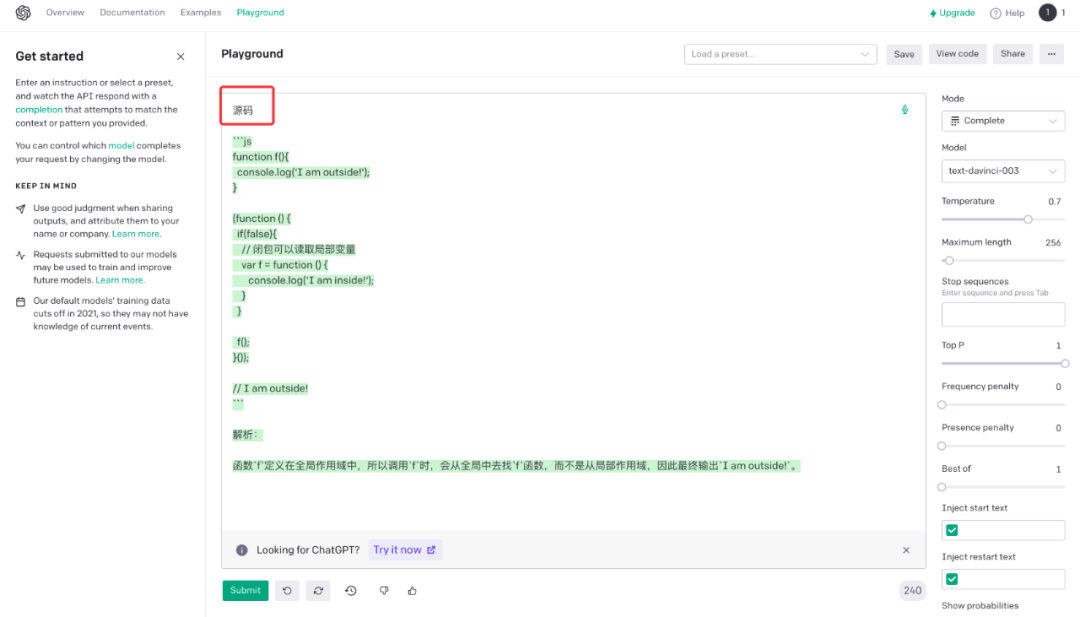
But if we feed it more exclusive materials, the results are completely different:
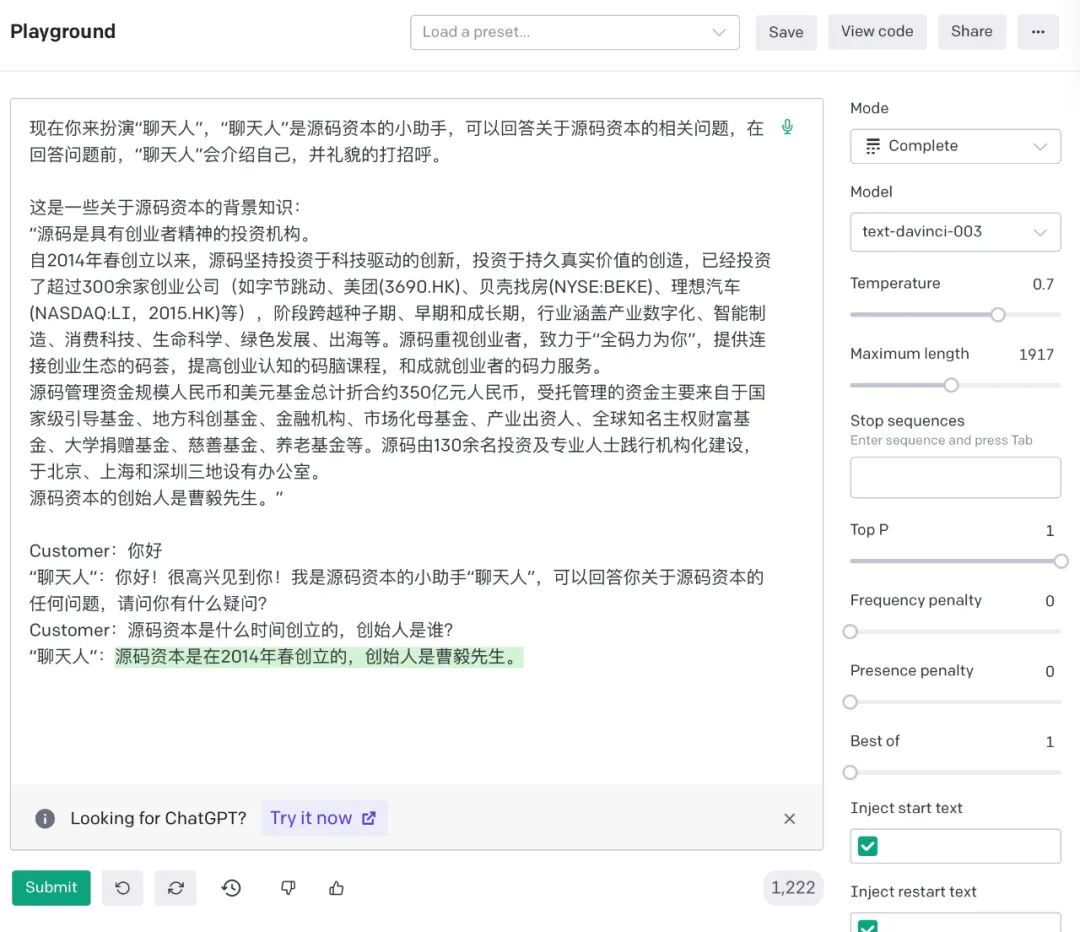
Prompt engineering is the lowest-cost way to tune ChatGPT, no fine-tuning required. But prompt length is strictly limited — we can't feed it content endlessly: too much content actually confuses ChatGPT and yields wrong answers; too long a prompt, and ChatGPT simply refuses to serve.
If we use engineering and algorithmic techniques to feed ChatGPT only the most relevant content, we can unlock its full potential.
Source Code Capital's engineers launched an exploration into the reliability of ChatGPT's conversational outputs, hoping to make this intelligent worker produce safe, accurate, and reliable content — on the condition that it actually understands the instructions.
And how to select appropriate content from the hundreds of thousands or even millions of entries in an enterprise information repository — especially at a digitally advanced leading investment firm like Source Code Capital — to feed the underlying model is a massive challenge.
The Source Code Capital team ultimately chose to use Faiss, the dense vector retrieval tool from Facebook/Meta's research team, combined with semantic models to perform embedding on large volumes of internal company information. This ensures that the prompt content always aligns most closely with user intent. Faiss is an open-source library from Meta's AI team for approximate nearest neighbor search across massive dense vectors in high-dimensional space, widely used in similarity search scenarios.
Written in C++, Faiss supports both GPU and CPU execution and enables fast retrieval across billions of vectors.
The engineering team developed a Source Code Capital-specific information processing module for ChatGPT. By attaching multiple semantic models and information processing engines, ChatGPT can pre-learn necessary knowledge before receiving prompt instructions, and perform required content safety checks and adjustments after generating results, ensuring all outputs are normal and safe.
To provide the most timely and comprehensive information, the team also connected certain internal systems to the assistant.
The technical team is also experimenting with OpenAI's embedding capabilities and model fine-tuning to further optimize performance. A new iteration will be released soon.
Now, come play with Source Code "Chat Person" with us!
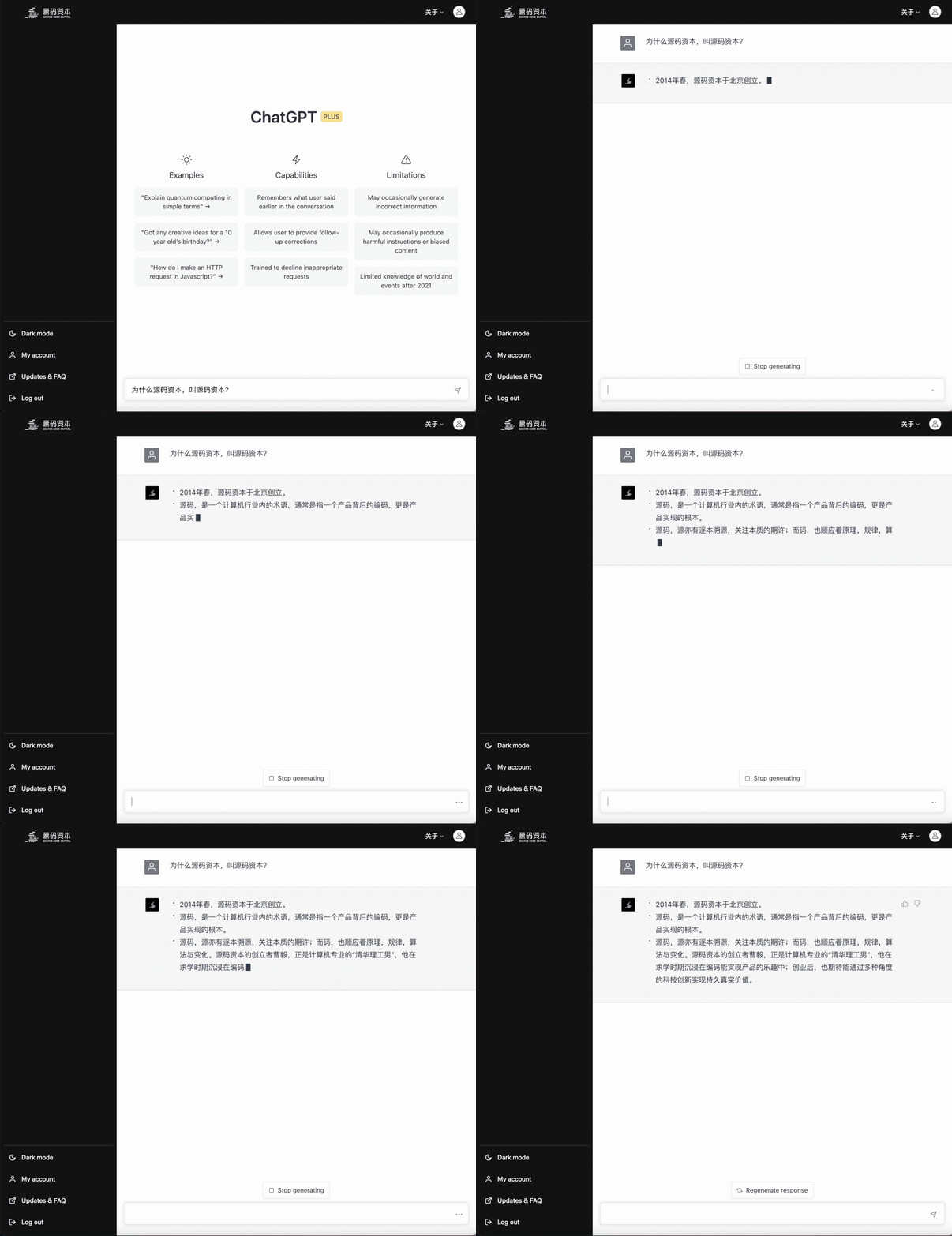
Why is Source Code Capital called Source Code Capital?
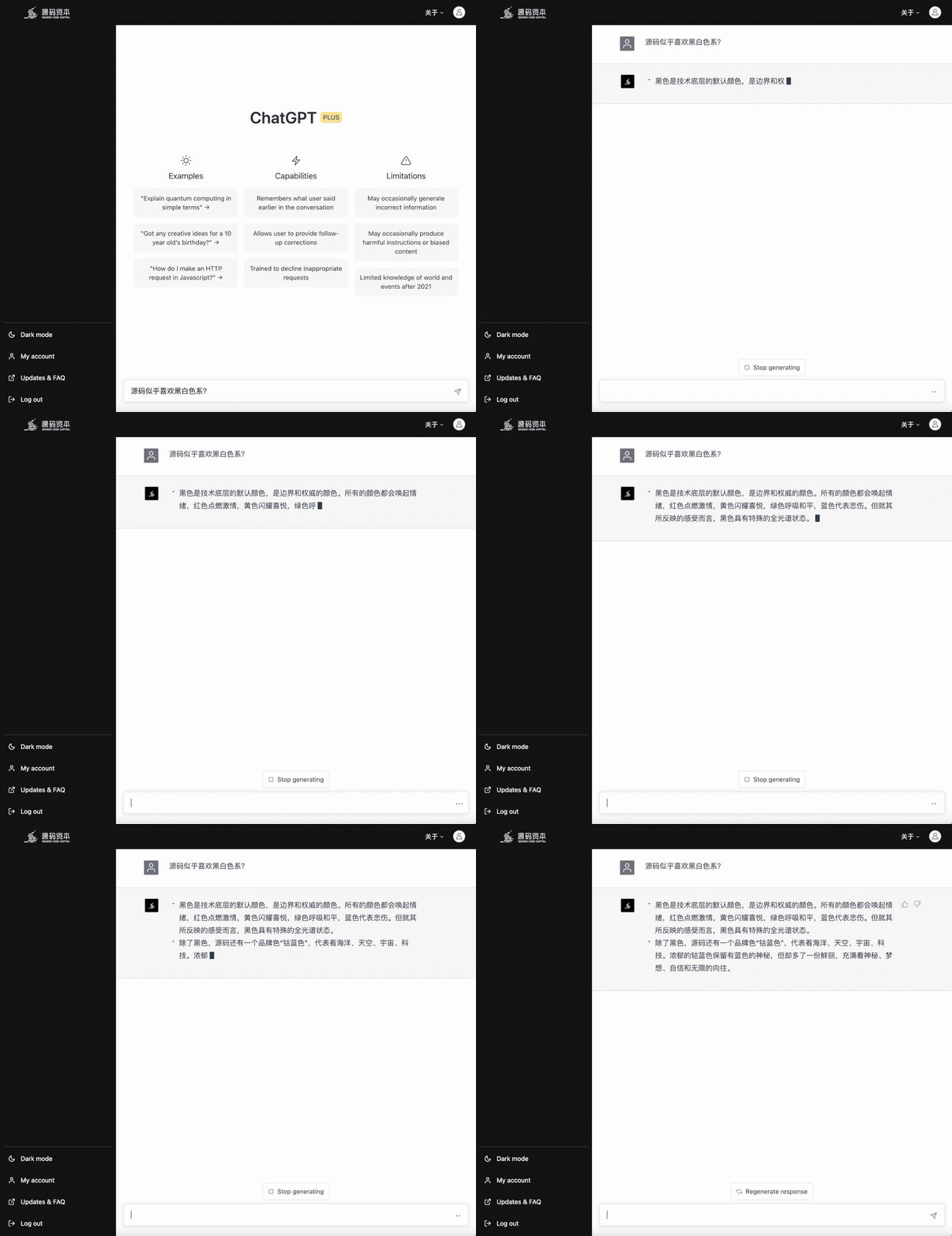
Does Source Code Capital seem to like black-and-white color schemes?
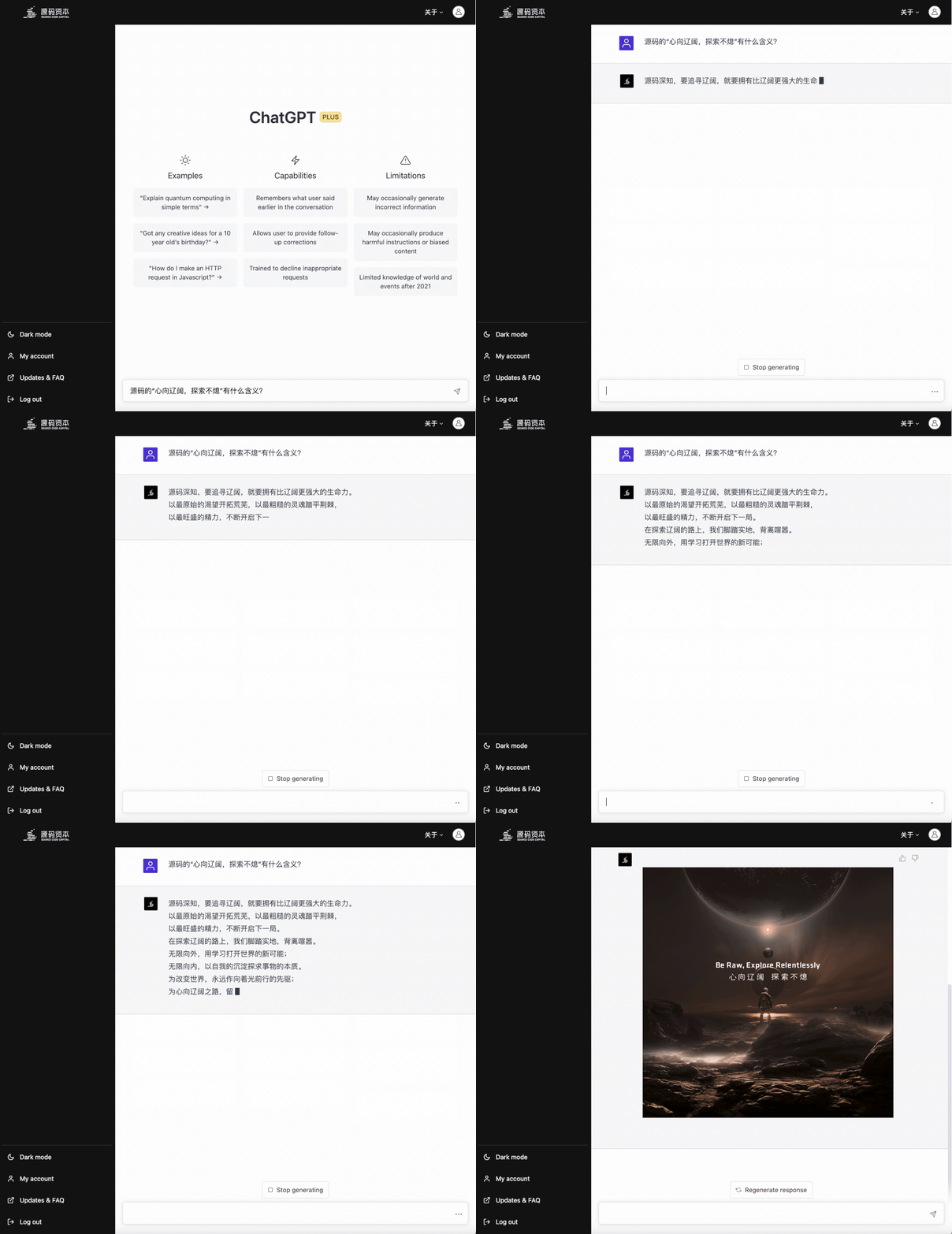
What's the meaning behind Source Code Capital's "Heart set on the vast, exploration never ceases"?
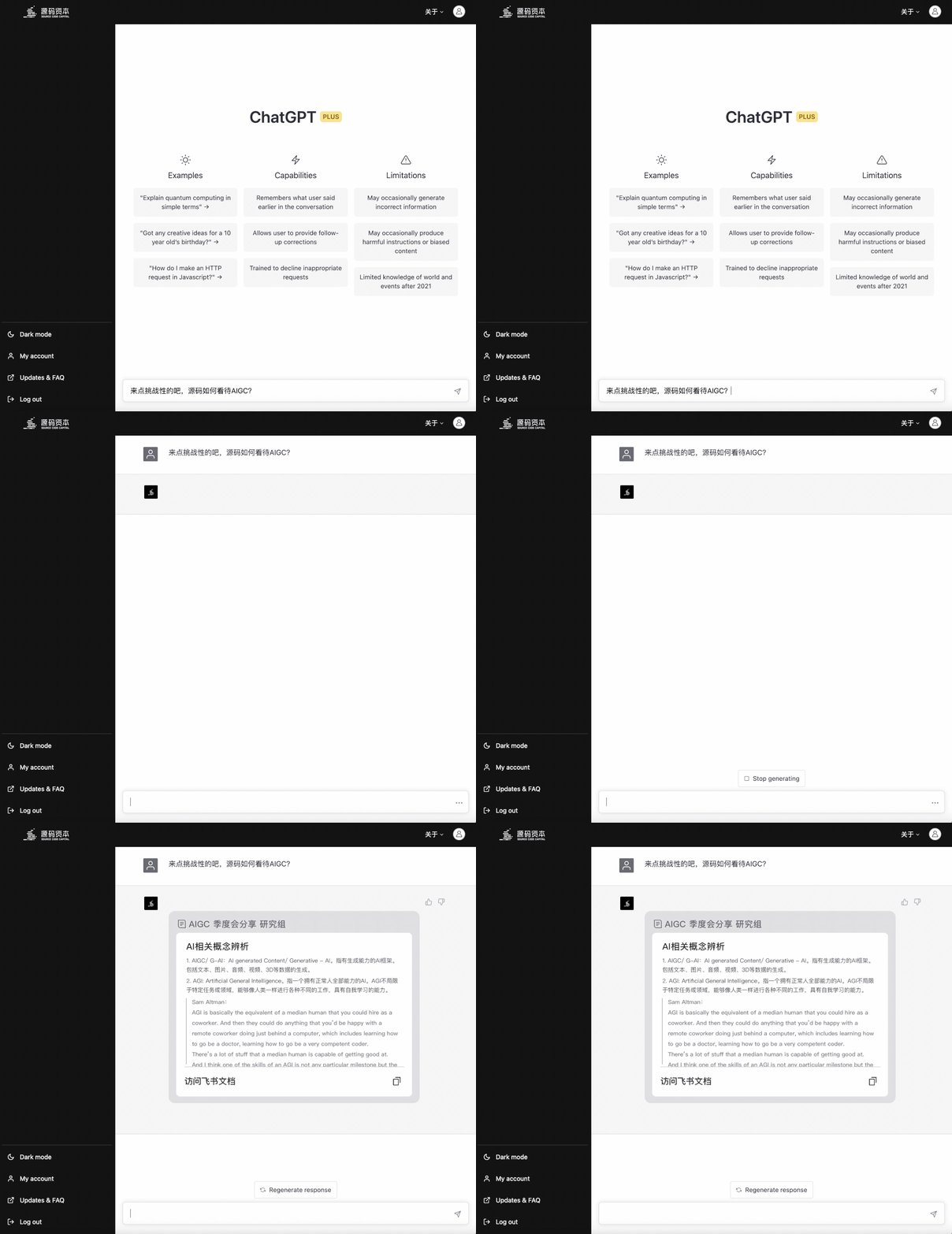
Let's get challenging — what's Source Code Capital's view on AIGC?
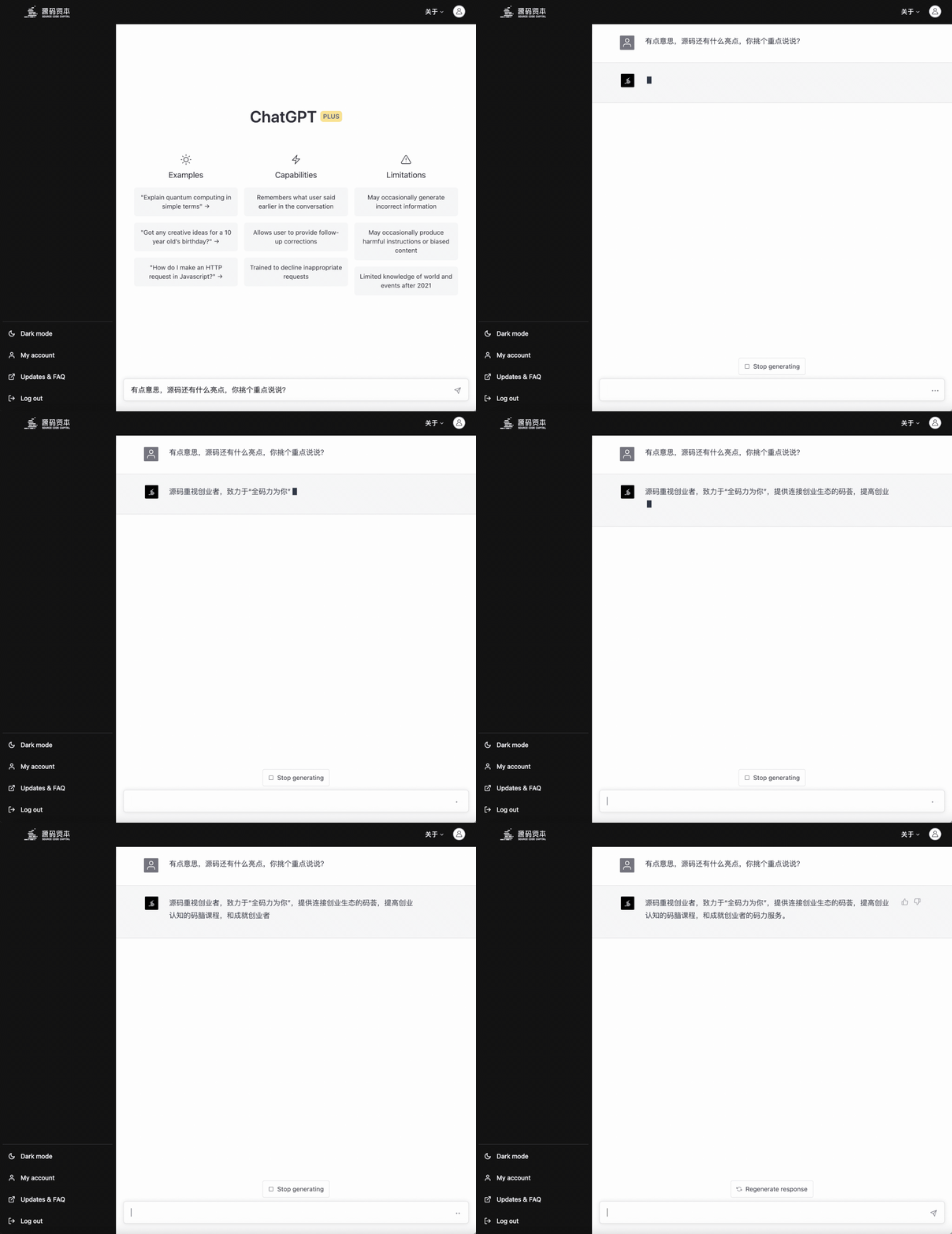
Interesting. What else stands out about Source Code Capital? Pick a highlight.
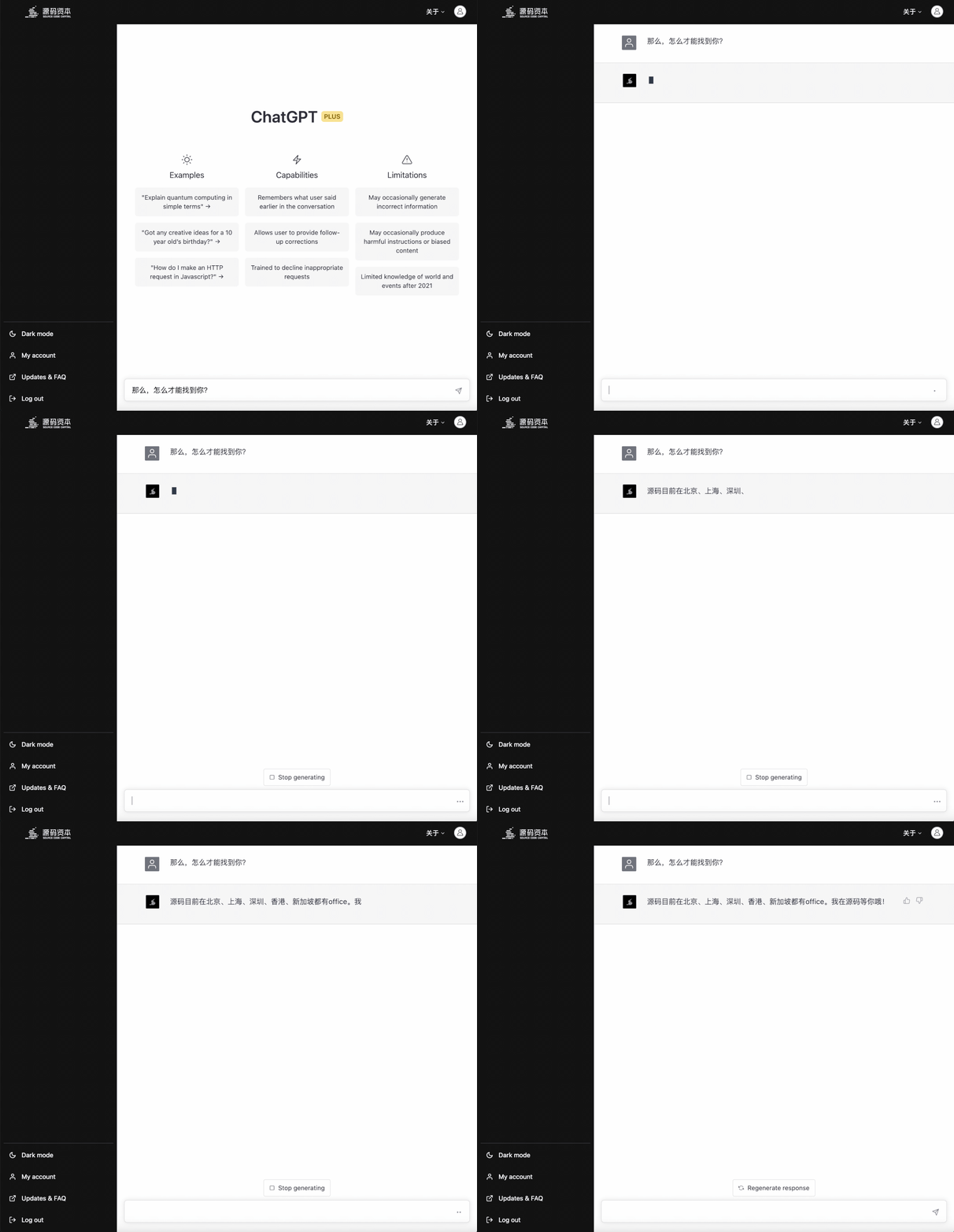
So, how can I find you?