AIGC "Peak Series" | With Global Vendors Racing to Build Large Models, Entrepreneurs Should Consider These Three Opportunities

Large language models, tools, and application R&D
The AI wave ignited by ChatGPT continues to spread globally. But looking at Microsoft's announcement to integrate AI into Bing and Edge, and how tech companies worldwide are chasing the AIGC trend and racing to launch large language models and related products, this wave has already moved from conceptual discussion to real-world implementation.
To help entrepreneurs seize this AI opportunity, Code Brain has organized three "Together Toward the Future" AIGC events since March 10, inviting Hongjiang Zhang, Dr. Li Wei from Silicon Valley, and Dr. Long Bo to discuss the technical pathways, commercial applications, and future trends of ChatGPT and large language models. As ChatGPT rapidly evolves and spreads, we've kept pace with its evolution — our content has expanded from concept analysis to scenario implementation, and our speakers have broadened from expert academics to frontline technical practitioners, all aimed at cutting through the fog to explore various AI application scenarios.
On April 22, Code Brain's fourth AIGC event — "How Will AIGC Profoundly Impact Product, R&D, and Operations?" was held simultaneously at Source Code Capital's Beijing office and online. We invited Lei Li, General Manager of Microsoft's Data Science and AI Solutions division; Feng Bin, Co-founder & CTO of ONES, an enterprise R&D management platform; David Zhang, Founder & CEO of GamesMind, a game AI platform; Pu Yang, CTO of Source Code Capital; and Yiwen Hao, an investor at Source Code Capital. Together they explored the practical impact of AIGC on enterprise product development, R&D, and operations, and led attendees through hands-on demonstrations of ChatGPT and Midjourney.
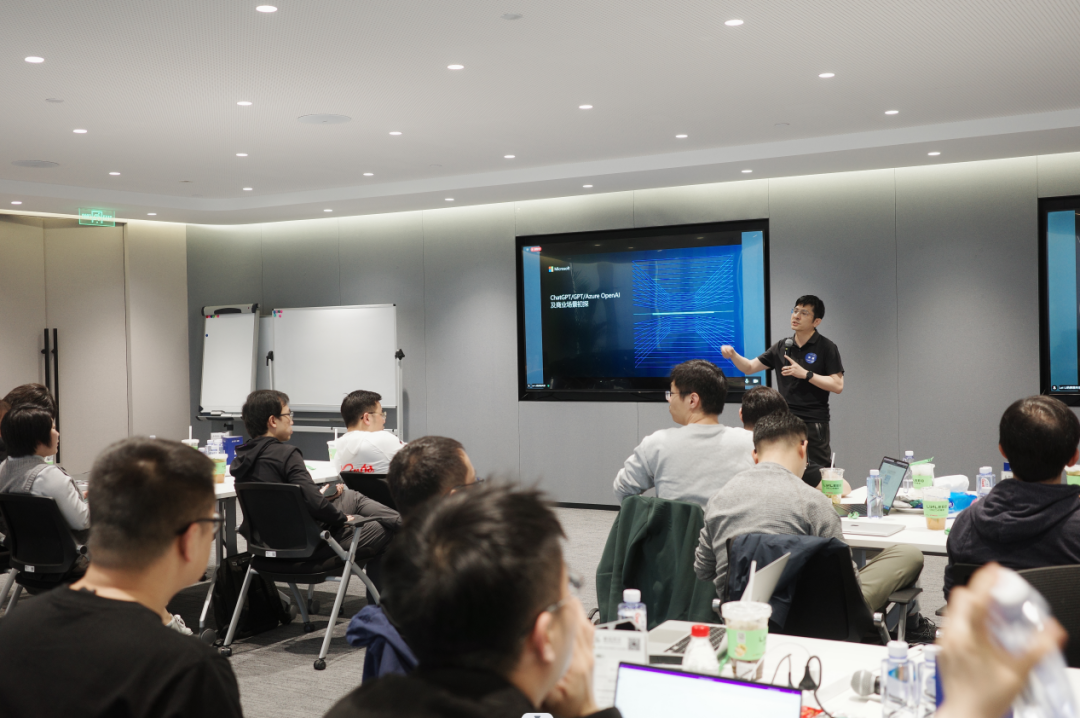
Today we're bringing you the first major piece from our fourth AIGC event — a keynote by Lei Li, General Manager of Microsoft's Data Science and AI Solutions division, on "ChatGPT/GPT/Azure OpenAI and Preliminary Exploration of Commercial Scenarios." He shares his take on ChatGPT's underlying logic and the exploration of OpenAI's technology and commercial value.
Today I'll focus on three things:
First, the relationship between ChatGPT and GPT, and between OpenAI and Microsoft;
Second, how to understand ChatGPT's capabilities;
Third, what can enterprises do at this starting point of artificial general intelligence?
Let me start with four questions:
First, large language models have strong natural language understanding capabilities. Based on LLMs, how can we improve the experience for C-end or B-end customers?
Second, how can we build our own products by embedding AGI capabilities?
Third, from an R&D perspective, how should we upgrade our productivity tools?
Fourth, how can we leverage AI capabilities to improve internal operational efficiency?
01
ChatGPT:
A Milestone in the AGI Era
Since December 2022, ChatGPT has become wildly popular globally. Everyone's been playing with it, and lots of interesting things have happened. Here, let me share some tidbits people care about.
ChatGPT is a capability demonstration of the GPT model. When designing it, they considered how to make GPT's abilities more accessible to the general public. Since GPT-3's data cutoff was June 2021, and ChatGPT was built on GPT-3.5 as its underlying model, it knows nothing about the world after June 2021.
Early on, we talked about data warehouses, then big data. AI has actually been a discipline for a very long time — machine learning in 1997, deep learning in 2017, generative AI in 2020. GPT behind ChatGPT is based on generative AI scenarios, and it intersects with NLP. By the time GPT-4 was ready, it already had multimodal capabilities. From our current perspective, the ChatGPT we see is GPT optimized for Q&A and dialogue formats. There's also a strong scenario built on 3.5 specifically for code. At least within the model system, these scenarios have been solved by one general foundational model.
Joking aside — 20 years ago, countless Beijing real estate opportunities lay before us, and many people missed them. I believe we are indeed at a milestone moment. What will emerge at this point in time requires some thought and ideas.
02
Large Models, Tools, and Application Development:
Three Opportunities Entrepreneurs Can Seize
Many people talk about large models, including the 175 billion parameters and so on. Actually, when OpenAI first built its entire system, Microsoft provided it with a massive compute pool — currently close to 30,000 GPUs. After completing the GPT-3 model, the parameters were 175 billion, but ChatGPT has 1.5 billion parameters. Going forward to GPT-4 and beyond, parameter scale isn't necessarily going to keep expanding, because parameter scale relates to data corpus and scenario directionality.
Actually, GPT-4's image capabilities haven't been fully opened up yet. For now, starting from language model capabilities, we can summarize four abilities: content generation, summarization, code generation, and semantic retrieval. But different angles lead to different scenarios. What we care about most is the model's inherent capabilities — not just focusing on ChatGPT, but on what can be done in what scenarios?
For scenario-based applications built on models, we need to find a benchmark. Microsoft's early $1 billion investment in OpenAI wasn't just an investment — it was a technical partnership. On the technical collaboration level, Microsoft integrated AI across its entire product line. What we should think about is: from our own product perspective, how should we integrate? Treat Microsoft as a demonstration, then reverse-engineer inspiration for yourself. Among currently visible models, GPT-3.5 supports 4K tokens, GPT-4's base is 8K tokens, and can support up to 32K tokens — different capabilities enable many interesting things.
Take improving customer experience as an example. In a customer service center scenario, we receive customer complaints and call logs. We can convert customer records from speech to text using Speech-to-text services, then process with GPT, finally forming customer intent and summaries. This is an API call to the GPT model, enabling it to effectively extract the key information you need.
What we're building now are systems — the important thing is how to use GPT well. How to handle dialogue, and what the final result of that dialogue is? Previously I used LUIS for some things; now with a model like GPT, we can do much better. For example, hotword and customer satisfaction analysis — the less perfect current systems are, the more opportunity exists. Extending this functionality, the same logic applies to call center and customer service problem and log summarization, professional document summary analysis, and industry research report writing.
Regarding code capabilities mentioned earlier, we can use GPT for AI-assisted coding. It can generate code from natural language — for example, generating SQL, then building BI analysis dashboards around natural language. From a business analysis perspective, if weekly complaints by region are rising month-over-month, natural language can generate SQL statements, query the database, and produce dashboard results.
From a translation perspective, take "青梅竹马" (qingmei zhuma, childhood sweethearts) as an example. If translated literally, it's "green plum and bamboo horse" — but that's not the real meaning. Under the GPT model, the translation barrier is lowered. You can have it generate a prompt or draw a picture of childhood sweethearts, and translate the prompt into English. For translation services, the main issue now is response time — we have dedicated translation services with faster response times than GPT. For example, in The Wandering Earth where people wear earphones for simultaneous translation — as compute power improves, this will definitely be solved. For people who need to work in foreign languages, writing emails in Chinese or English is no longer a problem.
Now everyone's getting competitive. Various industry players are building their own large models, with different considerations driving them — this is advancing technology overall. Some call them large models, some general large models. Doing language large models from text, generative image large models — if done well, they should be general large models. If not built on a general foundational model, there will be certain fragmentation. For OpenAI, it's just two separate model packages, which is why OpenAI talks about general large models — this is a good catalyst and inspiration for everyone.
In summary, roughly three opportunities are emerging:
First, large model R&D opportunity — this is a high-investment play.
Second, tools opportunity — when you have GPT's model, or another company's model, think about what tools to build on top of it.
Third, applications opportunity — how to leverage general large model capabilities to make applications better and smarter.
03
Data Security and Compliance:
OpenAI and Microsoft Have Thought More Comprehensively Than Us
Let's talk about data security and compliance. Everyone knows ChatGPT is a demonstration of GPT model capabilities, so ChatGPT lets people touch and use it. But many people treat ChatGPT as a little helper — objectively speaking, when ChatGPT builds dialogue scenarios, it can use your data for training, and this business model itself leans toward To C.
If you're going to build industry applications based on a model, enterprise users care about data ownership. This creates an important security issue — whether writing code or generating images, based on GPT large models, from product R&D to market launch, facing different customer groups and business models, security must be considered and addressed.
OpenAI, from model iteration to成果发布, public testing, official release, and stable model formation — whether past or future — needs a good scenario for continuous iteration. So ChatGPT is a good channel to derive and drive underlying model iteration. When officially releasing this model for enterprise services, it needs to be placed in a secure, available, integrated To B scenario.
First, in To B scenarios, you can't touch my data. As a public cloud user, the public cloud only provides technical support — whether SaaS or PaaS, there are security permission systems, compliance guarantees, ethics reviews, etc.
Second is availability. OpenAI has data centers in the United States providing compute. If we build our own applications on top, when deploying globally, there will be multi-region data center selection needs. Similar model services will gradually appear in the US and Europe, and enterprise users can choose based on needs. Currently, with tight compute resources, deploying GPT services in China-based data centers is still in planning and discussion, of course related to resources and local market demand.
Let me give a small scenario example: using natural language to query data and build internal analysis systems. First, convert logs to text, then use OpenAI GPT services to structure the text, then focus on relevant intent. Combine intent to present analysis dashboards, then wrap this analysis dashboard in natural language — this is a To B application scenario. In meeting scenarios, speech can become text, and text can generate meeting summaries. If you're a CRM system, you can also write emails based on the CRM system.
We call this "Copilot" — the term works well. Many people are asking whether GPT will replace humans in the future; for now, it's still just an assistive role. The "Copilot" concept turns everyone into a driver — like a leader who can assign it tasks. Of course leaders also need to ask good questions and communicate clearly.
From completing GPT-4 last summer to releasing the GPT-4 model in February-March this year, this time was spent on all related compliance checks and optimizations. I've been talking about coding — let me briefly note that on GitHub Copilot, individuals can use the personal version. The personal version can generate code from natural language, suggest comments, etc., including supporting automated test cases, filtering similar code, generating comments, and so on.
But if the personal version is brought into an enterprise, there are issues. The personal version doesn't provide data security guarantees. For example, code being used externally does happen, because model training is occurring — so you need to discern usage scenarios. From a To B perspective, this changes; under compliance requirements, external parties must not touch the code.
For example, we package a model version for each enterprise to use — it's a standard product. If your enterprise data does fine-tuning, and it changes when running at another enterprise, I lose control myself.
This model is in the customer's own workspace, like a database on public cloud — the database doesn't use your data content, you just treat it as a container. In the workspace, a model is deployed for you — this is a customized model, no longer a standard model. If you fine-tune the model, it won't affect other enterprise users. These are the most basic guarantees in data privacy compliance. This is why using model services versus using ChatGPT personally — we need to普及 this distinction. Most people currently access ChatGPT in personal ways, so you need to control your own data — which data is appropriate for ChatGPT, which isn't — this must be in your hands. If you feel this matters, consider enterprise-grade approaches. From a commercial service perspective, looking at scenarios, using ChatGPT like a personal tool — initially ChatGPT didn't guarantee data wouldn't be reused.
Recently everyone's been talking about privacy, data, security — let me clarify: from when ChatGPT started building models, these considerations were already in place. From a domestic perspective, we've only been focused on AI these past two months because ChatGPT became hot, and then people paid attention to what GPT can do. Only when we understand its capabilities can we design scenarios we care about and appropriate application forms.
Another scenario: what if an enterprise has its own data? Say you built an application, you have your own data, but GPT doesn't have this data. You just want it to be your enterprise's technical assistant, without publishing these technical documents online — we can do this several ways. If it includes Word documents and PDFs, I need to call services like form recognition, image-to-structure, etc., build my own enterprise document library, provide search capability based on the enterprise document library, then combine with ChatGPT to achieve an enterprise technical service assistant. This involves multiple services; OpenAI is just one of them.
In short, we're now in a new era of artificial intelligence. Perhaps someone else's words, or seeing a scenario, becomes an inspiring entrepreneurial idea. When you feel innovation is lacking, you can also learn from benchmarks, find your capability boundaries,挖掘细分场景, and enrich your capabilities simultaneously — perhaps you'll find something interesting. Alright, that's all from me, thank you everyone.