Code Watch | Who Are the AIGC 'Big Players'?

How will value evolve across the generative AI value chain? Will new moats emerge? And who stands to be the biggest winner in this space?


In the year just past, disruptive AI applications led by ChatGPT and Midjourney triggered a global resonance around AIGC.
Source Code Capital believes that this wave of generative AI may conceal enormous opportunities. Unlike previous deep learning waves, the vastly larger model scale has significantly raised the barrier to entry for competition. Smaller companies may prefer to use services directly rather than build their own models, giving AI a chance to become a platform-level service. At the same time, as AI capabilities continue to advance, AI applications are drawing closer to concrete business scenarios — fluid, natural conversational bots and surreal, magnificent image generation have made ordinary individuals part of this technological carnival.
It's worth noting that, like most technologies, generative AI shows limited technical differentiation. Yet we remain hopeful about its application and commercial prospects, and highly valuable use cases may still emerge. The expansion of model scale makes traditional economies of scale more pronounced; meanwhile, an appropriate product form and business model may spawn additional moats, such as sufficient proprietary closed-source data. Through refinement by excellent product managers, generative AI may also deliver entirely new experiences and forge robust user ecosystems.
As a foundational technological shift with potentially very high upside, generative AI is a field well worth serious attention.
An a16z investor recently published an article on the firm's website, comprehensively summarizing and examining the situations facing players across the generative AI stack — from applications to models to industry infrastructure — and offering some fascinating insights: companies that trained generative AI and deployed it into real-world apps created the most value, but did not capture the most value in the value chain.
As an exhilarating new technology, how will value evolve across the generative AI value chain? Will new moats emerge? Who will be the biggest winners in this space?
Source Code Capital has compiled this article for our readers, with some adjustments to phrasing for clarity. We hope it brings you a better reading experience and inspires deeper insights.
01
The Big-Picture Technical Architecture: Infrastructure, Models, and Applications
We've observed early-stage technical specialization emerging in generative AI. Hundreds of startups are rushing in to develop foundation models, build AI-native applications, and construct infrastructure or tools. Typically, hot technologies get overhyped and overspent before market adoption. But generative AI's boom is driven by real market returns and real companies. Models like the AI-powered text-to-image model Stable Diffusion and the natural language conversational model ChatGPT are seeing explosive user growth; many applications have surpassed $100 million in annual revenue within a year of launch. AI models already outperform humans by orders of magnitude on some tasks. There are thus ample signals that large-scale transformation is underway in AI. But the critical question is: where will value accrue in the generative AI market?
Through extensive conversations with generative AI companies, we found that infrastructure providers may be the biggest winners, capturing the most wealth. Application companies, despite rapid growth, are still struggling with retention, product differentiation, and gross margins. And while model providers determine whether this market exists at all, most have yet to reach large-scale commercial thresholds.
In other words, companies that trained generative AI and deployed it into real-world apps created the most value but captured the least. Predicting how value distribution will evolve in this industry is not easy. But we believe the key is identifying which factors can achieve differentiation and which can become moats. This will profoundly shape market structure (e.g., horizontal versus vertical competitive dynamics) and long-term value drivers (e.g., margins, retention). Regrettably, beyond pre-existing traditional advantages, we have yet to find any structural moats in the current technical division of labor.
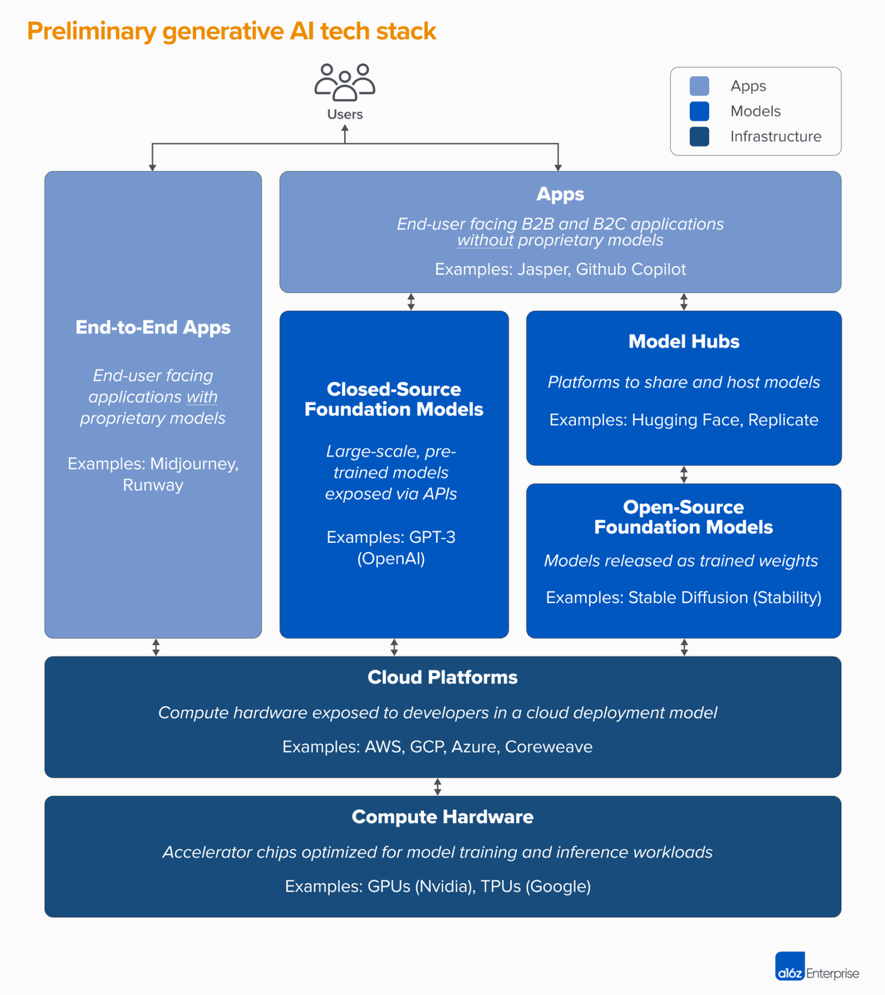
[Source: Matt B., Guido A., & Martin Casado (2023, January 23). Who owns the Generative AI platform? Andreessen Horowitz. Retrieved January 30, 2023, from https://a16z.com/2023/01/19/who-owns-the-generative-ai-platform/]
Through the "application-model-infrastructure" analytical framework, the entire generative AI stack currently divides into three layers:
-
Application layer: Typically integrates generative AI models into user-facing products, whether based on proprietary models or third-party APIs.
-
Model layer: Powers AI products through dedicated APIs or open-source checkpoints (requiring a hosting solution).
-
Infrastructure layer: Executes training or inference requests for generative AI models, such as cloud platforms and hardware manufacturers.
02
Applications: A Path to Scale, but Retention and Differentiation Remain Elusive
In previous technology cycles, conventional wisdom held that to build a standalone large company, you needed consumer or enterprise customers. This easily leads us to assume that the largest companies in generative AI will also be application companies serving end users — but this may not be the case.
To be sure, because AI-generated content is so novel with multiple use cases, generative AI application growth has been staggering. In image, text, and code generation, annualized revenue has already exceeded $100 million across all three domains.
However, growth alone is insufficient to build an enduring software company — what matters is that growth must be profitable. In a sense, users must generate profits upon signing up (high gross margins) and remain for the long term (high retention). In the absence of strong technical differentiation, B2B and B2C applications capture long-term customer value through network effects, data storage, or increasingly complex workflows.
But in generative AI, these assumptions don't necessarily hold.
Due to varying model inference costs, gross margins differ widely across application companies: a few reach as high as 90%, but more often fall in the 50-60% range. "Top of funnel" companies are seeing astonishing growth, but customer acquisition efficiency and retention have already begun declining — whether this acquisition strategy is scalable remains uncertain.
Applications in this space are largely similar because they rely on comparable underlying AI models, and haven't developed network effects, data, or workflows that competitors can't replicate.
Thus, it's still unclear whether selling applications is the only or best path to building a lasting generative AI business. As competition intensifies and model efficiency improves, margins should rise; as AI tourists depart, product retention should increase as well. Some argue that more vertically focused applications will have differentiation advantages, though this remains to be seen.
Looking ahead, generative AI application companies will face several difficult questions:
-
Vertical integration ("model + application"). Consuming AI models as a service allows application developers to iterate quickly with small teams and swap model providers as technology advances. Some developers believe the product is the model, and that training from scratch is the only way to build a moat — through continuous retraining on proprietary product data — but this comes at the cost of higher capital requirements and less agile product teams.
-
Building features vs. building applications. Generative AI products can take many forms: desktop apps, mobile apps, Figma/Photoshop plugins, Chrome extensions, even Discord bots. Integrating AI products where users already spend time is easy because the UI is typically just a text box. Which of these will become standalone companies, and which will be acquired by giants?
-
Navigating the hype cycle. It's unclear whether the current user churn among generative AI products is inevitable, an artifact of the industry's early stage, or whether user interest will decline as the technology moves past the peak of inflated expectations. These questions have major implications for application companies: when to accelerate fundraising, how aggressively to invest in customer acquisition, which users to prioritize, when to confirm product-market fit, and so on.
03
Models: Model Providers Invented Generative AI, but Haven't Yet Reached Significant Commercial Scale
Without the outstanding research and engineering work of companies like Google, OpenAI, and Stability, the generative AI we're discussing wouldn't exist. Through novel model architectures and scaled-up training, everyone now benefits from current large language models and image generation models.
Yet compared to the usage and buzz around these applications, model-related revenue remains relatively modest.
The AI text-to-image model Stable Diffusion achieved explosive community growth, supported by an ecosystem of user interfaces, hosting products, and fine-tuning methods. However, its parent company Stability has made free inference a core principle of its business.
In natural language models, OpenAI's GPT-3/3.5 and ChatGPT dominate. But so far, even with one price reduction, OpenAI has built relatively few killer applications.
This may all be temporary. Stability is a new company and not currently in a rush to profit. And as more killer applications are built — especially if model capabilities are successfully integrated into Microsoft's product matrix — OpenAI also has the potential to develop a vast commercial landscape and reap significant rewards in NLP. Given the enormous usage of these models, large-scale revenue may not be far off.
But they also face formidable competitors. Models released as open source can be hosted by anyone, including external companies that don't bear the tens or hundreds of millions in training costs. It's unclear whether any closed-source model can maintain long-term advantages.
AI companies including Anthropic (founded by former core OpenAI employees), natural language processing platform Cohere, and Character.ai (founded by former Google researchers) are also building large language models (LLMs). Their models use similar architectures, are trained on similar datasets (i.e., the internet), and their performance is approaching OpenAI's. The example of Stable Diffusion also shows that if open-source models reach sufficient performance benchmarks and gain community support, closed-source alternatives may struggle to compete.
Perhaps the clearest conclusion for model providers is that commercialization will be tied to hosting. Demand for closed-source APIs (like OpenAI's) is growing rapidly, and hosting for open-source models (via Hugging Face and Replicate) is gradually becoming a hub for convenient model sharing and integration. There are even some indirect network effects emerging between model producers and consumers. A strong hypothesis is that model providers may be able to monetize through model fine-tuning and hosting capabilities in partnership with enterprise customers.
Beyond this, model providers face many thorny questions:
-
Commoditization. It's widely believed that AI model performance will converge over time. But in conversations with application developers, we find that differentiation will persist. Both image and text generation have strong leading players, though their advantages aren't based on unique model architectures but rather on high capital investment, proprietary product interaction data, and scarce AI talent. Will these prove to be lasting advantages?
-
Disintermediation risk. Relying on model providers is an effective way for application companies to get started and grow. But once they reach a certain scale, application companies have strong incentives to build and host their own models. Many model providers have highly concentrated customer bases, with a few applications accounting for most revenue. What happens when these customers turn to in-house AI development?
-
Does money matter? The promise of generative AI is enormous, but it may also be so potentially harmful that many model providers have become public benefit corporations (B corps), or issued equity with capped returns (as in Microsoft's investment in OpenAI), or otherwise explicitly incorporated public interest into their missions. This hasn't hindered their fundraising. The question is whether model providers actually want to be profitable, and whether they should be.
04
Infrastructure: Infrastructure Providers Are Everywhere, and Reaping the Rewards
Generative AI requires cloud-hosted GPUs/TPUs in virtually every respect. Whether model providers/research labs are training, inferencing, or fine-tuning, or application companies are doing some combination of both — compute (FLOPS) is always the lifeblood of generative AI.
It's the first time that the progress of the most disruptive computing technology has been constrained by large-scale computation.
Consequently, substantial funds in generative AI ultimately flow to infrastructure providers. Rough estimates suggest application companies spend approximately 20-40% of revenue on model inference and per-customer fine-tuning; these costs typically go directly to cloud providers, or to third-party model providers who in turn spend roughly half their revenue on cloud services. Thus, we have reason to suspect that 10-20% of total generative AI revenue today flows to cloud providers.
On top of this, startups training their own models have raised billions in venture capital — the majority of which (80-90% in early stages) also goes to cloud providers. Many public tech companies spend hundreds of millions annually on model training in partnership with cloud providers or hardware manufacturers.
For such an emerging industry, this is truly a massive amount of money, and most of it goes to the three giants: Amazon AWS, Google GCP, and Microsoft Azure. These cloud providers maintain over $100 billion in annual capital expenditures to ensure they have the most comprehensive, reliable, and cost-competitive platforms. Particularly in generative AI, they also benefit from supply constraints because they can secure priority access to scarce hardware (such as NVIDIA A100 and H100 GPUs).
But interestingly, substantive competition is emerging. Challengers like Oracle have entered the market through heavy capital expenditures and promotional measures. Some startups, such as CoreWeave and Lambda Labs, have grown rapidly by offering solutions specifically tailored to large model developers. They compete comprehensively on cost, availability, and personalized support, and offer more granular resource services (i.e., containers) — while major cloud providers, constrained by GPU virtualization limitations, only offer virtual machine instances.
And the biggest winner in generative AI to date — NVIDIA — lurks behind all of this. The company reported $3.8 billion in data center GPU revenue in fiscal Q3 2023, a substantial portion of which went to generative AI applications. NVIDIA has built formidable moats through decades of sustained investment in GPU architecture, a robust software ecosystem, and deep penetration in academia. A recent study found that NVIDIA GPUs are cited in research papers 90 times more frequently than leading AI chip startups.
Other hardware options do exist, including Google's TPUs, AMD Instinct GPUs, AWS Inferentia and Trainium chips, and AI accelerators from startups like Cerebras, SambaNova, and Graphcore. Intel has also entered this market with high-end Habana chips and Ponte Vecchio GPUs. But so far, these new chips haven't captured significant market share. Two notable exceptions are Google and TSMC — the former's TPUs have some appeal in the Stable Diffusion community and among large GCP customers; the latter manufactures all of the above chips, including NVIDIA's GPUs (Intel uses both its own and TSMC's fabs for its chips).
In other words, infrastructure providers occupy a profitable and durably entrenched position. Key questions they need to address include:
-
How to prevent cross-cloud migration. Whether you rent NVIDIA GPUs from one provider or another, it's the same hardware. Most AI workloads are stateless, meaning model inference doesn't require attached data and storage (beyond the model weights themselves). This suggests AI compute tasks may be easier to migrate across clouds than traditional application compute. In this scenario, how do cloud providers increase stickiness and prevent customers from switching to the cheapest option?
-
How to survive after the chip shortage ends. The high pricing by cloud providers and NVIDIA itself is largely supported by best-in-class but supply-constrained GPUs. One vendor told us that the A100's list price has risen since launch, which is extremely rare for compute hardware. When this supply constraint finally eases through increased production and adoption of new hardware platforms, what impact will this have on cloud providers?
-
Can challenger clouds succeed? We firmly believe vertical clouds can capture market share from the three giants by offering more specialized services. So far in AI, challengers have gained market traction through modest technical differentiation and NVIDIA's support. For NVIDIA, existing cloud providers are both its largest customers and emerging competitors. The long-term question is whether this is sufficient to overcome the three giants' scale advantages.
05
So, Where Will Value Be Created?
We don't know yet. But based on early data from generative AI and experience from early AI/ML companies, our intuition is as follows:
Right now, no systemic moats have emerged in generative AI. Application products lack differentiation because they use similar models; models are trained on similar datasets with similar architectures, making long-term differentiation unclear; cloud providers run the same GPUs with limited deep technical differentiation; even hardware companies manufacture their chips at the same foundries.
Of course, there are standard moats: scale moats ("I have/can raise more money than you!"), supply chain moats ("I have GPUs, you don't!"), ecosystem moats ("Everyone already uses my software!"), algorithm moats ("We're smarter than you!"), distribution moats ("I have a stronger sales team and more customers!"), and data moats ("I've crawled more of the internet than you!"). But none of these moats are likely to be durable. It's too early to tell whether stronger, more direct network effects will prevail for any layer of players.
Based on available data, we're not yet clear whether generative AI will see long-term winner-take-all dynamics.
Strange as this is, it's good news. The potential market size is difficult to grasp — it lies somewhere between all software and all human effort — so we expect many, many participants, competing healthily at every level, with markets and users ultimately determining the optimal industry structure. If the primary differentiator of end products is AI itself, vertical products may win out. If AI is part of a larger, long-tail feature set, platform products will have the advantage. Of course, over time we'll see more traditional moats being built, and even new types of moats emerging.
In any case, one thing is certain: generative AI has changed the game. Everyone is learning these rules in real time, massive value will be unleashed, and the tech landscape will become very different as a result. Let's wait and see.
Brief introductions to select companies and models mentioned:
- Stable Diffusion
Stable Diffusion is a deep learning text-to-image model released in 2022. It is primarily used to generate detailed images from text descriptions. Developed by startup Stability AI in collaboration with the CompVis group at Ludwig Maximilian University of Munich.
- ChatGPT
ChatGPT is an AI chatbot program developed by OpenAI, launched in November 2022. The program uses a large language model based on the GPT-3.5 architecture and is trained through reinforcement learning.
ChatGPT has received unprecedented attention. Within just five days of launch, ChatGPT surpassed 1 million users.
- Hugging Face
Hugging Face is an American AI/ML community and platform company, founded in 2016, that develops tools for building applications using machine learning. It gained early attention through its Transformers model library and high-quality community. Users can host and share ML models and datasets on Hugging Face, as well as build, train, and deploy models — making it a model hosting platform.
- OpenAI
OpenAI is an American AI research laboratory aimed at promoting and developing friendly AI for the benefit of humanity as a whole. OpenAI was founded in late 2015 by Elon Musk and Sam Altman, and is headquartered in San Francisco, California. The most cutting-edge text generation models in the GPT-3 series and the text-to-image model DALL-E 2 both come from OpenAI.
In 2019, under the pressure of high model training costs, OpenAI spun out a for-profit organization with a profit cap, OpenAI LP. Shortly thereafter, Microsoft announced a $1 billion investment in OpenAI and obtained licenses to commercialize some of OpenAI's AI technologies and integrate them into products.
- Stability
In 2020, Emad Mostaque founded Stability AI, hoping to become an institution as open as OpenAI but in a non-profit model. In August 2022, Stability launched its first free, open-source product model, Stable Diffusion.
Initially, Stability AI raised $10 million at a $100 million valuation. In October 2022, Stability AI announced $101 million in investment from Coatue and Lightspeed, with its valuation reaching $1 billion.
This article is compiled from a16z: Who Owns the Generative AI Platform? | Andreessen Horowitz
If there are any copyright concerns, please contact us
If you're interested in AIGC-related topics, please leave a comment to discuss with us