AIGC "Peak Series" | BAAI Conference: Humanity's Future and Hidden Concerns in the Post-AI Era

The Post-AI Era: Where Does Humanity Go From Here?


Preface
From June 9 to 10, the BAAI Conference — a premier gathering for AI insiders — took place in Beijing. BAAI, often called China's strongest answer to OpenAI, hosts this annual international summit as its flagship professional exchange on artificial intelligence. The speaker lineup was stacked with heavyweights: Turing Award winners Geoffrey Hinton and Yann LeCun, OpenAI CEO Sam Altman, and over 200 top minds from industry and academia. The event's sheer caliber earned it the nickname "AI's Spring Festival Gala."
This year's program covered cutting-edge foundation models, brain-inspired computing, AI safety and alignment, vision and multimodal large models, embodied AI and reinforcement learning, generative models, AI systems, open-source AI, and autonomous driving.
Hongjiang Zhang, chairman of BAAI and foreign member of the US National Academy of Engineering, joined Source Code Capital as a Venture Partner in 2017. Dr. Zhang previously served as CTO of Microsoft Asia-Pacific R&D Group. His accolades include the 2010 IEEE Computer Society Technical Achievement Award, the 2012 ACM SIGMM Outstanding Technical Achievement Award, and the 2008 Asian American Engineer of the Year Award. Since 2018, he has topped Guide2Research's ranking of top computer scientists from mainland China.
Source Code Capital has compiled highlights from key speeches at this year's conference, hoping to contribute to humanity's collective pursuit of AGI.
01
Turing Award Winner Yann LeCun: Large Language Models Won't Lead to AGI
At the 2023 BAAI Conference, Yann LeCun — one of the "godfathers of deep learning" — delivered a keynote titled Towards Machines that can Learn, Reason, and Plan. In this talk, he surveyed his long-standing advocacy for self-supervised learning, sketched an ambitious vision for AI research over the next decade grounded in cognitive science, and proposed a roadmap to strong AI built on self-supervised learning, world models, reasoning, and planning.
He argued that AI's progress requires abandoning mainstream approaches like generative models and reinforcement learning.

|Yann LeCun
Chief AI Scientist at FAIR and head of Facebook AI Research. Recipient of the "Neural Network Pioneer Award." Member of the US National Academy of Sciences, the National Academy of Engineering, and the National Academy of Law. 2018 Turing Award winner. Author of The Road to Science: Humans, Machines, and the Future.
Key Takeaways:
- Current machine learning systems use a fixed number of computation steps between input and output, preventing them from reasoning and planning the way humans and animals do.
- Self-supervised learning aims to capture dependencies within the input, not merely map inputs to outputs. The training system learns dependencies between the parts we observe and the parts we haven't yet seen.
- Train a model on one or two trillion tokens and it delivers stunning performance. Yet it will also make stupid mistakes — factual errors, logical errors, inconsistencies. Its reasoning is limited, it generates harmful content, and it lacks underlying knowledge of physical reality because it was trained purely on text. It cannot fully comprehend human knowledge or truly plan its answers.
- You can get large models to do all sorts of things: write code in various languages, generate text, and the results look impressive. But they also hallucinate. If you want factual information, we're better off with information retrieval systems and search engines.
- AI research faces three major challenges: (1) Learning representations and predicting world models through self-supervised learning. Current self-supervised and reinforcement learning methods require enormous samples and trials. We need task-agnostic world representations via self-supervised learning, plus predictive models for planning and control. (2) Learning to reason: drawing on Daniel Kahneman's "System 1 & System 2" framework. System 1 corresponds to subconscious computation — things you do without thinking. System 2 is deliberate, full-brain reasoning. Today's AI systems remain largely at the System 1 stage. (3) Learning to plan complex action sequences — hierarchically decomposing complex tasks into simpler ones.
- How can AI truly plan the way humans do? Look at how humans and animals learn so quickly — through observation and experience of the world. From this, LeCun proposes the "World Model."
Reference:
BAAI Conference: The Godfather of CNN's Roadmap to Strong AI: Self-Supervision, Reasoning, Planning
02
OpenAI CEO Sam Altman: AGI Could Arrive Within a Decade
ChatGPT's launch ignited the current wave of AI innovation. On June 6, data from US marketing firm Veza Digital showed that OpenAI's website had surged to one billion monthly unique visitors by March of this year, setting a record for user growth among consumer-facing websites.
On June 10, during the full-day "AI Safety and Alignment" forum, OpenAI co-founder and CEO Sam Altman delivered the opening keynote — his first speech in China. He also engaged in a remote Q&A with BAAI chairman Hongjiang Zhang, discussing the future of AGI, GPT-5, open-source large models, and more.

In his speech, Altman quoted the Tao Te Ching — "A journey of a thousand miles begins with a single step" — to underscore that "AI safety begins with the first step," urging accelerated global cooperation.
Altman believes that against the backdrop of explosive AI growth, superintelligent AI could emerge within the next ten years. He called for global collective governance, alignment in research deployment, and the building of international trust. He also spoke positively of China's role in AI safety and alignment, stating that "China has some of the best talent in the world, and solving the difficult problems of AI systems alignment will require talent from everywhere."
Key Takeaways:
- AGI is a force so powerful that it will fundamentally transform our civilization — making meaningful international cooperation and coordination absolutely essential.
- We need international cooperation to build verifiable trust among nations in the safe development of increasingly powerful AI systems, and mechanisms that promote transparency and knowledge-sharing in AGI safety technology.
- Attempt to use AI systems to assist humans in supervising other AI systems, and improve model interpretability.
- AGI may happen soon, but within the next ten years, we will likely have superintelligent AI systems.
- From a human perspective, whether we have a small number of models or a large number doesn't make us safer. What matters more is whether we have a mechanism ensuring that every model undergoes sufficient safety testing.
Reference:
03
Turing Award Winner Geoffrey Hinton:
Two Paths to Superintelligence, and I'm Getting Old
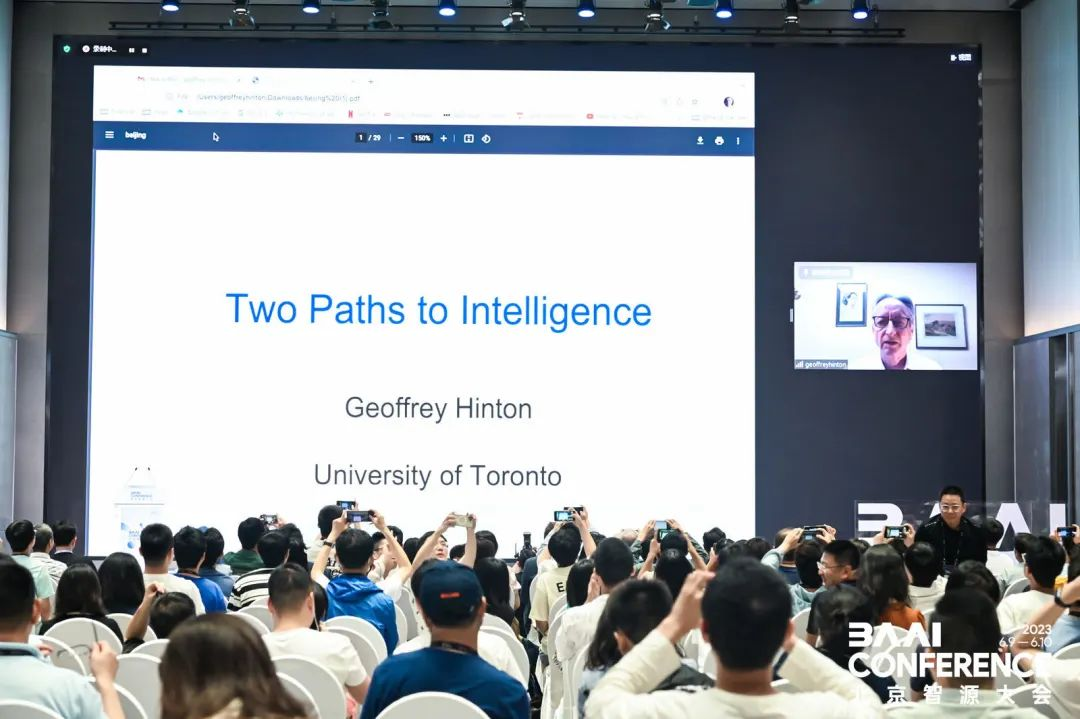
On June 10, Geoffrey Hinton — godfather of AI and Turing Award winner — connected remotely to the BAAI Conference for the closing keynote, Two Paths to Intelligence.
Analyzing computing architectures and their underlying principles, he argued that "artificial neural networks will become smarter than the human brain" — and that a less intelligent species controlling something smarter than itself poses an unprecedented challenge.
Starting from today's software-hardware-separated computing architecture, where training large models consumes enormous computational power, he proposed the concept of Mortal Computing to enable training large models with far less energy. Like a person's wisdom depending on their body and not being freely copied to another, the software would be tightly bound to the hardware it runs on.
Key Takeaways:
- Backpropagation (BP) is an algorithm that computes the gradient of all weights in a neural network — the derivative of the loss function with respect to the weights — which is then used with optimization methods like gradient descent for training. This gradient indicates the direction in which the loss function changes for each weight; optimization methods use this information to update weights and minimize the loss. Through backpropagation, neural networks can self-correct and optimize to better fit the desired mapping.
- Forward gradient learning is a deep neural network method for computing noisy gradient directions. Unlike backpropagation, forward gradient learning computes gradients on each individual sample rather than across the entire dataset. This makes it more biologically plausible, since biological neurons also compute on each input. However, when the number of parameters to learn is large, standard forward gradient algorithms exhibit high variance, meaning the learning process can become unstable.
- All digital computers built to date are "immortal" — their hardware is designed to be so reliable that identical software can run anywhere. "We can run the same program on different physical hardware; knowledge is immortal." In this sense, human intelligence (though not humans themselves) has already achieved immortality.
- Mortal Computing, by contrast, tightly couples learned knowledge with hardware, using extremely low-power analog computation and memristor weights for trillion-way parallel processing. But this means weights cannot be efficiently copied to replicate intelligence — immortality is sacrificed.
Reference:
Web3 Sky City: Mortal Computing: Giving Up Immortality — AI Godfather Hinton's BAAI Conference Closing Keynote (with Chinese video)
For more content from the 2023 BAAI Conference, visit the official website at https://2023.baai.ac.cn/