AIGC Summit | Creating the AI Productivity Gateway: OpenAI's Ambitions

The Apple App Store for AI Is Here
Preface
If ChatGPT's emergence was AI's "iPhone moment" — a storm that swept up the entire market's attention and capital, catalyzing the rapid rise of the whole supply chain — then now, AI's Apple App Store has arrived.
OpenAI held its developer conference in the early hours of November 7 Beijing time. The event had two headline announcements: "GPTs and GPT Store" and "GPT-4 Turbo," both detailed on OpenAI's website. Together, they reveal OpenAI's ambition to expand its consumer products, pursue multiple revenue streams, and become the undisputed giant of the AI space. Below, we'll break this down across three dimensions.
I. GPTs and GPT Store II. The New GPT-4 Turbo Model III. OpenAI's Ambitions
1
GPTs and GPT Store
The most significant announcement at this conference was OpenAI's launch of GPTs and GPT Store. Anyone — no coding required, just natural language conversation — can specify a particular need, give it instructions and a knowledge base, select capabilities (such as web search, image generation, or data analysis), and build their own GPT assistant — GPTs. OpenAI believes the best GPT applications will come from community builders, not necessarily people who know how to code.
Users can connect their GPT to databases, plug it into email, or use it as a shopping assistant. They can also build enterprise-specific GPTs tailored to departmental or company needs. Verified GPTs will be eligible to appear on the "GPT Store" launching later this month, with revenue sharing (just as apps on the Apple App Store earn developers a cut).
The feature is already available at chat.openai.com/create.
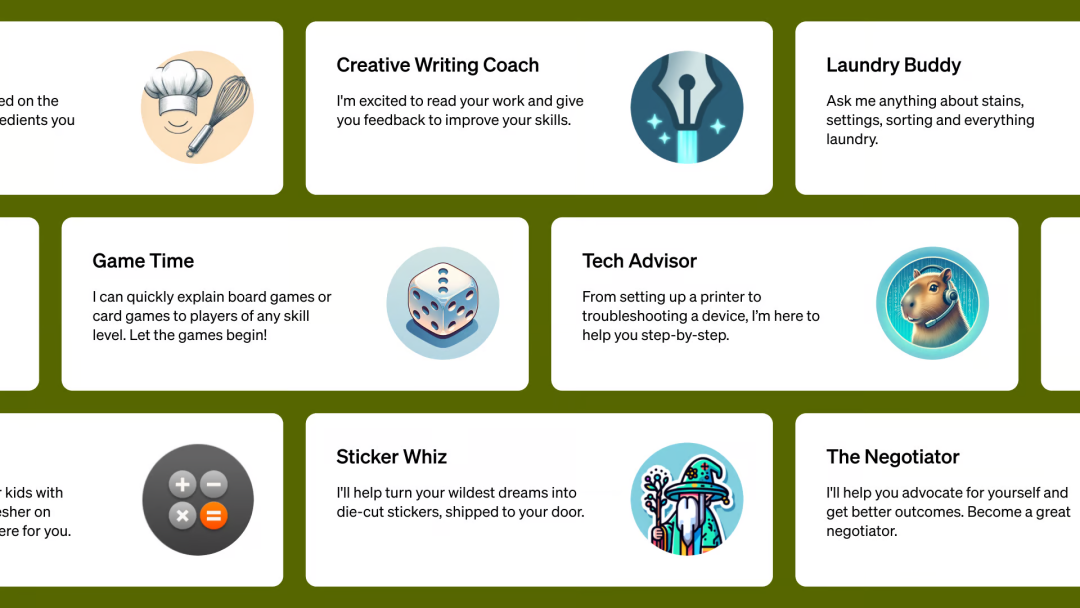
In May, OpenAI opened its plugin system, debuting with 70 large model-related applications spanning word games, translation, stock data lookup, and more. Now they've unveiled a far broader, deeper AI app marketplace.
At the event, OpenAI founder Sam Altman demoed building a personal GPT assistant "that gives entrepreneurs business advice." He opened GPT Builder and entered the request: "How do I help startup founders think through their business ideas and get advice?" GPT Builder generated a name and icon for the GPT, then conversed with Sam to ask whether he wanted to adjust these elements. Next, it asked how the application should interact with users. Sam said it should draw from his past speeches to provide constructive responses, then uploaded a transcript of one of his talks. — An "AI version of startup mentor Sam Altman" was born. Throughout this process, coding ability mattered less than having ideas.
For professional developers, OpenAI also introduced a more streamlined development path: the Assistants API, designed specifically for building AI assistants within existing applications. Using the Assistants API, OpenAI customers can build an "assistant" with specific instructions, leveraging external knowledge and calling upon OpenAI's generative AI models and tools to execute tasks. In short, it behaves more like an "AI Agent" — not just chatting, but going further to autonomously understand, plan, decompose, and execute complex tasks.
If you ask it to plan a trip to Paris, it won't just offer travel advice — it'll automatically categorize and mark the mentioned locations on a map. It can also read documents and call code to calculate travel expenses.
Every individual, every company, will have multiple specialized AI assistants. And if AI assistants can proactively break down and execute tasks, will a new human-computer interaction system — an operating system — emerge? Perhaps in the future, our interface with the virtual world won't be screens, but individual AI assistants.
An OpenAI staffer announced on stage that "$500 in usage credits" would be given to everyone in the audience, and the application automatically executed and completed this. A brand-new AI ecosystem is taking shape. The road to AGI has suddenly accelerated. Better technology, easier usage, cheaper prices for full-AI workflow services — everything appears to be flourishing. Yet many startups complain that while the door to AI entrepreneurship seems wide open, it's actually falling under the shadow of "the giant."

Six months ago, when the company directly launched its own products, it signaled OpenAI's determination to seize the AI-era consumer productivity entry point. But OpenAI has been clear: it will only pursue productivity directions, building a super assistant for the workplace.
This June, OpenAI co-founder Andrej Karpathy stated at a developer event that he and others inside OpenAI were more focused on AI Agents, because various new training methods for large models were things OpenAI had tried and abandoned over the past five years. On large models, OpenAI leads by five years. Only in building AI Agents do ordinary people, entrepreneurs, and geeks have an advantage over a company like OpenAI — everyone is currently on equal footing.
"AGI will fully leverage the capabilities of AI Agents — not one, but many. Perhaps digital entities, organizations, or civilizations will emerge," Karpathy said. But at the same time, he believes building AI assistants usable by everyone in daily life is deeply exciting, though participating in it may require ten years.
Last month, Sam Altman spoke to Y Combinator alumni, arguing that "wrapper" GPTs are doomed to fail because ultimate value lies in "user needs," not temporary "cost/speed issues." He singled out projects like "AI girlfriends."
He has stated on multiple occasions that compute/intelligence costs will drop exponentially, and the "digital entity" born from this process will be the future. But now it seems OpenAI is accelerating all of this.
2
Six Upgrades for GPT-4 + Lower Prices
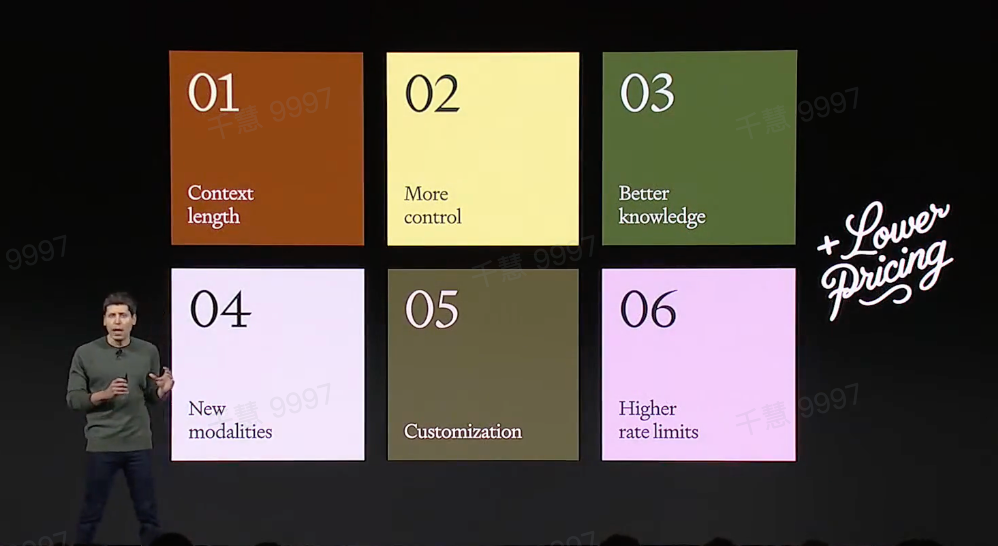
1. Longer context length: OpenAI previously offered a maximum context length of 32k. This time, GPT-4 Turbo directly increased context length to 128k — the longest available — roughly equivalent to a 300-plus page document.
2. Better API and function calling. Developers can now call multiple functions at once, with better instruction-following.
3. Knowledge base updated to April 2023. Users can now also upload external databases or files to provide external knowledge base support for GPT-4 Turbo.
4. Multimodality. GPT-4 Turbo supports OpenAI's vision model DALL·E 3 for text-to-image generation; the company also announced open-source speech recognition model Whisper V3, supporting text-to-speech.
5. GPT-4 supports fine-tuning customization.
6. Lower prices and higher rate limits. GPT-4 Turbo input tokens cost one-third of GPT-4, at $0.01 per 1k tokens (approximately RMB 0.07); output tokens cost half, at $0.03 per 1k tokens (approximately RMB 0.22). OpenAI stated this represents an overall price reduction of roughly 2.75x.
To help developers scale applications, OpenAI doubled the per-minute token limit for all paid GPT-4 users, meaning developers' costs will drop substantially. (This drew cheers both on-site and from remote viewers.)
3
OpenAI's Ambitions
"When I first saw GPT, my entire belief in foundation models was completely transformed!" Microsoft CEO Satya Nadella said at the conference.
Microsoft currently holds a 49% stake in OpenAI.
In 2019, under the crushing cost of training models, OpenAI spun out a for-profit arm with a profit cap: OpenAI LP. Shortly after, Microsoft announced a $1 billion investment in OpenAI, securing licensing rights to commercialize some of OpenAI's AI technology and integrate it into products, plus 75% of profit share until its investment was recouped.
Earlier this year, Microsoft invested another $10 billion, valuing OpenAI at $29 billion. Seven months later, The Wall Street Journal reported that OpenAI was discussing a possible share sale with investors, at a valuation between $80-90 billion. Valuation tripled. It became the world's third-largest startup, behind only Elon Musk's SpaceX and ByteDance.
OpenAI's losses reached $540 million in 2022. Founder Sam Altman mentioned earlier this year: "OpenAI expects to achieve $200 million in annual revenue in 2023, with a target of $1 billion in 2024."
That target may be reached this year. OpenAI's revenue this year is projected to hit $1-1.4 billion, primarily from consumer product ChatGPT Plus subscriptions and API calls — a stunningly fast path to profitability.
Microsoft is using OpenAI to bet on AI's long-term value. Microsoft's internal R&D spending in fiscal 2022 was $26.6 billion. Through an additional $10 billion investment to bind itself to the top AI team, this has proven, from a long-term perspective, to be remarkably cheap.
All of the above shows that OpenAI's ambitions extend beyond a single killer consumer app like ChatGPT, beyond providing large model services and back-end technical support for other AI companies, or even beyond being the AI brain behind Microsoft. Technically, its research toward AGI is driven by deep internal conviction. Commercially, its intention to make ChatGPT the core consumer productivity entry point is equally clear. Now, OpenAI wants to directly build an app marketplace facing both consumers and businesses — a one-stop shop where all user needs for AI can be solved, paid for, and delivered instantly.
Additionally, OpenAI is in discussions with iPhone legendary designer Jony Ive about collaborating on a new AI device. Sam Altman himself has invested across three rounds in AI wearable startup Humane, including this year's Series C. Last month, OpenAI was also reported to be formulating a response to AI chip shortages, with options including developing its own AI chips and evaluating potential acquisition targets.
Those who lived through the mobile internet boom will remember how the App Store's success brought Apple enormous commercial opportunity. Through app sales and in-app purchases, Apple turned the App Store into a highly profitable business that contributed significantly to the company's growth. YouTube, meanwhile, built its vast video empire through ad distribution and creator revenue sharing.
Now, OpenAI has combined both approaches, while continuing to expand outward.
OpenAI's GPTs (alongside ChatGPT, GPT-4, and the underlying large models that preceded them, and now the AI application platform) currently have nearly 100 million weekly active users, 2 million developers, and 92% of Fortune 500 companies using OpenAI's tools to build their own AI products and businesses.
This AI innovator has rapidly grown into the absolute leader of its industry. With breakneck iteration speed and continuously falling prices, it is working to keep users spending more time within its platform ecosystem — a logic that sounds familiar. All of mobile internet's wars eventually became battles for user time; user time = monetization potential. If AI-era commercial competition ultimately follows the same logic, OpenAI is now carving out territory on this new continent with few rivals.