AIGC "Peak Series" | Dr. Li Wei: The ChatGPT Tsunami — Who Gets Washed Away? Who Rides the Wave?

Insights into the AI Ecosystem and LLM Large Language Models from ChatGPT


In our previous article, AIGC "Peak Series" | Dr. Wei Li: Humanity's Linguistic "Tower of Babel" Is Complete — The Glory and Challenges of ChatGPT, we shared Dr. Wei Li's insights on what ChatGPT means for human-machine interaction, and how the Large Language Model (LLM) behind it was forged.
In this article, we share Dr. Li's unique perspectives on "How ChatGPT Is Reshuffling the AI Ecosystem" and "The Ecosystem and Applications of Large Language Models." Below are selected highlights from his talk.

01
After the ChatGPT Tsunami: The AI Ecosystem Faces a Reckoning
The immediate impact of the ChatGPT tsunami is that the NLP ecosystem faces comprehensive baptism or reshuffling. Every existing NLP product, service, or vertical must be re-examined through the LLM frame of reference.
When we old AI hands first started heatedly discussing ChatGPT internally, the first thing everyone wondered was: How could ChatGPT integrate with search technology? Could it disrupt search?
Search is traceable — every returned result has a record, and there's no real information fusion to speak of. ChatGPT is untraceable but excels at information fusion: ChatGPT essentially cannot plagiarize; every sentence it spits out is language it has digested itself. Clearly, traditional search and ChatGPT are two completely different approaches, each with its own strengths and weaknesses.
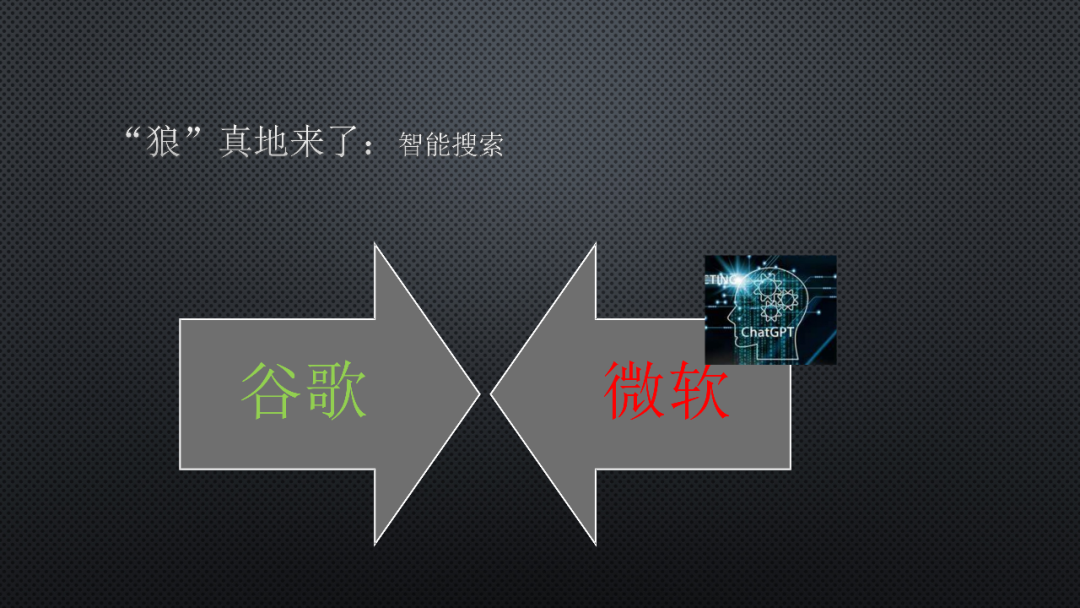
Search is the king of information services, ubiquitous, with its own giants (Google, and Baidu in China) and a very stable business model. Since search rose to prominence in the Web 1.0 era, its form and model have barely changed — for over twenty years. In fact, for years, new technologies and entrepreneurs have continually attempted to challenge search, and the venture capital world has kept an eye out for potential "next Google" search disruptors. Yet search's position has remained impregnable. But this time is different. Microsoft, armed with exclusive code licensing for ChatGPT, has made a bold, high-profile launch of so-called "new Bing." Google, which had been making money while lying flat, has been forced into emergency mobilization to meet the challenge head-on. A grand drama of search + LLM is now playing out like a live theater production, telling us that although fusing the two technologies still has many difficulties to overcome, the trend is irreversible: reshaping the search ecosystem is imperative.
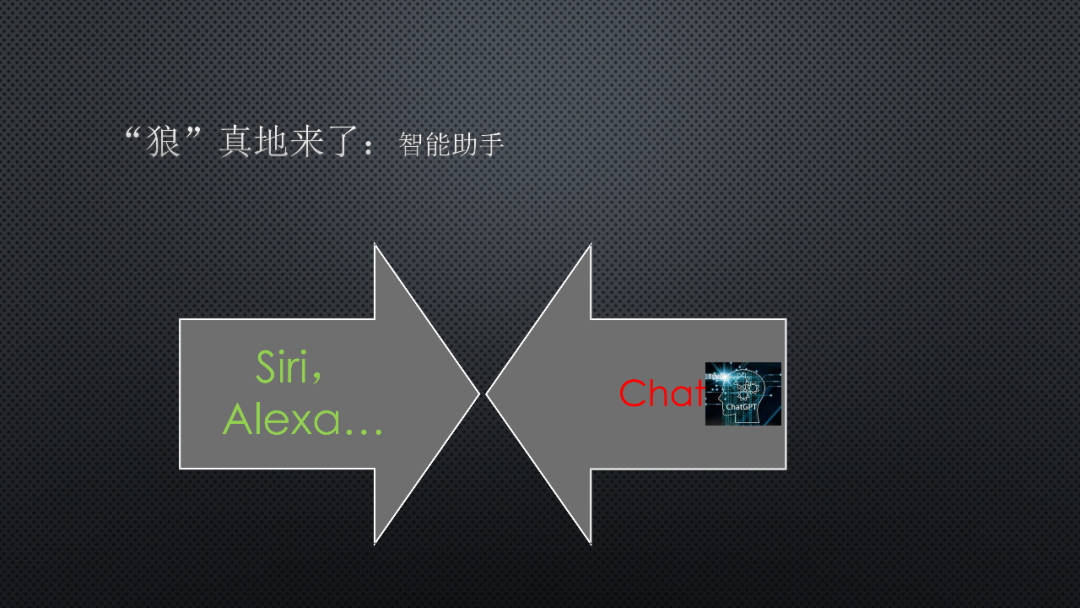
Beyond search, all those finely polished, targeted information products and services now face the same fate of being re-examined and baptized — including chat, functional dialogue, grammar correction, machine translation, summarization, knowledge Q&A, and more. The representative products in these areas (Siri, Xiaobing, Grammarly, etc.) previously enjoyed technical moats that have suddenly been lowered. It truly feels like a flood crashing through the Dragon King's temple.
Within this NLP Dragon King's temple, although many products, thanks to years of refinement and user inertia, won't face immediate extinction — some may persist for quite a while — they're all on a downward path nonetheless. This is the epoch-making victory of general-purpose AI over traditional AI. Something we previously dared not believe. We had been so skeptical of the general-purpose route, just waiting to laugh at the AGI evangelists. Who would have thought that when they finally laughed, it wouldn't be a chuckle but a laugh that topples cities — even "topples countries and the globe" — sweeping all before it.
Consider Siri, which Apple released 13 years ago. Thirteen years — longer than the golden decade of the deep learning revolution itself — yet Siri has only just rolled out two or three rounds of conversational capability. Now comes ChatGPT with its dimensional reduction attack. What's Apple to do? Embrace LLM, certainly. The same goes for Amazon's flagship product Alexa, also polished for years with massive user data accumulated. Though it's been smoothed at every edge and corner and won't be replaced overnight, it still faces technical adjustments.
Then there's the e-commerce customer service we all know well. As everyone knows, whether Alibaba or JD.com, their online after-sales service has been polished quite smooth. Because after-sales issues are relatively concentrated with a limited problem set, once enough data is accumulated, user experience gradually improves. But customer service isn't limited to after-sales Q&A. When customer questions exceed the expected problem set, current customer service often appears "artificially stupid," struggling with both comprehension and response. Faced with ChatGPT's superhuman Q&A capability and silky multi-turn dialogue, what can be done? There's no way out except to embrace it.
Before ChatGPT, Xiaobing had pushed multi-turn chat to the extreme — reportedly, some people became obsessed with chatting with it, still wanting more after a whole night. It crafted a personified image capable of emotional exchange with humans. In the pre-ChatGPT era, Xiaobing was the absolute ceiling for chat, its multi-turn interaction capability leaving competitors far behind. Who would have expected a程咬金 to burst in midway? After ChatGPT emerged, Xiaobing's position became extremely awkward. ChatGPT wasn't designed for idle chit-chat at all — chat is merely a bridge to achieve multi-tasking; its essence is a human-machine interface. Chat is just its byproduct. Even so, the general-purpose large model achieved a dimensional reduction sweep of targeted products. Before ChatGPT's silkiness and generality, a personified chatbot simply isn't on the same level. Besides embracing it, there's still no other way.
Abroad, when it comes to correcting spelling and grammar in essays, only Grammarly has done it best and survived to capture the market, with over 100 million users. Now its position is also extremely awkward, because for the same assisted writing, ChatGPT is equally adept. Looking further ahead, Grammarly's choice will ultimately be the same: either embrace ChatGPT, or head toward extinction.
Google MT represents the machine translation field; domestically, Youdao, Sogou, and Baidu also use neural machine translation. But when ChatGPT, traveling the same neural route, emerged, it was still a dimensional reduction attack. Using ChatGPT for machine translation yields more natural and diverse translations. The generative large model's stochastic nature means each translation result differs — you can feed it the same text repeatedly and pick your favorite. Specialized machine translation systems clearly face the question of how to embrace LLM.
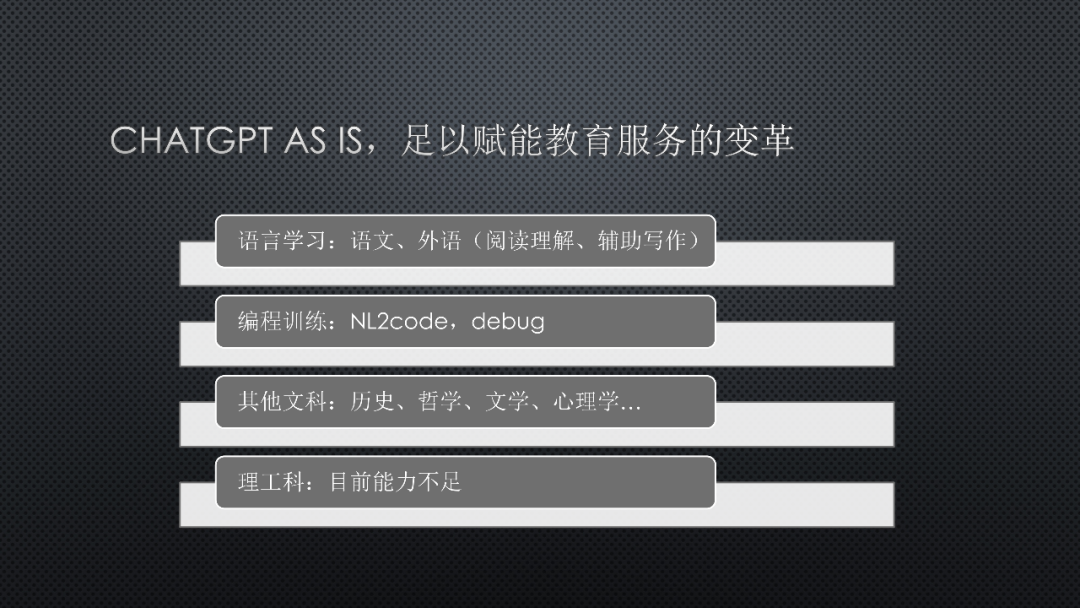
Finally, education. It's obvious that ChatGPT's large model dimensionally crushes all education products. In the education track, everyone developing ecosystem products and applications needs to re-examine how to embrace this new LLM era within the large model framework. Education itself deals with language, whether liberal arts or sciences. Though current large models aren't particularly strong in STEM, this knowledge shortcoming should be remedied to varying degrees quite soon. ChatGPT will inevitably bring disruption to education, while also providing the greatest opportunity for educational modernization. Language learning and computer programming education need hardly be mentioned — ChatGPT itself is a language large model. Though its programming currently doesn't reach professional engineer level, it has already learned common code forms quite well. At minimum, it can assist your programming; in fact, GPT-powered Co-pilot has already become an auxiliary tool for increasing numbers of coders.
Stepping back, we also face enormous risks — fake news, for instance. If you want to hype a company, you can have ChatGPT generate all manner of advertorials, speaking with apparent authority. Those Dianping reviews will eventually be drowned in indistinguishable real-and-fake comments, because the cost of manufacturing fake news approaches zero. Without good safeguards, all this will plunge humanity into a world where truth and falsehood are indistinguishable. We've been discussing the benefits, how LLM empowers the new ecosystem. I believe that under this new ecosystem, in the next five to ten years, new Alibabas and Baidus will certainly emerge — this is the big shift in the technology ecosystem from a developmental perspective. But the dangers of LLM abuse we face are equally enormous. Is humanity prepared? Clearly not. Of course, that's another topic; we'll leave it at that.
02
Large Models: A Wave of Mass Entrepreneurship Is Arriving
LLM with ChatGPT at its peak is like a nuclear weapon. With it, countless more product forms and tracks await entrepreneurs to develop and land.

On this topic, we must especially emphasize the unprecedented entrepreneurial conditions ChatGPT brings: ChatGPT itself has become a product testing ground — it is a playground with infinitely low barriers, where everyone can play. The low barrier is due to the paradigm shift in human-machine interface mentioned earlier. For the first time in AI history, machines are accommodating humans, rather than humans accommodating machines. Human language, not computer code, has become the tool for human-machine interaction. The significance of this change for the explosive growth of the NLP new ecosystem cannot be overstated. In fact, this provides the conditions for "mass entrepreneurship."
Anyone who has started an AI company should understand this. For a startup team to have a chance at success, the most basic requirement is close cooperation and communication between the product lead and the technical lead. The product lead, relying on market intuition and understanding of customer needs, strives to find the optimal market entry angle for converting technology into service, forming a product design. The feasibility of this design needs to be validated and endorsed by the technical lead. However, all too often, due to different professional backgrounds and knowledge structures, the product lead and technical lead talking past each other is not uncommon. Once this happens, the startup is basically doomed.
ChatGPT fundamentally eliminates the problem of talking past each other. Previously, only the technical lead and coders could validate a solution's feasibility. Now, product leads/CXOs, engineers, data analysts, users — people from all backgrounds and specialties — have a unified platform, ChatGPT, for exchanging product ideas. Everyone can simulate services on it. Not only is the barrier between human and machine overcome, but barriers between humans are overcome as well. This occurrence is precisely the prerequisite for product explosion and mass entrepreneurship.
In the United States, several hundred startups are already building on large models. While the upstream large models haven't fully sorted themselves out, what they're doing downstream is already work-in-progress. And countless ordinary people keep appearing online to explain how to use ChatGPT to earn 5,000 RMB in just two or three hours — this type of sharing is increasing, meaning the entrepreneurial enthusiasm of grassroots masses has been mobilized. Everyone seems able to use this opportunity to find an entrepreneurial angle. Summarizing and synthesizing these grassroots ideas may also reveal new tracks for information services that can be streamlined and scaled to meet market demand.
ChatGPT-like large models will ultimately exist at the operating system level. Every AI-related product and service, especially those concerning language and knowledge, will be inseparable from it. Back when Intel dominated, the famous logo was Intel Inside. In the future, it will be Chat-Inside — though that's not quite accurate; it should be Chat-In&Out. What do I mean? When a ChatGPT-like large model empowers a product, it is both the waiter and the chef. The waiter can take your order, engage in dialogue, understand your needs; at the same time, it does the work itself, satisfying your information needs, and delivers too. Both surface and substance, using both its linguistic genius and its knowledge skills.
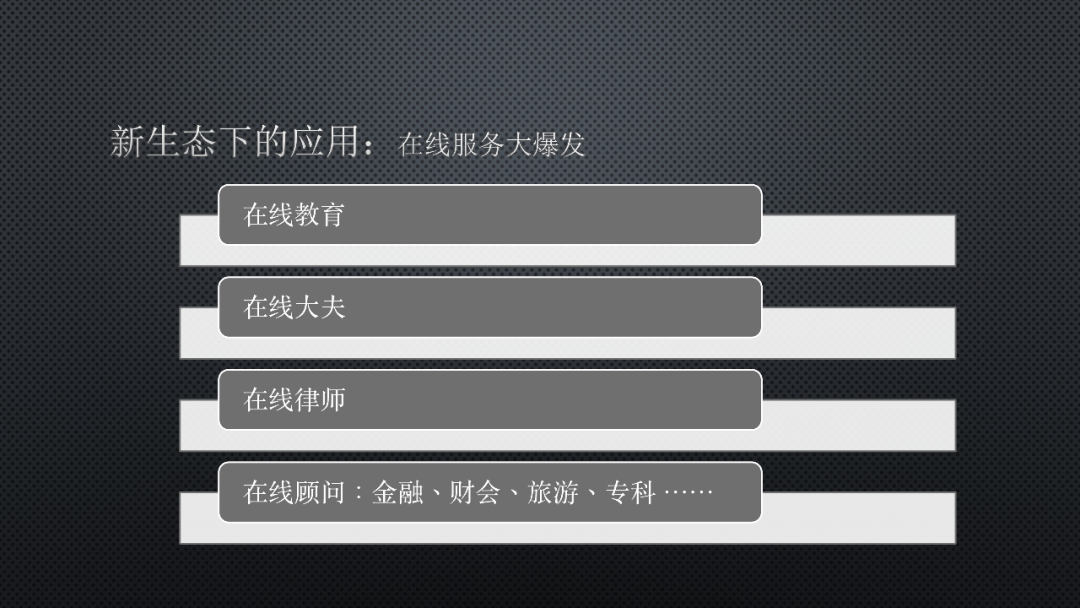
This is what I call the new ecosystem form that may see the greatest development in the next five years: the LLM expert workstation ("zuotai"), which may open countless entrepreneurial doors. The basic service form is online information services across all industries — whether online education, online legal, online consulting, online finance, online travel — all aimed at dramatically improving service efficiency. With ChatGPT, you only need to hire one expert to replace tasks that previously required 10 or even 100 experts, ultimately ushering in a productivity explosion.
At this point, the application ecosystem is clear and reliable. The principle is that experts must have final say on results (human judge as final filter). This is the most basic setup, though it doesn't exclude experts tuning input prompts to elicit better LLM responses.
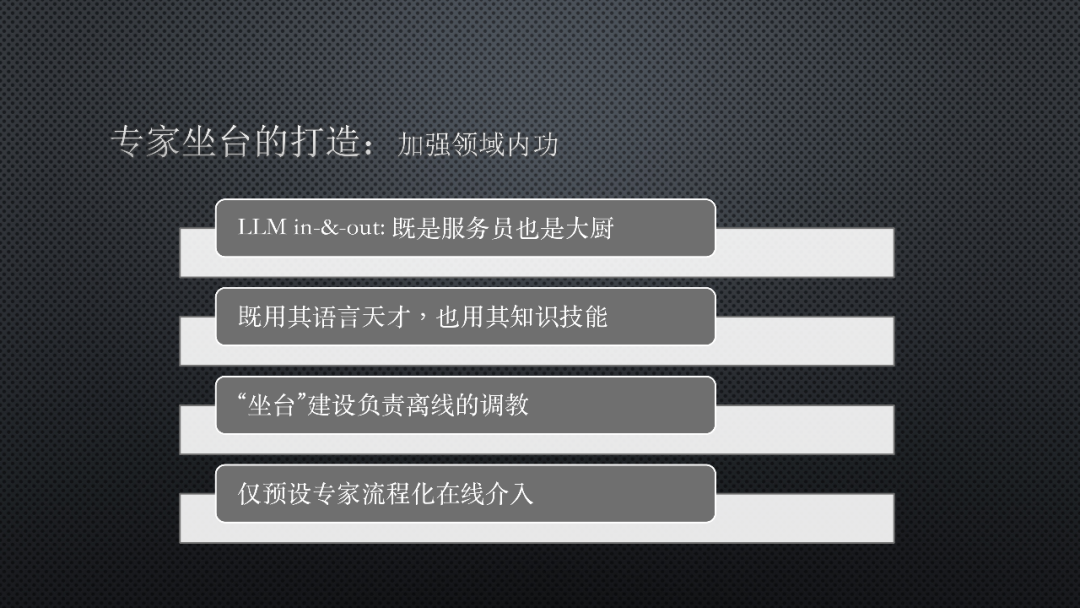
For nearly every scenario application, there is a task of building an expert workstation ("zuotai"). Downstream entrepreneurship following this thinking has countless market entry opportunities, including supplementing deficiencies in existing products or services — for example, every细分场景 in online education, plus online doctors, online lawyers, online financial consulting, etc. — as well as pioneering previously unimagined or unconsidered business scenarios. This is the visible, imminent great transformation or reshuffling of ecosystem form, offering efficient expert advice (expert-in-loop services).
Speaking of zuotai, domestic e-commerce giants have previously built customer service zuotai at considerable scale. These emerged under pressure when user needs and satisfaction couldn't be met by fully automated solutions, nor could they be handled by fully manual approaches. Now with LLM, the conditions are ripe to extend this form to all online service domains. The productivity explosion this can bring exceeds imagination.
The "Human as judge" design philosophy has already proven its effectiveness and efficiency in low-code platforms of recent years (e.g., RPA platforms, parser-enabled information extraction platforms, etc.). My latest patents specifically address this process (human as judge to replace human as coder). But that was in the context of low-code rapid development environments, where this human, though not needing to hand-write code, still had to be familiar with software development processes like unit testing, regression testing, and debugging — not merely serving as judge. What we're discussing here is a completely new form, where human only needs to judge to complete the service. It is now entirely possible to build online information service "zuotai" targeting various细分赛道 or scenarios. Specifically, the expert's role is only at the final go or no-go moment, using their knowledge and experience to make the determination. Being referee rather than athlete is vastly more efficient.
Worth emphasizing: what's fresh about ChatGPT's emergence is that it serves both back-end and front-end. This is like seeking a marriage partner — usually the beautiful ones lack substance, the capable ones lack beauty. Suddenly arrives someone both "all-capable" and beautiful. This cannot but stimulate the imagination of countless suitors to the limit. We information industry entrepreneurs are ChatGPT's suitors. "Presentable in the parlor, capable in the kitchen" — that's ChatGPT, because chat is only ChatGPT's surface; its essence is human-machine interface, while its ability to complete various NLP tasks is its substance. With both surface and substance, downstream ecosystem products and services can be built around it. In the Intel era, computer product brand advertising featured "Intel Inside." The new ecosystem going forward should be called "chat in&out," referring to LLM-empowered new ecosystems that empower not just the surface of human-machine interaction, but equally — or more importantly (depending on the nature of the specific落地 service) — the substance of product services, with only the expert's final check. In this form, the expert still remains behind the scenes. That is: the work is delegated to it, the delivery is still by it, with only an expert supervisor and arbiter positioned behind. To use another analogy: LLM is both waiter and chef, only before serving, a manager gives it a look-over to ensure service quality and bear responsibility (e.g., online doctors, online lawyers, online consultants, etc.).
Under such an ecosystem, the next five years will be a period of great explosion in online services. Coincidentally, the three-year pandemic has also greatly promoted grassroots awareness of online services, helped cultivate users' online habits, and nurtured the market. Personally, for example, I never used food delivery apps or online doctors before the pandemic, but now I use both. Compared to previously going to restaurants to order takeout myself, or making clinic appointments for a common cold, the convenience is incomparable — I never want to return to the previous inefficient offline services. With the right timing, location, and momentum, the new ecosystem cannot lack opportunity.
How to build a zuotai? Since it's already LLM in&out, it sounds like anyone can build one, with an expert for each zuotai, opening for business online tomorrow — then what room is there for entrepreneurs? Of course it's not that simple. This is because ChatGPT-like LLM as work horse displays potential in various professional knowledge domains, but this potential is riddled with holes and internal injuries. These injuries were discussed earlier; under the current route, they are fundamentally incurable. That is: shiny surface, but the substance isn't solid, results are unreliable, even potentially fatal. The construction of zuotai aims to address this problem: how to strengthen internal capabilities so that online services require only streamlined expert intervention, not productive expert input (as in RPA). What's desired is result review at the output end after zuotai deployment (go/no-go and post-editing) — these are online interventions, not offline tuning (fine tune). Offline tuning is the zuotai builder's task, which begins to enter the deeper waters of the new ecosystem. Some roadmaps here are quite clear, some can be foreseen to be solved soon, and a smaller number of points remain unclear, needing exploration and further validation.
Let's examine in detail where the main problems lie, and what possible breakthrough points and solutions exist. First, regarding breadth of professional knowledge, LLM is formidable. No way around it — strong memory, big appetite, digested vast amounts of material, all exceeding what any expert can manage. You can test it with specialized terminology in any domain; LLM will have its own digested summary for any obscure, narrow topic, comprehensive and systematic. There may be minor errors in details, but in terms of comprehensive coverage, it crushes experts. Why this matters: LLM compensates for human deficiencies, including experts'. In software terms, humans have precision to spare but lack recall; LLM is the opposite — precision insufficient, recall abundant. LLM can dredge up potentially overlooked items from big data's black hole, bringing them onto human cognition's radar at any time. Therefore, the top priority in zuotai construction is overcoming LLM's precision bottleneck.
We're not attempting to completely solve this problem: to be frank, if completely solved, there'd be nothing left for humans to do, with诡异 prospects — let's not go there. We aim to improve precision to the point where results don't seriously impact the online expert's work efficiency. If LLM bombards experts with garbage, that certainly won't work. As long as 1/4 of LLM's output reaches the level of manual expert research, the zuotai's efficiency is guaranteed, and this online service can stand. Because the expert is merely making four go/no-go determinations, and since the optimal solution among these four appears randomly, the expert's actual work experience is roughly approving one out of every two results they review. Go! This isn't burdensome, nor does it reduce online service efficiency or competitiveness. 1/4 is a very容错性大的 expectation; current refinement schemes reaching this threshold are generally feasible. Precisely because of this basically feasible overall judgment, we can conclude: the entrepreneurial doors under the LLM new ecosystem are indeed open.
"Together for a Shared Future" AIGC Series — Third Session
Coming soon, stay tuned~