MaHui | Chinese AI Founders' Existential Choice: Models First or Applications First?

At the 2025 MaHui Investor Annual Meeting, a debate unfolded over the critical choices facing China's AI entrepreneurs...

Amid the turbulent tides of technology, China's AI entrepreneurs face a strategic choice that will shape long-term value and commercial landscapes...
Recently, at the 2025 MaHui Investor Annual Meeting, a debate on "Path Choices for China's AI Entrepreneurship" kicked off.
The "Source" team — Yang Chen, VP at Galaxy Universal; Yuwei Hu, CFO at Meshy; and Yinchuan Li, founder of Nuoyin Intelligent — represented "Model First." The "Code" team — Xiuhann Hu, founder of NieTa; Binson Liu, founder and CEO of LynkSoul; and Yungang Huang, managing partner at Source Code Rhythm — represented "Application First." Lulin Li, AI investor at Source Code Capital, served as moderator.
Model vs. Application: which path can better "Go Big," which path lets Chinese entrepreneurs go further? Li opened with a sharp question. As an AI investor, she said, this topic crosses her mind hundreds of times daily. "'Go Big' is never about blindly chasing scale. It's about building a high-quality future through deep insight into business models and fundamental laws, creating lasting, genuine value."
Before the debate began, the audience cast initial votes, and Application First won by a landslide.
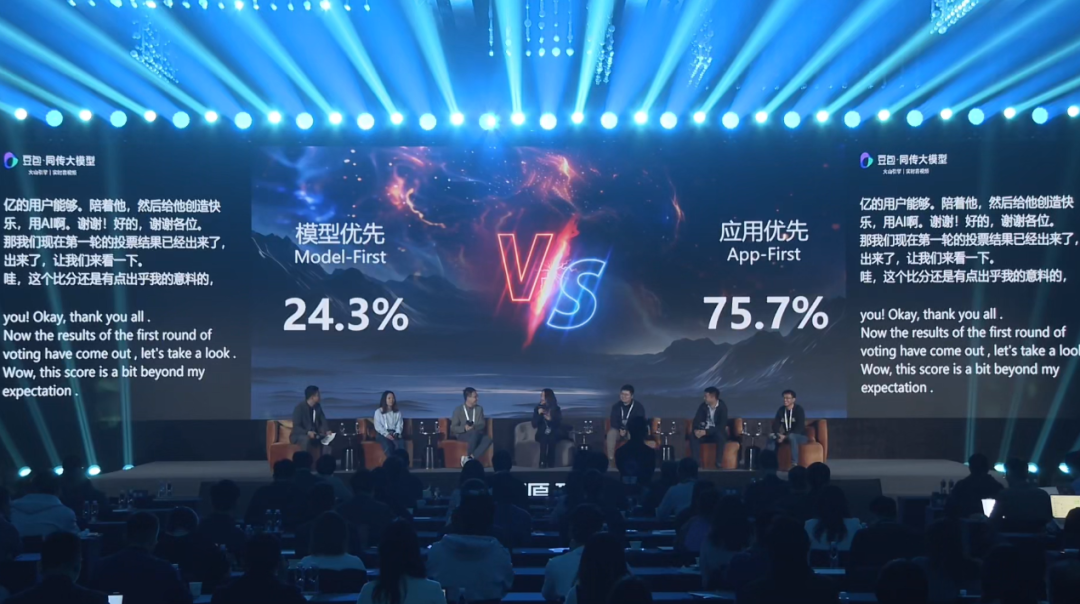
Over the next hour-plus, six guests engaged in a candid and intense exchange of ideas, covering window periods, evaluation metrics, business models, and technical paths.
Will the ending match your expectations?
Below, the distilled essence, preserving original intent:

"'Go Big' isn't merely about expanding scale — it's about the depth and breadth of value. Please introduce your company's positioning, and share your unique vision for 'Go Big': how do you define 'better business model' and 'longer-term user value'?"

We focus on embodied general-purpose intelligent robots. Our "Go Big" vision is built on the general embodied intelligence large model we've developed, achieving deep service penetration across thousands of industries. The ultimate goal is for these intelligent agents to become not just key labor forces in industrial production, but to enter hundreds of millions of homes with high cost-performance and reliability.

We provide AI-driven 3D generation tools, currently serving millions of users globally. Our understanding of "Go Big" is to become the standard-setter and infrastructure for 3D generation. When any user — whether professional creator or ordinary consumer — has a 3D generation need, Meshy should be the first name that comes to mind. This means our technology must achieve extreme productivity efficiency and irreplaceability, defining the next-generation workflow for 3D digital asset creation.

As a consumer-facing home robotics startup, Nuoyin's "Go Big" manifests in deep market penetration and user mindshare: through full-stack self-development, achieving tens of millions in global shipments, making Nuoyin intelligent robots a household "necessity" rather than just a "novelty." This large-scale, high-frequency deep engagement embodies long-term value.

We help young people shape AI avatars and create fantasy content. We want NieTa to become an online, AI-driven "Disney," incubating new cultural IPs and social ecosystems through technology-enabled virtual identities and interactive experiences. "Go Big" lies in unlocking the immense commercial value of user imagination**, building an AI-driven, UGC-centric virtual cultural stronghold. Ultimately becoming young people's own infinite life experience.

I'm Yungang Huang from Source Code Rhythm, representing the early-stage investor perspective. For me, "Go Big" boils down to one sentence: "Invest in the great companies of the AI era**."** Greatness doesn't necessarily show in a single metric, but in continuously creating value over the long term, with sufficiently deep moats.

We make AI gaming companions, called "HakkoAI" overseas and "Doudou Gaming Companion" domestically. The goal is through deep understanding of specific scenarios, to give players a true AI companion that truly gets them during gameplay — we currently serve over 15 million users. Our "Go Big" is providing AI companions for gamers worldwide, bringing them joy.
01
Round One: Survival and Moats — Deadlocked on "Window Period" and "Innate Advantage"
Lulin Li, Source Code Capital | Moderator: Whatever path you choose, "survival" is the prerequisite for "Go Big." What do you see as the "window period" you absolutely must seize? And how will your greatest "innate advantage" or moat ensure your long-term competitiveness?
Yinchuan Li, Nuoyin Intelligent | Source Team/Model Team:
As a consumer-facing home robotics company, our core moats are two: first, full-stack self-development capability. This shows not just at the model layer, but in hardware cost control and supply chain optimization — bringing comprehensive robot costs into ranges consumers can accept, while delivering good experiences. Second, we have strong large model data flywheel and self-development capabilities (including new architectures), truly solving household needs.
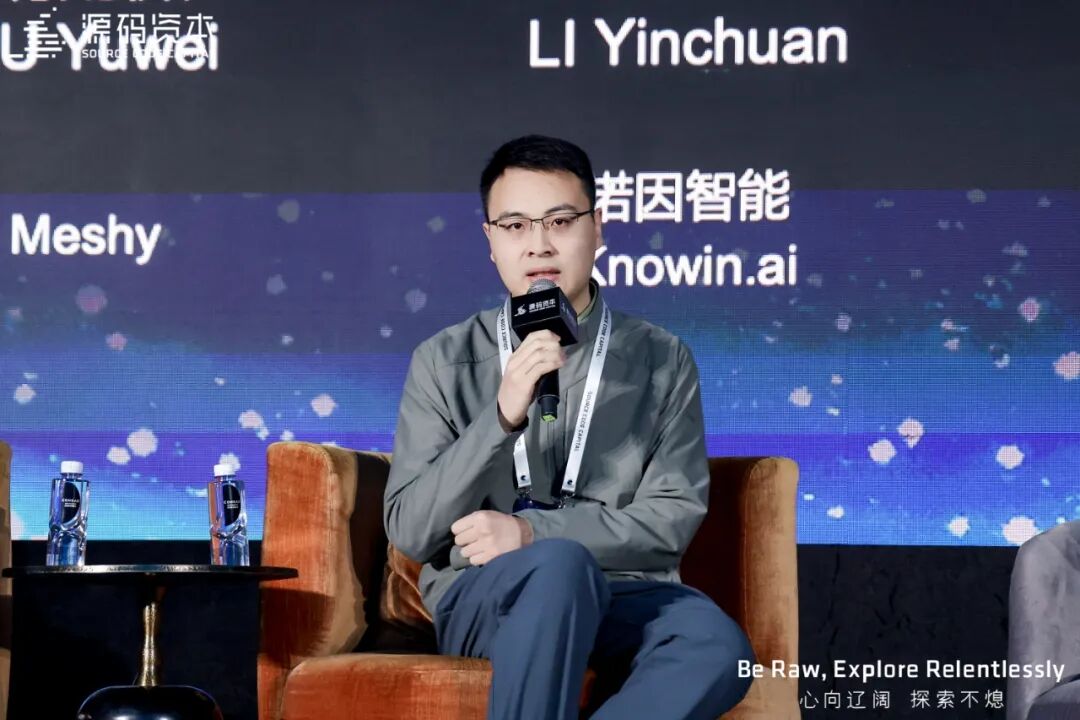
Yinchuan Li, Founder of Nuoyin Intelligent
Galaxy Universal Yang Chen | Source Team/Model Team:
Our innate advantage lies in years of accumulated robotics industry experience and a world-class embodied intelligence scientist team. The embodied intelligence track remains early-stage; we hope to convert current technical breakthroughs into industrial appeal, widening the "technology window" into an "industry door," ultimately becoming a "triumphal arch to the future." At this stage, our mission is enabling true large-scale robot deployment through our synthetic data technology, then exploring more embodied intelligence technologies to broaden this path.
LynkSoul Binson Liu | Code Team/Application Team:
We believe the biggest window is capturing AI model dividends, accumulating user insights — especially data — then forming data flywheels. AI changes too fast; the most important moat is rapid iteration capability, and forming ecosystem moats — data, upstream/downstream partners, brand recognition, and user mindshare.
NieTa Xiuhann Hu | Code Team/Application Team:
I believe the most precious asset right now is that group of "new creators" traditionally overlooked by conventional applications — they may not excel at visualization or concrete expression, but are incredibly gifted at "worldbuilding" and "imagination." In our community, we already have eighty to ninety thousand such creators shaping their own characters, building their own worlds.
I believe they're the ones who can truly amplify AI model dividends. As models grow stronger, with models like Sora emerging, plus compute costs potentially dropping to near mobile internet-era traffic fee levels, this category of applications will see true explosive growth.
Meshy Yuwei Hu | Source Team/Model Team:**
Many application-first examples mentioned just now are indeed industries built on already-capable large models. But for us, 3D AI currently has no fully usable off-the-shelf large model; traditional CG production speed can't keep pace, so we must start from models. For us, we need to define the "standard" for 3D generation within three years. Enabling ordinary users to start from zero and conveniently build whatever they want through 3D generation.
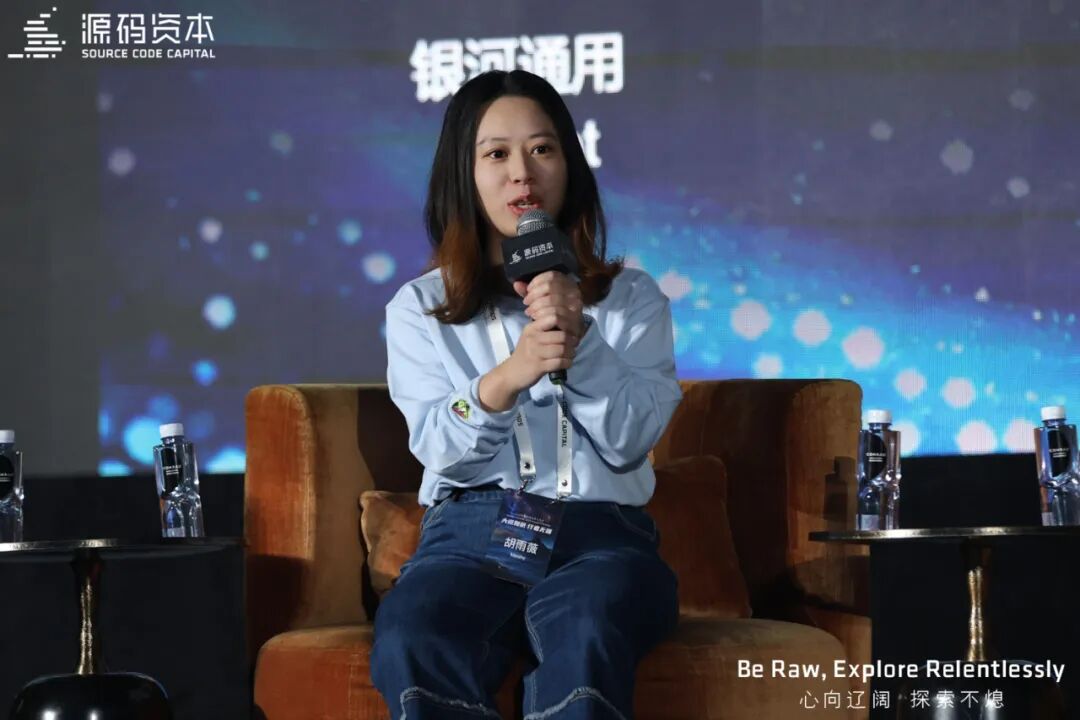
Yuwei Hu, CFO of Meshy
02
Round Two: Proof of Grounding — "Metrics You Can't Fake"
Lulin Li, Source Code Capital | Moderator: I'd like everyone to speak candidly — how do you evaluate your PMF and best practices? What are the "metrics you can't fake" internally? Which commonly used internet-era metrics no longer work for you?
NieTa Xiuhann Hu | Code Team/Application Team:
Shifting competitive environments have invalidated many internet metrics. Back then was an incremental environment; attention was easier to capture, content was scarce. Now it's hard to "infer preferences in three clicks" as before.
In our new social/content creation scenarios, there's a common misconception: people habitually view all experiences through a "tool-goal orientation" — only looking at final output quantity and quality.
But in our product format, the generation process itself holds value. So internally, I care more about user participation frequency during generation, "battery consumed" — meaning how often and how willingly users actively create here.
Simply put, we quantify whether users are willing to continuously "invest creativity"**.
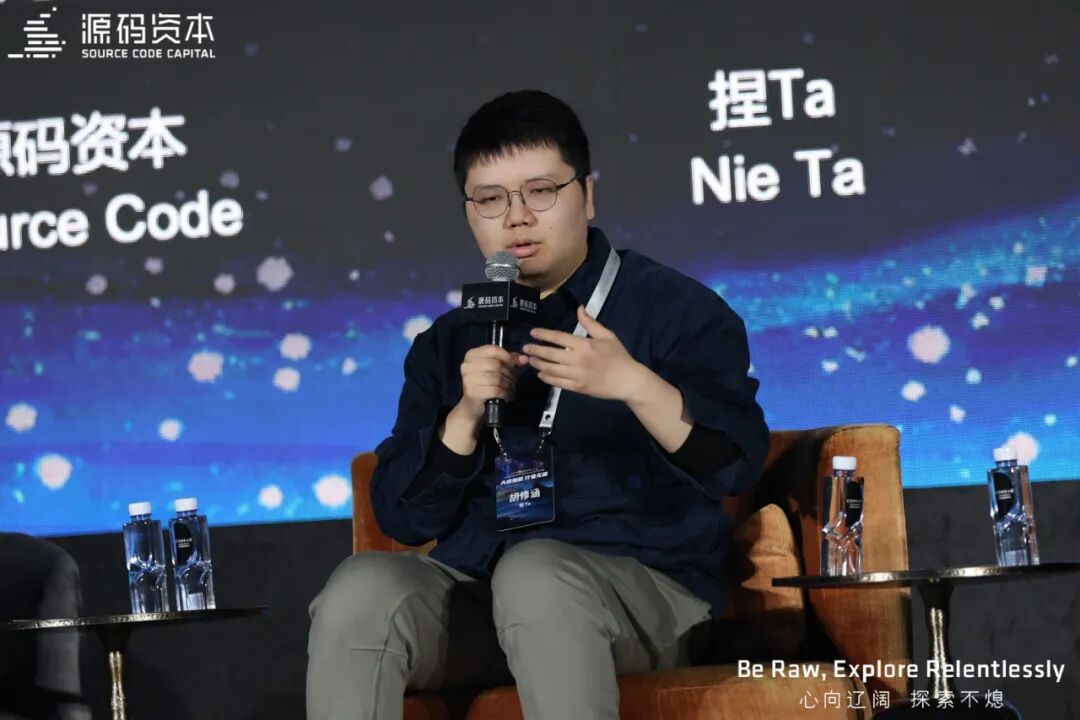
Xiuhann Hu, Founder of NieTa
LynkSoul Binson Liu | Code Team/Application Team:
I think many "classic metrics" from the internet era truly no longer hold. Take AI chatbots — many people used to obsess over daily conversation turns, conversation duration. But from a true user experience perspective, the ideal is: I ask one question, you clarify all related issues, answer everything at once, give results directly. In this case, solving the problem in one turn is optimal experience**, fewer turns is better, not more.
By the same logic, the "MVP, small steps, rapid testing" approach popular in the internet era often doesn't fully apply today — technology itself changes too fast; you've just validated a small version when model iterations may have overturned half your assumptions. Meanwhile, what doesn't work or isn't viable now doesn't mean it won't be in the future, because technology advances rapidly.
For us, what matters more is whether users are truly using AI companions to solve actual gaming problems, whether they actively ask us to support more games and scenarios. These behaviors are far more real than conversation turns or duration.
Yungang Huang, Source Code Rhythm | Code Team/Application Team:
From the early-stage investor perspective, I'm increasingly sensing a key shift: over the past year, more and more startup teams need only 3-5 people to build decent AI applications, costs far lower than the previous generation of entrepreneurship. Marginal returns on model pre-training are declining; instead, post-training, problem definition, and scenario selection have become more critical.
Yinchuan Li, Nuoyin Intelligent | Source Team/Model Team:
From the home robotics perspective, early-stage PMF focuses on what different demographics are willing to pay for robots, what capabilities they value. Later stages focus on whether real household needs are being solved — including robot shipment volumes, daily household usage frequency, usage duration, etc.
Many traditional metrics also no longer apply. From the hardware-software integration perspective, for example, early-stage people focus heavily on "gross margin," but for home robots, initial hardware costs are necessarily high — as long as real user pain points are solved, costs will clearly decline as the industry develops. This may differ from gross margin evaluation in more traditional smart home appliance sectors.
Yuwei Hu, Meshy | Source Team/Model Team:
From the 3D generation perspective, we track time spent and stickiness among power users — are they just playing around and leaving, or truly using us as a productivity tool, spending several hours daily generating models directly usable in production. And the complexity of models they generate — do they casually try an idea, or directly generate highly complex, rigged models for production use here.
Yang Chen, Galaxy Universal | Source Team/Model Team:
We're ToB-scenario robots; they're not products or tools but direct labor force. From this PMF perspective: one, will employers pay for them; two, do their colleagues find them useful, any complaints; three, will the clients they serve pay, any negative feedback.
Many internet metrics were never mentioned in our entrepreneurship, but today's opportunity makes me reflect that we could more openly introduce internet product elements to measure robotics products. Frankly, the robotics industry overall still lacks excellent product managers, making the matching efficiency between technical capability and market demand quite low. Going forward, we could consider more openly exposing model capabilities, using massive user real feedback and interaction to determine resource investment direction, achieving product-oriented reverse driving.
Open Debate: Hold Your Ground, or Defect?
Lulin Li, Source Code Capital | Moderator: Now for today's liveliest segment — open debate. The rules: each side's guests explain "why I believe my path should be the first moat to build." For example, the model team explains why models should come first. After one side finishes, the other immediately sends someone to battle — first come first served, whoever grabs the mic speaks first. Alright, 3, 2, 1... Binson goes first!
LynkSoul Binson Liu | Code Team/Application Team:
The vote already showed the issue. We believe Go Big means earning enough users, enough profit. Looking at past tech revolutions — electrification, the internet — infrastructure came first, but ultimate winners were applications across industries. This AI round is the same. Mr. Chen just mentioned what's most lacking now is product managers. What do product managers do? Applications, not models. I want to ask the other side: models are extremely homogenized now, how many will ultimately survive? Can they earn enough profit?
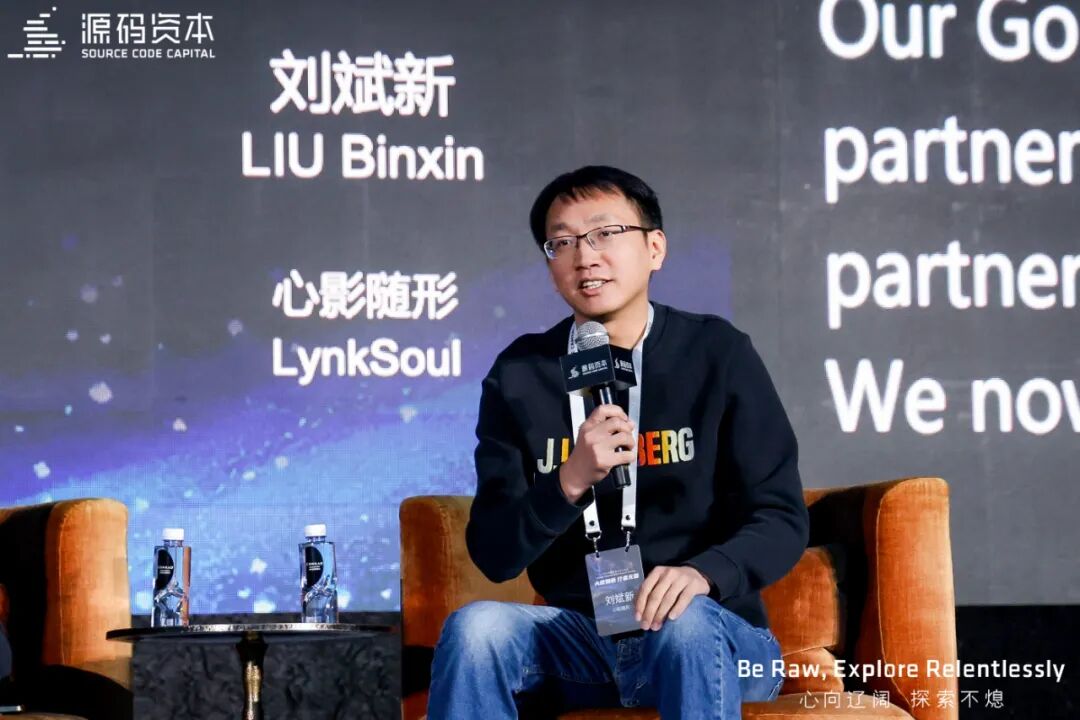
Binson Liu, Founder and CEO of LynkSoul
Galaxy Universal Yang Chen | Source Team/Model Team:
I completely reject the notion that profit is a core element of Go Big. Who has the most profit? Livestreaming counts. Do you see any livestreaming company that's truly a very big company? So everything is based on models. Our robotics industry differs from large models — because our foundation models aren't mature yet, we're all building foundation models. Robotics has been around twenty-plus years; before it was application-first, all kinds of AGVs, sorting systems — why didn't they Go Big? Because nothing could connect applications. At this stage, models are what connect applications. Model technology lets more needs converge on one technical foundation; continuously improving this foundation enables Go Big.
NieTa Xiuhann Hu | Code Team/Application Team:
As a whole, oligopolized infrastructure enterprises, lacking sustained excess profit — is that an acceptable Go Big definition? We face the entire industry, always hoping to maintain excess profit, maintain discourse power to define the track and continuously iterate. In the previous internet generation, core technical transformations like recommendation systems were completed by application companies finding sustained data flywheels in suitable scenarios. Short-term general large model definition might help companies get better entry points, but Go Big must ultimately be answered at the application layer.
Yinchuan Li, Nuoyin Intelligent | Source Team/Model Team:
Today we're debating how to "Go Big," but it sounds like you're talking about how to survive. Company valuation growing 3-5x versus 10,000x — completely different concepts. True "Go Big" is entirely creating new categories, capturing consumer mindshare. Any AI enterprise with potential to reach trillion-scale relies on extremely strong R&D and underlying model capabilities, not mere user growth. AI is more productivity tool than social application, so it's hard to monopolize consumers; consumers are more willing to pay for the best productivity.
NieTa Xiuhann Hu | Code Team/Application Team:
The opposing side transformed the question into who's more important later-stage, but our debate topic is application-first or model-first. We don't deny that later-stage application companies can incubate core technical modules. But the core issue is: lacking application scenario definition, we can hardly perceive new demands enabled by new technology. In the AI era, new demand is always the most important element for Go Big. In times of massive technological transformation, we speak of generations, demographics, shifts in resource allocation power. The greatest opportunity manifests in new demands from new demographics. How to observe what new things they do under new technology — that's what "first" means.
Yungang Huang, Source Code Rhythm | Code Team/Application Team:
Our Code team discussed this internally. Now language model pre-training's emergent capabilities show diminishing marginal returns. For model vendors, to break through certain capabilities, they need to find scenarios and applications. Where returns are currently higher is post-training, especially RL. How to clearly define tasks? Find applications. Otherwise the data you obtain, other model vendors can also obtain — your model won't be better than others.
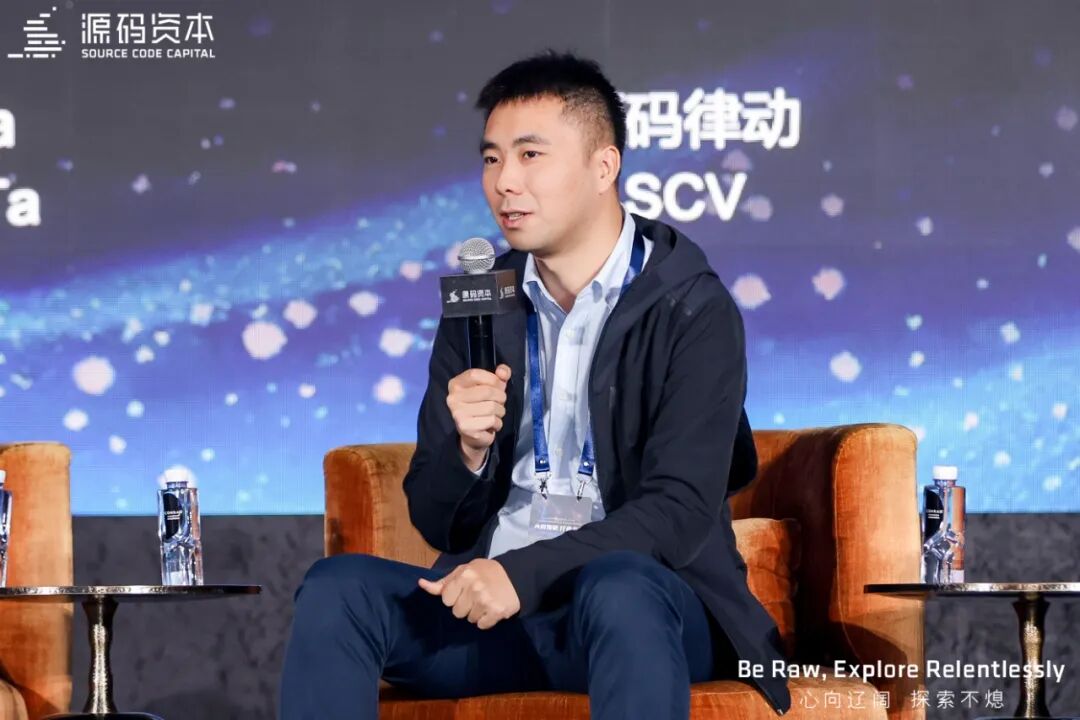
Yungang Huang, Managing Partner of Source Code Rhythm
Galaxy Universal Yang Chen | Source Team/Model Team:
Today's topic is interesting — model-first or application-first. First, today's robotics industry and traditional internet industry have different model states and application states. For robotics, it's definitely model-first today, because mature foundation models don't yet exist — there's virtually no talk of applications. Second, GPT-2 and GPT-3 had some application-capable features, but by GPT-4, many GPT-3 applications died — because model-first later directly built out those capabilities. If discussing Go Big as the goal, models must come first to open the entire market scale.
Yuwei Hu, Meshy | Source Team/Model Team:
Our biggest difference from the internet era is — AI development now changes too fast, leaving applications less time.
Yinchuan Li, Nuoyin Intelligent | Source Team/Model Team:
Truly high-return industries are often emerging industries, with core opportunities actually hidden in new demands. If new demands exist but no ready models can satisfy them, then without first building the model, where would subsequent applications come from? If demands can be satisfied by a model through simple post-training, that's not new demand — probably just small demands that large model vendors or internet companies are unwilling to address.
Yuwei Hu, Meshy | Source Team/Model Team:
To add, model development investment is relatively internally controllable, but application costs paid to large model vendors may be less controllable.
LynkSoul Binson Liu | Code Team/Application Team:
We don't need to directly call APIs. We can deploy open-source models ourselves — we're not paying taxes to models.
NieTa Xiuhann Hu | Code Team/Application Team:
If a model's core elements mainly come from new scenarios, advancing the model through establishing rewards and human data feedback within them — then essentially the other side is also supporting our application-first view.
Yungang Huang, Source Code Rhythm | Code Team/Application Team:
There's a constraint condition in today's scenarios — should Chinese entrepreneurs start from models or applications. China's resources are generally scarce; past language models had six or nine "little dragons," but now truly doing models requires massive investment. Will robotics embodied models face the same situation?
Galaxy Universal Yang Chen | Source Team/Model Team:
On China's track, there is indeed a window period. We need to capture more resources to guarantee our technical path and long-term development stay at the industry's core. But for robotics, we must first build the foundation model before considering application-layer matters. Definitely model-first.
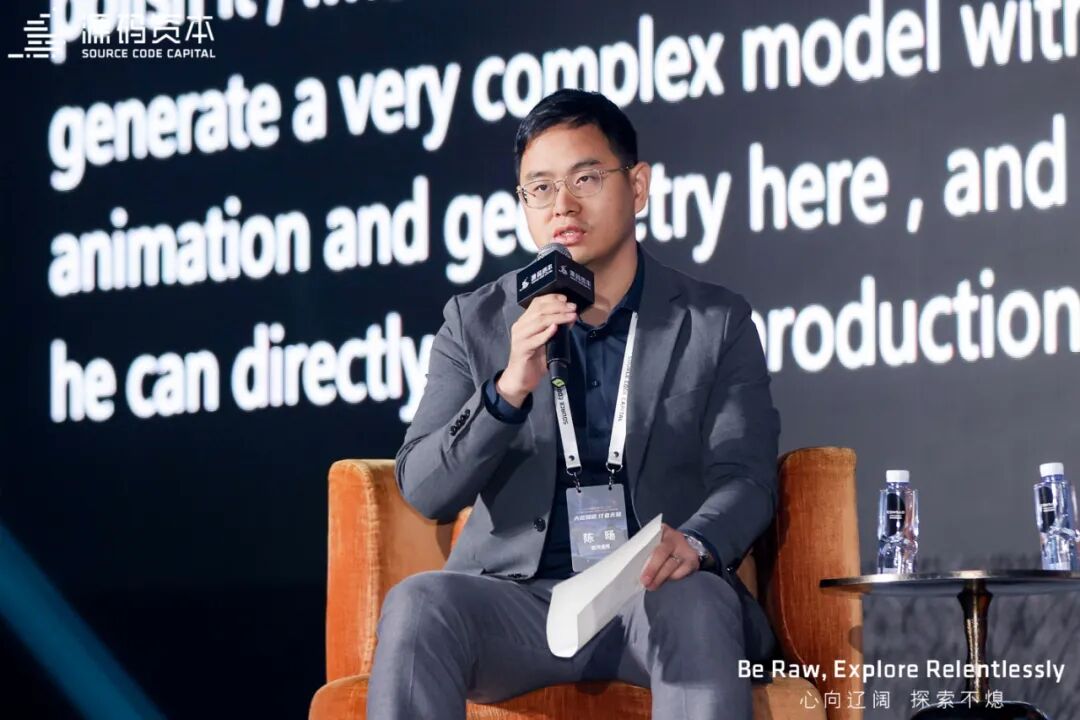
Yang Chen, VP of Galaxy Universal
Yinchuan Li, Nuoyin Intelligent | Source Team/Model Team:
Many examples just cited were large language model-related cases. But in robotics, embodied intelligence — we aren't behind the United States; we're at the same starting line. Meanwhile, our industry's compute is sufficient — because at the starting stage, embodied intelligence doesn't have as much data as large language models; any company has enough resources to train models. On this equal starting line, for the next three years, model-first will definitely bring more opportunities.
Yungang Huang, Source Code Rhythm | Code Team/Application Team:
Haha, defecting a bit. Language models are better approached from applications; embodied models need models first, it's truly too early. For us, both model-first and application-first — we'll invest in both, the key is who can Go Big.
Closing Statements: AI, by Everyone, for Everyone
Moderator | Lulin Li, Source Code Capital: Alright, we're handing initiative to the live audience for round two voting. Please take out your phones and scan again. The final results are revealed — somewhat surprising, from Application's initial landslide to Model 53.2% vs. Application 46.8%. Now we'll ask each team to send one representative: first, your reaction to this result; second, a summary; finally, one sentence for everyone journeying together on the AI path.
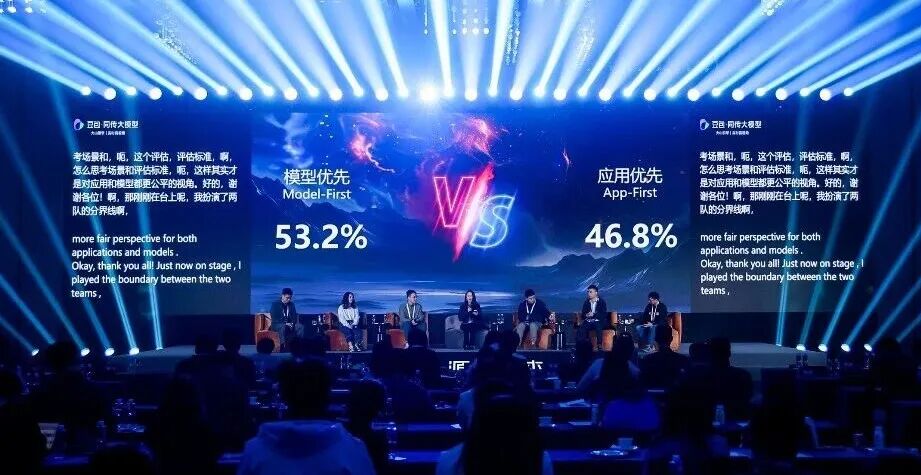
Final score: Model team overtakes Application team
Yinchuan Li, Nuoyin Intelligent | Source Team/Model Team:
This result was somewhat expected. People may habitually feel application innovation is more important, but gradually realize that in AI, the focus should be on models. This actually relates to an inevitable trend in China's tech circle development — entrepreneurship ultimately comes down to talent competition. After returning from studying in the United States, I joined a domestic research institute, and in my growth process clearly felt one change: before 2015, AI was basically America influencing China; in the decade from 2015 to 2025, this situation transformed dramatically. You can see it in AI top conference acceptance author numbers — now most AI talent is actually concentrated in China itself. With so much talent gathered, we have sufficient strength to develop quality models, create uniquely pioneering user experiences, and seize new tracks. This talent gathering, technology breakthrough momentum will become increasingly prominent over the next five to ten years. In the future, on China's track, more companies capable of "Going Big" will inevitably emerge, and these companies will attract global talent through superior culture.
NieTa Xiuhann Hu | Code Team/Application Team:
This result didn't particularly surprise me. I happened to do robotics in school, SLAM and other foundational things; my career has mainly been application-focused. I can understand that with huge first-mover possibilities, people place high importance on models.
In our Go Big application process, we inevitably think clearly about models, define our own post-training, define final demand optimization objectives. On one hand we speak of new demands, but on the other hand all demands are actually old demands, just new scenarios enabled by technology. So in the process of technology enabling new scenarios to solve old demands, the model variable also plays a role.
But we think about: in one scenario, from one demand angle, how to see users? How to thoroughly experiment and think about users first? This may be where the model side currently lacks strength in resources and direction. We hope the entire industry can define the problem as: how to think about scenarios and evaluation standards. This would be the better perspective for both applications and models.**
Lulin Li, Source Code Capital | Moderator: Just now on stage I played the boundary between two teams, but in daily work, I prefer to be a bridge. Because today's debate tells us this isn't a zero-sum game of life and death — without models, applications are water without a source; without applications, models are castles in the air.
AI is by everyone, for everyone. This is an industry discussion among builders of different paths, testing each other and providing mutual inspiration, under massive uncertainty yet infinite possibility. Thanks again to our six guests, thank you all, and thank you everyone here.
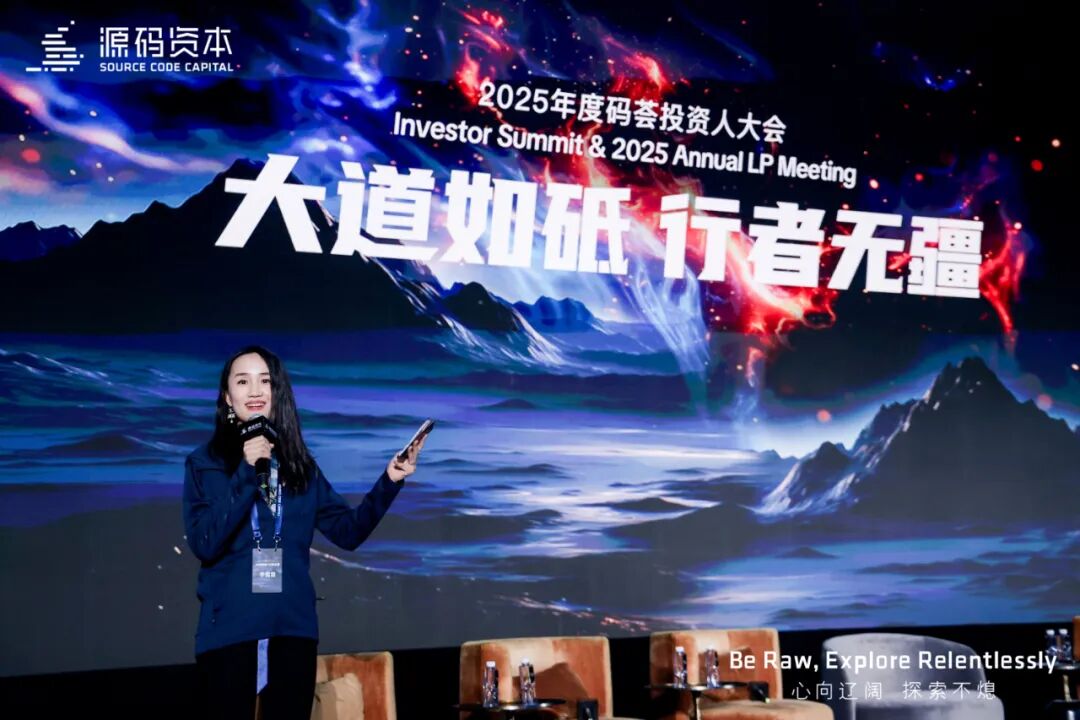
Lulin Li, AI Investor at Source Code Capital