Code Brain | The App Store Changed Everything Fifteen Years Ago. It's Time for a Reset.

This is the only way for the App Store to sustain its next 15 years of prosperity.

Last year, Apple and Epic Games, the developer of Fortnite, each petitioned the Supreme Court to intervene in their antitrust dispute. A week ago, on Tuesday, the Supreme Court rejected both petitions. This decision means third-party apps can now promote subscription options to Apple users outside the App Store — such as paying directly through their websites — without Apple taking a cut. For users, it means lower prices.
The author, Christina Warren, is an American developer advocate, podcaster, and writer. In this article, she traces the history and impact of the App Store. At this new inflection point in business history, she also explores where the App Store might be headed.
When the first iPhone launched on June 29, 2007, it came with just 15 native apps and no third-party ones whatsoever. For consumers and skeptical tech media, this was clearly inadequate.
Apple encouraged iPhone users to make do with limited "web apps" as substitutes for the native apps already available on other platforms, including Palm, Windows Mobile, and BlackBerry. Users and developers didn't submit. In just over a month, the iPhone was "jailbroken" — freed from manufacturer restrictions to install unauthorized software — and the first third-party game appeared. Apple released the iPhone SDK in March 2008, dramatically intensifying interest in this era-defining smartphone. Combined with a thriving community of jailbreak app developers, this set the stage for the launch of iPhone OS 2 four months later. Introduced alongside the iPhone 3G, iPhone OS 2 brought numerous new features, including Microsoft Exchange support and improvements to Apple's cloud service MobileMe. But the real star of that launch was the App Store — a new, centralized digital storefront where users could download apps for their iPhone or iPod touch directly on their devices.
It is no exaggeration to say that the mobile software industry, and arguably the entire software industry, was transformed. Fifteen years later, developers, businesses, and users still feel the App Store's effects. Not only because the way we acquire and use apps — mobile or otherwise — now resembles the App Store model, but because the entire industry has been built around the broader App Store ecosystem. A study by Analysis Group found that since its launch, the App Store has generated over 370 billion total downloads, and developers have earned more than $320 billion directly. The App Store ecosystem alone produced over $1.1 trillion in billings in 2022.
In this article, we will answer the following questions: How did the App Store and its developer ecosystem reach this point? And where is the App Store headed in the future?
01
Better Late Than Never
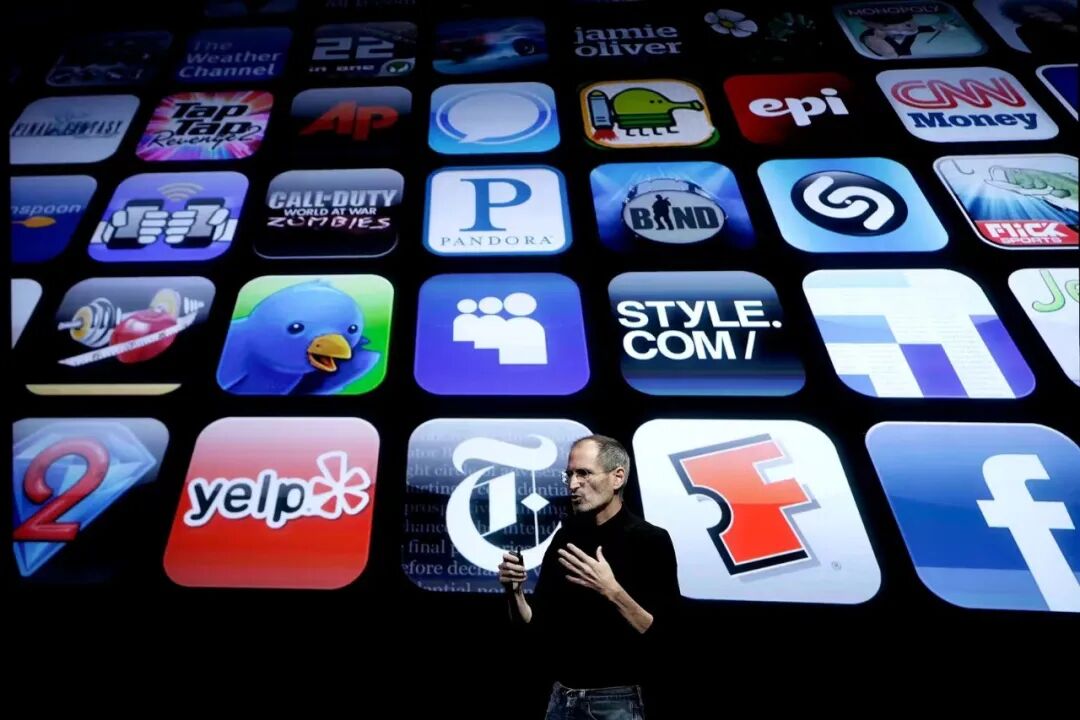
Apple was not the first company to conceive of an "app store." As early as 2003, Danger — co-founded by Andy Rubin, who later led the team that developed Android — released the T-Mobile Sidekick, one of the first smartphones to integrate internet access, instant messaging, email, and PC applications. Before that, in the "cell phone" era of the 1990s and early 2000s, Nokia 3110 or Samsung flip phone users could only buy ringtones or small web games.
Although the concept of smartphone applications emerged relatively late, the iPhone had key advantages over its predecessors and competitors. First, the original iPhone (and iPhone 3G) had superior hardware, meaning apps could achieve higher quality than on BlackBerry or Palm Treo devices. iOS used programming languages and system UI similar to what Mac OS X developers already worked with. This meant thousands of existing Mac OS X developers were primed to build for the new platform, not to mention the millions more eager to try creating mobile apps. Capacitive multi-touch screens and motion gyroscopes gave developers a hardware platform with unprecedented possibilities.
Second, timing. The summer of 2008 was pivotal in tech history. Internet applications and services had finally become fast enough, and ubiquitous high-speed connectivity (3G or Wi-Fi) enabled incredible experiences on smartphones. Web 2.0 was in full swing, with startups like Facebook, Twitter, and WordPress rapidly disrupting and reshaping people's lives. Had the App Store launched alongside the first iPhone in 2007, the software and technology ecosystem couldn't have supported it. Web 2.0 fueled an explosion of mobile apps and games that could communicate with online services, delivering more connected and real-time experiences to users. The iPhone and iPod touch also offered significantly better graphics performance than other handheld devices of the era. Together, these factors opened a new world for developers — 3D games found growing acceptance among users, kickstarting the casual gaming market that continues growing today.
And perhaps most importantly, there was Apple's promise of ecosystem control. Unlike app stores on other mobile (and even desktop) platforms, the App Store was built around Apple's rules from day one. Carriers couldn't dictate what could or couldn't be installed on the device; Apple could. This meant all apps on the App Store had to pass Apple's official review and follow specific guidelines. It also meant that unless you jailbroke your device, the only way to run third-party apps on an iPhone or iPod touch was through the App Store.
Apple's approach here more closely resembled what Nintendo, Sony, and Microsoft did with video game consoles than what Microsoft did with Windows PCs. Apple wanted to control not only what appeared on the App Store, but also all payments within apps, taking a 30% commission. Developers could set their own prices for their apps — something not always possible on other platforms, if they existed at all. Soon, people discovered that developing for the App Store could generate real money. Many mobile developers earned more than they ever had before, or at speeds they'd never experienced.
From the outset, some developers and users viewed these terms as obstacles, objecting to Apple's commission rate, review guidelines, and the App Store as the sole distribution channel for device apps. Fifteen years later, this tension remains widespread, evident in Epic's lawsuit against Apple and various antitrust investigations in the EU, UK, and United States.
Nevertheless, Apple's control over the entire ecosystem, the quality of its developer tools, and user growth of two to three times per quarter continued to motivate developers to commit to the iPhone ecosystem. As apps became ubiquitous, a new marketing slogan emerged: "There's an app for that."
02
App Overload
As of June 17, 2023 (the most recent update to my Apple data archive), I had downloaded 1,293 apps on iOS and tvOS in less than 15 years. Trying and reviewing apps was part of my job, and I've spent 15 years in iOS's walled garden.
Looking back at my App Store purchase history over the past 15 years is like opening a time capsule of a bygone tech era. These apps witnessed all the manias, booms, and busts. The first app I downloaded was Obama's official app. Other apps I downloaded that same day included: two different Twitter clients, the official Facebook app, an RSS client, and an $8 copy of Scrabble. Today, Facebook remains active; surprisingly, the old version of Scrabble still runs.
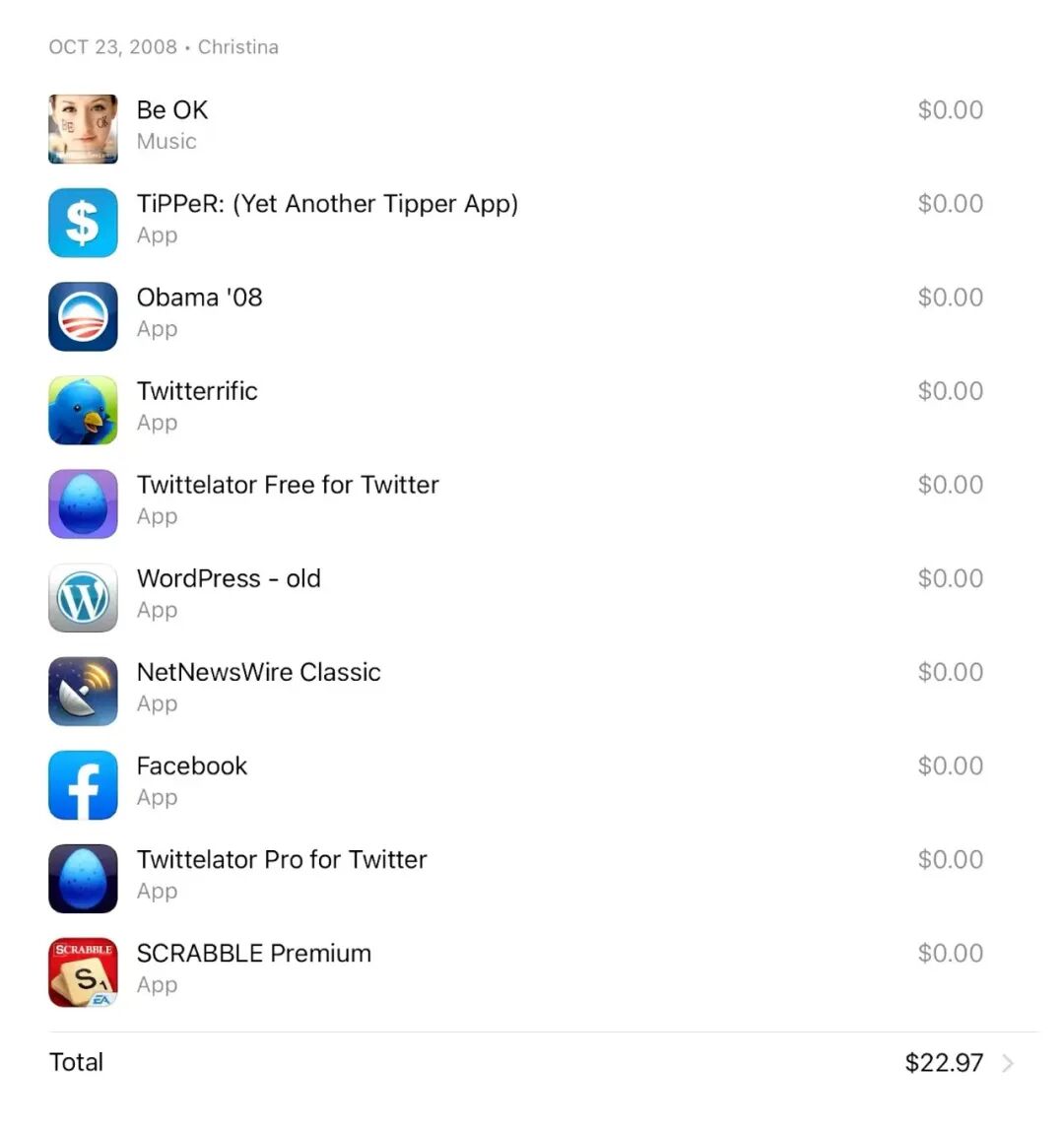
At the same time, this is also the residue of an era that has largely passed. Even though App Store revenue continues to grow every quarter, generating hundreds of billions of dollars for Apple annually, the mobile app culture we depend on has itself changed.
For streaming services like Netflix or Spotify, games like Minecraft or Roblox, and photo and video apps like CapCut or Facetune, phone or tablet apps remain necessary or ideal forms. But single-use apps are increasingly unnecessary, even redundant.
True, I still have banking apps on my phone, but I could just as easily check my balance by visiting the bank's website. While I once felt excited about getting new apps on my iPhone, I now usually resent having to download an app when I know I can accomplish the same thing on the web with fewer interruptions or less storage drain. Apple introduced App Clips in iOS 14, designed to let users access a small part of an app for single-use tasks without downloading the full application. But three years later, hardly any users or developers have adopted the feature. I think I may have seen an App Clip while traveling somewhere in the world, but that place also accepted Apple Pay, so the App Clip was completely unnecessary. (Editor's note: In the China market, users may feel this even more acutely, as an increasing number of mini-programs have replaced standalone apps.)
Moreover, the business environment surrounding mobile apps has changed along with the App Store. Apple still takes 30% of app sales, but now there are in-app purchases and subscriptions. Subscriptions are increasingly becoming the mainstream way for developers to earn revenue, partly because selling new versions of apps within Apple's ecosystem has become more difficult for developers. Unlike standalone software, developers can't easily offer existing users discounts on new versions. So developers are encouraged from the design stage to consider subscription pricing, so apps can receive regular updates or provide corresponding services, rather than offering version upgrades or one-time purchases.
The subscription app model wasn't invented by Apple; Adobe brought SaaS (software as a service) into the mainstream with Creative Cloud in 2013. But its prevalence on the App Store — joined by many web and desktop applications in this trend — has left many of us feeling app and subscription fatigue.
You can still make a lot of money through mobile apps, but usually not from the app itself alone. Today's most successful app developers differ from those 15 years ago, when a good idea could get millions of downloads overnight. Now, apps need to be part of an ongoing business, not necessarily the business itself.
03
The Future of the App Store
As a software developer, I often imagine what mobile apps will look like 15 years from now. Will head-mounted AR devices replace our phones, with everything existing in the metaverse or on Apple's Vision Pro? Will the web finally assert dominance and replace all standalone apps? Will I be playing a 2038 version of Gardenscapes on a foldable glass screen, as depicted in Westworld?
One thing that might be different is that we may end up with more than one App Store. Under the EU's new Digital Markets Act, Apple and other large tech companies are required to "allow third parties to interoperate with their own services in certain situations." That is: allowing third-party apps to be installed through app stores not controlled by Apple. Although the specific implementation details remain unclear, reports indicate Apple is preparing to allow alternative app stores on iPhones — at least in the EU. The company's deadline for DMA compliance is March 2024, so we will soon see how Apple adapts to the new legal requirements. Other countries and regions are also considering similar legislation requiring third-party app stores and third-party payment processing. So by 2038, the App Store may still be the central place to get iOS apps, but likely not the only way.
One area where I hope to see change is app quality and discoverability on the App Store. Early on, Apple's control over the App Store served both itself and users well; Apple claimed that its rules about what was and wasn't "suitable" for the App Store helped protect users from malware, fraud, and unnecessarily expensive apps. But 15 years later, many of those early promises have faded. The App Store is now flooded with scam apps buoyed by fake reviews, and Apple has done little to effectively stop this.
What we face is a situation where irresponsible companies can earn millions from unsuspecting users — sometimes these apps literally do nothing — while if a developer wants to make an open-source classic video game emulator, users must jump through several hoops to get it on their devices. Perhaps additional regulation, or possibly even AI, could help filter out scam apps and fake reviews, delivering a better experience for users. If done right, this might even help revitalize the app market.
Even though users complain about and tire of app subscriptions, I expect their growth to continue. But over the next 15 years, it's equally possible that different revenue models could become mainstream. Who knows? Maybe micropayments will finally become a reality. I'm not holding my breath.
Still, I'm quite certain the App Store will continue to exist in some form, and that Apple will fight tooth and nail to get its cut from every app I buy. And that old version of Scrabble? It will probably still run.
Source: CHRISTINA WARREN