Observations from Silicon Valley | Source Code Capital's Han Guang: The Road to ASI Won't Be a Straight Line

More than a century ago, it took electricity decades to truly transform the world. What path will AI take today?


Not long ago, Hank Han, Managing Director at Source Code Capital, made another trip to Silicon Valley to talk with frontline researchers, founders, and investors. It had been just four months since his last visit, yet the changes were so rapid they made time feel compressed: on one side, intelligence gains seemed to hit no ceiling, and researchers had never been more optimistic; on the other, doubts like "it's too expensive, where's the revenue?" were spreading, and the market had undergone a significant pullback.
More than a century ago, electricity took decades to truly transform the world. What path will AI take today?
Below are Han's first-hand observations from this trip to Silicon Valley — about intelligence, implementation, history, and the attitude we need in the face of a revolution no one has lived through before. Edited for length:

It had only been four months since my last trip to Silicon Valley, but the pace felt dramatically faster. It's hard to imagine such emotional swings in such a short span — from "frontier labs can do almost anything" to "are models more like pharmaceutical R&D?", with wild oscillations in between. The capital markets moved in kind. I'll organize what I saw and heard around a few keywords, roughly in two groups: one about "intelligence gains," where optimism is nearly universal; another about "real-world implementation," where skepticism is growing.
1
Intelligence: No Visible Ceiling for Now
Let's start with the exciting half.
This trip to the United States, researchers at nearly every lab were talking about the same thing — RSI, recursive self-improvement. It means: AI's progress drives its own progress. AI continually generates ideas for improving model training, filters them, then uses massive compute to validate them, yielding the next round of improvements, and so on. Four months ago, this topic wasn't discussed so intensely; this time, nearly everyone was talking about it, and all believed it already had a rudimentary form.
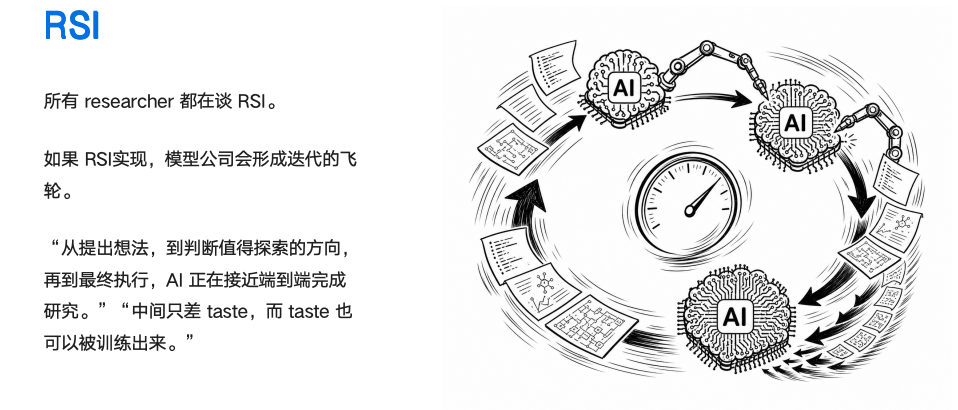
One researcher broke down "AI doing research" into three steps: generating ideas, filtering ideas, and executing validation. In his view, AI already surpasses today's researchers at generating ideas, and never tires; at end-to-end execution and validation, AI is far superior to humans. The only remaining gap is "filtering" — picking the most promising few from a hundred ideas, where the very best human researchers still have the edge. But he believes that even this "taste" can eventually be trained.
Alongside this comes another judgment: model capability improvements currently show no sign of hitting a ceiling. Pre-training, mid-training, post-training — none of these stages appear to be tapped out. Model capabilities advance in a "sawtooth" pattern — progress on some tasks humans find easy may be slower, but surpassing human performance in certain domains is almost a given. One line stuck with me: "The main difference between companies and the general public isn't that they possess secret knowledge unknown to outsiders, but that they believe more deeply in Scaling Law, and more deeply that the current technology curve will continue."
Researchers' optimism exceeds that of the market, and that of outsiders. When asked "if compute weren't an issue, how long until ASI," one researcher's answer was: one second. In his view, technology is the least of his worries — with sufficient compute and ideas, everything will come quickly.
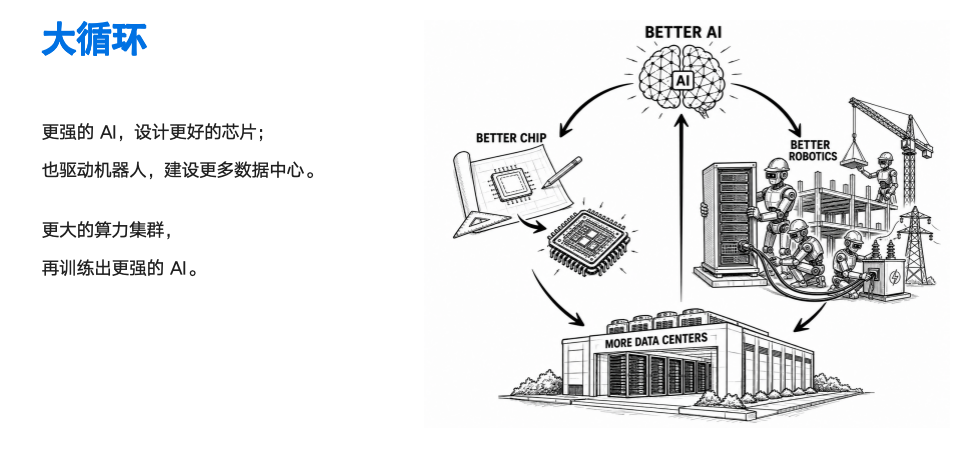
I also heard a new term this time: the "great loop." Stronger AI designs better chips; in the future, AI-driven robots build more data centers; larger compute clusters train even stronger AI — a closed loop extending from the virtual world into the physical and back again. If this holds, intelligence development would accelerate further.
What truly determines "who can keep moving forward steadily" is another word: Roadmap. A Roadmap is a rough consensus across the entire company about where it's headed over the next two years — how compute is allocated, who's responsible for each piece, a planned direction for everything. Today, the hard part isn't occasionally training a good model; it's producing better models stably and predictably, generation after generation. The Roadmap is crucial to this.
Anyone can have an occasional flash of insight; but sustained, predictable iteration requires a clear map. Today, only a handful of companies can produce this map — and this is where the real distance opens up between the leaders and everyone else.
2
Implementation: Too Expensive
But this time, we also clearly heard another voice. On "will intelligence keep improving," almost no one doubts it; but once the conversation turns to "how does it actually change the real world," skepticism emerges. The first and most direct challenge — it's too expensive.
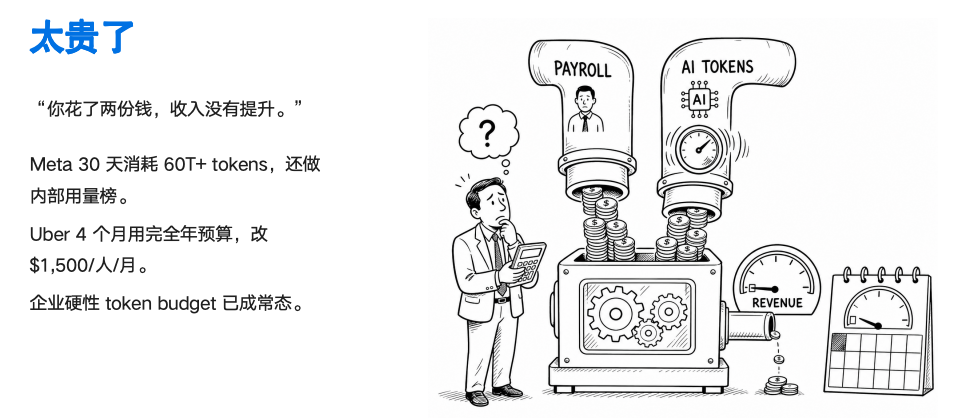
Enterprises are starting to set hard budgets for AI. After some frontier model releases, there was a period where revenue growth stalled — partly due to external conditions, partly because enterprises hadn't truly integrated AI into their operations.
Some companies consume tokens at staggering monthly rates, even creating internal usage leaderboards; others burn through their annual budget in months. A session might end after just a few questions. It's hard to imagine such expensive tokens transforming every aspect of the world someday. "You're spending twice as much, but revenue hasn't increased much."
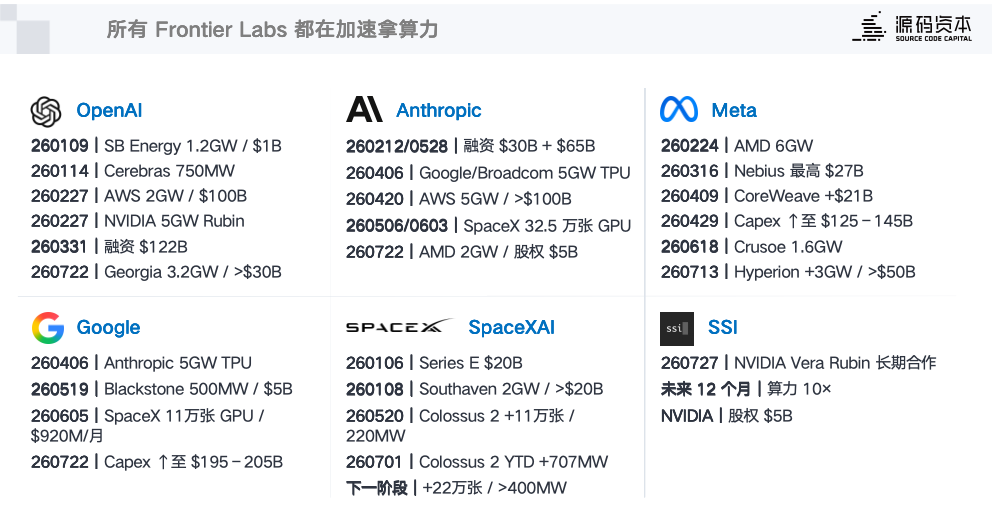
So sentiment began to swing back, and the market returned to those old questions, dragged out anew each quarter: Is the spending too high? Where's the return? Who pays? Will cloud vendors cut orders? This round, the capital markets experienced a significant emotional pullback. So this time in the United States, what we felt was two parallel tracks: one of intelligence gains, as fast as the most optimistic imagination; another of its impact on the real world, once again being questioned.
Even Sam Altman's recent interviews indirectly acknowledged this: as a species, humans adapt easily to new environments — show today's models to someone from 2019, and they'd probably call this AGI, amazing; but people today have already grown accustomed. Perhaps we're at a peak of the emotional cycle, facing a period of more skepticism ahead.
The core of the doubt, call it the "productivity paradox." Every frontier lab is accelerating compute acquisition, each investment larger than the last; but where is the revenue growth?
If you were the majority shareholder of "World Inc.," generating trillions in annual revenue, and your R&D department told you there was a new technology that could boost revenue in the future but required massive capital investment that would increase year after year — as a major shareholder, you would certainly ask: what incremental return will all this spending actually generate? — regardless of how remarkable the technology itself may be.
What we see more of today is still giving everyone an AI copilot: it boosts individual efficiency, yet hasn't produced a productivity leap for that massive whole. Headcount isn't reduced, revenue isn't rising, and change remains at the margins within old organizational structures.
3
History: Electricity's Forty Years
This isn't the first time humanity has faced such a moment. In 1881, the first central power station went into operation; but electricity didn't truly drive manufacturing productivity gains until the early 1920s — a full forty years in between.
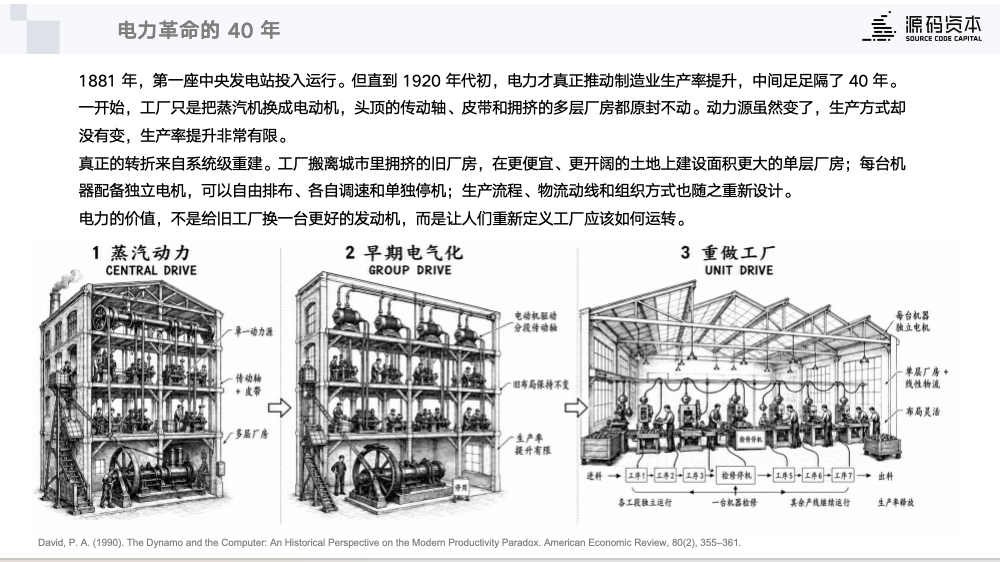
Initially, factories simply swapped the steam engine at the center of the workshop for an electric motor. The overhead drive shafts, belts, crowded multi-story buildings — all remained exactly the same. The power source changed, but production methods didn't, and gains were limited. The real turning point came from system-level reconstruction: factories moved to more open land, single-story buildings went up, each machine got its own motor, freely arranged and individually speed-controlled; production processes and organizational structures were redesigned accordingly. Ford's assembly line emerged at this very moment.
Electricity's value wasn't in giving old factories a better engine — it was in letting people redefine how a factory should operate.
Today, we may be at a similar juncture. What the market is truly searching for are the "heavy electricity users" of the intelligence age — companies that can truly convert "intelligence" as a new factor of production into better output.
But here's an unavoidable paradox: forcing a mature company to fundamentally transform its organizational form, even to downsize, is painful. Everyone logically embraces AI, but when it comes to concrete action, resistance is often enormous. During this trip, a VC we spoke with in the United States mentioned that at a company like Adobe, internal resistance was enormous when employees tried to truly integrate AI with their products. So the more likely future is this: a wave of companies "built from scratch around the new factor of production" will gradually emerge and slowly eat away at existing markets.
This time, we already saw some early examples.
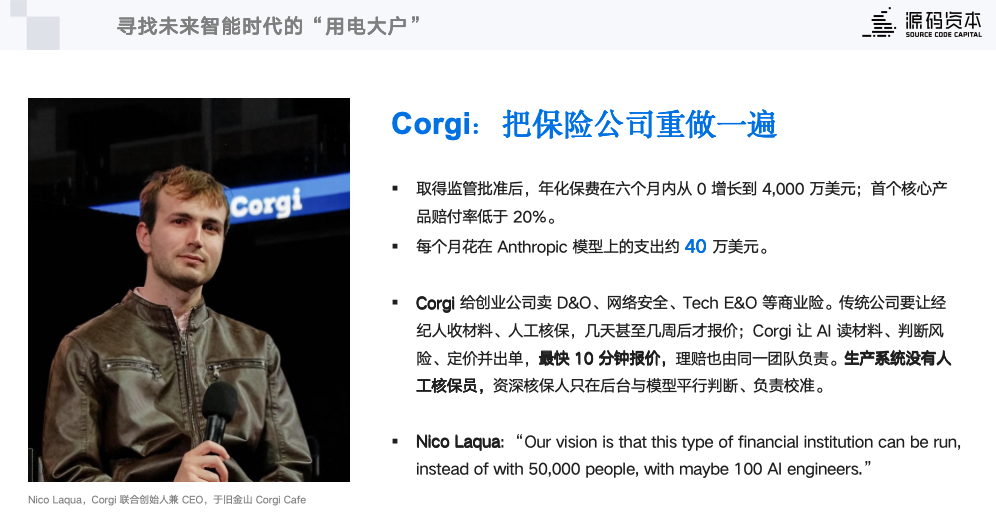
One company called Corgi is actually in an old business — selling commercial insurance like D&O, cyber security, and Tech E&O to startups. The traditional approach requires brokers to collect materials, underwriters to assess risk manually, with quotes taking days to weeks. Corgi has AI read the materials, assess risk, and price and issue policies directly. It's an "old company" in that it offers an existing service, and a "new company" in that its organizational form and cost structure are different — its insurance is cheaper, and its response faster.
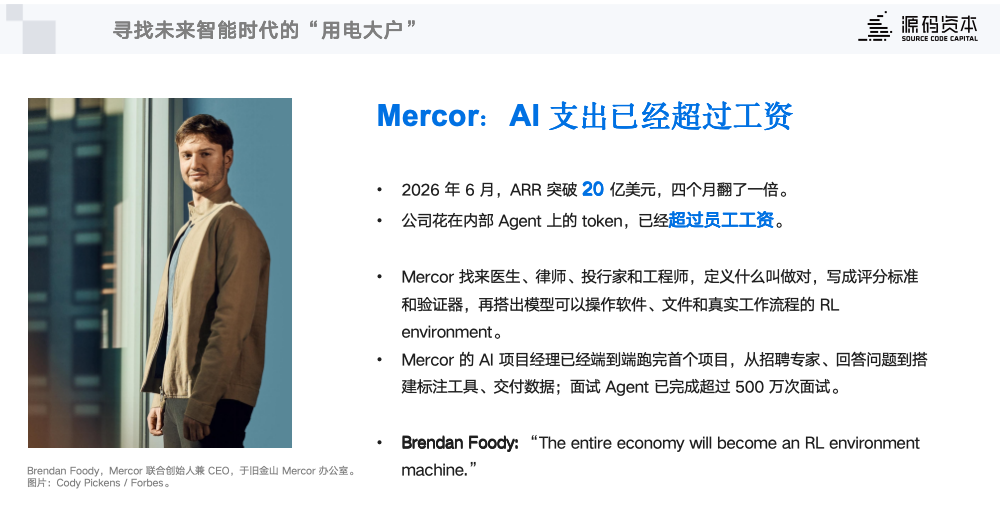
Another company, Mercor, sells data. Its spending on AI already exceeds what it pays people. It brings in experts from various industries — doctors, lawyers, investment bankers, engineers — to define "what counts as doing a job correctly," writes this into scoring criteria, then builds environments where models operate real workflows.
They're both still small, with few users, but designed from the start to "directly deliver results." Where exactly are the future "heavy electricity users"? Honestly, we don't know yet; we can only see faint signs. But for AI to truly change the world, more such companies need to emerge — this is what the entire world is watching.
4
Cycles: A Bumpy Road
Zoom out: AI has emotional cycles.
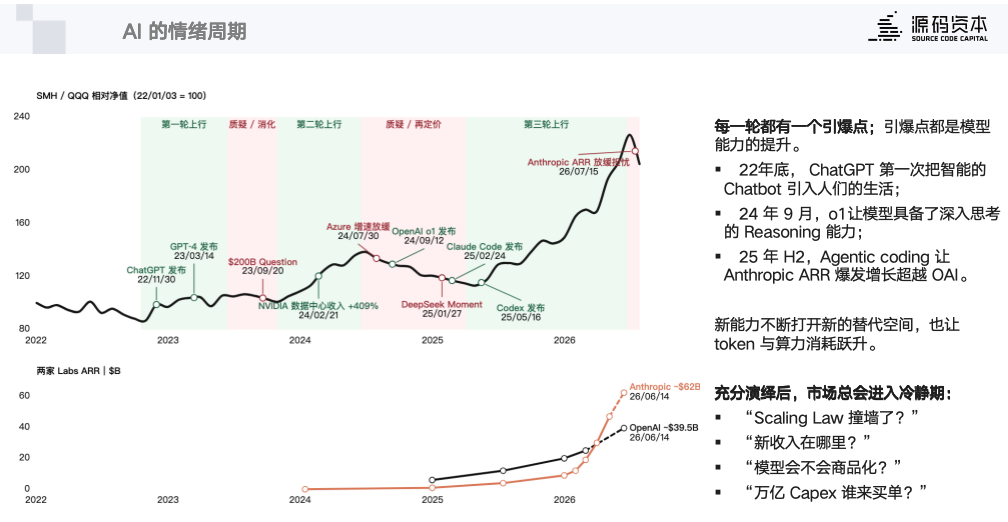
Looking back over these years, each trigger point has been a leap in model capabilities or accelerated revenue at a key industry node — ChatGPT in late 2022, deep reasoning in 2024, agentic coding in the second half of 2025. New capabilities open new imagination, sentiment turns euphoric; and after several quarters of full pricing-in, the market always enters a cooling period, repeatedly asking: Has Scaling Law hit a wall? Where's the new revenue? Will models be commoditized? Who pays for the massive investment? Two years ago this was "who pays for $200 billion," and it will become "who pays for $3 trillion."
History keeps reminding us: the industrial trend is real, and bubbles can be real too.
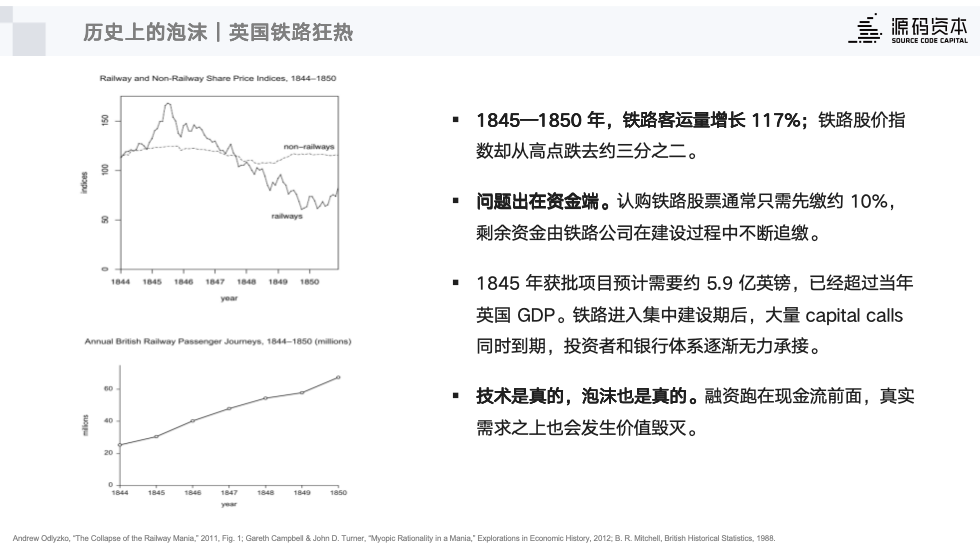
Nineteenth-century British railways: passenger volume more than doubled in a few years, yet stock prices fell roughly two-thirds from their peak — the problem was on the funding side, with subscriptions requiring only 10% down and the rest called in during construction, concentrated build periods maturing simultaneously, the system unable to absorb it. The electricity sector during the Great Depression: electricity demand barely declined, yet leveraged holding companies layered upon layers were wiped out; and electrification itself soon recovered and marched on.
The technology is real, and so is the bubble. Financing runs ahead of cash flow, and value destruction happens even above real demand. You can be right about the trend, yet people can still fall along the way. The future world is already unfolding, and we feel a very strong push from behind; but sometimes, this car hits the brakes unexpectedly, and if you haven't braced yourself, you'll be thrown off. The bumps on this journey will exceed many people's imagination.
Greed and fear will replay again and again, becoming humanity's recurring footnotes.
The world is becoming more complex than ever. We believe future GDP will be extraordinarily abundant, and AI will transform every aspect of this world; but the past few months, indeed the past two years, keep reminding us: this path will not be a straight one. The starting point is now, the destination is AGI or ASI — perhaps both ends are certain, but the middle is full of turbulence.
So we choose to hold optimism in one hand and reverence in the other: fully believing in the long-term direction while remaining sufficiently open, looking squarely at what is actually happening, because no one has lived through such a revolution. Going deep into the mechanics of this intelligence revolution, staying open, staying learning, being empirical, not stubborn, not arrogantly certain that one's previous views must be correct — this is perhaps the most important quality at this moment.
For Source Code Capital, this is also precisely our consistent approach: not chasing every emotional high, but holding steady to our judgment through the bumps, accompanying those companies that are truly defining the future through complete cycles.