Code Brain | Where Do Great B2B Startup Ideas Come From?

How to Uncover Great B2B Startup Ideas From Your Own Experience

We've all heard the Levi's jeans origin story: Levi Strauss built a thriving business selling durable denim to prospectors during the California Gold Rush. The "sell picks and shovels" approach works just as well in tech. When hordes of startups pile into a hot sector, serving other businesses in B2B can be a shortcut around the brutal competition in consumer markets.
Lenny Rachitsky, a longtime product leader at Airbnb who has invested in numerous emerging B2B startups, spent hundreds of hours interviewing founders of successful B2B companies — including Notion, Figma, Linear, Gong, Retool, Hex, and Sprig — to compile a series of accessible, in-depth guides on B2B entrepreneurship. Today, Code Brain brings you one of them. It's a long read, so we'll publish it in three parts. Follow the Source Code Capital WeChat account for the next two installments.
Every good B2B startup idea has three key ingredients.
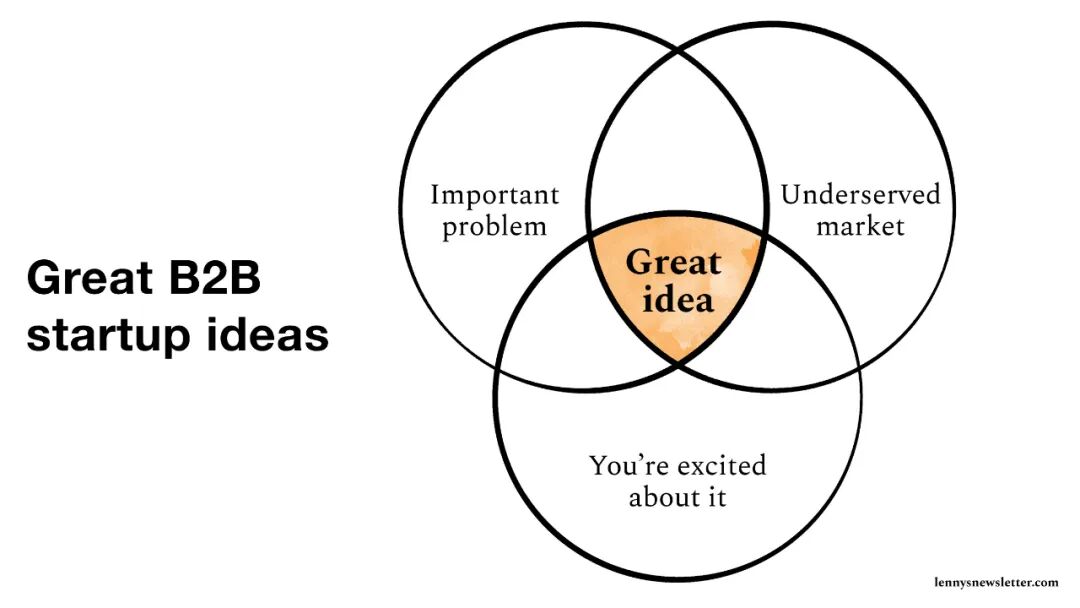
A problem people care about
The problem you're solving must be one that many people are willing to pay serious money to fix. Most failed startups die from too small a market, not from a bad idea. If you want to build a venture-scale business, you need a clear path to $100 million or even $1 billion in annual revenue. Ryan Glasgow, CEO of Sprig, landed a meaningful early deal: "Very early on, Robinhood signed a big contract with us. They were super straightforward: 'We love it, we'll deploy tomorrow.' We'd just finished our first version, and they deployed it immediately."
Sprig provides full-lifecycle user research services for products, offering testing, surveys, and other tools to capture user feedback and suggestions on new ideas, designs, or prototypes.
An underserved target market
For problems people care about, existing solutions fall below market expectations. Kunal Shah, founder of CRED, has a framework called Delta-4 for measuring a solution's potential.
- How do users rate existing solutions on a scale of 1 to 10?
- How do they rate yours?
The people who care about your product should score your solution at least 4 points higher. This means if incumbents already score 6 or above, displacing them will be tough. Tomer London, co-founder of Gusto, learned this firsthand. "We asked customers how they'd rate their current payroll providers, and they just went off. We didn't prompt them, but more than half our interviewees were cursing out their vendors."
Gusto is a human resources software company that provides payroll, benefits, and tax administration services, helping businesses streamline HR processes.
Personal drive to solve it
At the end of the day, this has to be a problem you're willing to spend years working on. The following advice from Dylan Field, co-founder of Figma, captures this determination well. "There are so many opportunities out there. Because so many markets are underserved, when you're looking for just one, it can feel like nothing's quite right. What matters most is finding a domain that personally excites you, because building a great company takes a long time, and passion is crucial.
If you spend three or four years in a space you hate, you'll burn out and quit. It'll depress you, maybe even make you resent life. Don't do something just because it could work. Find something you genuinely care about — even if it doesn't pan out, you'll still learn from it, and the idea remains yours."
Summary: Find a problem you care about in an underserved market. Here's how to do it. Finding a good B2B startup idea
After interviewing numerous B2B founders, I've identified three paths to finding a strong idea.
- Past pain: Identify what was most painful about your work at your previous company, then build a solution for it.
- Exploration: Pick an area of interest, analyze it to find market gaps, then visit ten potential customers and listen carefully to what they need and what frustrates them.
- Current demand: Identify what you're already doing that shows signs of demand, then go all in.
Below is a categorized breakdown of how the B2B startups in my research found their ideas.
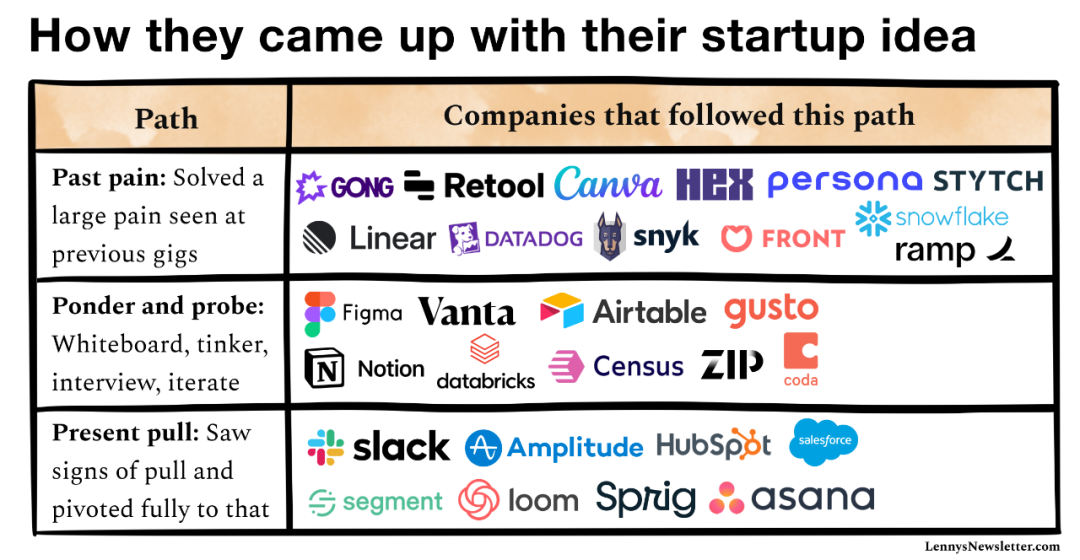
Whichever path you choose, you need to find two things: pain and demand. Pain means there's an opportunity to solve a problem — this is essential. Demand means you're solving a problem that actually exists. Let's illustrate these three paths through the stories of successful B2B founders.
Past pain: Identify what was most painful about your work at your previous company, then build a solution for it.
When I started this research, I assumed this was how all successful companies found their ideas. In reality, only 40% did. Let's look at how five successful startups — Gong, Retool, Linear, Persona, and Hex — found their ideas through past pain.
Gong's CEO was tormented at his previous company by his inability to figure out what was going wrong in the sales process.
My current co-founder Amit had a business intelligence company called Sisense. His problem was poor sales performance with no way to diagnose it. Why deals closed or fell through — that knowledge was locked in people's heads. CRM systems couldn't reflect what people were thinking; the data was meaningless. Nobody knew why a deal didn't happen.
He left Sisense to find who could solve this. I was on sabbatical with nothing going on, studying deep learning, so we hit it off: let's try building a system that captures the abstract knowledge in salespeople's heads and uses it to guide other departments, improving internal visibility.
— Eilon Reshef, Co-founder and CPO of Gong
Gong is a sales conversation recording and analysis platform. By recording and analyzing sales calls, meetings, and chats, it provides tools that help sales teams understand their process, identify pipeline leaks, and improve their techniques.
Retool founder David Hsu found himself rebuilding the same product at every company: "Probably not many people know I'd founded several companies and products before Retool. Each time, when building these products, we had to build our own internal tools. Eventually, when you've built enough of the same things, you realize they all share the same building blocks. We thought, 'There has to be a better way.' We're lazy engineers, and we figured other engineers are lazy too. That's where the idea for Retool came from."
— David Hsu, Founder and CEO
Retool is a low-code development platform that helps companies quickly build internal tools. With a drag-and-drop interface, Retool lets you build powerful internal tools without writing any code.
Linear's founders were deeply frustrated that Jira was the default bug tracker at their previous companies. "Linear came from the pain of bug tracking while developing software. I was at Coinbase, Karri [co-founder] was at Airbnb, and Tuomas [co-founder] was at Uber. We were all at these growth-stage companies and saw how they operated at scale.
I distinctly remember 2016 at Coinbase, when we were around a hundred people, hiring a VP of Engineering. Next came the push to standardize tools across teams, and Jira arrived.
I naively tried to keep my team on Trello, but quickly realized it was a war I couldn't win. There were no other solutions on the market; you just accepted Jira. Eventually my team switched too, and I always felt terrible about it.
At Airbnb, Karri built a Chrome extension to reskin their Jira interface. At Uber, Tuomas built developer tools on Fabricator. We had similar experiences of 'this feels wrong, we should do something about it.'"
— Jori Lallo, Co-founder
Linear is a project management tool for complex software development. It offers robust features for tracking progress, assigning tasks, managing risk, and communicating project information.
Persona's founders realized identity management tools were deeply flawed while working at Square. "I worked on identity development at Square for a long time. We used to joke, 'I bet within ten years someone will build a better tool to solve this for us.' As we developed, we noticed existing identity providers assumed one technology could solve all customer identity problems, when in reality every company is multimodal here: there are different ways to verify different people in different contexts. So we saw an opportunity to solve this in a unique way."
— Rick Song, Co-founder & CEO
Persona is an identity verification platform that helps companies implement multi-factor authentication. It offers multiple verification methods including biometrics, passwords, SMS, and tokens, helping businesses improve security and reduce data breach risk.
Hex's founder realized no one would build what he needed, so he'd have to do it himself: "I started as my own user. I'd been looking for something like Hex but couldn't find it. I spent months going around asking people, 'What do you use for this need? What do you use for that problem? Have you found anything good for this?' Everyone said, 'No, but if you find something, let us know.' One day it hit me: 'Maybe we should just build this. If we don't, no one will.'
I didn't initially want to be a founder. Lots of people want to be founders — they feel like they're just one idea and one co-founder away. My situation was the opposite: I had a clear idea (Hex) and two co-founders I'd worked great with at Palantir. We spent some time thinking about whether to start Hex, and ultimately decided we had to, because if we didn't, nobody would."
— Barry McCardel, Co-founder of Hex
Hex is a collaborative platform for data science and analytics, empowering individuals and organizations to make better decisions through data. Hex combines SQL, Python, R, and text in powerful notebooks, letting users publish projects as interactive data apps with one click.
Summary and Reflection
- Did any of your past work or products create unique value for your company or colleagues?
- What tools did you badly want at a previous job (and how much would you have paid for them)?
- What products did you have to rebuild from scratch at every company you've worked at?
Follow Source Code Capital for the rest of this series.