Code View | Structural Opportunities Persist Long-Term — Growth-Stage Consumer Investment Strategy Through a Beta Lens

Over the past decade, nearly a hundred Chinese companies have reached unicorn status at $10 billion valuations, with 70%–80% of them backed by venture capital. These companies have led growth across every industry. Source Code Capital has successfully captured some of these major beta opportunities in multi-billion-dollar sectors — ByteDance, Meituan, Li Auto, and KE Holdings, among others. Today, dozens of MaHui members are on the journey from $1 billion to $10 billion.
The macro environment is steadily brightening. On September 24, China's three top financial regulators held a press conference to announce a series of capital market policies, injecting confidence into the market. On September 26, the Politburo convened to analyze economic work, sending a strong signal of growth stabilization. We take an ultra-long-term view on value creation and firmly believe that numerous structural opportunities persist — driven by technology, globalization, domestic substitution, industrial upgrading, management optimization, innovation, openness, and focus. Source Code Capital remains committed to investing in technology-driven innovation and the creation of lasting, genuine value. We will continue sharing our growth-stage investment strategies through a beta lens, and we look forward to walking alongside more outstanding entrepreneurs.
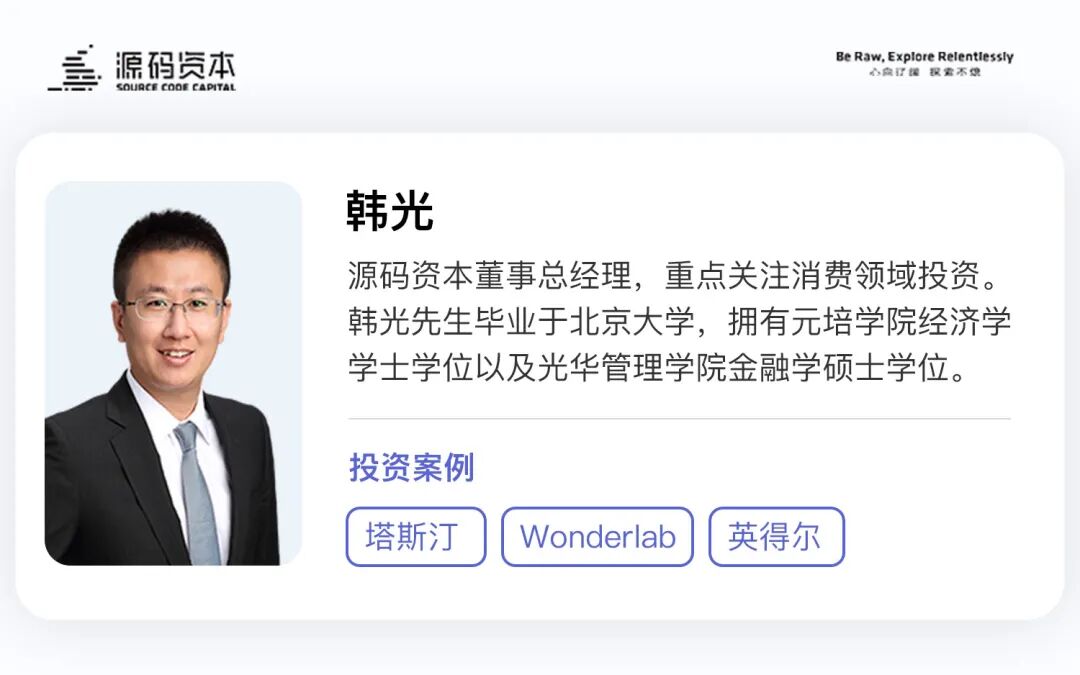
This article was written by Guang Han, Managing Director at Source Code Capital.
Looking ahead five to ten years, we believe AI, going global, and domestic substitution in the home market are high-certainty, wide-impact trends where new giants may emerge. The matrix formed by these three trends intersecting with various industries shapes our foundational framework for identifying opportunities.
1
The "Flying Geese" Formation of Going Global
At its core, the gradual upgrading of going global is an alternative expression of national power.
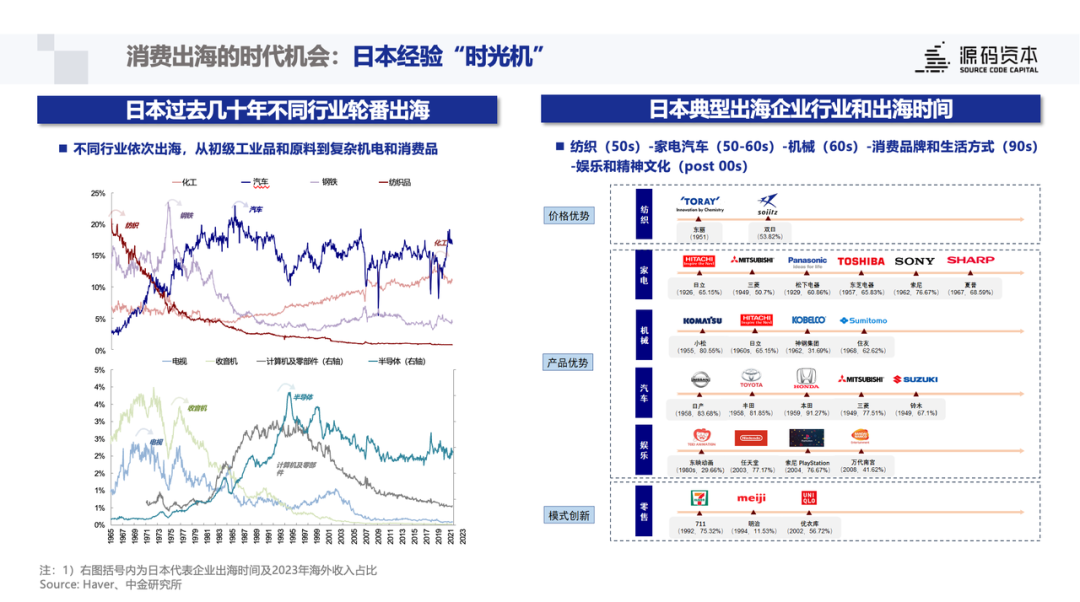
Take Japan's industrial history as an example. Over the past several decades, its different industries went global in sequence, with exported products steadily upgrading. Looking at when typical Japanese companies expanded overseas, you can see the interwoven rhythms of different industries.
It started with textile companies in the 1950s, followed by home appliance, automotive, and machinery brands in the 1960s, then consumer and lifestyle brands in the 1990s, and finally entertainment and spiritual/cultural brands in the 21st century. This corresponded to a progression from OEM to simple consumer goods, to complex industrial and consumer electronics products, to lifestyle brands, and ultimately to cultural symbols and value exports. The overall trend moved from simple to complex products, from function-heavy to value-heavy attributes — a steady climb up the ladder.
China's exports have undergone major shifts over the past decade. First, the structure of Chinese exports has fundamentally changed: simple trade and basic consumer goods have declined as a share, while manufactured goods — especially complex products — now dominate. Second, leading Chinese companies are gradually winning mindshare overseas, with foreign consumers' trust in Chinese products steadily rising. The "flying geese" formation of brand globalization is taking shape.
In primary markets, going global is already a "consensus" theme; the key lies in how to select investment opportunities. Specifically, we have three types of bets.
The first is OEM/ODM-to-brand transformation. These companies start as excellent OEM suppliers, having accumulated manufacturing capabilities, management expertise, product design skills, and overseas customer relationships in their early years. The period when they begin building their own brands represents a good entry point for investment. Not all companies break through this stage, but those that do build moats more quickly. We've seen such cases across multiple industries — in pet supplies, there's Gambol; in furniture, there's Jiangxin; and among our portfolio companies, IndelB is gradually building its own brand in the car refrigerator space after starting as a contract manufacturer.
The second is horizontal expansion by "small champions" — finding companies already proven in a single market, single product category, and single channel, and investing early in their expansion into new markets, categories, and channels. This requires high organizational and operational efficiency from the team. The most representative case is Anker, which started with portable chargers, reaching RMB 750 million in revenue in 2014 and RMB 1.3 billion in 2015. In 2016, it entered wireless audio and smart home, then continuously expanded its brand portfolio, launching robot vacuums in 2021 and portable power stations in 2022.
The third is "domestic winner goes global" — companies with the potential to win in the domestic market that also have overseas expansion potential, betting on the team's operational capabilities and adaptability to local markets. Multiple domestic consumer sector leaders have already gone global, including MINISO in retail, Pop Mart in designer toys, and Mixue Ice Cream & Tea in beverage chains.
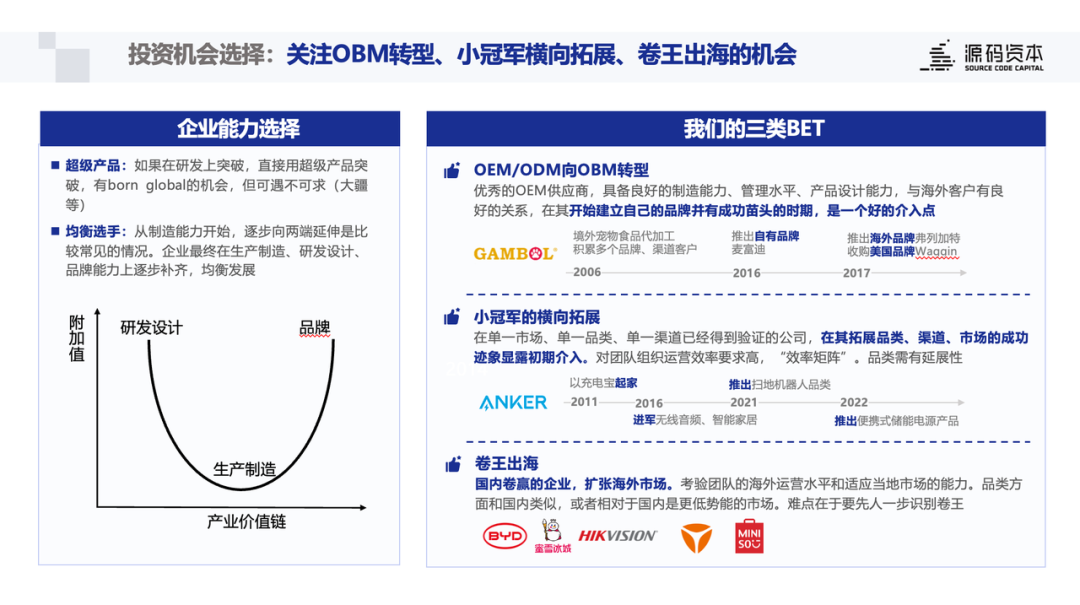
Overall, so-called global investment isn't about investing in "going global" for its own sake, but about investing in excellent companies and supporting them as they seek larger market spaces and demand. We believe that with China's global flying geese formation now taking shape, more outstanding brands and investment opportunities will emerge.
2
Consumer: "Big Waters, Big Fish"
Like manufacturing, consumer sectors also have "domestic substitution." As consumer acceptance of domestic brands has steadily risen, the past decade has seen a surge of excellent domestic brands at both the channel and brand levels — one reason for the "consumer investment boom" in primary markets during 2020–2021. In the past one to two years, domestic consumer investment has faced阶段性 exit and liquidity challenges, and we're often asked: can we still invest in domestic consumer? Our answer is yes, and Source Code Capital continues to actively pursue opportunities here.
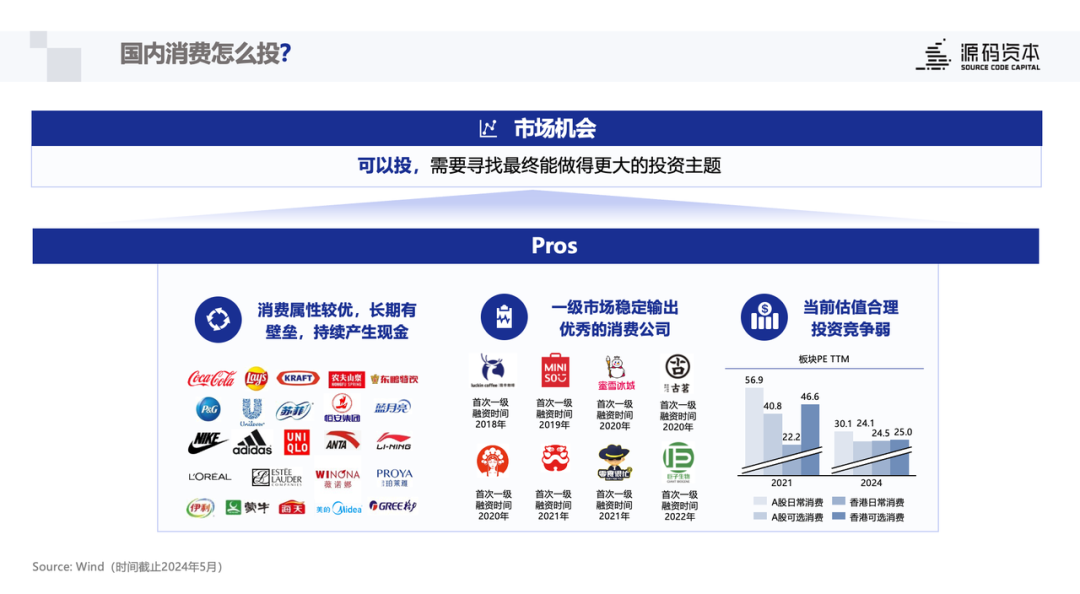
Many consumer sub-sectors have attractive business characteristics: they can build moats, sustain high ROIC over the long term, and continuously generate cash flow.
Historically, China's massive market scale, combined with generational shifts in its population, has meant there's always unmet consumer demand — and thus, new large-scale consumer companies keep emerging.
Primary markets have consistently produced excellent consumer companies. Many brands that raised their first financing rounds in the past five years have already reached considerable scale or even gone public, including Luckin Coffee, MINISO, Giant Biogene, and Tastien. With consumer sectors currently in a cooler phase, company valuations are more reasonable and investment competition has weakened — we believe this is an excellent time to invest in consumer.
At the channel level, we focus on ten-thousand-store chains where channel and product are integrated.
The biggest historical constraint on building ten-thousand-store chains has been management capability — very few teams can manage large organizations, so companies hit a ceiling where organizational gravity becomes overwhelming. This tests companies on many dimensions: management tools, organizational culture, the founding team's learning ability, and more. Over the past decade, these factors have gradually improved: changes in IT systems and infrastructure, talent outflow from multinational corporations and leading private enterprises elevating China's overall business management capabilities, and rising personal caliber among a new generation of founders. Secondary constraints have also been unlocking: strengthening consumer purchasing power, increasing market homogeneity, and so on. We believe China's domestic consumer market still holds opportunities for 10+ new chain brands, and likely more over the longer term.
At the brand level, we focus on "domestic substitution" in categories where domestic brands are currently weak. Across categories, after decades of development, China's consumer market overall favors domestic players. Over the past five years, numerous sub-sectors in food and beverage, athletic apparel, home appliances, and consumer electronics have seen domestic brands gain significant share versus foreign competitors. While overall consumer acceptance of domestic brands is rising, some categories still favor foreign players — these are our key focus areas. At the company level, challengers in each industry have taken different angles: better cost-performance, new functions or forms enabled by new technology, faster iteration and new product launches, revitalization of old brands, and so on. The timing of challengers' emergence varies by industry, requiring patience.
Overall, in consumer markets, big waters yield big fish, and we believe opportunities remain. "We can't predict which angle the fish will leap from — our job is to wait by the stream."
3
AI+ May Be the Biggest Opportunity of the Next Decade
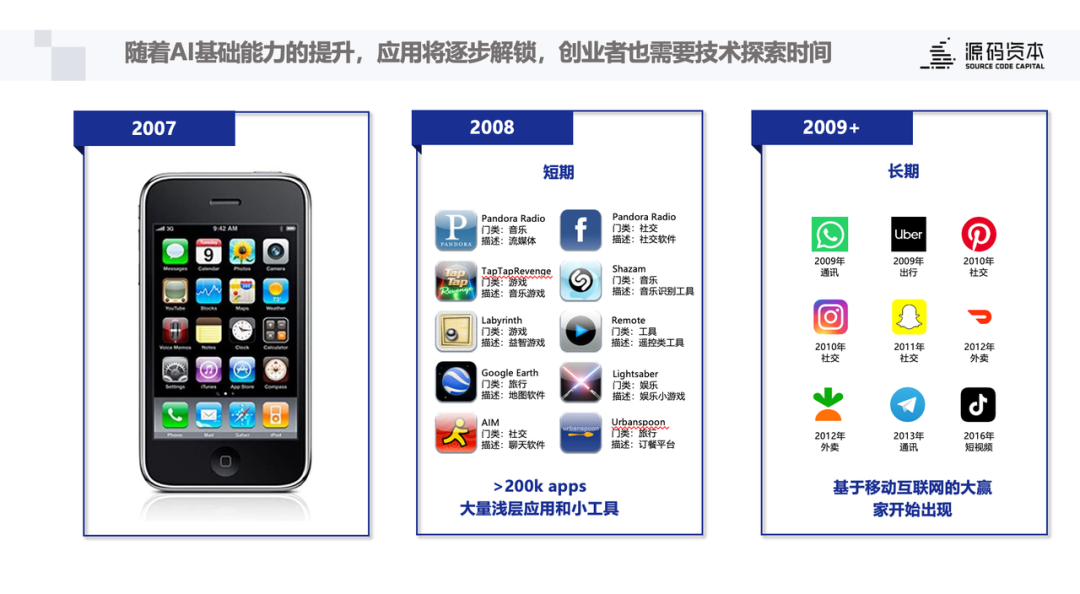
On the AI applications front, we're still in early stages. Since OpenAI released ChatGPT in November 2022, capital and tech giants have been pouring money in frantically, but the Superapp everyone is waiting for has yet to appear. Looking back at historical experience: after the first-generation iPhone launched in 2007, the App Store was initially dominated by shallow apps and small utilities; it took several years before the major winners of the mobile internet era began to emerge. We believe that as model inference and multimodal capabilities improve further, and as the cost of calling large models declines, super apps of the AI era will gradually unlock.
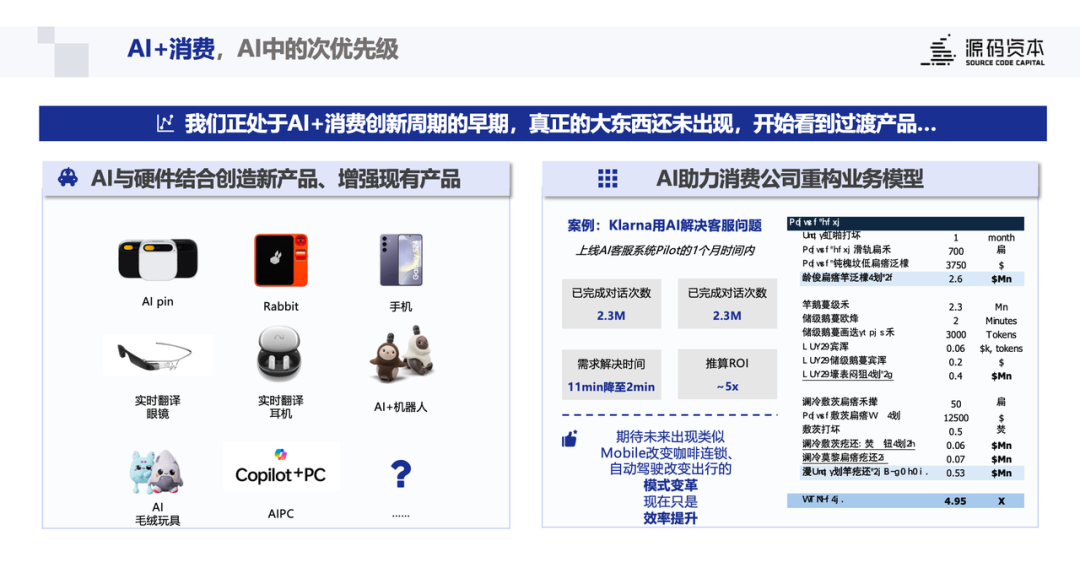
On the AI+consumer front, this is a secondary priority within AI. We're in the early stages of the AI+consumer innovation cycle. Over the past year, we've already begun seeing numerous transitional products.
One category is AI-hardware integration, either enhancing existing product functionality or creating entirely new product forms. The former includes real-time translation earbuds, AI PCs, and AI phones; the latter is represented by products like AI Pin and Rabbit.
Another category is AI intervening in company business processes to empower or restructure them — for example, AI applications in customer service that save labor costs and deliver higher ROI. But these opportunities currently focus mainly on improving operational efficiency. We're more hopeful for transformations that change business models or processes, like autonomous driving did for mobility or Mobile did for coffee chains.