Source Code Capital | Bill Xiong of Earth-2: Entrepreneurs Must Have Light

Holding yourself to a higher standard in business really isn't a bad thing.

As 2023 began, the sci-fi blockbuster The Wandering Earth II took the world by storm, reawakening humanity's deeper awareness and consensus around protecting our planet.
Protecting Earth and the fate of humanity — faced with such a grand and serious topic, where do we even begin? Technology, or more precisely AI technology, is the obvious answer. The film's widely discussed concepts of "digital life" and the AI robot "MOSS" showed audiences the vast potential applications of AI. At the same time, the chatbot model ChatGPT was exploding across global tech circles. Like MOSS in the film, ChatGPT could truly converse like a human, even drafting emails, copy, and translations — the science fiction of The Wandering Earth II seemed to be becoming reality. A film and a conversational large language model made the start of 2023 feel extraordinarily imaginative and full of unknown possibilities. But practically speaking, where does planetary protection actually begin? What is ChatGPT's essence? And how should AI help humanity protect Earth? "Using AI as the foundation, making satellites perceptive and capable, helping humanity improve Earth from space" — this was Bill's novel solution. On February 15, the 12th episode of "Leap of Faith Livestream" welcomed serial successful entrepreneur and investor Bill, who shared his life journey of "guarding Earth"!
From tourism and hotels, to AI and life sciences, to founding PingPong — now one of the world's largest cross-border trade digital service providers — to now going all-in on Earth-2, a space resource collection and operations company... As Bill himself put it, "More than 20 years of entrepreneurship, I couldn't finish in three days." In this livestream, he not only shared his restless heart drawn to the vast heavens, but also brought Earth-2's practice of the "improve Earth from space" philosophy, along with invaluable entrepreneurial experience for fellow founders.
Below are excerpts from the livestream
01
Earth-2: A Satellite with an Operating System, Computing Power, and an AI Framework
Source Code Capital Xingchen Zhang: The blockbuster success of The Wandering Earth II has brought significant attention to Earth-2, a high-tech enterprise merging AI technology with the aerospace industry. Bill, what problems does Earth-2 hope to solve? What have you done to actually change Earth?
Bill: Da Liu (The Wandering Earth author Cixin Liu) once said that according to sci-fi writers' predictions, by 2001 there should have been a million people living in space, with magnificent space cities and spacecraft reaching Saturn. But in reality, beyond that one moon landing, humanity's farthest space voyage has only been about 500 kilometers. "You promised me a sea of stars, but you only gave me Facebook." Twenty years have passed, and many predicted scenarios haven't materialized. But the next decade will definitely be better than now. I think AI may be the only field living up to expectations. ChatGPT's recent popularity represents a direction — AI is the foundation of the future.
In The Wandering Earth II, Earth's crisis may not come from the sun or physics, but from human culture. Global warming, unpredictable disasters — Earth is getting increasingly "temperamental." As entrepreneurs, when new technologies emerge, we hope to build AI systems for real-time observation, prediction, and decision-making about Earth, reducing disasters. I think that's meaningful entrepreneurship.
For Earth-2, step one is to become an aerospace company that builds high-performance spacecraft and deploys space intelligence. Along this path, we transform our AI technology and space-based computing into aerospace infrastructure, enabling Earth observation. Our company slogan is "Improve Earth from Space." We hope to observe and analyze Earth's changes in real time, rapidly detecting climate disasters — watching from space as a dam, a river, a mountain, a field, even a single tree changes — to prevent sudden incidents, and eventually help society with early warnings. That's our value.
In practice, we've been continuously trying to civilianize our technology, bringing it closer to daily life. For example, in 2022 we developed a locust migration algorithm targeting "locust plagues." Working with the UN, we obtained historical locust migration data, combined it with satellite and meteorological data, and created a locust migration path prediction. This algorithm has been deployed mainly in Saudi Arabia, the UAE, Egypt, and other countries. Another example: for extreme high temperatures and resulting fires that have become frequent in recent years, our fire early warning system will soon launch. It directly senses heat sources via satellite and dispatches satellites to predict fire evolution paths in real time, helping governments and fire departments with monitoring and reducing fire damage. This algorithm will soon be uploaded to our satellites.
The satellites we launch, you could understand as the Monkey King's fiery eyes — real-time disaster observation to reduce their occurrence.
Source Code Capital Xingchen Zhang: What is Earth-2's vision?
Bill: We want to design and build humanity's largest space machine collective, integrating communications, navigation, near-Earth exploration, and cosmic research capabilities to help solve Earth's problems, monitor climate and environmental changes, study interstellar travel, and search for extraterrestrial life — establishing benchmarks for future commercial and extraterrestrial civilization.
Our reasoning for exploring extraterrestrial life is simple. China, the United States, Europe — all have launched numerous interstellar probes. The technology on them uses the same principles as observing fires, monitoring emissions, or tracking pollution sources: analyzing changes in light and other electromagnetic waves. The only difference is that previous technology took photos and transmitted them back to Earth for processing. What we do is process on the satellite itself, allowing algorithms to evolve faster and faster. Essentially, if we can observe fires on the ground, we can also detect whether life exists beyond Earth.
The concept of "space robots" is quite broad. If we only talk about satellites, that doesn't fully represent what we're doing. It includes other spacecraft, like space elevators. Furthermore, the satellites we're planning have "hands and feet" — they can do many things. In the near term, satellite "life extension," such as refueling. Then, exploring new extraterrestrial civilizations. Actually building space cities can't be done by a few astronauts; it must be done through robots. We hope to use AI as the foundation, making satellites perceptive and capable, helping humanity accomplish more.
Regarding timelines, aerospace projects have always been long-cycle. Conversely, I don't expect to see certain things realized in our generation. As written on our company vision wall: "However far this life may push the boundary between what we know and what we don't, it will go farther still — because aerospace is inherently about legacy, and we stand on the shoulders of giants." We hope to carry forward the vision of older generations of aerospace professionals. As for how far we get — first, we need to be a good company, with good business and profit, solving real problems. Then through good culture, pass it on to more future generations.
Source Code Capital Xingchen Zhang: Bill, you've long had AI investments and layouts, and ChatGPT has been especially hot lately. Could you talk about ChatGPT and the AI business you're currently exploring?
Bill: First, I may not be as enamored with ChatGPT as others. I think its victory lies more in clever conceptual thinking. Second, ChatGPT founder Sam Altman is also someone who quite likes to talk about business logic and essence. What's clever about ChatGPT? It essentially understood that AI's essence is the extraction and connection of information — just as I've said before, the biggest difference between AI and traditional algorithms is evolution from precise programming to fuzzy programming. ChatGPT is fuzzy programming. Fuzzy programming brings stronger generalization capabilities, and with self-learning, faster evolution. It also knew where the moat was, so it approached this from the start with scientific research methods. You could say it was a natural, inevitable result.
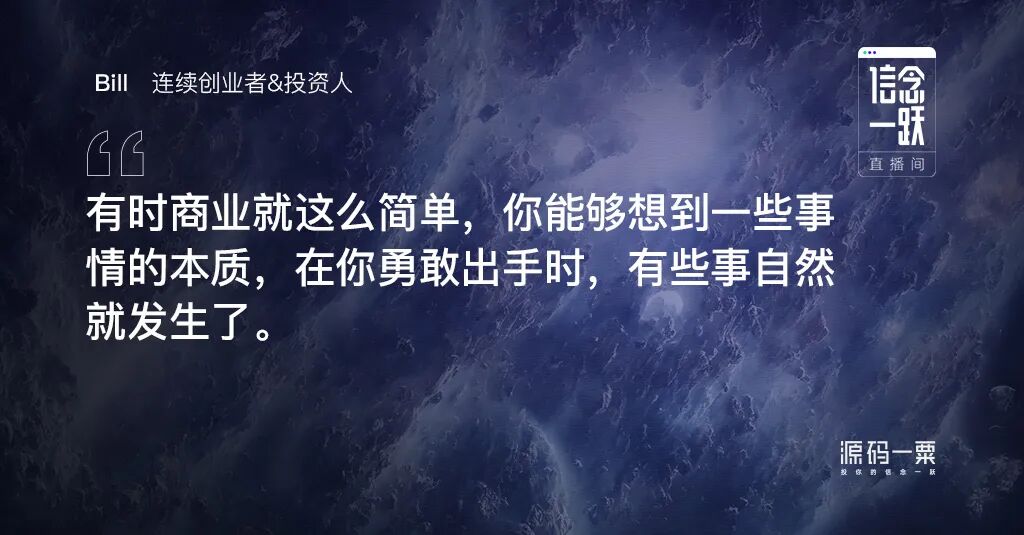
Sometimes business is just this simple: you grasp the essence of something, and when you act boldly, things naturally happen. This was very much like the original iPhone. For Steve Jobs, there was no need for so many revolutionary changes on a phone — a better touchscreen would suffice, and the phone could even look ugly. But they didn't settle. I think that's a classic example. Having higher standards for yourself as a company — there's nothing wrong with that.
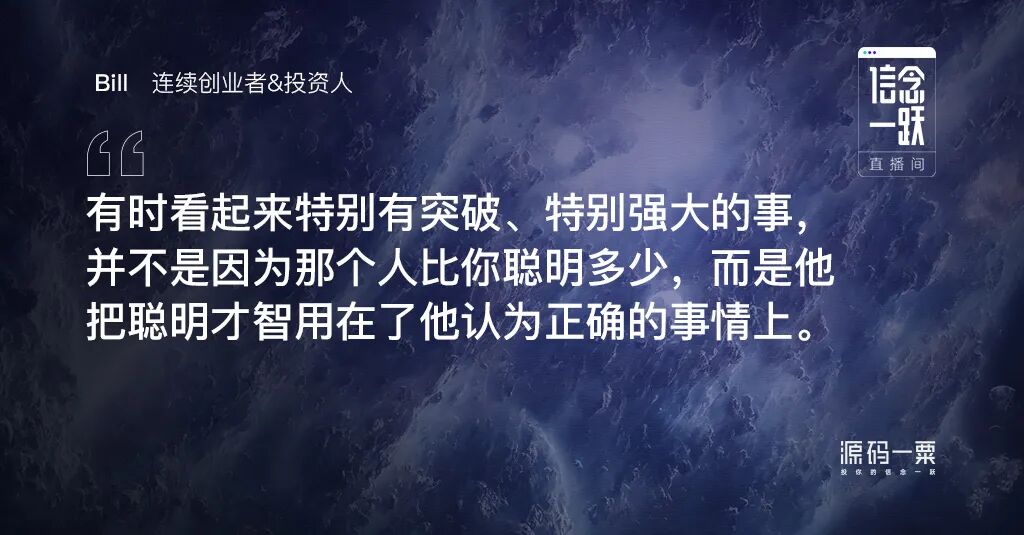
Second, by learning from OpenAI's thinking, there's still opportunity to approach or surpass them. I studied systems science, which emphasizes two things most. First is robustness — system stability. A system like ChatGPT with over 100 billion parameters certainly has more than one stable state. That means maintaining good generalization capabilities across different dimensions. Second is introducing negative feedback — what people now call reinforcement learning. What I'm really saying is: sometimes things that look particularly breakthrough, particularly powerful — it's not because that person is so much smarter than you, but because they applied their intelligence to what they believed was right. Looking at the entire AI industry, after all these years, beyond a few specific scenarios, it hasn't solved universal problems. So OpenAI's pursuit of artificial general intelligence means pushing this industry's boundaries higher. Sometimes you just need to think about how to make the whole industry better. Once you figure that out, things are actually quite simple.
In a sense, Earth-2 is also connected to this. As an AI company, there's a competitive triangle — computing power, data, and scenarios. When I was thinking about this, it struck me: satellites are excellent. Under the UN's Outer Space Treaty, data collected above 120 kilometers is public, free, and unrestricted. Our satellites have infinite data — about the entire Earth. And we happen to have a way to move the powerful computing needed for so much data up there, analyzing scenarios in real time. In other words, in five more years, with 5% of ChatGPT's investment, we might achieve 50% of its effects.
Back to AI companies. I've been in e-commerce for a long time. In my view, e-commerce evolved from selling images and text to selling video — all are processable data. We initially got into AI to provide more globalized solutions for e-commerce clients, like cross-border scene staging, regional model replacement, etc. Whether you're Chinese or American, you can generate many different scenarios from original photos, which clients then use for product details and contextual presentations.
Actually, no one was talking about AI-generated content at that time. We didn't much consider going down ChatGPT's path, probably due to our scenarios. Of course, along the way we saw GPT-2.0, 3.0's state. We thought a better approach was flexible model calling, leveraging our core technologies that have deeper understanding of scenarios. We have a term: "models that manage models." This is where we might go farther than other companies.
Source Code Capital Xingchen Zhang: Putting AI on satellites — what's hardest about that? Why wasn't anyone doing AI satellites before?
Bill: This is genuinely difficult. First is understanding the technology's value. When we talk to people about AI satellites, they need to understand what AI is. It's similar to Tesla's early days — when it marketed electric vehicles, everyone thought it was worthless or problematic. That's somewhat analogous.
The hardest part is that people are used to satellites having, say, 200MHz processing frequency. But now you need people used to 200MHz CPUs to understand putting 50 billion transistors up there, deploying 200 models, completing 200 tasks simultaneously. For example, originally needing 50 satellites costing 10 billion, but finally solving it with tens of millions — how to understand this, how to achieve it? That's the real difficulty.
Second is high talent costs. China's and America's aerospace industries differ greatly. China's aerospace industry carries some national pride; many treat it as an honor or holy grail. America treats aerospace as a driver for new technologies, constantly trying new ideas and methods. To compare: our team sends AI to 36,000 kilometers, but America has already sent it to Mars. For some technical details, finding suitable talent is hard, and talent is expensive.
Finally, AI satellite development cycles are very long. We spend two years building a satellite. In other industries, a company might go public in two years. We're just here waiting for satellite launches.
Source Code Capital Xingchen Zhang: AI capability as a great innovation for satellites — have you encountered particularly difficult customers in this process?
Bill: Last year we encountered a problem with roughly a $100 million constellation project. Because it was a new deployment, we hit difficulties with the first satellite. The market was previously entirely dominated by companies like Airbus. When we entered, the difficulty wasn't abroad — our product's competitive advantage was too strong. The difficulty was domestic. Chinese private enterprises had no precedent. This was exactly the same scenario as when I founded PingPong.
We established the US company first, then the domestic PingPong company later. We solved the overseas problem first, then discovered that domestic payment operations required licenses, but China had long stopped issuing payment licenses. Fortunately, what we did was meaningful. PingPong helps Chinese people collect money earned overseas — the country supports this. We demonstrated sufficient professionalism, so we smoothly became one of the few companies holding payment licenses both in China and abroad. Thus, in pushing China's cross-border payment and cross-border industry standards, the government was quite clear: if I didn't do this, it would eventually become Western territory. By doing it and complying with all regulations, the country encourages it.
Bill's Entrepreneurship Lessons: Belief, Light, and Evolution
Source Code Capital Xingchen Zhang: What was the origin of PingPong? What was the most important takeaway from PingPong's entire entrepreneurial journey?
Bill: PingPong was born mainly because I had founded an e-commerce company doing both domestic and international business. On platforms like Amazon and JD.com, we were probably among the largest merchants and brands. But the domestic and international ecosystems differed enormously. I was still young and always felt life had more to offer. Rather than enjoying success alone, better to bring my industry experience to a more universal context.
So my high school classmate, PingPong CEO Chen Yu, and I decided to do something big. We said we'd build China's PayPal, and we knew the market opportunity had to come from China. That's where we started. Fortunately, when we entered cross-border e-commerce, China's total industry was $20 billion. After seven years, it's now $500 billion — twenty- to thirty-fold growth. PingPong is now China's largest cross-border payment company, larger than PayPal or Ant Group's cross-border e-commerce payments. This confirms that famous saying: "Society rewards those who truly create value."
Before these two companies, I had already been entrepreneuring for 10 years. Now it's nearly 20 years — yacht companies, tourism, hotels, I've done almost everything. The first decade, young and reckless, made some money then lost some. If you want to do something, you have to consider whether you're worthy, and whether society needs your project. If you figure this out, success may not be far.
Source Code Capital Xingchen Zhang: In your entrepreneurial experience, were there lessons or insights from trial and error? Which risks should you take, which shouldn't you?
Bill: First, you need a transcendent mindset before engaging in worldly affairs. If you can truly master this state, you become more objective. Irrational speculation is the enemy of success. In entrepreneurship and investment alike, the biggest problem is don't speculate, don't take risks.
In Warren Buffett's words, "Emotions are a bad thing, whether positive or negative." Behind this is how we view ourselves with calm and objective eyes. Second, flexibly harness the benefits of pressure, prosperity, and adversity. Nietzsche said, "All decisive things arise from adversity." In systems science terms, we call this "negative feedback." Through this approach, we can make companies more stable. Whether PingPong or other companies, we pay extreme attention to cash flow, growth, and overall take rate. But we also create some negative lines, using small instabilities to prompt reflection and review, avoiding bigger pitfalls.
Most people start businesses for self-actualization, but ultimate success comes because society needs it. To summarize, there are three entrepreneurial traps: self-actualization, conservatism, and unwillingness to pay bravely when the right timing truly arrives. As entrepreneurs, you need not only a clear head at all times, but also a transcendent mindset — constantly examining your own and your company's value. Be brave when you should be, but bravery isn't the same as taking risks.
Source Code Capital Xingchen Zhang: In a startup, how do you set iteration pace?
Bill: Startups are inherently contradictory. Even giants are anxious, let alone small startups — I'll use my earlier example. From a conventional perspective, a $100 million project, given before satellite launch, represents enormous client trust. If you choose to lie flat when encountering difficulties, you're treating it as just a business. But if you think bigger — can this $100 million order double? — and try to turn luck into inevitability. As Jeff Bezos said, "You must think about what won't change."
From my perspective, first, this industry will definitely need to be smarter, and will definitely need to solve more specific problems — this is unchanging. What changes might be international environment, economic conditions, hot topics, available capital, or even whether this company ultimately survives — all possible. The unchanging dimension should guide how you view these changing dimensions. If you believe what you're doing is right, there will certainly be solutions, and these solutions emerge from these changing processes.
Source Code Capital Xingchen Zhang: Regarding team management and execution, what summaries and insights can you share?
Bill: I've never been a particularly good CEO myself. In companies I lean toward strategy and culture; I'm very persistent on big directions. Whatever business I do, I basically write something on the wall or website. At PingPong, I wrote: "With great dreams, I can achieve great things. Helping global cross-border e-commerce solve problems and gain global competitiveness is meaningful." I think this is also what we tell all our teams — we hope to unify everyone's values through our vision and belief. Everything else is just division of labor; even your position is just a tool, specific expertise is also a tool. Ultimately, through all our combined efforts, we create a more intelligent organism — the organizational entity itself. As Yongping Duan particularly emphasizes, in the end a company is its culture. What is culture? It's not dependent on any single person. Whether that person is present or not, the company follows established rules. That's what matters most.
Source Code Capital Xingchen Zhang: Currently, Earth-2 is from zero to one; PingPong should be one to ten. At different stages, how is culture different?
Bill: Different company tracks mean different specific execution and implementation, with vastly different nuanced cultures. But fundamentally, everything is the same. In my eyes, whether Earth-2 or any other company, the thinking is identical — create value for customers, help customers create greater value through us. In management approach, we also follow Drucker quite a bit: unleash human potential and goodness. We don't think we're so amazing. More often, we stand from the customer's perspective, helping them solve problems.
Source Code Capital Xingchen Zhang: What advice do you have for entrepreneurs?
Bill: I have my own entrepreneurial trilogy: belief, light, and evolution.
First is belief. I think you should be a valuable person, especially not a competitive one. Being competitive is fine as a leader in business or in market competition. But building a company is a marathon. You must understand value and belief. No process is easy. What supports you to keep going? I think only one thing: belief. And belief comes from what? It must come from altruism, from wanting to create value.
Second is having light. Entrepreneurship can't rely on belief alone; you need methods and ways to get key things done. Whether product breakthroughs, truly moving customers, finding crucial funding, or a kindred spirit partner — these are all getting key things done. You need light.
Third is evolution. Because you have belief, because you can get key things done, you still need to evolve. Small success isn't hard; the hard part is continuously turning small successes into big ones. After evolution, the first thing to do is reinforce belief. If you keep this entrepreneurial flywheel spinning, few things won't succeed.