MaHui Member Whale Announces Completion of C1 and C2 Funding Rounds


Enterprise AI company Whale announced it has completed consecutive C1 and C2 funding rounds, raising over $60 million in total. Investors include Temasek, Linear Capital, Bosch Ventures, MTR Lab, Telkom Indonesia, Singtel, and SM Prime, the largest retail group in the Philippines.
The new capital will fuel global expansion of Whale's enterprise AI product suite, accelerating its presence in key verticals including automotive, fashion retail, fast-moving consumer goods, and chain restaurants, with a focus on China, Southeast Asia, North America, and the global market for innovative enterprise solutions.
Source Code Capital led Whale's Series A round in 2019, doubled down in the 2020 A+ round, and has continued its support ever since. As a long-term partner, Source Code Capital has backed Whale's leapfrog growth through AI talent recruitment, customer network expansion, overseas market exploration, and industrial resource coordination.
The following is a deep-dive interview with Whale founder and CEO Jerry Ye, conducted by Silicon Star Pro.
Everything is about decision making
Silicon Star: Walk us through your entrepreneurial journey.
Jerry Ye: I came back to China to start a company at the end of 2017. The decade before that, I was in the United States. I did my undergrad at the University of Virginia, studying computer science and economics, then went to Caltech for a PhD in neuroscience. At Caltech, my advisor was Christof Koch — he's quite well-known in neuroscience, and that lab has produced a lot of notable people. Fei-Fei Li was my direct senior. I didn't finish the PhD, then went to Harvard, didn't finish there either, and then joined Facebook to work on Feed Data and Feed Machine Learning.
Silicon Star: Why did you decide to walk away from both PhD programs?
Jerry Ye: I was studying decision making. And when you go deeper into decision making, it gets very philosophical — questions like whether humans have free will, what consciousness is, and so on. Eventually I felt philosophy wasn't for me; I wanted to do something more applied. So I went to Harvard Business School, joined a marketing group, and studied how consumers make purchase decisions. The main method was neuroscience — putting people in MRI machines to see which brain regions lit up. At the time, there were only seven professors globally working in this field, consumer neuroscience. Very few practitioners. There are more now. But I still felt it wasn't applied enough. Academia moves slowly; industry moves faster. So I went to Facebook.
What we're doing now actually still has some connection to my research at Harvard Business School.
My first project there was data analytics for retail spaces. While working on it, I realized that online data was already abundant, but offline — despite having plenty of behavioral data — had very little of it mined into something comprehensible.
For example, when you walk into a store, most people instinctively turn right. That proportion is over 80%. So in physical retail, posters and display areas on the right side tend to get higher exposure. Same with subway stations — ad space on the right should actually cost more, because people naturally tend to look right. Why? Psychologically, the right side feels safer, especially in regions where traffic keeps right. But in Hong Kong it's different — many people turn left, which relates to left-side traffic.
These are all highly commercially valuable behavioral patterns, but in the past they were hard to systematically extract due to lack of sufficient data, and most people aren't consciously aware of them day-to-day.
Another very practical example: in queueing scenarios, once there are seven people in line, the eighth person tends to hesitate or simply give up. For businesses, that's customer loss. So we used cameras in supermarkets or stores to record these behavioral data, model and analyze them, helping merchants make better decisions.
Silicon Star: How did you end up starting a company?
Jerry Ye: In 2017, I was at Facebook NY, met an angel investor from Alpha Startups at an event, and he encouraged me to start a company and gave me some money. At the time, I didn't really know exactly what to do.
Silicon Star: But it must have been related to your research and what you did at Facebook.
Jerry Ye: Right. My background was decent enough, so I came back. We got lucky — our first client was Procter & Gamble, our second was Watsons. Both are still our clients today. That's why we do enterprise service: because the first clients we encountered were large enterprises. If our first client had been an SMB, maybe we'd be in the SMB market now.
So I've always said our company is customer-driven. The customer determines far more.
Silicon Star: You had customers before you even had a product.
Jerry Ye: Exactly. Customers raised needs, and we solved them. So our first product was SpaceSight, a camera-based product. Using computer vision to collect and analyze data from customer stores. And a major inflection point that enabled us to actually build this out was the transformation in the automotive industry. Around 2018, cars shifted to electric vehicles, and EVs were developing extremely rapidly during that period. That brought an upstream change: suppliers that had served legacy automakers couldn't serve emerging EV makers, or rather, it gave us an entry point. So this was a window of opportunity that we happened to catch.
Today roughly 40% of automotive brands are our clients; we've gone very deep in this industry. If you go to direct-to-consumer auto showrooms in shopping malls, basically they're either using our cameras or our AI Hub.

Store traffic scenarios
Silicon Star: You made these inflection points sound almost natural in retrospect, but these opportunities were available to everyone. As CEO, how did you seize them?
Jerry Ye: Looking back, it's actually hard to know why I made certain decisions at the time. In the end, I think it was instinct. I just felt I had to do it.
I remember vividly: during our Series B, Temasek had just invested, and I was presenting strategy to the board. They noticed I talked about the automotive industry for a long time, and later in discussion asked why I spent so much time on it — and it turned out it was simply because I saw opportunity there. Very instinctive.
And the board made a decision then: focus on the automotive industry.
Many products later also came from automotive industry demands. For example, smart badges — customers raised this first. They felt that beyond seeing, they needed to "hear," meaning using badges to record data, do conversation analysis, analyzing dialogues between customers and sales staff, mainly recording customer preferences and understanding the gap between excellent and average salespeople. We built this product because the automotive industry had this need. It was all a very natural process. I wasn't deliberately looking for a product and then fitting it to the market. I think today everyone talks about Product-Market Fit — at least in our experience, in enterprise service, it's the reverse: we had the market first, then we had the product.
We don't have PMF, we only have go-to-market. I think PMF emerges from the market — start from market demand and do what the market needs.
AI sells know-how; products built on empty thinking can't win in the market
Silicon Star: That's actually quite different from today's hot AI products. Those mostly start with the product first.
Jerry Ye: What's good about AI today is that it's very easy to start with AI, because there's so much you can do. So you build some AI first, put together a proof of concept, then go look for demand. But the downside is: when you have AI before demand, your understanding of that demand may not be very deep.
Whether or not you have AI, you should identify customer needs first. What do customers need now? A lot of it lies in their operational workflows. A recent HSG presentation mentioned that AI delivers results — and an important part of that is that you now need an Operation layer more than before. Previously you just built a tool; now you're accountable for results.
Silicon Star: Many new AI companies themselves haven't figured this out.
Jerry Ye: Right. Let me give an example — our own B2B operations. We need to acquire customers, talk to them, and within those conversations do needs analysis. How do you do needs analysis? What does the customer need? Needs analysis is a methodology. In the end, AI needs to produce this needs analysis as a spreadsheet — that's a workflow. Humans did it before; now AI solves this workflow.
But if I ask an outsider to do needs analysis for our company, no matter how powerful their AI is, they won't do it well — they don't understand us. Customers often say this: "You don't understand me." It's because you haven't deeply understood this user workflow, this operational workflow — how can you build something without understanding?
For example, we're currently working with a large private equity financial institution on a project to replace analysts with roughly two years of experience. We're doing quite well now. We use badges to record, then need very specific analysis workflows — the information to extract from interviews requires a lot of know-how.
We chat with analysts every day, iterate repeatedly, until the report comes out. How to synthesize this is also an interview methodology. Once this workflow is working, it becomes an AI agent, and this AI agent becomes useful. You give this agent to them, they feel it's usable, and the next day I can sell to more fund companies.
So you see, AI doesn't actually sell AI — it sells know-how. Think about it: agents essentially sell know-how. Previously, professional expertise couldn't be scaled into something standardized. For example, top-tier investment banking methodology — they might need two years of training to cultivate an analyst. Now you train the AI, and you can replicate at scale.
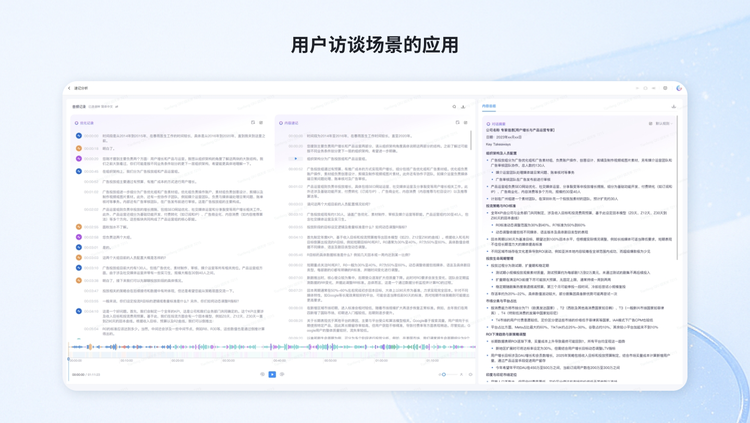
User interview scenario
Silicon Star: Recently popular AI Agent products mostly don't emphasize this know-how. They emphasize one product solving all needs.
Jerry Ye: I don't think general-purpose can work. Why I don't think it works — beyond the serious example I just gave — even for something like planning a Japan trip, that requires know-how too. You can't just output something directly; trip planning requires extensive interaction and exploration with the user, it requires deep domain know-how. So without this know-how, you can't build it. That's why starting from customers is the same thing — you must deeply accumulate customer know-how, then use AI to replicate it. That's what should be done.
Those flashy things don't solve problems. Really solving problems? If you actually test in front of customers, they don't solve anything.
Silicon Star: According to OpenAI and various general agent visions, models and capabilities will keep iterating and eventually eat everything.
Jerry Ye: Impossible, I think they're overthinking it. Scenarios are essentially know-how — accumulated by professionals in professional contexts. So I think managed service companies might actually be the AI companies of the future.
Silicon Star: You've actually been using AI capabilities all along, but people habitually use ChatGPT 3.5 as a dividing line — companies founded before and after are categorized into different eras. So what was your instinct when ChatGPT emerged? I saw you previously shared that you shouldn't mention AI in your product, because only when you don't mention it does it mean it's truly accepted. But today in your new product launch, you've put AI in the name.
Jerry Ye: Right. Actually from 2017 to now, there were two major inflection points in between. First was Bitcoin, Web3. A lot of people flooded into Web3 then, and some companies pivoted to Web3, but we didn't. For AI, we held an all-hands meeting and immediately said: all in AI.
Silicon Star: What was the timing? When ChatGPT completely blew up?
Jerry Ye: Roughly when GPT came out. Actually we had sensed it before, felt that moment was approaching. Because we were already using Diffusion Models and so on; by GPT-3 we had already researched extensively and been applying it.
It was also interesting — at the board meeting, actually half the people didn't think we should all in AI. But in retrospect it was very right. I decided then that everything had to be done with large models. Today in our camera product, 80% is done with VLM (Vision Language Models), and the results are very good. Many competitors can't keep up. I think that was a correct decision.
If we're asking whether ChatGPT was a watershed — it was, but the key wasn't the technology itself. It was whether you took that step early enough. At the time everyone said SaaS was doomed, but if you had taken that step toward AI earlier, many SaaS companies actually had a chance to survive and even thrive.
Why? From the customer's perspective, they'll come to you first, not some newly emerged AI company. You're their long-term partner, their trusted business entry point. AI arrives, and naturally they want to know "what should I do." But whether you can seize this opportunity still depends on you — whether you've thought ahead, whether you dare to act early.
Silicon Star: Good instinct, and the specific execution rhythm matters too. After going all in AI, I saw your thinking evolved — initially you emphasized AIGC usage in your content products, while today's new products emphasize possibilities brought by Agent reasoning capabilities like CoT.
Jerry Ye: Agent is fundamentally a very bottom-layer thing. We've been using agents all along, including Chain of Thought (COT), Chain of Action (COA) — always using them. It's just that today people know, oh, you use COA, that's nice. I used to have to educate clients: I use ten agents to do this, and clients would think, why so "wasteful," why ten agents? Now I don't need to. And now reasoning capabilities matter too; many product problems get solved much faster.
Whether to mention AI — here's how I think about it. In 2017 we also had a lot of AI in our products, but we didn't like calling ourselves an AI product, because we were a product that solves customer problems. From the customer's perspective, they don't need to know whether AI or something else solved it. As long as you solve it. Emphasizing AI actually traps you in AI thinking.
And today, why put AI in the name? Because customers' understanding of AI has changed. Customers need AI now. Customers today say "I want to do AI" — that's the change brought by ChatGPT and DeepSeek.
Silicon Star: ChatGPT educated the world; DeepSeek educated the China market.
Jerry Ye: Exactly. That's what happened. These customers previously would have needed long education about AI. Now they don't. Finally they won't challenge me asking why put AI on cameras — today it has to be there. The customer change is higher AI acceptance. But what hasn't changed: they still need problems solved.
Also, I think what's more important is the organizational change it brings. We used to need engineers to solve problems; now engineers aren't needed. Now product managers (PD), even everyone can solve.
I now require all pre-sales solution (SA) people to solve. Previously when we did demos in front of clients, we'd collect requirements, pass them layer by layer to engineers. But you know the furthest distance is from customer requirements to engineers. By then maybe only 20% of information remains — massive information loss at each layer.
Now, something very powerful: SA can solve directly in front of the customer. They directly write a prompt, build one or two agents, and solve the problem. We call this real-time POC. Customer wants something, real-time delivery. Used to take a week; now it's real-time. No comparison.
Don't box yourself in; self-imposed limits are fatal
Silicon Star: Your products essentially use AI and other technologies to serve this thing called the "customer journey" cycle, or I understand it as taking the data-based recommendation algorithms that Facebook and others did very well, and placing them in the physical world of offline commerce.
Jerry Ye: Right. We mainly do Marketing & Sales. Currently serve many consumer brands. From the customer perspective, it's how to make money. For the customer's customer, it's the customer journey. For example, coffee — from wanting coffee to finishing it — there are now very many AI tools helping optimize this journey. It consists of two parts.
One is standardization. Whether using visual images or voice for inspection, or all content going out needing compliance checks, we need to ensure all marketing and sales actions are standard. These inspection-related things, we use a lot of large model capabilities.
Second is how to help sales. The essence is how to communicate better. The core of our product is communication. Whether it's AI-generated content or Agentic AI helping sales, it's helping customers with external communication. For example, Watsons has 80,000 store staff; each staff member posts four pieces of content daily — that's 320,000 pieces of content per day. We help enterprises do this communication well.
These all require a lot of technical capabilities. What I think we've truly accumulated is still mostly know-how. For example, if I were to open a coffee shop now, I'd definitely run it the best, because I understand it too well.
Silicon Star: So even SaaS companies born before ChatGPT still have opportunities.
Jerry Ye: What is SaaS? SaaS is software as a service — it's an artificially defined thing. Aren't AI companies also SaaS? They are too. So I think your company's definition must come from yourself: which customers you serve determines what kind of company you are. SaaS is something investors define; you can't box yourself in that way.
In today's competition, our advantage is the scale effects from accumulated data. If someone started a camera AI company today, I tell you it definitely won't work. I have enough cameras, enough data, and I'm an AI company training these AIs daily. Suppose you do the same thing now — at best you get 80% accuracy in front of customers; I can get 95%. Customers will obviously choose us; you can't get in. And AI actually helps me solidify this scale moat, not disrupt it. So I think SaaS companies, if you think clearly: if you're not just doing tools, if you have data, if you have scale, you can easily treat AI as your moat.
So I think the word SaaS got corrupted. But we've always said: we're a B2B company. Whether SaaS or not, we don't care today. AI or not, B2C and B2B fundamentally haven't changed. B2C is still a traffic business; B2B is still about serving customers well. That's it.
Silicon Star: So once you define your customers clearly, you won't get caught up in saying "I'm a so-called SaaS company, now should I do AI SaaS or what" — instead it's: what do customers need now, and can my technology, based on my judgment, meet that need.
Jerry Ye: Right, that's exactly right. The customer is here; as long as you serve them well, using the latest technology, the best technology, the most appropriate technology to serve them, you can build a great company. That's enough. Never start with the product first — once you have a product and go around promoting it, it won't work.
Silicon Star: I saw you raised funding this round, which in this environment isn't easy. This round was mainly overseas investors. What's your overseas expansion situation?
Jerry Ye: Becoming a global company has always been our vision. The pandemic's impact on domestic offline business also pushed us to think more actively about internationalization. Later we achieved some actual revenue in overseas markets like Southeast Asia — about 30% of total revenue in 2024, and we'll reach 50% this year. For dollar funds and overseas strategic investors, we've become an attractive investment target, and this has indeed helped us secure critical funding, attracting overseas strategic investors like Temasek, Bosch, and Telkom Indonesia. This is also key for us to continue expanding overseas markets.
Silicon Star: Today's international environment makes some entrepreneurs hesitate about going global.
Jerry Ye: Actually, in some overseas emerging markets, competition isn't as "intense" as domestic. When you go out earlier and more decisively than other hesitant companies, you can actually gain certain first-mover advantages and competitive space. Don't let these imagined difficulties box you in.
More importantly, true "going global" requires the core team, especially the CEO, to have determination — to personally go to target markets, "walk every corner," deeply understand local markets, culture, and customer needs. If it's just nominal, or with a "go play around" mentality, it's very hard to succeed.
Silicon Star: So today's uncertainty is actually opportunity.
Jerry Ye: Right. I've always said: in changing markets, wherever there's change, there's opportunity. You need to find change; finding change means opportunity. Change is actually good. What's most frightening is calm seas.
Silicon Star: What are your plans for Whale over the next five or ten years?
Jerry Ye: We still won't engage in empty thinking about products, markets, and the company. We'll continue serving customers in China and globally. Only this way can we more deeply understand and experience how next-generation customer needs emerge, what drives next-generation consumer decisions, and what new sparks will fly when next-generation marketers, technologists, and businesspeople collide at the intersection of business and technology.

Whale Technology core team
Original article: Interview with Whale's Jerry Ye: AI Sells Know-How; Flashy Star Companies Ultimately Sacrifice Themselves to Educate the Market