MaHui Member ToolDance Raises Over $10 Million on First Day of Crowdfunding, Redefining Desktop CNC

Source Code Capital was the exclusive investor in J&T Global Express's seed round, continued to lead its angel round, and has kept increasing its stake through the Pre-A round.


MaHui member ToolDance, the first-generation desktop CNC product ToolDance X1, raised over $10 million on its first day of crowdfunding, setting a new record for the category and demonstrating fresh momentum in desktop CNC. Source Code Capital was the sole investor in the company's seed round, continued to lead its angel round, and has since doubled down on its Pre-A round. Recently, Hard Kr published an in-depth feature on ToolDance's product logic, technical approach, and delivery progress.
Full article below (Author: Peng Li; Editor: Silai Yuan):
Late on the night of October 15, the lights were still on at ToolDance's Shenzhen office.
Their first-generation desktop CNC product, the ToolDance X1, had just gone live, with crowdfunding totals changing by the second. Three minutes in: $1 million. Thirty-nine minutes: $5 million. In under 13 hours, the figure hit $10 million.
The results exceeded the team's expectations. Recalling the moment, one employee was still visibly excited: "We couldn't even keep up with the victory announcements."
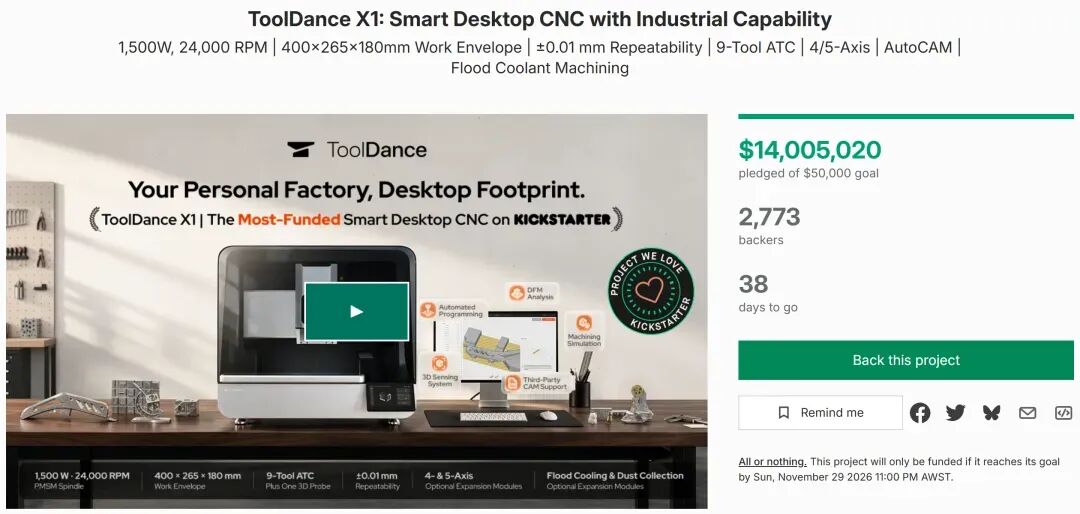
The ToolDance X1 became the third desktop CNC product to break $10 million in crowdfunding, following Makera's Z1 and NestWorks' C500. At the time of writing, the total has surpassed $14 million, overtaking NestWorks C500 to set a new category record.
Founded in 2025, ToolDance was started by Allan Wang, who spent seven years at DJI from 2016, leading mechanical structure and mapping radar product teams. CTO Zhang Min previously worked at Huazhong CNC and Siemens, and served as deputy general manager of Beijing JCZ — a STAR Market-listed company — and general manager of its subsidiary, bringing top-tier domestic expertise in CAM algorithms and CNC system development. COO Meng Lingyu, chief engineer Lü Rong, and electronics systems lead Liao Zhou all have years of experience at DJI and Cloud Whale, while CMO Brenda is a marketing executive with over a decade of startup experience in Silicon Valley.
The ToolDance X1 is a fully enclosed three-axis CNC milling machine with a cast aluminum frame and a machining envelope of 400 × 265 × 180 mm (X × Y × Z). Early-bird pricing starts at $2,999. The first batch is expected to begin shipping in March next year.
On the hardware side, the X1 features a 1,500W permanent magnet synchronous spindle and a nine-station automatic tool changer — both best-in-class among current domestic desktop CNC offerings — capable of machining aluminum, titanium, stainless steel, and other metals. On the software side, ToolDance developed its own ToolDance Studio, which includes an AutoCAM automatic programming system.
Wang often feels that building a desktop CNC was "destined." In 2011, while studying welding at Harbin Institute of Technology, his graduation project was on metal 3D printing. He still keeps the first part he ever printed. After leaving DJI in 2023, Wang spent over a year exploring desktop metal fabrication and hand-built a desktop CNC prototype — both to prove the direction's potential to investors and to himself.
ToolDance was founded right as smart hardware entrepreneurship was peaking, and raised cumulative funding in the hundreds of millions of RMB before shipping any product. But as that wave receded, investors began watching these companies' progress closely. Wang's answer has been impressive. The next major test is stable delivery and production capacity. "There are still massive details to work through, and plenty of technical engineering challenges to tackle."
1
A Clear Focus on Parts Machining
Wang's decision to build a desktop CNC came not only from his passion for metal fabrication but also from the evolution of 3D printing. "Almost every industrial manufacturing device has the potential, driven by two forces, to become a large market. One force is manufacturing itself moving from the factory floor to the point of use. The other is the trend toward tool toy-ification, which further expands the use case from fabrication to emotional consumption."
Wang believes that a manufacturing process's capabilities and scenario potential determine its market size — and that desktop CNC is the next big opportunity.
After years of development, 3D printing has broken into diverse scenarios like parent-child interaction and education. To find desktop CNC's use cases, ToolDance invested heavily in early research: distributing surveys on Reddit, building a standalone site with a research firm, and conducting one-on-one interviews.
Wang told Hard Kr that two scenarios emerged most clearly from the research. The first is R&D prototyping, where users prioritize efficiency. The second is hobbyist creation driven by personal interest, where the priority is enjoyment. To reach the broadest audience, he aimed for the overlap between the two: "Maintaining the tool's utility while making it accessible and affordable enough for hobbyists."
Crucially, by product type, use cases split into two categories: parts machining and sculptural work. "Our research gave a very clear answer: over 80% of user demand is concentrated in parts machining." Parts machining also demands harder CAM technology, while covering sculptural CAM well. This directly shaped ToolDance's product definition: parts machining as the core entry point.
From this product boundary, the entire logic of the ToolDance X1 becomes clear. While competitors like Shuma Electronics and Infinite Workshop launched five-axis machines directly, the X1 kept three-axis as its base, with four- and five-axis as optional add-ons that users can configure themselves.
"Most parts don't require five-axis technology — three-axis already solves the majority of parts machining problems," Wang explained. Positioning the base machine as five-axis would disconnect it from the primary use case, reducing scenario-fit efficiency, while also driving up price and preventing it from becoming a viable interest-driven purchase.
That said, Wang acknowledges five-axis is the future trend, since it simplifies fixturing and lowers the barrier to use. So even as an add-on, the five-axis module received substantial engineering attention. In the current product, the four-axis module supports联动 machining of workpieces up to Ø120 × 160 mm (diameter × length) when the tailstock is installed. The five-axis module supports both 3+2 positioning and full five-axis联动 machining, with RTCP tool-tip following.
Beyond its scenario-driven approach, another distinguishing feature of the X1 is its nine-station tool changer. CTO Zhang Min told Hard Kr that precision manufacturing's complexity inherently requires many tools: "Roughing, finishing, holes, threads, chamfers — different features on the same part may need different tools. Accommodating more tools enables more operations to run continuously, reducing mid-process manual tool changes." Currently, consumer-grade desktop CNCs max out at six-station changers. Zhang believes that "one key metric of a CNC's tool capability is how many tools it supports."
A machine focused on parts machining also means the software must not only generate executable toolpaths but meet tight dimensional tolerances. Zhang noted that the X1 achieves a repeat positioning accuracy of ±0.01 mm — industrial-grade performance.
This is no easy feat. During metal cutting, both the tool and machine can be affected by cutting forces and vibration. CAM-generated toolpaths need to be as smooth as possible, with cutting parameters arranged to minimize sudden load changes and create stable machining conditions. In Zhang's view, this is a systems engineering problem of finding balance under multiple constraints: meeting safety and accuracy requirements while also considering machining efficiency, cutting stability, and surface finish.
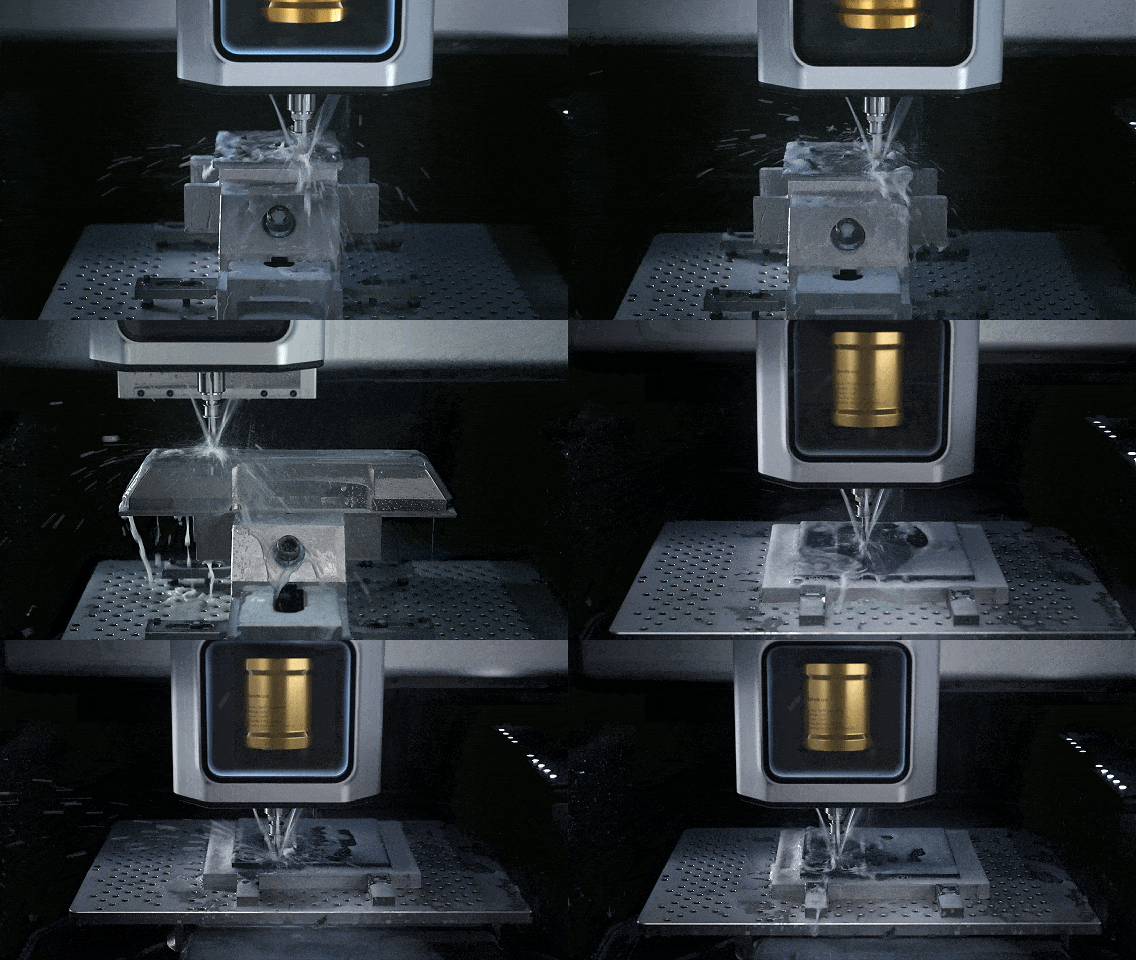
Moving from factory to home introduces many practical concerns like noise and chip management. On the X1, Wang explained, the machine performs relatively quietly even at high-power roughing: "In quiet mode, aluminum roughing measures under 65 dBA at half a meter from the machine. We want it to be acceptable with the door closed in the next room." Dust collection with multi-stage filtration, and wet cutting with chip management, appear as optional modules.
On delivery, Wang is confident. Guo Yao, the company's manufacturing and delivery lead, has extensive new product launch experience from Foxconn, Jabil, Huawei, and Cloud Whale. More importantly, the company designed for manufacturability from the start — adopting an automotive-grade philosophy of breaking the machine into part, module, and assembly levels, with testing at each level before advancing.
On the supply chain, Wang said the company locks in long-lead materials early and maintains dual-source backups for critical components. On capacity: in October, Phase I of a 10,000-square-meter facility began phased operation, with a single-shift designed capacity of 1,200 units per month. "We test every unit for accuracy, airtightness, safety compliance, and more before it leaves the factory."
Wang believes that CNC's transition toward mass adoption requires more than making a difficult tool easy to use — it needs to evolve from "tool" to "toy." For most ordinary people, today's CNC isn't yet a toy. "Getting more people to spontaneously want to use it and enjoy the making process still has a way to go." Building a product with good enough experience remains the most important task right now.
2
CAM Software Built on Safety and Determinism
CAM software is the key to desktop CNC breaking into the mainstream. For industrial equipment to reach the desktop and consumer markets, ease of use is a major hurdle: How well can an interested but inexperienced ordinary consumer actually use it?
Take traditional hand carving as an analogy. An experienced craftsman must carefully judge where to cut, which part to machine first, and how to handle different materials. This experience-dependent, hard-to-articulate judgment could be called a kind of "feel."
Now, CAM software should shoulder part of what once relied on professional expertise. Ideally, the user inputs a model, tells the software the desired outcome, and the software plans a reasonable process accordingly.
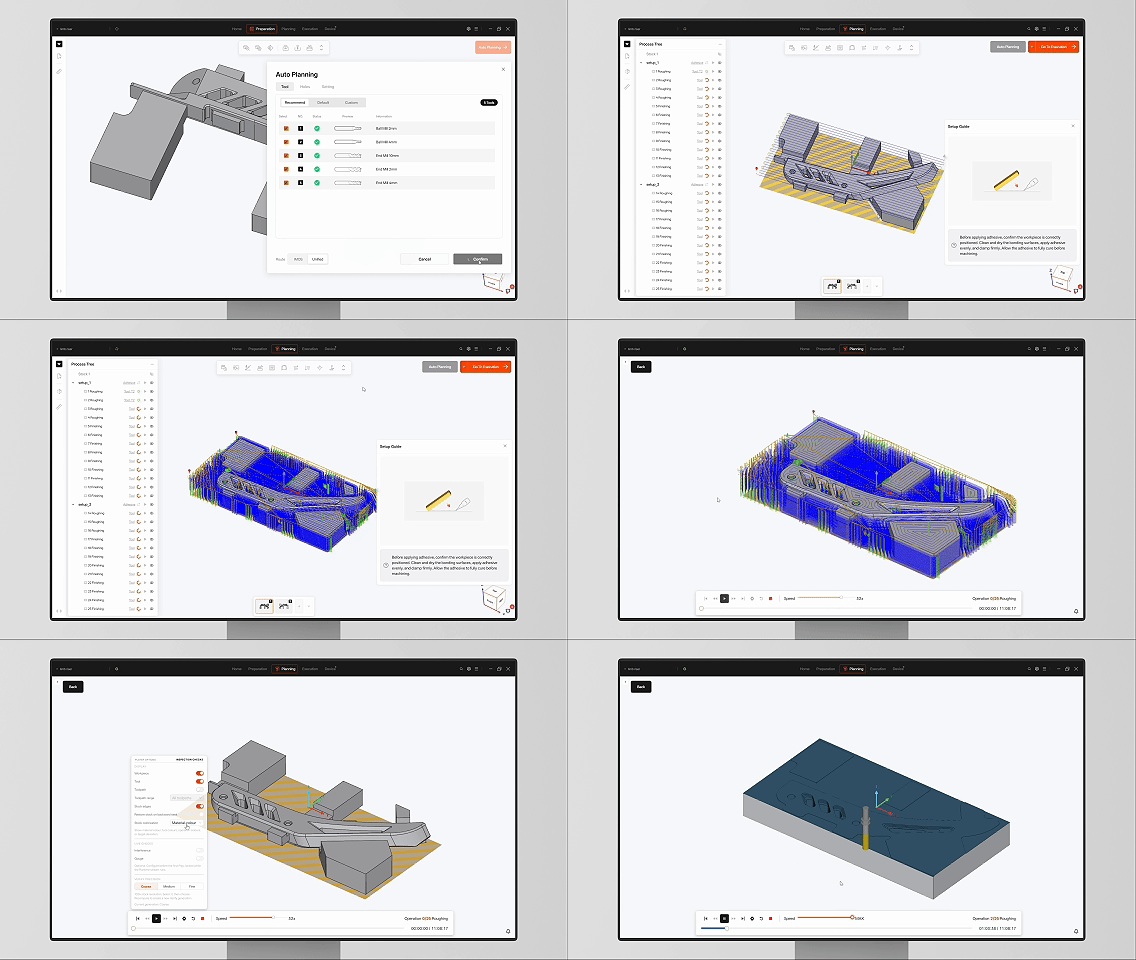
Currently, the X1 ships with ToolDance Studio. After importing a model, users can run a manufacturability analysis to check geometric features, tool accessibility, and stock and machining constraints, receiving suggested model modifications. AutoCAM then automatically generates toolpaths, feeds, and speeds. Finally, simulation verifies the machining process. In other words, the software attempts to consolidate the preparation work that previously required specialists into a relatively coherent workflow.
ToolDance's CAM software is led by CTO Zhang Min. He recalled that over more than a year of development, the team spent the most mental energy on automatic programming. Part geometries, tool conditions, and process requirements vary widely; generating executable solutions requires handling a series of constraints simultaneously.
The hardest part was choosing the technical approach for automatic programming. In industrial CNC machining, if CAM-generated programs cause machine collisions, the equipment, tools, and workpiece can all be damaged. In consumer CNC, the same risks exist. The stock material users bring may carry not just material cost but personal significance.
Therefore, the team made machining safety and reliability a key criterion for technical decisions. Process planning needs to leverage experience and rules; toolpath generation must satisfy clear accuracy and machining constraints. The team chose to combine intelligent algorithms, machining knowledge, and precise geometric computation: "We use AI where AI belongs, and rule-based heuristic algorithms where determinism is needed."
Another distinctive feature of the X1's CAM software is that after generating toolpaths, users aren't forced to accept them as-is. Before a process plan is sent to the machine, users can edit and modify toolpaths or create their own processes. Automatic programming lowers the barrier to entry, while editability preserves space for users to judge and adjust based on actual needs.
Complementing process planning is machining simulation and safety checking. Zhang said the team invested heavily in simulation, aiming for results as close to actual machining as possible. Through high-precision material removal simulation, users can preview the tool cutting the stock, and check for collision and interference risks between the tool, tool holder, workpiece, fixture, and relevant machine components under defined clamping conditions. Users can also compare the simulated part shape against the target model to see where too much material was removed or where stock remains. Simulation also covers multi-axis machining, helping users check motion and interference at different orientations.
For ToolDance, the coming challenge is not only completing delivery on schedule but ensuring product quality and user experience stand up to market scrutiny. For the maker community watching this space, whether this product can truly enter workshops and everyday creative scenarios will be an important test of the desktop fabrication equipment market's potential.