Code Brain | After All These Years, Why Do We Still Love *Friends*?

A "Utopia" Built on Friendship, Courage, and Love


Preface
Friends is a show that rewards repeated viewing. Though the lives of its six protagonists remain forever frozen in that decade, we who watch Friends are constantly projecting our own lives onto the experience. Every time you open Friends, it's as if you can instantly travel back to that "utopia" built from friendship, courage, and love. This essay is a review published by The New York Times on the 25th anniversary of Friends' premiere. If you've never seen the show, you can still get a sense of it from this piece.
WESLEY MORRIS September 11, 2019
There was a time when we made do with just a sliver of television — the domain of three broadcast networks (the major American broadcasters CBS, NBC, and ABC), where "changing the channel" meant cycling through a triangle. We had local public stations, and UHF antennas that pulled in old programming. Now? Now we romanticize this so-called Golden Age of cable-assisted, internet-distributed television, nitpicking the deluge of streaming content. Looking back, television from that era of scarcity seems lesser in quantity, quality, and authenticity. But who was Friends lesser than? The show ran 236 episodes — just one fewer than Game of Thrones, House of Cards, and Orange Is the New Black combined. Most of them are perfect as pure, clean comedy. You might struggle to think of Friends as a perfect show, let alone a great one, because it doesn't look like it took much effort. Most "old TV" looks like it wasn't hard to make — even when characters break up, bleed, or die. That's because, even when these things happen to them, they clearly aren't in a movie. And now television is movies, which is why we prefer it. The American sitcom was anti-cinema from start to finish, thanks to the demands of advertisers. Before television became "too much," we had plenty of it, including plenty of NBC's Friends. Think of how much work went into producing 24 episodes across a nine-month season (some scripted shows somehow did even more). It was an unbelievable amount of labor, which we viewers took for granted. A network like NBC could turn "of course" into "must," making you feel that missing it would be some kind of catastrophe. In the 1980s, it demanded that "everyone watch." A decade later, we had to watch "must-see TV." Technically, it was an uncertain era. If you missed an episode, who knew when you'd get to see it again?
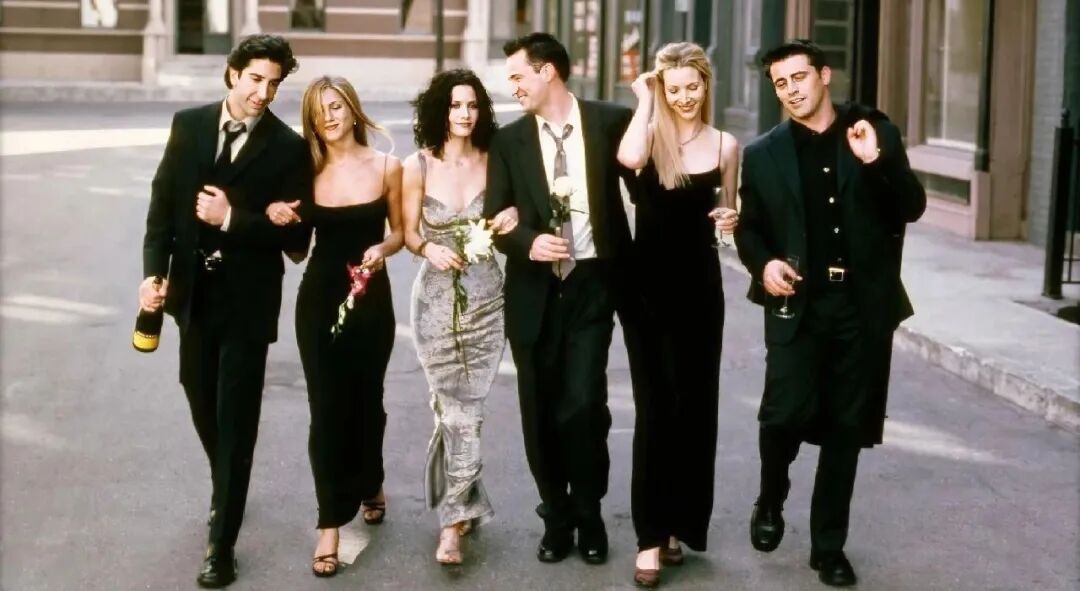
Friends was elite-level simple television. So many jokes, so much physical comedy, so many surprises and touching moments, plus the electrified screams of a live audience. Hairstylists were doing the Rachel — not that many could pull it off. Coffee shops became people's second homes. Over the course of ten years, tens of millions of Americans watched all this writing, directing, and performing, and it all looked effortless. The work and a nation's investment in it felt like proof of some kind of golden age.
Friends premiered on NBC in the fall of 1994 and ran for ten full years, typically drawing about 25 to 30 million viewers each week (sometimes more). Now it airs on Nickelodeon's Nick @ Nite block. Which means that if, like me, you enjoy channel-surfing in order, starting from NY1 and going down five channels — past local news, TNT, and The Simpsons — you always end up landing on Chandler, Joey, Monica, Phoebe, Rachel, and Ross. Laziness is one reason. (Do you still use the number pad on your remote? I bet you don't even have a remote anymore.) But the real reason is simplicity. Friends is an extraordinarily easy show to watch. Seinfeld — and The Simpsons — derived their genius from the "comedy" generated by the "situation." What trouble would Jerry and the gang get into? Whether you're watching for the first time or the twenty-seventh, this animating premise is a major source of pleasure. Friends' premise was friendship. Questions of behavior and economic inequality seemed only to bind them closer together.
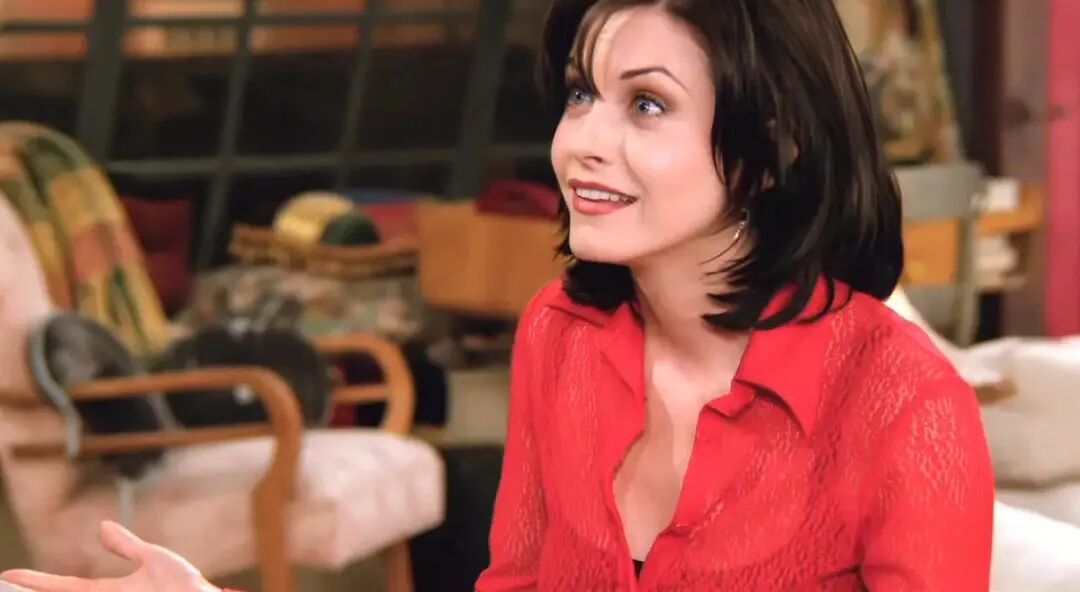
Friends still
Take Episode 29, for example. To celebrate Monica's promotion, the group goes out for an expensive dinner. Phoebe, Joey, and Rachel order the cheapest items on the menu, then refuse to split the bill evenly. The income disparity drives a wedge between those three and the other three, until Monica loses her job and Joey boldly offers to cover her $4 coffee tab — with Chandler's money. The theme song wasn't lying: they really were always there for each other, ready to be the butt of the joke and everything else. This companionship is the show's invisible charm.
Writers could devise plots for directors to stage. But these six actors doing something together, or nothing at all — this was the happiest moment of many people's week. This companionship was also remarkably flexible. The six could attack each other, fight, lie, be what we'd now call "brutally" honest with one another while keeping plenty of secrets. They could break up (many times, in many ways), yet as a sextet, they could always reconcile. I loved them as six. I also loved them in pairs and trios, like permutations, like chemistry experiments. There's one episode where Chandler, Joey, and Monica's defenses crumble and they confess to the other three that yes, when Monica was stung by a jellyfish, Chandler really did pee on her wound. I've probably rewatched that scene ten times. I don't know how many takes it required, or how much caffeine was consumed. But it's an absolute miracle of convulsive laughter. And any random combination among them could produce this kind of astonishing, vibrant comedy, because this was the greatest ensemble in television history. Other hall-of-fame comedies, like The Mary Tyler Moore Show and Cheers, threaded wit, banter, and clowning through pretension and grousing. All in the Family and the early seasons of Designing Women, though initially bursting with energy, personality, and expressiveness, eventually devolved into farce altogether. In shows like The Golden Girls and Frasier, treasures worth rewatching were tucked away in a smorgasbord of slapstick, acid, and innuendo. But in Friends, the ratio of treasure was higher. They attempted more, more frequently, and rarely failed.
The actors, for one thing, had more to work with. The friends on Friends started as types. Rachel was the princess, Monica the control freak, Joey the dim actor. But these types were constantly recombined.
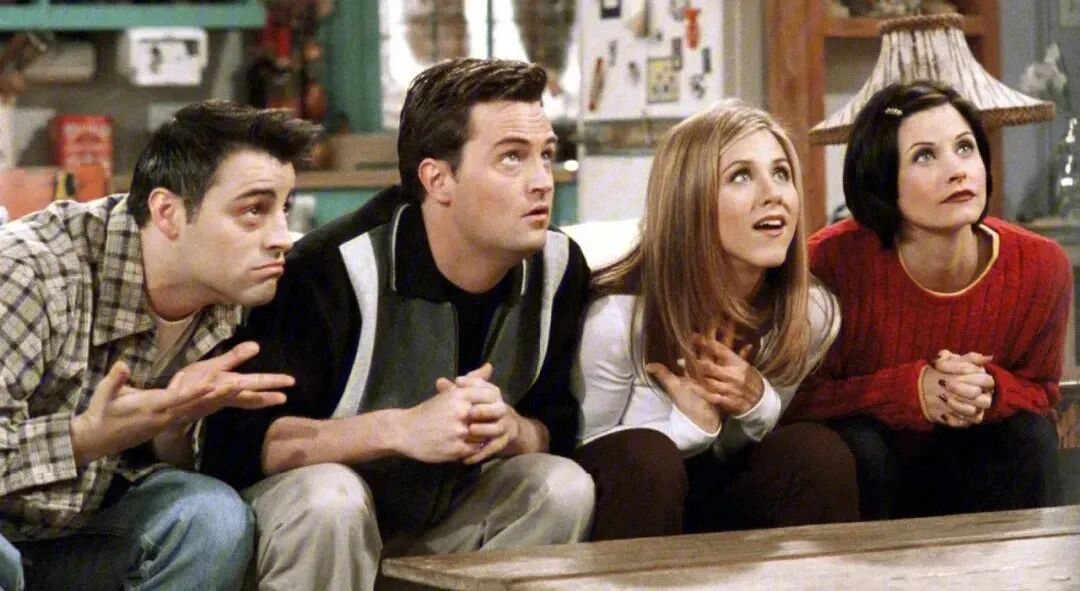
Ross seemed like a geek because his paleontology was frequent joke fodder, and David Schwimmer's mumbly kvetching often came across as whiny. But Ross was melancholic, attention-starved, insecure, quick to anger — basically a dark character — with the physique of a brainless jock. Phoebe quickly evolved from a naive hippie chick into a schemer, a dreamer, a peacemaker, and a troublemaker. In the era of Three's Company, she would have been the Suzanne Somers of the group, an unfortunate blonde. But Lisa Kudrow, with her off-the-charts intelligence, made you forget she was a blonde at all. In fact, early in Friends' run, there's a scene where several of them are watching TV, and Matthew Perry, in his characteristically infectious sardonic mode, has Chandler say: "I think this is that episode of Three's Company where there's some kind of misunderstanding."
"Then I've already seen it," Phoebe replies, and turns off the TV.
Friends could easily have become Three's Company, whose "situation" and "comedy" actually paired quite well. Chandler was frequently assumed to be gay; he could easily have become Jack Tripper, Three's Company's fake homosexual. Matt LeBlanc's Joey was like Somers, but in a Tony Danza way. Which might have made Courteney Cox Friends' Joyce DeWitt — neutral and sensible. At least for a few episodes, Cox's Monica did seem to be the center of the group. Monica was Ross's sister. Rachel was an old high school friend who became her roommate.
But midway through the first season, it became clear that this ship had no captain, only many rowers. And Cox rowed hard, never getting her due. She wasn't as funny and intriguing as Perry and Schwimmer, nor did she radiate the blazing, intense comic color that Jennifer Aniston brought to Rachel. She couldn't materialize sarcasm and shock in cursive and calculus like the other five. But fierce ambition made Monica utterly uncategorizable.
I mean, I suppose she's the competitive Type-A personality. Monica is the most psychologically representative character: she used to be fat, lost the weight through tremendous effort, and kept it off. The show's flashbacks put Cox in padding, mocking how large Monica once was — we can of course disapprove of this now. Yet these flashbacks also explain why she experiences everything as competition, why winning and control matter so much to her. Monica had been so out of control, so bereft of poise and composure. Every actor performed with commitment, but Cox internalized this feeling into Monica's very psyche.
These days, people bombard Friends with criticism over all manner of issues — homosexuality, mental health, race, interracial dating, ethnic identity. (At Rachel's baby shower, annoyed by receiving too many diapers as gifts: "What are we going to feed this baby — Indian food?") The "problematic" Friends are unhelpful to the show's complicated relationship with these issues. Sometimes it simply looked the other way. Monica especially was susceptible to the allure of casual Blackness. Her cornrows and Chandler's disdain for them are one example. But my favorite is when she has a cold and insists on having sex with Chandler anyway. He's not really into it. But she kills it, wearing a Muppet-like scarlet plush robe, full of mucus and Guy-era R&B. "Are you saying," she asks, writhing toward her man, "that you don't, even, want to try this?" That's Peak Monica: white appetite for victory taken to its extreme.
There's a way of watching Friends that makes its very whiteness — and the privilege that comes with it — the problem. The show's magical casting configuration would probably be offensive if attempted today — I understand that grievance. In Friends' heyday, Eriq La Salle on ER was basically the biggest non-white star on a hit show for a long stretch. What Friends presented to you were white people who could leave a baby on a bus and suffer no consequences, whose regular table at Central Perk was only occasionally challenged (a "RESERVED" card sat permanently on the coffee table). But I don't quite believe that all that effort, all that repeated, breezy door-opening, was for that.
Friends' social stakes were largely wagered on gender difference, which allowed the men to be chauvinists, horndogs, and layabouts while the women had to be impeccable. But upending stereotypes became central to the show. In one episode, the women know less about the men than the men know about them, which costs Monica and Rachel their apartment. Fair enough: Do you know what Chandler does for a living? Yet their home suddenly belongs to Joey and Chandler. The twist remains surprising to this day. I watched this early episode in a college dorm with roommates, where bad housing could destroy friendships. That night I wasn't watching a comedy. I was watching a cautionary tale. The show knew we were loyal to the women's side, and that Monica might not survive making breakfast in a man cave. So it refused to let them wipe the slate clean. Her cry of "No" doesn't belong to sitcom. It belongs to Hamlet.
Friends left prime time in 2004, just as culture began to distrust that meaningful risk-taking between genders was possible. Its descendants — How I Met Your Mother, The Big Bang Theory, The Mindy Project, New Girl, and the short-lived, quip-dense masterpiece Happy Endings — all performed respectably. But Sex and the City, which premiered on HBO in 1998, and the films that tumbled out of Judd Apatow's laugh factory, had convincingly re-sorted men and women into ladies' nights and boys' clubs, to the point that culture never reinvested in a place like Central Perk where men and women could find solace together.
Friends wasn't a fantasy when it originally aired. But I understand why so many people who weren't even born during its premiere binge it on cable and streaming, like devouring a pint of ice cream. (I know a 10-year-old as fluent in Friends as I am.) There are no sex scenes, only Monica and her robe and her cold; only Julia Roberts guest-starring as an avenger who makes Chandler wear her underwear as punishment for a pre-adolescent prank; only a final round of Rubik's Cube seduction, occasionally spiced with amusing lewdness.
Beyond that, the show is like an oasis: adult women and adult men playing together, with no monsters to fear, avoid, or accuse. This may explain why so many of us are addicted to it. Of course, it's very good simple television — funnier, dirtier, bolder than you've heard, than you remember. But now, perhaps Friends really is a fantasy. If you want to restore some companionship to your life, maybe it's not just must-see TV. Maybe it can show you how.
Original link: https://www.nytimes.com/2019/09/05/arts/television/friends-tv-show.html?_ga=2.159621117.1935573288.1698918770-877067364.1698757436