Code Brain | What AI Scientists Just Discovered: Your Personality Determines Startup Success or Failure

The point is, the traits that make a startup more likely to succeed don't all need to be concentrated in a single founder.
Startups solve many of the most challenging problems of our time, but have you ever wondered whether a startup's ability to survive long-term has anything to do with its founder's personality? Elon Musk's appetite for risk, Jeff Bezos's composure, Mark Zuckerberg's discipline and restraint — what connects these charismatic personalities to their success?
As it turns out, a startup's odds of success depend on many factors: industry, location, economic climate. When researchers zoom in on elements tied to the founding team — their prior experience (especially failures), their centrality in global networks of other founders and investors, team size — all of these shape a startup's trajectory. But researchers at Oxford University's Oxford Internet Institute, University of Technology Sydney, and University of Melbourne have now found that "founder personality is a notable feature of firms that ultimately succeed."
The researchers analyzed detailed data from over 20,000 startups worldwide and discovered that a startup's success really is linked to its founder's personality traits — and this model predicts a company's success better than the factors the business world typically weighs first, such as what industry the company is in or how old the founder is.
The findings were published in the journal Scientific Reports.
Paul McCarthy, adjunct professor at UNSW and lead author of the paper, said in a press release: "Personality is not only important for startups, but crucial for improving the odds of success. A small group of shrewd venture capitalists have been exploiting this secret for a while, but now we have the data to prove it."
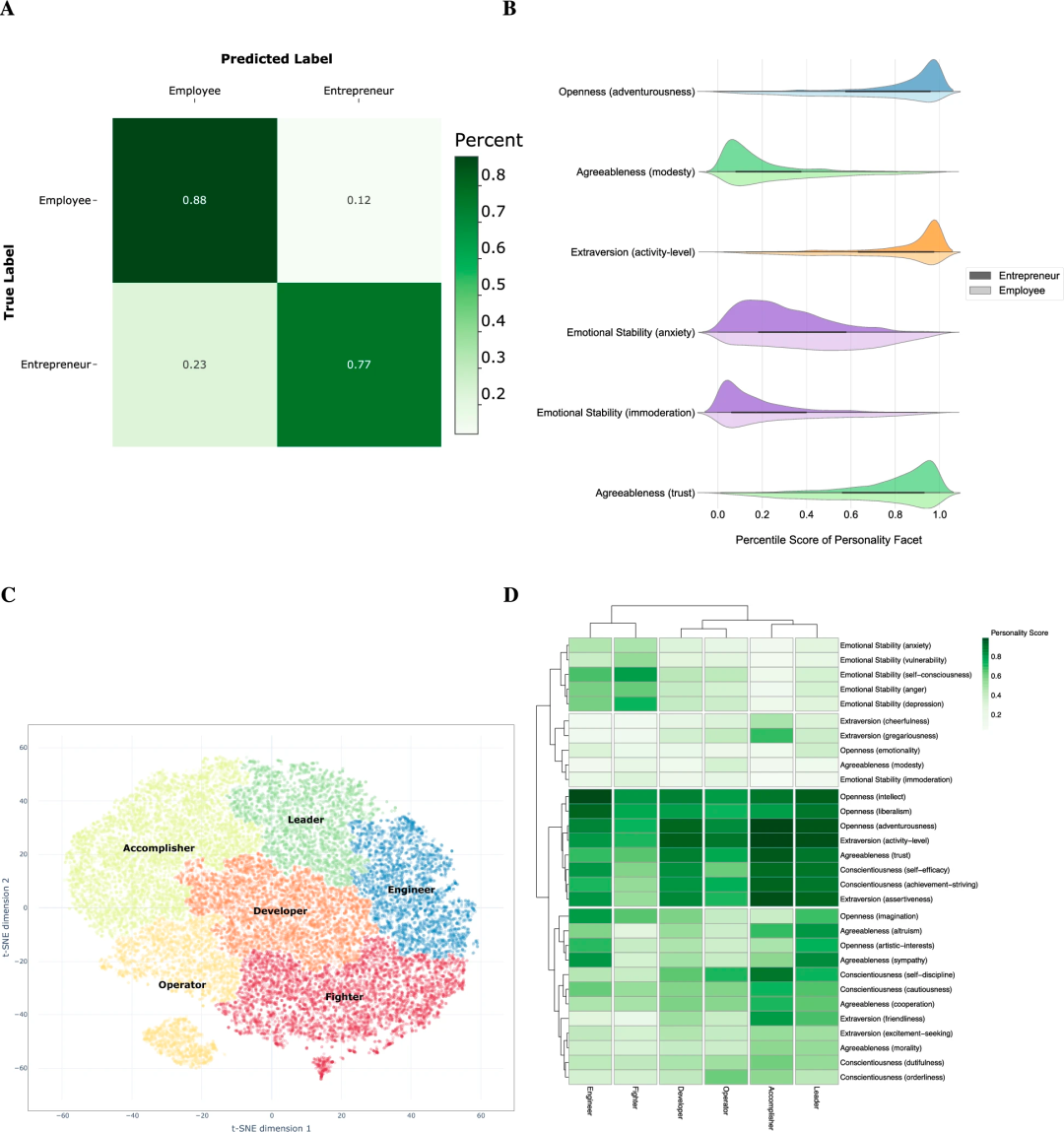
【Figure caption: Founder-level factors in entrepreneurial success. (A) Successful entrepreneurs differ from successful employees. A classifier using only personality information can accurately distinguish between them. (B) Successful entrepreneurs show distinct Big Five facet distributions, particularly in risk-taking, modesty, and activity level. (C) Founders cluster into six distinct types: Fighters, Operators, Accomplishers, Leaders, Engineers, and Developers (FOALED). (D) Each founder personality type has its unique facet profile.】
The research team fed language and activity data from X (formerly Twitter) on 21,000 founder-led companies into AI algorithms, using the Big Five personality model to analyze their personalities. Also known as OCEAN, the Big Five posits that every person possesses five traits to varying degrees: Openness, Conscientiousness, Extraversion, Agreeableness, and Neuroticism.
Compared to MBTI and the Enneagram, this framework is more widely used in psychology and business, frequently serving as a hiring metric. Extensive research has shown that Big Five scores clearly correlate with job performance, career satisfaction, and organizational commitment. In everyday life, the Big Five also offers people a way to better understand their own personality traits, helping them identify strengths and weaknesses to improve accordingly.
They cross-referenced these profiles against Crunchbase data to determine the link between founder personality and startup success. Success was defined as whether a company was acquired, acquired another company, or went public on a stock exchange.
The study found that startup founders' Big Five profiles differed significantly from the general population across 30 dimensions. The key personality traits that distinguish successful entrepreneurs include a preference for variety, novelty, and starting new things (openness to adventure), comfort being the center of attention (lower modesty), and high energy (higher activity level).
Ultimately, the researchers didn't find a single answer — there is no one "founder personality." However, founders with the following six personality types are more likely to succeed.
The six types are: Fighters, Operators, Accomplishers, Leaders, Experts/Engineers, and Developers.
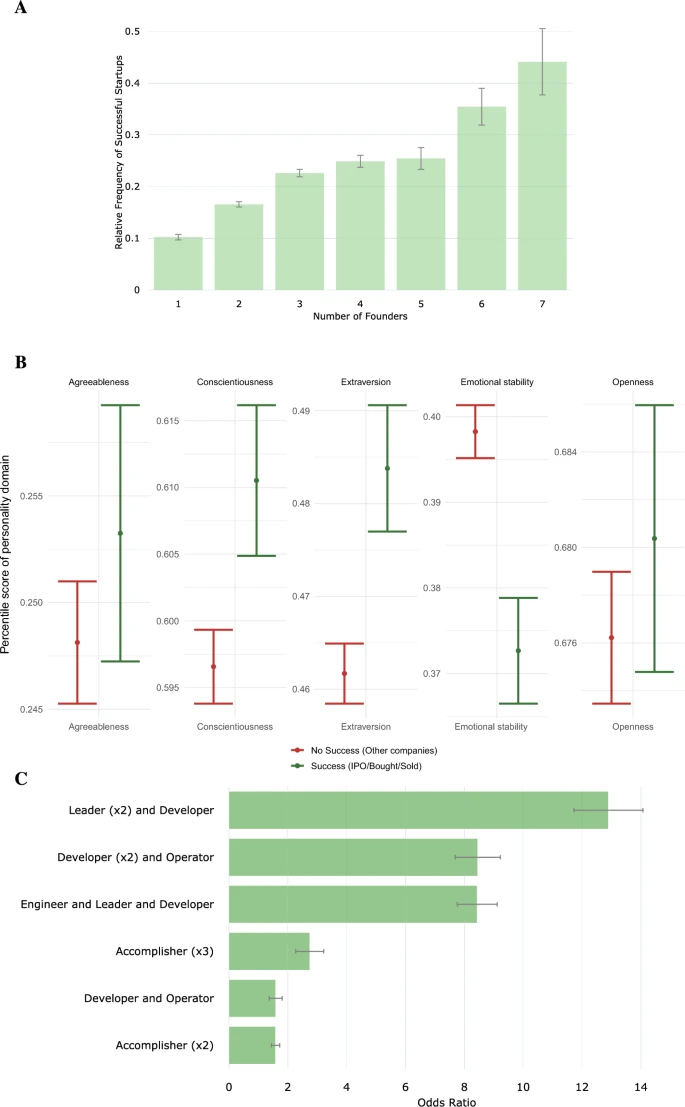
Additionally, the results demonstrate the benefits of larger, personality-diverse teams in startups. The more diverse the personality traits among founding team members, the more likely the company is to succeed. "Personality diversity should be considered a new dimension of team diversity that influences team performance and ultimately success," the researchers noted. Initially, they found that companies with multiple founders were more likely to succeed. (As shown in the figure.) Companies with three or more founders were more than twice as likely to succeed as solo ventures. This aligns with investor advice and previous research.
Successful startup founder teams also tended to score higher on openness, conscientiousness, extraversion, and agreeableness.
And here's the key: these traits don't need to be concentrated in a single founder. The researchers also found that three specific triad combinations were more than twice as likely to succeed as other combinations: one Leader and two Developers; one Operator and two Developers; and one Engineer, one Leader, and one Developer.
This echoes a theory widely accepted in startup circles, most notably AKQA chief creative officer Rei Inamoto's "3H" theory from 2012 ("Hipster, Hacker, Hustler"). His formula for startup success: you need one super-cool founder, another who's a programming expert, and a third who just grinds away.
Beyond that, the researchers found that successful startup founders have personalities significantly different from successful employees. Using just personality trait data, they could train a simple predictive tool to distinguish employees from entrepreneurs with over 80% accuracy.
"Greater awareness of this novel form of diversity may help create more resilient startups capable of more significant innovation and impact," the researchers said.
Just as "career maps" can guide people in choosing a profession, perhaps data on successful entrepreneurs' personality traits can help people understand whether they're cut out for entrepreneurship — and whether they should take the leap to start a company.
Original article: https://www.nature.com/articles/s41598-023-41980-y#Tab1