Code Brain | Aligning Top to Bottom, Pulling Across Horizontally! How to Run a Successful Strategy Co-Creation Session

A successful strategy co-creation session needs to hit on all "five senses": a sense of ceremony, a sense of mission, a sense of vision, a sense of psychological safety, and a sense of ownership.
The turn of the year is when companies hold their strategic planning sessions. You may recognize one of these familiar scenes:
- The boss sits stiffly at the front, reading verbatim from a script prepared by the strategy department or an assistant, while the audience struggles to keep their eyes open;
- The boss gathers everyone at a hotel or resort for several all-nighters, desperate to finally figure out what they've been mulling over for years. The boss is energized; the team is exhausted, their bodies going through the motions while their minds drift back to their own endless to-do lists;
- The boss disappears into the crowd, strolling around with a smile, listening to discussions, giving a thumbs-up to good ideas, and asking a few sharp questions during presentations to spark deeper thinking...
In all three scenarios, almost everyone besides the boss is in a state of apathy. Apathy means feeling nothing — no positive feelings, perhaps even some resentment, dissatisfaction, or numbness. Year-end strategy sessions are training grounds and energy hubs. They are moments to review the past and plan for the future from the present. A high-quality strategy session can efficiently align thinking, understanding, and action. It creates focus in strategic deployment and breakthroughs in execution, truly achieving unity of purpose from the CEO through the core team, management, and frontline employees — everyone pulling in the same direction with shared commitment.
Designing and organizing a strategy session is technical work that requires careful planning and artful arrangement. How do you transform an "apathetic" strategy session into one where people feel engaged — even with all "five senses" activated? How do you turn a strategy "announcement meeting," "discussion forum," or "abstract brainstorming session" into a genuine "co-creation session" that achieves "unity of purpose and horizontal alignment"? How do successful strategy co-creation sessions work in practice, and what key techniques can we learn from them? Drawing from a recent collaboration with a startup, I'd like to share a "five senses" framework for strategy co-creation: ritual, mission, vision, safety, and ownership. With this toolkit, success becomes almost inevitable.
First, let's understand the basic framework of a strategy co-creation session. The structure is largely similar across organizations, typically revolving around where we want to go, where our opportunities lie, and how we get there.
1
Sense One: Ritual
When we hear "ritual," we naturally think of group photos at the end of meetings, motivational music videos, dinners and drinks. But effective ritual in strategy co-creation actually begins before the meeting even starts, including but not limited to:
- Who attends?
Participants contribute 90% to the success of a co-creation session, so choosing the right people is critical. Usually the CEO decides who attends, considering their role, responsibilities, intellectual vitality, and organizational level. Some clients I've worked with take a horizontal cut — everyone VP-level and above — in the name of fairness (in China, circles and hierarchy matter; attending such a meeting signals entry into a certain circle or level). But they fail to realize that sometimes poor business performance and company stagnation stem precisely from VPs and above not fulfilling their responsibilities. So whether to use such a cutoff depends on company culture and headcount. Too many attendees drags down efficiency and prevents genuine consensus. Some clients invite industry experts, customers, and investors to participate. The benefit is diverse perspectives that enrich the session's output. I recommend this for small-scale startups — I've seen it work brilliantly. Once participants are confirmed, create a small group chat. This itself creates ritual: everyone discusses meeting arrangements, expectations, dress code, and begins to sense the flavor of co-creation in advance.
- Who facilitates?
An internal executive? The CEO themselves? Or an external facilitator? Each has pros and cons, but I recommend going external. An external facilitator may not know the company deeply, but brings enormous value in process design and pace control, plus fresh suggestions for making the co-creation session better. If the facilitator has some industry reputation, participants bring more curiosity and anticipation — building suspense is itself part of ritual.
- What preparation?
A strategy co-creation session lasts only a few days; thorough pre-session thinking and preparation yields double the results with half the effort. If participants come unprepared, efficiency and effectiveness suffer dramatically. To reinforce the session's importance, each participant must complete pre-session homework. The company should also assign dedicated staff to gather, analyze, and research information related to the "five perspectives," producing valuable insights. In every strategy co-creation session I've participated in, this annual professional insight sharing has been deeply inspiring and become an important ritual in itself.
- Ritual during the process
Throughout the co-creation session, each small goal and consensus reached deserves its own ritual — a glass of wine, a piece of cake, a small game, a red sticker. The process needs immediate rewards so everyone knows the progress, can relax, and achieves results joyfully. In my collaboration with this startup, what impressed me most was the first day ending on Christmas Eve. While everyone ate pizza, the founder sang "Silent Night."
- Closing ritual
Strategy co-creation sessions typically run 2-3 days, or even two days plus another two. So much happens — frustration, gloom, arguments, delight, emotion. Recording and editing these moments into an amusing video clip, playing it to everyone's laughter, provides a release and a perfect closing. Some companies arrange special ceremonies, like painting a large ship and holding a "boarding ceremony" symbolizing embarking on a new journey together.
2
Sense Two: Mission
Many companies begin their strategy co-creation sessions with business analysis or reviewing the past year's performance and strategy execution. This is understandable, but it immediately plunges everyone into specific business contexts. High performers relax easily; those with weaker results due to various factors tend to start dejected and disengaged from the discussion. For fast-growing startups, new senior hires or core talent often join within 1-2 years, so successful strategy co-creation must begin with reviewing or discussing the company's mission, enabling newcomers to develop deeper understanding and commitment. What is mission? For a company, it's the reason for existence, the one great thing it commits to doing continuously, the starting point and original intention behind doing it, and the value it brings to others. Some startups first clarify their original intention, then find what to do that fulfills it. Others first identify something worth doing, then gradually understand why they're doing it and what their original intention is. Either way, what you do and what you believe are mutually reinforcing.
The co-creation session with this startup began with mission discussion. The company had grown from a small workshop of several people to operations across China's major first-tier cities. But in recent years, it faced both pandemic impacts and growth plateaus. In the previous stage, the founder was simultaneously product manager, sales manager, and customer service manager. But to reach the next level, the company couldn't rely on the founder couple alone — it needed a core team connected by shared mission. While the two founders had their original entrepreneurial intention, newer team members didn't truly understand its origins. This required everyone to start from the origin and connect emotionally. In this process, the founder shared their original intention, followed by group discussion and diverse interpretations. Through review and discussion, the mission became increasingly clear. Finally, when a new colleague stood up, wrote the new mission on the whiteboard, and read it aloud, everyone was ignited. Excitement was palpable, eyes shining — they truly felt mission's impact. In that moment, each person possessed intense sense of mission. This company, an employee insurance service provider still modest in scale, has a mission that stirs excitement every time it's read: "Building great organizations — bringing health and security to everyone, delivering peace of mind and moving experiences."
3
Sense Three: Vision
Mission is a long-term pursuit, not achievable in one or two generations. Along this extended journey toward the ideal, we need阶段性激励, and vision serves this crucial function.
Vision describes what the enterprise hopes to become, painting a shared beautiful aspiration that mobilizes people's full commitment from the heart. Vision must have a time horizon. Previously many clients set 10-year or even 20-year visions. But now external factors — market, policy, international relations, technology — change so rapidly, especially for startups, that overly distant visions may become inappropriate. So I suggest startups consider formulating a 5-year vision.
Vision needs to be vivid and visual. When discussing vision, I particularly encourage using drawings (vision boards). This is where a visual facilitator becomes valuable, rapidly translating discussion into visual images. This lets people see the vision, enter it, and find ways to achieve it. At this startup's co-creation session, the visual facilitator rendered everyone's discussion on the wall, and the visual impact was immediate.
Another good practice: when discussing vision, analogize to a brand in another industry to create intuitive understanding — "become the Hermès of such-and-such industry," "become the Huawei of such-and-such field." Of course, don't just propose the idea; conduct detailed research on how this company achieved such positioning and image, and what's worth learning. Most company visions are a single sentence. To make vision more attractive, compelling, and believable, it must be supported by vision goals. Vision goals need both financial and non-financial perspectives, with vivid imagery that excites people and makes them want to fight for it.
4
Sense Four: Safety
After discussing mission and vision, people are usually in an emotionally elevated state. After all, they're committing to something significant together, they've found like-minded people, and the beautiful future always brings joy.
But the more magnificent the ideal, the more bony the reality. After the peak, energy inevitably sinks. Because next comes discussion of 2-3 year strategic opportunities, differentiated competition, business posture, resource allocation, capability matching — a series of practical issues that return everyone to their roles and the targets they must bear. At this stage of the strategy co-creation session, don't rush to set targets and break them down. First build consensus on the surrounding environment and find breakthrough points; consensus on strategies and approaches to achieve strategic goals, so everyone clearly knows both future strategic objectives and how to achieve them — this gives people safety. Teams with safety have greater energy and higher probability of achieving goals. Frequent mountain climbers know this feeling: walking in darkness, hearts anxious, every step cautious because we don't know what's ahead. In darkness, once we spot a small distant light, we feel much more at ease. However far the journey, as long as the direction is right, heading toward that light, we know we'll eventually arrive.
How do we know if the direction is right, the pace appropriate, whether opportunities will slip away? With these questions, a deep "five perspectives" analysis greatly boosts the team's confidence and safety. The "five perspectives" must be done thoroughly; superficial treatment wastes time and fails to reveal unseen opportunities and risks. Another important reason for the "five perspectives" presentation: most team members are deep in or focused on only one domain, rarely able to survey the full landscape from the company height. So "five perspectives" aligns cognition and builds consensus, while also being a vehicle for collective learning and growth that keeps team members from falling behind. We all know the input-process-output principle, but not everyone realizes that for good output (strategic innovation), the quality of input materials matters. The "five perspectives" are the raw materials for strategic innovation; their quality directly determines strategic innovation output.
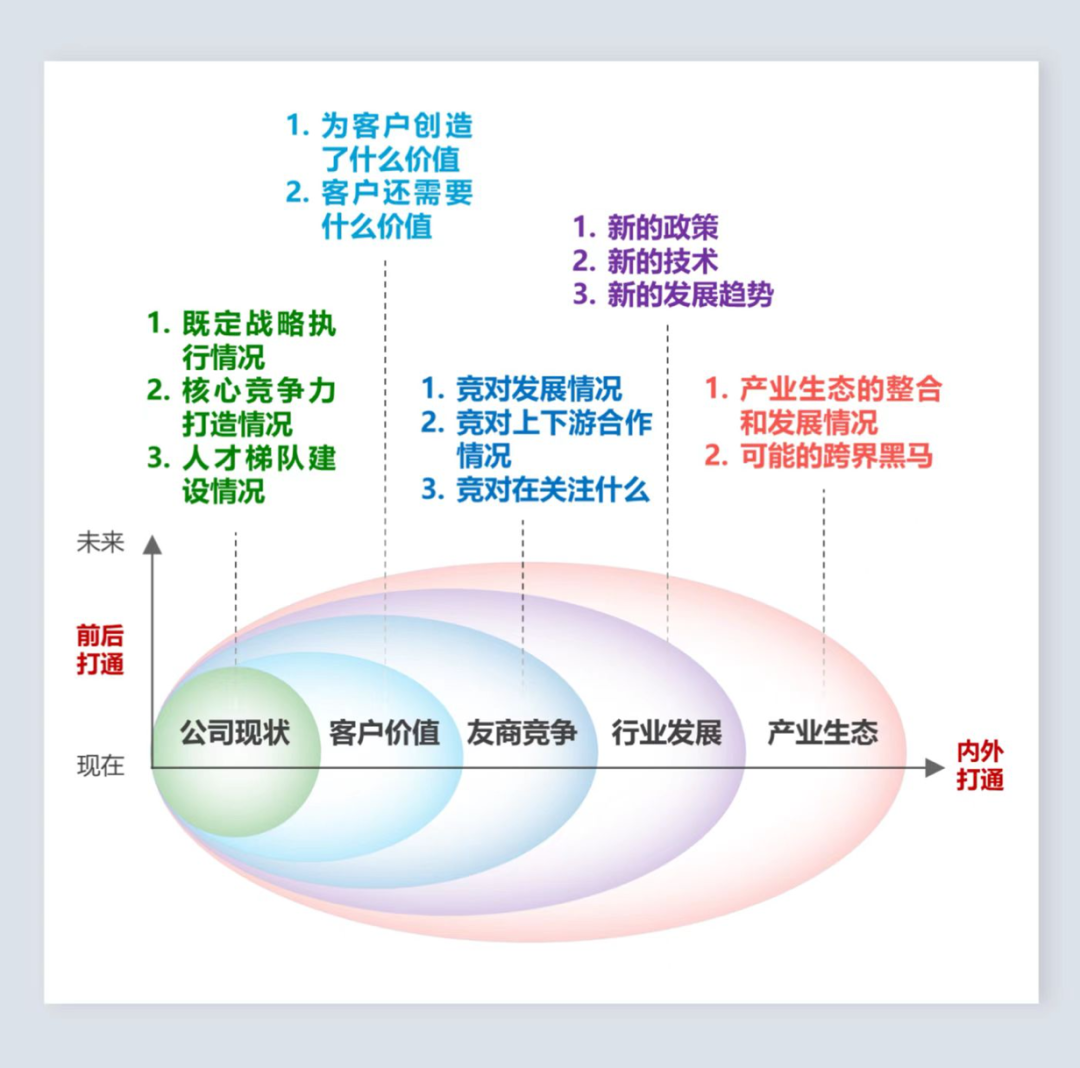
After the "five perspectives," the team has deep insight and consensus on the situation. Based on this, discussing 2-3 year strategic goals and approaches yields unexpected results. One crucial check: do strategic goals align with and flow from the vision and vision goals? Are they on the right path toward realizing the vision? Consider this hypothetical: The Chinese Mountaineering Team's mission is to plant Chinese flags on all the world's high peaks. Its vision is to become the world's #1 mountaineering team within ten years. What should the team's strategy and strategic goals be to advance this vision as quickly as possible?
5
Sense Five: Ownership
Discussion of strategy, strategic goals, and must-win battles is particularly challenging.
Typically, people think inertial thoughts: what achievements have we made, what are our business results, how do we forecast development over the next 1-2 years from our current base. But this isn't the value of a strategy co-creation session. Organic linear development — just have finance or business partners calculate that. The reason to hold a strategy co-creation session is to pool collective wisdom, ignite people's drive, innovate in approaches, and achieve qualitative leaps and breakthroughs in results. This stage is especially brain-intensive; people usually hit thinking bottlenecks. This startup's co-creation session encountered this blockage. The founder had some ideas but they weren't mature, and she didn't want to impose views that would limit thinking. At this point, people needed mental relaxation. As the saying goes, the more relaxed, the more successful. After 20 minutes of free activity and the inspiration of a glass of wine, new ideas gradually emerged, were put on the whiteboard, continuously added to, then continuously refined, until patterns clarified, main threads surfaced, and consensus formed around 2-year strategic goals and six major priorities, plus 1-year goals and the must-win battles to achieve them.
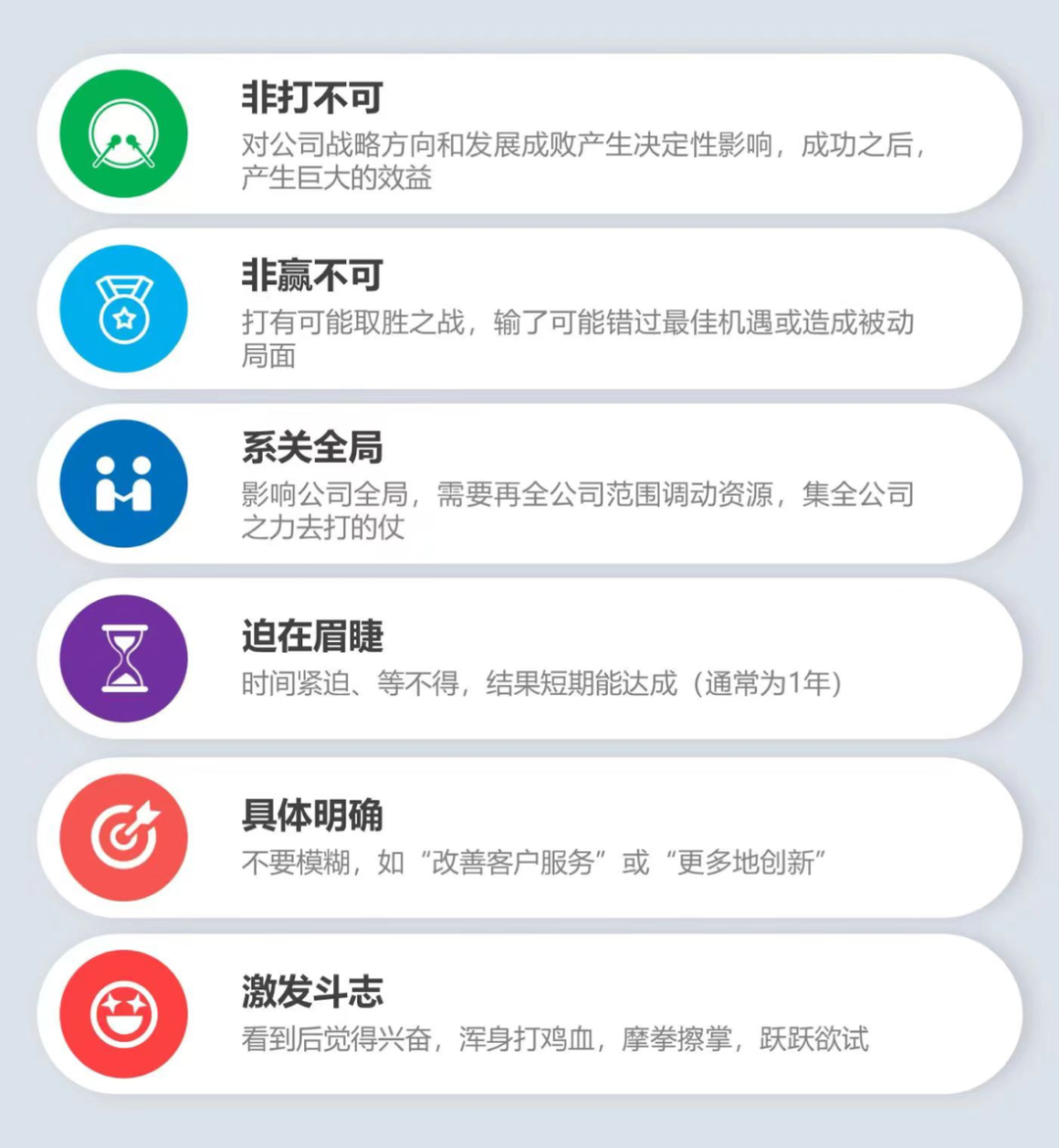
Must-win battles require mobilizing company-wide resources; front, middle, and back offices must cooperate fully to win. So must-win battles cannot be numerous — ideally fewer than six, three is best, and some companies have only one must-win battle per year. Fewer must-win battles means focused resources, means clarity and thorough thinking; means full commitment, fighting with backs to the river, no retreat, only victory. Too many must-win battles means the opposite. After consensus on must-win battles, another critical step is implementation: identifying commanders and team members for each battle, action plans, and timelines. We often say strategy formulation is hard, but strategy implementation is exponentially harder. The starting point of strategy co-creation is mission discussion and review; the endpoint is must-win battle implementation. Based on my years of consulting experience, getting more people to feel strategic ownership — what we call ownership — exponentially increases the likelihood of strategic execution and achievement. Must-win battle implementation is the most important step for building ownership. Without this step, strategy cannot land; it remains the boss's strategy rather than everyone's shared strategy. Without ownership, execution goes off-track, and people make excuses when encountering resistance.
At this startup's co-creation session, the team ultimately identified three must-win battles. One was universally recognized as the hardest. When selecting its commander, the room was initially silent. Then one colleague bravely stepped forward to take on the responsibility, selecting several key people to join the battle. This courage and confidence came from the preceding discussions, from self-breakthrough, from the ownership of "taking responsibility for the child you birthed." At the session's close, the founder selected a clip from the film Leap (夺冠). Several people were moved to tears watching it. Through the co-creation session, people united with focused energy, truly achieving the transformation from "I" to "we." The company's future no longer relied on one or two individuals, but on "us" — this stronger team creating together. Isn't this what every founder wants?!
Successful strategy co-creation moves from "apathetic" to "five senses" — ritual, mission, vision, safety, and ownership. With the "five senses," are you still worried about strategy execution?
About the author: Ms. Chen Xueping formerly served as Vice Chairman of Korn Ferry China and President of its consulting business, and previously as President of Hay Group Greater China. With over 20 years in organizational consulting, her expertise focuses on strategy decoding, group governance, executive team building, leadership development, and culture and values. She is author of the book Strategic Breakthrough (战略破局) and has published numerous articles on organizational management.