Code Brain | Compensation Incentives: Both Science and Art

Code Brain: Ecosystem Connection, Cognitive Resonance
Entrepreneurship is a never-ending journey of self-cultivation. The solidity of one's fundamentals directly determines how far a company can go. Under the pandemic, startups had their operational and organizational blind spots ruthlessly exposed. Managerial fundamentals became a critical test — and mandatory course — for core leadership teams.
That's why Code Brain is launching its "Management Fundamentals" course series, targeting three foundational yet core managerial capabilities for founders: people, finance, and operations. Focusing on personal leadership, talent assessment, performance management, compensation and incentive design, high-performance teams, goal management, and business-finance integration — 10 major themes in total — it provides comprehensive basic management methods and practical tools that leaders can apply immediately, helping elevate founders' fundamental management cognition and capabilities.
Starting August 2022, the "Management Fundamentals" series runs monthly, with two sessions each time. For the "Compensation and Incentive Design" theme, we specially invited Bian Zhihan, former head of Huawei's financial transformation project and resident instructor at Gaowei Academy, to spend a full day teaching startup compensation structures and the design of short-, medium-, and long-term incentive mechanisms. Nearly 100 CEOs and executives from over 40 companies in the MaHui ecosystem participated both online and offline.

The following content is selected from the classroom:
Research by Harvard University professor William James in The Principles of Scientific Management found that without scientific, effective incentives, people only realize 20%-30% of their potential. Scientific and effective incentive mechanisms can unlock the remaining 70%-80%.
In China, "xin" (薪) and "chou" (酬) are distinct concepts. Xin refers to salary, chou to bonus. As the saying goes, "Salary keeps you fed; bonuses get you working." Together, they correspond to fixed income and variable income.
In human resources, there's a fundamental compensation model called the 3P theory (Pay for Position, Pay for Performance, Pay for Person). It designs compensation based on role, performance, and person. Later, an M (Pay for Market) was added — meaning you must benchmark against the market, not operate in an internal echo chamber.
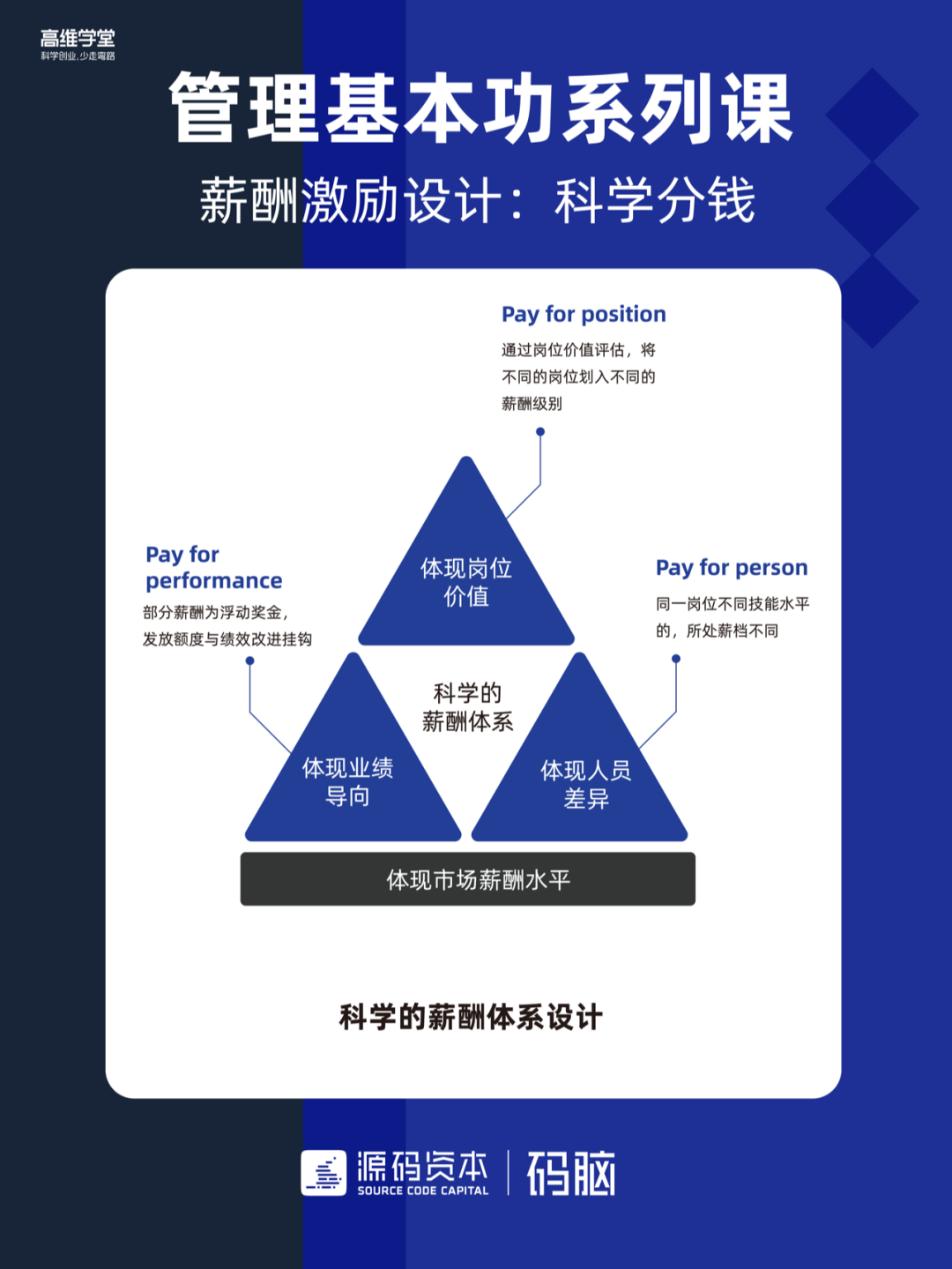
Generally, we determine compensation grades based on role value; based on individual differentiation, we determine specific pay bands within a grade — higher or lower, usually a range; then we dynamically adjust employee compensation based on market levels.
Compensation structure typically has five layers:
- Salary
- Salary + allowances
- Salary + allowances + medium-term incentives (bonuses)
- Salary + allowances + medium-term incentives (bonuses) + long-term incentives (equity)
- Salary + allowances + medium-term incentives (bonuses) + long-term incentives (equity) + benefits
When applying compensation incentive design in practice, the lower the employee level, the more design focus should be on pay itself. Conversely, the higher the employee level, the more design focus should shift to medium- and long-term incentives.
Below, I'll provide specific methods for short-, medium-, and long-term compensation incentive design.
01 Short-term Incentives (Salary)
Salary is the most basic part of compensation design for all companies. For a given company, fixed salary typically accounts for 70%-90% of total compensation. Salary is a rigid cost in business management — it generally only rises, never falls.
Facing salary decisions, you probably have many questions: What salary is appropriate for each role? How to handle salary inversion between new and veteran employees? Should identical roles in different regions have different pay?
For these questions, here's a 16-character management method: define roles and grades, set pay by grade, match person to role, change pay with role change.
1.1 Define Roles and Grades
A prerequisite for defining roles and grades is mapping out your organizational structure, evaluating the value of each position, and internally ranking all positions by value — what we call the "Role Value Map."
Generally, we determine role value based on dimensions like responsibility level, required capability, work complexity, and hiring difficulty, then benchmark against the market to set specific grades. Many SMEs have unclear role responsibilities, which makes salary-setting difficult. So before defining roles and grades, you must first do the structural mapping.
After mapping the organizational structure, how do you generate your company's Role Value Map? The basic method is: first classify horizontally, then grade vertically, finally align and connect.
Horizontal classification means categorizing by departmental function — management, technical, sales, etc. As a rule, don't create separate categories for fewer than 30 people. Vertical grading means subdividing grades within each major category. Alignment and connection means ensuring internal comparability after classification and grading, so employees can transition smoothly during cross-department transfers — this facilitates internal mobility and organizational fairness.

1.2 Set Pay by Grade
After defining roles and grades, how do you set salary for each grade?
The HR professional approach is broad-banding — each grade's compensation is a range, with some overlap between adjacent grades. Generally, for SMEs, around 10 grades is appropriate, with 20% pay difference between grades. The highest salary in a company is typically ten times the lowest.
Once you control these key elements, you'll have essentially created a "Salary Framework Table" — the most basic quantitative tool for salary management. On this foundation, you can design regional variations: if this table represents first-tier cities like Beijing, Shanghai, Guangzhou, and Shenzhen, apply a 20% discount for second-tier cities, 30% for third-tier.
1.3 Match Person to Role
Competency-based pay setting: With the Role Value Map and Salary Framework Table, the next step is placing people into roles. Evaluating whether an employee can handle a role is called "weighing the person" — this is quite difficult. In this area, Huawei drew on foreign experience to develop absolute standards. This absolute standard weighing process is called competency qualification assessment.
Briefly: Huawei's lowest grade is 13 — competent specialist level, capable of independent work. Above that is skilled supervisor level — rich experience, able to guide others. Above that is manager level — must make individual experience explicit, complete fixed-duration case sharing, and "mentor and elevate" two subordinates to promotion each year. This process is also one of extracting and depositing individual capability into organizational capability.
Proficiency-based pay setting: Above, we placed employees into specific roles based on competency. But a role's salary is typically a range — so do you pay this employee 24,000 or 33,000 monthly? This depends on proficiency level; stronger professional capability means higher pay. If less experienced, position toward the range minimum — generally range median × 0.7 is the minimum, range median × 1.3 is the maximum.
Performance-based pay setting: After determining salary, use performance results to determine raise magnitude. Only capability verified through performance merits a raise.
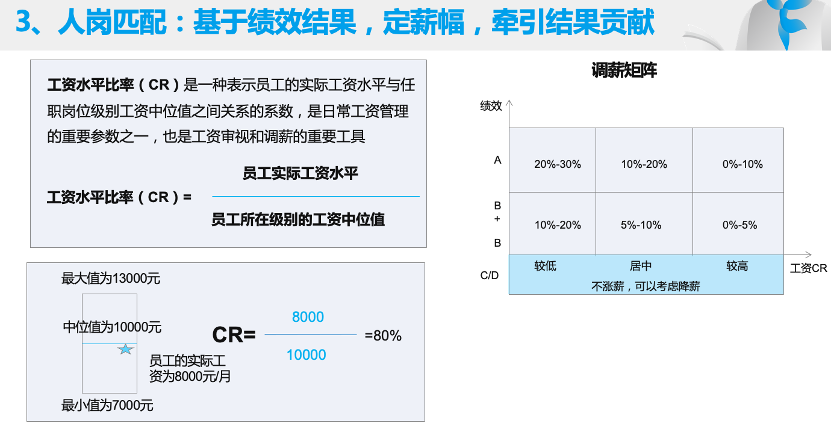
1.4 Change Pay with Role Change
The fourth point of salary management is changing pay when roles change. When an employee's person-role match changes, adjust salary based on the corresponding salary framework range for the new match, combined with current pay level and performance.
But there's typically a three-to-six month probation period — adjustment doesn't happen immediately upon transfer. And if an employee passes competency qualification assessment, this can trigger a raise.
02 Medium-term Incentives (Bonuses)
Bonuses are the most complex and most motivating element of compensation. For bonus design, we also have a four-sentence principle: when the big river has water, the small rivers fill; first to the team, then to the individual.
2.1 How to Determine the Bonus Pool?
Company bonus pool: First, at the company level, how do we calculate the bonus pool?
There's a basic formula: Company Bonus Pool = (Pre-bonus Company Profit − Shareholder Capital Base Return) × Human Capital Allocation Ratio. This human capital allocation ratio mainly depends on how talent-dependent the company is.
Team bonus determination: First, bonus algorithms need to match business scenarios — it mainly depends on what the business management priorities are. If there are many priorities — sales growth, profit growth, efficiency improvement... the more you want, the more complex the algorithm. From an economic perspective, it's best to focus on one priority per phase; the clearer the focus, the easier to achieve results.
There are many team bonus algorithms. I'll elaborate on three typical scenarios: mature business, growth business, and innovation business.

2.2 How to Distribute Bonuses for Mature Businesses?
Mature businesses have relatively stable growth/decline curves. For these, you can use year-over-year growth method and base-plus-increment method.
Year-over-year growth method — guiding principle: tied to current operating results, calculating bonuses based on year-over-year performance growth, driving positive growth and profit improvement. Calculation: Bonus Pool = Baseline Bonus Pool × (1 + Performance Growth Rate)
Base-plus-increment method — guiding principle: tied to current operating results, heavily incentivizing based on performance increment, avoiding "lying flat" wins, driving positive growth. Formula: Bonus Pool = Base × Sharing Coefficient × Discount Factor + Increment × Sharing Coefficient × Acceleration Factor
2.3 How to Distribute Bonuses for Growth Businesses?
Growth businesses often spike to peaks then crash to valleys — high volatility, making bonus design quite difficult. Some companies implement commission bonuses to motivate the business; when business multiplies several-fold, they discover the bonus amount is too large and regret it. Others implement commission bonuses with caps — but this violates human nature. When business is half-done and bonuses hit the cap, what then? Defer business to next year?
In this situation, Huawei uses a circuit breaker mechanism. The circuit breaker also has a ceiling, but bonuses above the ceiling are deferred to the following year. Circuit breaker + bonus rollover can appropriately mitigate the impact of business volatility on compensation.
Performance target achievement rate method — guiding principle: tied to current operating results, calculating bonuses based on team performance achievement rate, driving current period target attainment. Formula: Bonus Pool = Baseline Bonus Pool × Performance Coefficient × Adjustment Coefficient.
2.4 How to Distribute Bonuses for Innovation Businesses?
Innovation businesses carry high risk, have no business volume, and may be terminated at any time — what to do? Innovation businesses need time-limited protection mechanisms. You might try the employee convolution method. Formula: Set 30% of the compensation package as base bonus pool, then adjust based on company profit.
2.5 How to Determine Individual Bonuses
After bonuses reach departments, how do they get distributed to individuals?
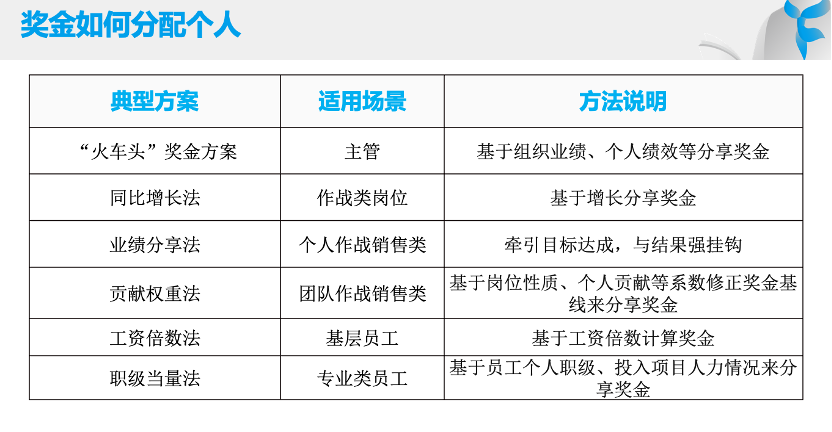
For example, a fast-moving consumer goods company's HR department has 8 people and received 670,000 yuan in bonuses. How to split it? The dumbest way is equal division — but 8 people have different capabilities and contributions, so equal division is clearly inappropriate.
What about dividing by salary level? Higher salary means greater capability means greater contribution means more bonus? But salary often doesn't accurately reflect role value. Salary is negotiated; honest employees who didn't negotiate well already lose out, and continuing to lose out on bonuses adds insult to injury — also inappropriate.
At this point, you might try the grade equivalence method, making micro-adjustments through individual allocation coefficients. Calculation: Employee year-end bonus = Department total bonus pool × Individual allocation coefficient; Individual allocation coefficient = Individual salary × Individual performance coefficient × Other influencing factors.
2.6 Special Bonuses
The bonuses mentioned above are basically algorithm-generated. Huawei calls these operational bonuses.
Operational bonuses are generated through operational metrics — employees can see them, calculate them, and receive them without guessing. The special bonuses I'll discuss next target strategic and important task-based contributions.
There are always tasks in a company that matter greatly for its future, but without incentives, no one will voluntarily take them on. So special bonuses are used to increase the company's "soil fertility."
Special bonus frameworks need structure — you can't leave loopholes for creating bogus categories to grab special bonuses. So design mainly considers three aspects:
- Major breakthroughs at the customer and market interface — like landing a major client, defeating a competitor, etc. Here, set reward amounts based on project process and results;
- Innovation breakthroughs in new domains, new businesses, new technologies, new products — set reward amounts based on the specific new business;
- Major internal management improvement breakthroughs — like leading a compensation transformation, building a compensation system, etc. Here, set reward amounts based on management improvement.
03
Long-term Incentives (Partnership Mechanisms)
3.1 Recognizing the Past
When discussing long-term incentives, everyone's first reaction is stock options, equity — and when discussing options and equity, people think of facing the future. This is actually a cognitive bias. Long-term incentives can also face backward to recognize history. At Huawei, we give one-time bonus compensation to teams and individuals who made historical contributions but didn't receive corresponding incentives, along with role promotions and competency promotions, as well as honorary titles and other spiritual incentives.
3.2 Facing the Future
Beyond recognizing the past, we must also face the future. There are two types of future-facing instruments — ESOP and TUP. ESOP investment shares are relatively stable; TUP dividend shares are relatively flexible.
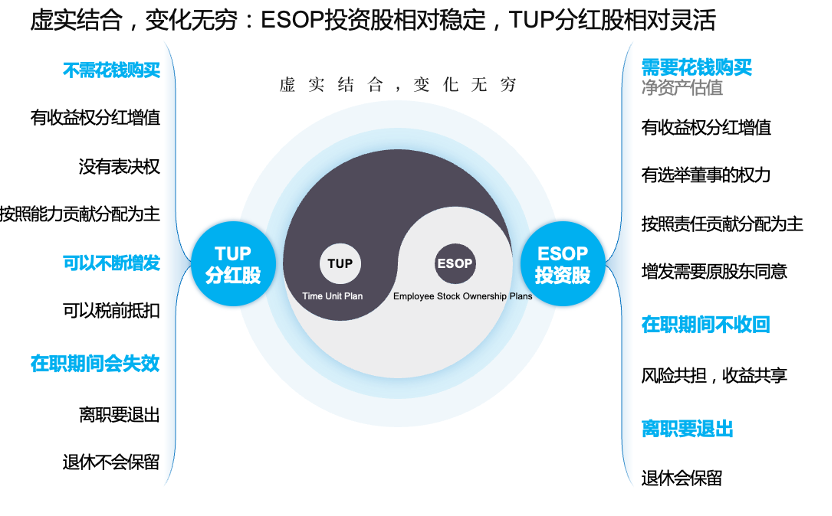
Huawei ESOP shares are a type of saturated virtual restricted stock — a special stock granted by the company to employees. Employees with virtual shares receive a proportion of dividends and the appreciation of net assets corresponding to the virtual shares, but have no voting rights, and cannot transfer or sell. When employees leave, the company must repurchase the shares.
Huawei TUP options are essentially a long-term but non-permanent bonus allocation right based on employee contribution and future development potential. Each year, a certain number of options are granted based on role and grade, performance. These options operate on a five-year cycle, settling at the end of five years. Employees don't need to pay to acquire TUP options.
Simply put, ESOP is investment stock — employees must pay to purchase it, typically allocated to management. The structure of management investing their own money is tied to their management results. TUP is dividend stock — employees don't need to pay, typically allocated to new employees. These are all part of compensation design.


Code Brain Issue 36 | The Essence of Performance Management Is Unlocking Human Potential
Code Brain Issue 35 | The First Step in Assessing and Deploying Talent: How to Interview Scientifically
Code Brain Issue 34 | How Far a Team Can Go Depends on These 6 Points
Code Brain Issue 33 | A Founder's 11,626.5 Hours
Code Brain Issue 32 | Leadership Is Leading People to Places Unvisited
Code Brain Issue 31 | Amazon's Ten Overseas Compliance Experiences
Code Brain Issue 30 | 60 Hours of "Practical Leadership" — Full Highlights!
Code Brain Issue 29 | Zheng Yunduan: What Really Drives Organizations?
Code Brain Issue 28 | Grasp Human Nature to Build a Good Overseas "Vanguard"
Code Brain Issue 27 | The Coming and Going of Carbon
Code Brain Issue 26 | Matters of Overseas Marketing
More MaHui members can click "Read Original" to view