Code Brain | Cracking Liu Genghong's Viral Formula

#Code Brain Ecosystem Connections, Cognitive Resonance
From fitness livestream star Liu Genghong to the "Big Wolf Dog" couple Zheng Jianpeng & Yan Zhen — who racked up over 315 million RMB in single-session GMV — to "Duoyu and Maomao Sister," who went viral nationwide with the catchphrase "so high," these phenomenon-level influencers were all discovered and cultivated by Wuyou Media. In this edition, Wuyou Media founder Ray Lei shares the traffic code behind creating viral stars through a hard-hitting Q&A, along with the entrepreneurial journey that led to cracking that code.
Guest Introduction

Ray Lei | Founder & CEO, Wuyou Media
Ray Lei has nearly two decades of experience in the online video industry, with previous roles at Phoenix Network and YY. Through continuous hands-on practice and deep reflection, he honed his expertise. In 2016, leveraging his sharp business instincts, he identified the massive growth potential in short-video and livestreaming — and dove right in. He pioneered the concept of an internet-native talent agency, built around three core pillars: "people IP," "content IP," and "product IP."
Hard-Hitting Q&A
Q1: How did Wuyou Media get its start? And how did you build the "Guangdong Couple" from zero to one?
Ray Lei: Wuyou Media actually started in entertainment livestreaming. By 2018, we'd already become the top MCN on Douyin in that category. Early that same year, we began experimenting with short-video content for Douyin creators — starting with just five talents. But we quickly figured out the methodology, producing accounts that gained millions of followers in a week, with one even hitting ten million that year.
Coming from a platform background myself, I've always believed that opportunities come from the era and the platform.
The "Big Wolf Dog" Zheng Jianpeng & Yan Zhen couple is a classic example. They came up around the same time as Duoyu and Maomao Sister. Back then, Douyin had just launched its Star Map platform, but the mechanisms and controls weren't fully mature yet, so we didn't go all-in on short videos.
After Star Map had been out for a while, we saw the commercial opportunity in short videos and ramped up investment in content production.
When the couple first signed with us, they already had their own company and were local singers focused on offline work. We convinced them to shift their energy online. Through various twists of fate, they gradually made that transition, working with our team to refine scripts and content, fully leveraging their natural personas.
Wuyou Media doesn't "manufacture" personas crudely — we "discover" what shines in each talent. For example, Yan Zhen is from Xiancun, a famous demolition village in Guangzhou. Plus it's hot in Guangzhou — everyone wears shorts. So we amplified her "landlady" image based on this backdrop, adapted it to Douyin's vibe, and produced distinctive content.
Our thinking was pretty straightforward back then: find one explosive angle, then hammer it relentlessly. We had the walking series, the rent-collection series. When we hit plateaus, we'd shoot a dozen videos a day, testing different directions. The formula was simple: keep searching for new angles, and when you find one that pops, keep hitting it.
Even when the e-commerce infrastructure was still immature, we weren't afraid to experiment. Drawing on our Taobao Live experience, our first Douyin live commerce session hit 7 million RMB in GMV. The platform took notice and threw us traffic support. We immediately made the bold call to convert our top advertising talent to live commerce.
We believe e-commerce is ultimately a reputation business. You need to build consumer trust — this is the social media era.
So to go from zero to one in creating a viral hit, I boil it down to three things:
First, ride the platform's wave — follow its lead and fully digest its strategies and policies. Second, personas need to feel natural, with genuine personal characteristics and distinctive traits. Third, sheer hard work. No matter what, the talent needs to stay in a state of constant grinding and refinement.
Q2: Is there a methodology for creating phenomenon-level influencers like Liu Genghong? How do you continuously produce viral content — what's the production mechanism?
Ray Lei: For a while people said Wuyou was good at couple creators, and we did find a lot of promising talent in that format. Actually, as early as 2019 we were thinking about bringing celebrities online, but the ecosystem wasn't mature enough then.
After the rapid development of short-video and livestream commerce in 2020 and 2021, celebrities gradually warmed up to the format.
A friend of mine was at the same record label as Jay Chou, and he recommended Liu Genghong to me. One conversation and the advantages were obvious: happily married, three kids, Jay Chou's friend, professional fitness trainer, plus he'd already done some livestreaming and knew commerce. I was confident he'd pour serious energy and time into new media. We hit it off immediately and signed him.
Last December we started testing scenario-based livestreams at his home in Shanghai. It was exploratory — even knowing his many strengths, you still need to test which ones resonate most with fans.
Based on Douyin user feedback, we found Liu Genghong gained the most followers when he did workout livestreams. The new follower demographics were excellent, and it didn't conflict with "product sharing." So from March this year, we committed to fitness livestreams, regularized the schedule around users' exercise habits — five days a week, Tuesday through Thursday at 7:30 PM, plus Saturday 9:00 AM and Sunday 7:00 PM.
As you can see, from stable livestreaming to now, it's evolved into something like a daily variety show, attracting massive loyal viewership. When Douyin launched its group chat feature, we directed users there — the groups filled up fast. Through interacting in these groups, we learned real user needs, and many content ideas came directly from user feedback.
So content creation today isn't one-way broadcasting — it's two-way. Content is generated through interaction with users. We also integrated content planning into livestreams, then clipped live footage into short videos, creating a virtuous cycle where short videos and livestreams reinforce each other, indirectly boosting account growth.
Liu Genghong hasn't started full commerce yet, and advertising has been relatively restrained — we need to further build user affection and loyalty. We've tested some commercial approaches with good results. Mentioning Skechers shoes in the livestream briefly — they sold out fast. This opened a new path for us: planting seeds in the livestream can also drive sales.
So "brand" and "performance" always go together — build reputation first, then convert.
Overall, having a phenomenon-level talent like this ultimately comes down to the right timing, right place, right people — the combined accumulated strength of both Wuyou Media and Liu Genghong.
Q3: How do you select KOLs? How do you incubate them? How do they blow up?
Ray Lei: Our selection criteria were set in 2017 — five elements: looks, emotional intelligence, talent, drive, and character. From our perspective, we're building a diversified system.
From entertainment streamers to short-video creators, live commerce, and this year's push into knowledge services — we've been steadfast about doing each segment well.
For example, Zhang Xinyao had star dreams and wanted to go that route. We arranged coaching to elevate his skills and fully supported his artist development. He worked hard, and his first role was in iQIYI's major drama The Good Man. When he joined the production, we worried about whether he'd adapt to his first filming experience — we sent a coach to walk him through every scene. His performance was so good the director added over ten days of scenes for him.
If we're making heavy resource investments, we absolutely look at character. But character isn't visible at first glance — it reveals itself through long-term interaction.
The choice between talent and company is mutual. After the Guangdong Couple reached top-tier status, they still chose to renew with us. When Zhang Xinyao came out of Produce Camp, his first move was flying back to Hangzhou to renew with us, even though his contract had plenty of time left... I see this as the best validation of our genuine commitment to serving our talents.
Q4: Every talent has different strengths — how do you capture traffic? Platform winds shift constantly; as a brand, how do you find precise user groups and hit their pain points?
Ray Lei: This is an interactive, social network era. Unlike the old one-way information broadcast, now you need feedback, comments — two-way interaction in the distribution process. The content you create determines what fans you attract; what fans you attract determines what monetization you can do.
You also need to deeply understand different platforms' strategic shifts. Douyin's algorithm logic has become more sophisticated, so creators' playbooks have diversified accordingly.
Wuyou Media earned its industry influence through continuous self-refinement. We started with Weibo livestreaming and hit #1 within six months. After pivoting to Douyin, we've held the #1 spot on Douyin's monthly MCN rankings for 37 consecutive months. As our performance improved, more brands took notice, and we could leverage our strengths to better connect with brands and improve conversion rates.
Brands doing placements also need to understand platform algorithms. For short-video ads, completion rate comes first, then shares, comments, likes, and interaction rate. What we do is use operational tactics to boost completion rates, interaction rates, and watch time, making account audiences more precise.
Live commerce works the same way — users need to "stick" when they enter the livestream. Why did Liu Genghong's livestream explode? Because average user dwell time was around 8 minutes. This triggers the algorithm to push further, data snowballs, and because the content is quality, the algorithm amplifies it further — this mutual reinforcement accelerates account growth.
Deeply understanding what the platform needs is how you get platform support.
Q5: What will the future collaboration between brands and MCNs look like? Some emerging brands on Douyin are excellent — how do you break through in the red ocean, efficiently?
Ray Lei: A brand's core is having rock-solid products with real selling points, suitable for video demonstration, plus healthy margins.
MCNs can partner deeply with brands, but how brands position themselves and design placement strategy is equally critical. Any collaboration is two-way — from strategy to creative to quality content, then good data and conversion.
For efficient brand-MCN collaboration, brands need to recognize chosen talents' characteristics while understanding their own brand identity. Combining brand character with talent style multiplies results. Wuyou Media doesn't just do seeding and distribution — we also dig deep at the strategy level to empower brands.
In short, there's still massive room for brands to build IP on Douyin.
Q6: What about high-ticket brands? Is there still opportunity on Douyin?
Ray Lei: High-ticket products still have opportunity on Douyin — no question.
When we first started Douyin live commerce, everyone told me there was an "iron rule" — nothing over 100 RMB sells on Douyin. But we believed the high-ticket market had room.
Through our experiments, whether it was 1,000+ RMB Weather Dan sets or 18,000 RMB Xiaoxiandun bird's nest annual packages, we got strong responses with solid GMV.
Our own data shows the premium consumer segment is stable. The key is how you present and guide — what content you use to attract this audience.
Q7: What are the differences between Douyin, Kuaishou, and Xiaohongshu? What fits which platform, any recommendations?
Ray Lei: I know the Douyin ecosystem best. My direct impression is that its public traffic distribution is stronger. Also, Douyin invented the "swipe up/down" gesture — compared to simple tapping, this dramatically improved the app experience.
Kuaishou is mainly about private traffic depth. Its algorithm distribution isn't as precise as Douyin's. For下沉市场 [lower-tier markets], Kuaishou is unquestionably still a crucial channel.
Xiaohongshu has evolved from a pure seeding community toward commercialization, with greater potential. When we built Liu Genghong's IP, we used Xiaohongshu and Weibo for reputation marketing. So Xiaohongshu is highly effective for reputation marketing and product seeding.
WeChat Channels is also an emerging platform and a future opportunity point.
Q8: With this year's COVID impact, should marketing budgets be adjusted? Is spending more cautious? Any budget allocation advice for new brands?
Ray Lei: I believe "surviving" is the prerequisite for growth. If brands must choose between traditional and new media, with limited budgets, new media is the better investment right now — especially short-video and livestream platforms. New media not only delivers exposure but enables short-path conversion with more transparent ROI. Brands can supplement with variety show sponsorships and other marketing when needed.
It's understandable that brands are cutting budgets during COVID. But when everyone's reducing brand spend, a brand that takes the opposite path and increases investment might actually see better marketing results.
I can't give definitive budget allocation advice — it depends on brand stage, revenue structure, and profit model in planning social media spend.
The Entrepreneurial Journey Behind Cracking the "Traffic Code"
Six years into entrepreneurship, Ray Lei has tasted every flavor of the journey. From Weibo livestreaming to Douyin livestreaming, to Douyin short-video talent and e-commerce, and this year's new push into knowledge services — Ray Lei has continuously led his team to break through and achieve, going all-in on every new domain, never missing a chance to strengthen and solidify their position. To date, Wuyou Media has ranked #1 on Douyin's monthly MCN list 37 times, earning numerous industry honors, charging forward relentlessly.
Looking back on this unforgettable journey, two talents' growth paths hold particular lessons for IP operations: the "Big Wolf Dog" Zheng Jianpeng & Yan Zhen couple, who repeatedly set Douyin commerce records, and fitness star Liu Genghong.
In 2018, Wuyou doubled down on short-video and livestreaming, newly signing million-follower talent the "Big Wolf Dog" couple. They clicked immediately with the team, starting from entertainment livestreaming. After learning that ecosystem — how to create content, how to interact — Wuyou began incubating their short-video presence. In three months they gained 10 million followers, and ranked #1 on Star Map advertising long-term.
On November 8, 2019, Douyin partnered with Wuyou Media to develop e-commerce livestreaming. Wuyou responded actively, calling on high-follower talent to test the waters. The "Big Wolf Dog" couple showed remarkable e-commerce potential, giving Wuyou strong conviction to pursue live commerce.
The following year, they moved their livestream to Hangzhou. Their first Hangzhou e-commerce livestream broke 100 million RMB GMV. Starting with premium beauty and skincare like Weather Dan, Estée Lauder, and SK-II, they gradually expanded to categories like Xiaoxiandun bird's nest — even 18,000 RMB annual packages sold well.
The "Big Wolf Dog" couple set a Douyin single-session record of 315 million RMB GMV, breaking four platform records. Behind these achievements lay countless hours of sweat — from livestream scripts to product selection, every layer was strictly controlled to create a trustworthy shopping environment for fans. From day one, their e-commerce livestream positioned itself firmly on major brands and official flagship stores, not just chasing margins — the goal was to build them as representative talents combining "brand" and "performance."
At the end of 2021, Wuyou signed Liu Genghong, growing him from 1.35 million to over 70 million followers, still growing steadily daily. Wuyou's team started with short videos, building multi-dimensional positive image, then identified his standout qualities to find his path — fitness livestreaming. Riding the at-home fitness wave, paired with livestream operational strategy, the "Herbal Fitness Jianzi Exercise" successfully attracted massive loyal fans, sparking a nationwide fitness craze. The interaction between Liu Genghong and his wife Vivi also became a livestream highlight, propelling his popularity upward. Real-time concurrent viewers peaked at 4.1 million. Liu Genghong ultimately gained cross-platform attention through his distinctive livestream format and professional fitness instruction.

From these two cases, we can see that scaling a talent IP shares similarities with building a brand — you can't rush it, but you also need to know when to act.
For Wuyou Media, incubating "people IP" is a "protracted war." Unlike traditional agencies that typically sign just a few artists, Wuyou goes deep on emerging platforms, signing and operating more talents to form a matrix,挖掘 [mining] their natural strengths.
Through years of deep cultivation, Wuyou Media has achieved strong results on Douyin: over 20 talents with 10 million+ followers, over 50 with 5 million+, over 330 with 1 million+. This month alone, 3 more talents broke 5 million followers. And Wuyou continues signing promising new talent, forming a relatively stable influencer pyramid structure.
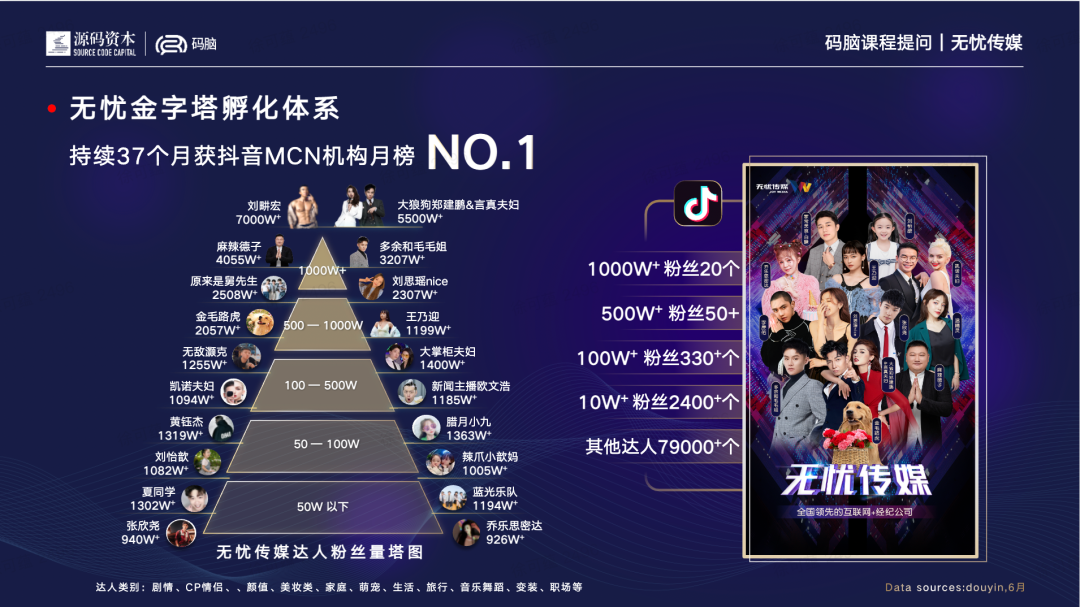
In short-video and livestreaming, Wuyou Media will continue exploring, continuously developing its methodology to empower every talent.


Issue 24: The "Change" and "Unchange" of Equity Financing
Issue 23: Eight Questions on Going Global: Where Are the New Opportunities?
Issue 22: Dealing with Supply Chain "Turbulence"
Issue 21: Clear Despair Beats Vague Hope — On ToB Sales During COVID
Issue 20: Is Your Cash Flow Still Healthy During COVID?
Issue 19: Entrepreneurs Need to Learn Appropriate Letting Go
Issue 18: Entrepreneurs' Time Management: "Two Learnings, Three Principles, Four Quadrants"
Issue 17: Your Core Startup Team Needs a "Deep Dialogue"
Issue 16: Three Keywords for Corporate Crisis Management from 3·15
Issue 15: The New Evolution of InsurTech
Issue 14: "Small" Trademarks, "Big" Trouble — How to Effectively Avoid Pits on the Entrepreneurial Road
Issue 13: Financial Opportunities in Industrial Internet
Issue 12: Top-Level Logic Thinking for Consumer Brands on Douyin
Issue 11: Inclusive Finance in the New Economic Situation
Issue 10: Brand: Meaning, Symbol, Value
More MaHui members available via "Read Original"