Code Brain | Developing Leadership Means Treating People as People, and Giving Time Time

Dismantling the logical flaws in traditional leadership development theory.
Henry Kissinger believed: "Leadership is taking people where they would not have gone by themselves." Management guru Peter Drucker defined a leader simply as "someone who has followers." Warren Bennis, who spent a lifetime studying leadership, thought "leadership is like beauty — it's hard to define, but you know it when you see it." And The Art of War held that excellent military commanders possess five qualities: wisdom, credibility, benevolence, courage, and discipline.
Leadership is highly valued in business organizations. The problem is: nobody can clearly articulate what it actually is or how to develop it. Source Code Capital has selected key chapters from management expert Yajun Wang's book The Enterprise as Algorithm, hoping to offer an alternative perspective that clears up some common misconceptions about leadership.
Yajun Wang is the founder of Jingmen Management, creator of the "Enterprise as Algorithm" theory, and an expert and practitioner in corporate strategy and organizational transformation. From 2012 to 2018, he served as Chief Strategy Officer at Longfor, where he built the prototype for an agile organization. Earlier, he worked at McKinsey & Company in New York and Greater China, as a founding member of the Greater China organization and strategy transformation practice. This article is republished with the author's permission.
The greatest enemy of good and excellent companies is using wrong theories to guide practice. The direct cost is money, the indirect cost is opportunity, and the long-term cost is morale.
Many leadership theories only tell us what excellent leaders do. Virtually every year brings new leadership books proposing their own models — typically 5 to 10 dimensions, illustrated through a series of small stories about successful leaders, hoping readers will learn from these cases. In The Leadership Challenge by James Kouzes and Barry Posner, a global survey on "the seven qualities people most want and admire in leaders they would follow" found that most people want to follow leaders with four qualities: honesty, forward-lookingness, competence, and inspiration. Excellent leaders demonstrate five corresponding behaviors: modeling the way, inspiring a shared vision, challenging the process, enabling others to act, and encouraging the heart — the external expressions of these qualities.
Many large companies hire consulting firms to customize their own leadership models. The typical consulting approach uses the firm's long-accumulated competency dictionary — usually dozens of entries like strategic thinking, systems thinking, customer centricity, innovation, and self-discipline. Through management interviews, workshops, and voting, they select 7 to 10 to form the company's leadership model: the dimensions where its leaders must excel. This model can then be applied to hiring, evaluation, promotion, and training.
Sample Competency Dictionary
| Big-picture thinking | Information analysis | Strategic thinking | Institution building | Innovation | Market orientation | Learning and development | Customer orientation | Motivation | Developing others | | Authorization | Team integration | Public relations ability | Communication and coordination | Plan execution | Business support | Achievement orientation | Self-reflection | Systems thinking | Self-discipline | | Responsibility | Organizational identification | Integrity | Adaptability | Action orientation | Confidence | Openness | Forward-lookingness | Proactiveness | Professional dedication | | Attention to detail | Performance orientation | Troubleshooting | Talent assessment and utilization | Market analysis | Teamwork | Verbal expression | Execution | Supervision and monitoring |
This "jigsaw puzzle" leadership model works reasonably well for recruiting and assessment — it allows building interview scorecards or leadership evaluation forms. But when applied to talent development — assessing each leader against the model and customizing development plans based on gaps in each dimension — the results are mediocre at best. It even leads to the view that "leadership can't be developed." Where's the problem?
1
The Paradox of Leadership Development
This jigsaw puzzle approach to developing leadership has three fundamental problems.
First, it conflates evaluating people with developing them. The relationship between the two is like that between outcomes and processes — different methods are needed to assess results versus improve them. An analogy helps: the difference between evaluating a company and running one. Stock analysts looking from the outside can analyze across multiple dimensions (net profit margin, ROE, debt ratio, growth rate, etc.) to see which companies perform well and which don't. But when running a business, entrepreneurs and management teams think about mission, vision, business model, strategy and execution, risk management, culture, collaboration methods, and incentive mechanisms. Different frameworks and methods are required. Similarly, frameworks used to evaluate leadership are unsuitable for developing it.
Yet this approach of using one unified theoretical framework for recruiting, evaluation, and development has greater formal elegance and professional appeal, making it easier to believe and accept. For example, "forward-lookingness" and "competence" are relatively easy to evaluate in executives. But how do you cultivate forward-lookingness and competence? This requires understanding how they actually form — and perhaps these seemingly different capabilities are simply two manifestations of the same underlying ability.
Second, it treats people as machines rather than living organisms. Looking at jigsaw puzzle leadership models, it's hard to sense real, flesh-and-blood human beings. Summarizing the behavioral characteristics of many different people, decomposing them into dozens of labels, then having executives select a few to "assemble" an "ideal leader" — this mechanical thinking cannot help us understand how a leader, as a living person, gradually develops from green to demonstrating these leadership qualities. Nor can it design methods to help others improve in these areas in the future.
Peter Drucker noted that in business there are "no marketing problems, no finance problems, no accounting problems — only business problems." The same applies to people. Traditional problem-solving approaches decompose large problems into many small ones, assuming that solving each small problem will naturally solve the large one. But understanding biological organisms and their interactions requires considering second-order effects — mechanical thinking won't suffice.
Third, it lacks research on the causal relationship between leadership and performance. The reason for studying leadership is that organizations hope to achieve better business results through it. So a crucial question is: among all leadership competencies, which truly matter for organizational performance and which are merely nice-to-have? What is the actual relationship between competency models built through surveys and workshops and business outcomes?
Thus, while these models have some explanatory power for the present — they can describe characteristics of good leaders — they lack the action-guiding capability needed to create the future. They struggle to tell us how to help more people become such leaders, creating a vast chasm between knowing and doing.
Wrong methods produce wrong understanding; wrong understanding produces wrong action. If you use methods for evaluating leadership behaviors to develop leadership, you naturally won't develop it — because you're using the wrong method, which then validates the view that "leadership can't be developed." To improve organizational leadership, companies must rely even more on external hiring, entering a vicious cycle.
So is there a better way?
2
Understanding the Leadership Flywheel
McKinsey published research in 2015 based on a survey of nearly 200,000 people, studying how 20 common leadership qualities affect organizational and business outcomes. The conclusion: four of these 20 qualities matter most, explaining about 90% of the gap between organizations with excellent versus poor leadership. These four are: supporting others, operating with strong results orientation, seeking different perspectives, and solving problems effectively.
Does this large-sample research happen to reveal the secret of leadership? Through long-term observation, comparison, reflection, and practice, I believe it does — at least until a better model emerges. These four qualities have first-principles characteristics. They are the source of many leadership competencies, and they are observable, explainable, practicable, and improvable. With slight adjustments to their descriptions, I call them leadership source qualities, and together they form a living, breathing "Leadership Flywheel."
The four source qualities are: problem solving, results orientation, seeking dissent, and enabling others' success. Problem solving, results orientation, and seeking dissent form the rotating parts of the flywheel, while enabling others' success is the central axis that gives the flywheel its purpose. These four parts reinforce each other; sustained practice improves personal leadership. The qualities used in jigsaw puzzle models — what I call surface qualities — grow outward from the inside, driven by the flywheel, and improve naturally. This "naturalness" comes from the innate self-coordinating capacity among a person's heart, mind, and body.
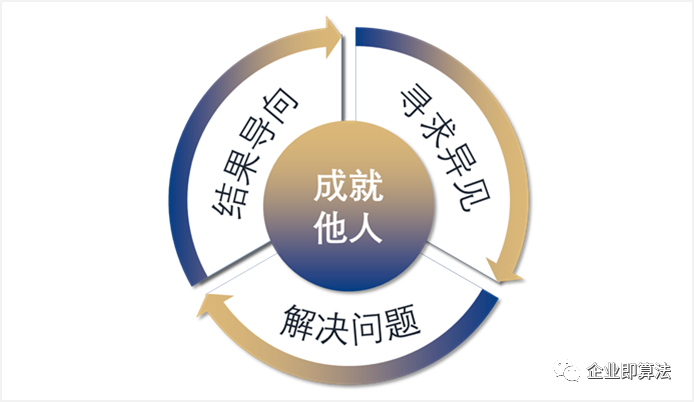
As leaders grow from managing themselves, to teams, to large organizations, to social organizations, complexity increases exponentially. Because the Leadership Flywheel is built on the deepest, most stable, mutually reinforcing set of capabilities, leadership development can also become exponential. Only exponentially growing leadership can manage exponentially growing management complexity, allowing entrepreneurs and leaders to navigate role transitions with ease.
The four source qualities of the Leadership Flywheel deeply match the capabilities that agile organizations emphasize — real-time, on-the-ground collaboration to solve complex problems. They are the power source that makes agile organizations function.
I call this model the Leadership Flywheel, not the Leadership Competency Flywheel, because it addresses the "how" of leadership, not just the "what." It represents kinetic thinking, not static thinking. Static thinking tends toward mechanization and idealization — easy to understand, hard to execute. Kinetic thinking addresses how to move from one state to another, and must generate action.
Source Quality 1: Problem Solving
That problem solving is the core of leadership is self-evident. Leading teams to victory, solving problems others cannot — this is forever a leader's core value.
We often treat problem solving as an outcome: "Don't just talk, solve the problem." But actually, problem solving is a methodology; problem-solving ability is the capacity to use methodology to achieve results. Abilities that cannot be repeatedly sustained are merely luck. The gap between professionals and amateurs is consistency. General methodologies like the McKinsey seven-step approach can solve many types of problems. Their foundation is structured and systems thinking: decomposing large problems into smaller ones, forming hypotheses and proving or disproving them, balancing benefits and costs throughout, then developing solutions. Such general methodologies continue to evolve — for highly uncertain problems, for complex problems, and so on.
Professional methodologies build on general ones for specific domains. Six Sigma, for example, is a professional methodology for optimizing standardized, repetitive work. But applied beyond its professional boundaries, it causes problems. In 2002, GE veteran Jim McNerney became CEO of innovation-driven 3M and implemented Six Sigma company-wide, including in R&D. New product revenue share dropped from 33% to 20% over five years, weakening 3M's innovation capability.
As leaders grow, they face increasingly complex and volatile problems, making problem-solving ability ever more important. Lisa Su, CEO of US chipmaker AMD, took the top role in 2014 and within a few years turned a company near bankruptcy into one with strong growth and profitability, with stock rising from under $2 to nearly $60. In 2019, she became the highest-paid CEO in America. Asked about her leadership characteristics, she said: "My defining trait is determination. With full commitment, there's no problem that can't be solved."
Viewing any difficult challenge as something that can be defined, analyzed, and solved, and continuously practicing to refine this process, gradually makes it a subconscious habit — and even enjoyable.
Source Quality 2: Results Orientation
Results orientation is often interpreted as rewards and punishments based on performance, mission must be accomplished — but this is a very narrow understanding.
Results orientation has two layers. First is beginning with the end in mind: having imagination and vision for the future, setting goals, honestly assessing current conditions, then using problem-solving methods to map the path and resources needed from present to future. This is essentially the ability to set strategy. Second is mission accomplishment: executing according to the established path and plan to achieve goals. But man proposes, heaven disposes — unexpected new problems will arise. Then, driven by desire for the goal, one must push through with physical, mental, and emotional energy.
These two capabilities must be unified in the leader, with tight integration of planning and execution. When major external changes occur, plans and paths must be adjusted promptly. When better opportunities emerge, higher goals must be set — not resting content with small gains. When external conditions are too unfavorable, goals must be lowered or shifted — not stubbornly persisting on one path. This adaptability is "planned opportunism," requiring strong systems thinking. It also draws on another source quality: seeking dissent.
Source Quality 3: Seeking Dissent
Actively seeking different opinions is not in mainstream leadership competency dictionaries, but it is an important part of scientific thinking.
A key method of scientific problem solving is forming a "hypothesis" about a problem and using facts, data, and analysis to prove or disprove it, thereby improving decision quality. Over a decade ago, when I was a consultant, I evaluated a project for a top global investment firm. The basic conclusion was to recommend investment. But on the final page, I listed several possible arguments against the investment. From then on, the firm required all internal project evaluations to include such a page, ensuring the investment committee saw counterarguments for more comprehensive decisions.
Most people only want to see the reality they wish to see and want. Actively seeking dissent helps leaders resist this temptation of self-confirmation, stress-test their own ideas, even change their original thinking. Excellent investors constantly adjust their views based on new information, rather than selectively ignoring evidence to prove themselves right — choosing face over money. The same applies to excellent leaders. To hear honest talk, Zeng Guofan hired several high-paid staffers who didn't want official posts, responsible for speaking truths others couldn't — equivalent to Huawei's "blue team," an authorized opposition.
Mencius spoke of "taking pleasure in hearing one's faults," but almost no one can actually do this. By actively seeking dissent, we can hear different views while feeling in control, exercising our ability to manage fear. Then when we passively hear criticism, we may initially feel uncomfortable, but quickly shift to: "I didn't even have to seek it out — dissent came to me. Excellent!"
Someone who can seek dissent must be inwardly open and growth-oriented. The Leadership Flywheel can thus continuously absorb new cognition and energy from the outside, gradually growing larger and stronger, driving the leader's sustained growth.
Problem solving, results orientation, and seeking dissent reinforce each other, creating flywheel effects. Only with results orientation does problem solving produce more implementable solutions. As problem-solving ability improves, leaders set higher goals. The structured and scientific thinking frameworks in problem solving allow different opinions to enter overall thinking rationally. Meanwhile, seeking dissent makes problem solving more rigorous and can produce creative solutions.
Source Quality 4: Enabling Others' Success
Enabling others' success is a long-term value orientation, positioned as the central axis of the Leadership Flywheel, giving meaning to the other three source qualities.
Leaders who make enabling others' success their axis are value-creating leaders; those who make enabling their own success their axis are value-extracting leaders. Excellent organizations — or rather, organizations in their excellent phases — need more value-creating leaders. Following Drucker's view that a leader is defined by their followers, enabling others' success most directly means first enabling followers' success, leading teams to victory so they gain glory and reward.
In reality, we also see people in leadership roles who are skilled at using subordinates rather than enabling them, and seem to do fine. This reflects a choice between long-term and short-term interests, because leaders who enable subordinates gain more followers and greater long-term success.
As leaders grow, enabling others' success takes on richer meaning — enabling the enterprise, partners, society. Leaders who long practice altruism as a requirement of themselves, cultivating an other-oriented mindset and habits over years, more easily transition from managing small organizations to large ones, even to social organizations.
Like seeking dissent, enabling others' success is open and generative. Defining one's value from an external perspective allows continuous absorption of information and energy from outside, growing the flywheel. Whether it's Chinese entrepreneurs pledging to contribute to China's strength, or Confucianism's cultivation of self, regulation of family, governance of state, and peace under heaven; whether it's the American Protestant work ethic that work glorifies God, or Japanese entrepreneurs like Kazuo Inamori's reverence for heaven and love for people — all define self-worth from an ultimate external perspective.
Deconstructing Surface Leadership Qualities
Can the surface leadership qualities we commonly discuss be explained by the four source qualities of the Leadership Flywheel? The current conclusion is yes, but like any theory, this is an ongoing process of proof and disproof. Here are some examples:
Communication and coordination ≈ problem solving + seeking dissent. Effective communication and coordination should be based on problem solving, not communication for its own sake. Seeking dissent allows us to actively listen to others' ideas in communication, making it more effective. In daily work, I also suggest using the word "communication" less, as it lacks results orientation.
Innovation ≈ seeking dissent + problem solving + results orientation. Seeking dissent keeps one open, and openness is the foundation of innovation. But new ideas alone aren't enough — turning ideas into reality to create value requires results orientation and problem-solving ability. Kevin Ashton, inventor of the Internet of Things, summarized historical innovation research in his book How to Fly a Horse: the innovation process is essentially a problem-solving process, where ordinary, tedious work produces extraordinary results. But if we only treat "innovation" as an outcome rather than a process with its own methodology, we cannot deconstruct or build this process. As mentioned earlier, if we treat "problem solving" only as an outcome rather than a process with professional methods, we can only evaluate, not develop, this capability.
Customer centricity ≈ enabling others' success + results orientation. Enabling others' success reflects understanding of one's own value, and a company's value is ultimately defined by customers. Results orientation, after clarifying the goal of creating customer value, helps ensure other activities revolve around this target.
Embracing change ≈ seeking dissent + results orientation. If someone can actively seek different opinions, making themselves uncomfortable for better final results, their heart is necessarily open and will embrace change.
Resilience ≈ results orientation + problem solving + X. With clear vision and goals from results orientation, and strong problem-solving ability, one can keep eyes on the target when facing setbacks, treating each setback as a new problem to solve. When one approach fails, devise another; when once isn't enough, try again — persistent grinding. X may involve some innate or environmental factors.
Empathy ≈ enabling others' success + problem solving + X. If you're thinking of enabling others, you'll consider things from their perspective. But ultimately, helping them solve problems is the highest form of empathy. X may involve having past experiences that resonate with the other person's situation.
Institution-building capability ≈ problem solving + results orientation + enabling others' success + X. Building institutions is for solving management problems, not building institutions for their own sake. A common problem is managers building institutions to control risk, but excessive control saps organizational vitality. Due to their role constraints, they cannot approach institution building with the goals and thinking of enabling the organization and results orientation. X covers some institution-building skills requiring professional training.
Readers can also try explaining other surface leadership qualities this way, continuously testing the model's explanatory and action-guiding power. The Leadership Flywheel also applies across regional cultures and industries.
McKinsey's analysis was based on a global sample of 81 companies across Asia, Europe, North America, and South America. Based on my years of close observation of Chinese leaders using this model, and understanding of excellent global companies (such as Zhengfei Ren at Huawei, Tadashi Yanai at UNIQLO, and Ray Dalio at Bridgewater — who shared internal documents externally rather than writing autobiographies, making them more authentic), this model has very strong explanatory power.
From a kinetic perspective, the relationship between the Leadership Flywheel and surface leadership qualities has three layers.
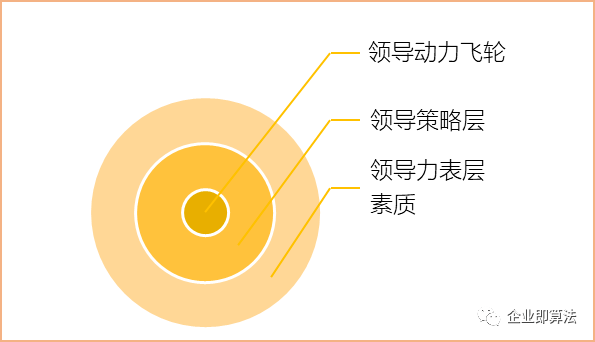
The Leadership Flywheel sits at the center, continuously growing larger and stronger through sustained practice. The middle layer is leadership strategy — leading different types of enterprises, at different developmental stages, in different countries requires different strategies. This layer also includes unique qualities shaped by a leader's personal history. The outermost layer is the leader's interaction with the external world, actually playing leadership roles and creating value, manifesting as various surface leadership qualities — what traditional leadership models describe. The entire system's energy comes from the central Leadership Flywheel, which drives the growth of outer-layer surface leadership qualities.
Practicing the Leadership Flywheel
Each source quality of the flywheel can be divided into two parts: mindset and technique. The two support each other — mindset adjustment allows technique to exert greater power, while practicing and using technique continuously adjusts mindset. This is the simultaneous cultivation of principle and method, getting the flywheel turning and forming one's own habits.
1. Problem Solving
Mindset: View the world through a problem lens; frame any challenge as a problem to be solved
Technique: Seven-step problem solving, various systems thinking frameworks...
2. Results Orientation
Mindset: Don't do things without value or with low value; only doing creates value
Technique: Defining success metrics, project management methods, to-do lists...
3. Seeking Dissent
Mindset: Because of difference, there is greater value and infinite possibility; take pleasure in hearing faults
Technique: The last item on any list must be "Other..."; when forming any decision, immediately ask "If I'm wrong, where's the pitfall?"; understanding various decision biases...
4. Enabling Others' Success
Mindset: Creating value for others makes you valuable; in the long run, benefiting others benefits yourself
Technique: Writing your own epitaph, situational leadership methods, giving and receiving feedback...
Practicing the Leadership Flywheel is a long-term, continuous process. Initially, conscious practice of tools and methods at the technique level improves skills while changing mindset. Later, as technique becomes more proficient, mindset continues to improve, and the two become increasingly smooth together. Eventually, one can apply technique flexibly based on understanding of leadership's essence, achieving results without being constrained by technique.
Josh Waitzkin, world champion in both international chess and Taiji push hands, believed his true specialty wasn't either domain, but rather his learning ability when the goal was becoming world-class. Masters and average competitors may appear to compete in the same sport, but their thinking and learning methods are worlds apart. The similarity between top masters across different domains exceeds their similarity to average competitors within their own domain.
Waitzkin called top-level practice "making smaller circles" — drilling down to the essence of a skill, then effectively compressing its external expression while tightly circling its internal essence. Over time, breadth gradually narrows while power steadily increases. Top masters necessarily avoid flashy flourishes. Great skill appears clumsy; heavy swords have no edge — achieving the best results with minimum input.
If enterprises wish to adopt the Leadership Flywheel methodology to improve leadership, senior leadership must believe people can change — but it takes time and patience. Previous unsatisfactory change was due to using wrong methods. If they don't believe people can change, they'll only solve business problems through hiring and replacement, falling into a self-fulfilling prophecy.