Code Brain | Equity Incentives Become Standard Practice: How Can Companies and Employees Achieve a Win-Win?

Whether an equity incentive plan is designed scientifically matters not only for achieving the "incentive" objective itself, but is also closely tied to dimensions such as corporate cost management and strategic development.

Entrepreneurship is a never-ending journey of self-cultivation. For core management teams, mastering the fundamentals of business operations and organizational management isn't just a required course — it's directly tied to how far the company can go.
That's why Code Brain is launching its "Management Fundamentals" series, targeting three foundational and core management capabilities for founders: people, finance, and operations. Covering ten major themes including personal leadership, talent assessment, performance management, compensation and incentive design, business-finance integration, sales management, and high-performance teams, the series provides comprehensive management methods and practical tools that leaders can apply immediately — helping elevate founders' fundamental management awareness and capabilities.
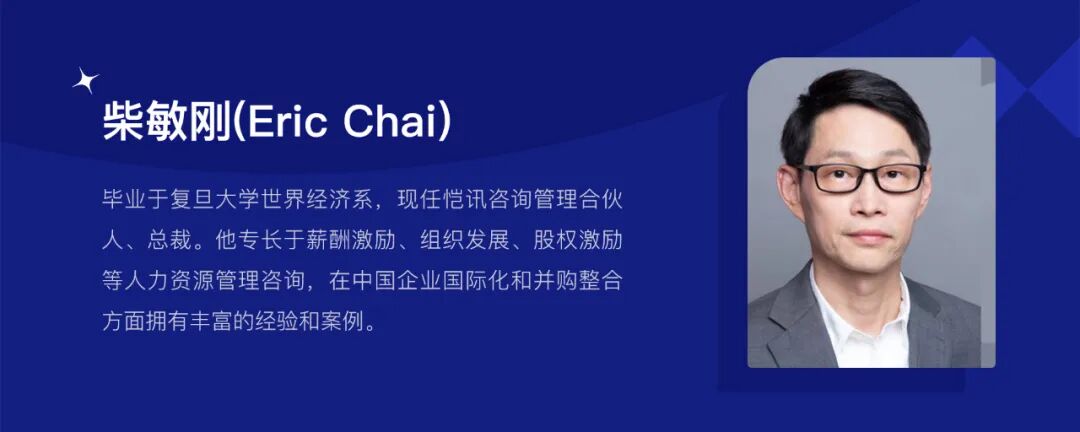
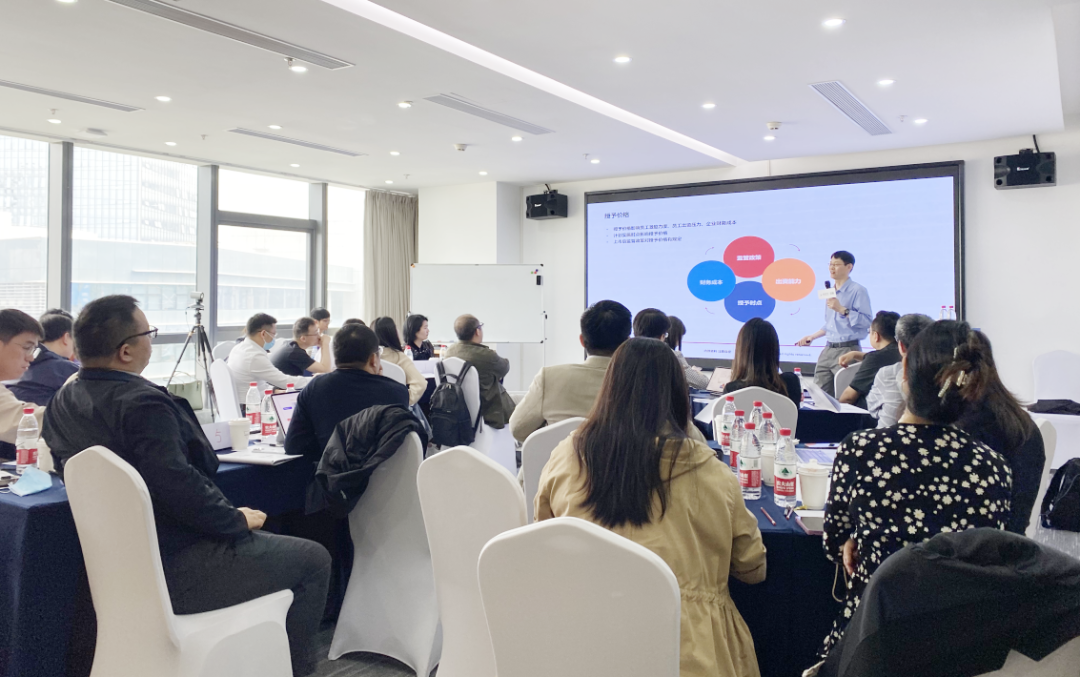
Starting in August 2022, the "Management Fundamentals" series has followed a rhythm of one session every two months, with two themes per session, each lasting two days. Six sessions have been completed to date. In March 2023, in Shenzhen, we specially invited Eric Chai, Managing Partner and President of Kaixun Consulting, along with his colleague Cheng Yang, to deliver a customized one-day course on Equity Incentive Design.

From an organizational perspective, Mr. Chai comprehensively explained the core elements of equity incentive design and practical implementation cases. Over 70 CEOs and executives from more than 20 MaHui companies participated in the course, both online and offline.

Selected highlights from the presentation:
01
Equity Incentives: The Standard for Talent Retention
After more than two decades of development, Chinese companies have seen equity incentives evolve from a tool used by tech and internet firms to a standard instrument across all industries for attracting, motivating, and retaining talent. Recent surveys show equity incentives have already achieved high penetration across diverse sectors.
Experience from developed countries shows that as companies mature, the endgame is always the development and succession of professional managers. Without resolving equity incentive issues, it's difficult to establish effective principal-agent relationships between shareholders and managers, making sustainable corporate succession and long-term stability elusive. This is especially true when a company becomes a sector leader — whether attracting top industry talent, executing strategic transformation, or aligning the interests of professional managers, equity incentives can play a powerful role.
To summarize our consulting experience in recent years, companies pursue equity incentives with several main objectives:
- Equity incentives have become an essential tool for talent management
- They effectively align the interests of shareholders and professional managers
- They support corporate strategic transformation
- They can also address compensation and exit issues for founding teams or long-tenured employees
02
Designing Equity Incentive Structures from Multiple Perspectives
1. Common Equity Incentive Instruments
First, some data for reference:
Analysis of executive compensation structures and equity incentive instruments among the top 250 U.S. companies shows that equity incentives comprise 70%-80% of total compensation, with base salary and cash bonuses each accounting for 10%-15%. Executive equity instruments are generally categorized as performance shares, restricted stock, and stock options.
For Chinese companies listed overseas, equity incentives account for less than 50% of compensation, with base salary and cash bonuses at roughly 20% and 30% respectively. Hong Kong-listed companies primarily use options, restricted stock, or combinations thereof.
For domestic Chinese listed companies, the ratio of base salary, cash bonuses, and equity incentives is approximately 3:3:4. In recent years, A-share companies have increasingly favored restricted stock.
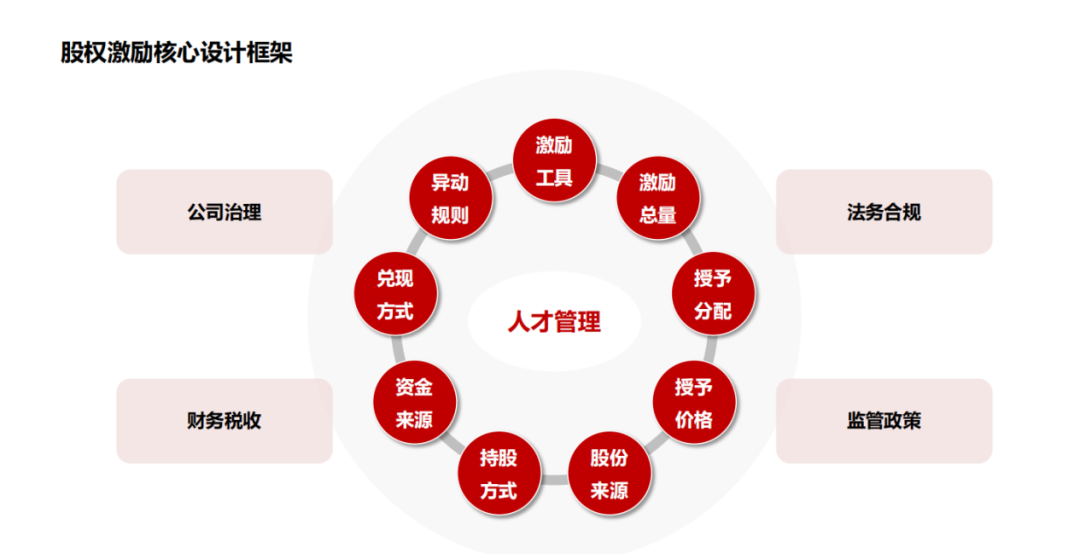
Equity incentive design requires consideration from two perspectives. From the external perspective: corporate governance, legal and regulatory compliance, finance and taxation, and regulatory policy. From the internal perspective: the primary focus is talent management.
Common equity incentive instruments include employee stock ownership, stock options, restricted stock, performance shares, phantom stock, stock appreciation rights, dividend rights, and performance units.
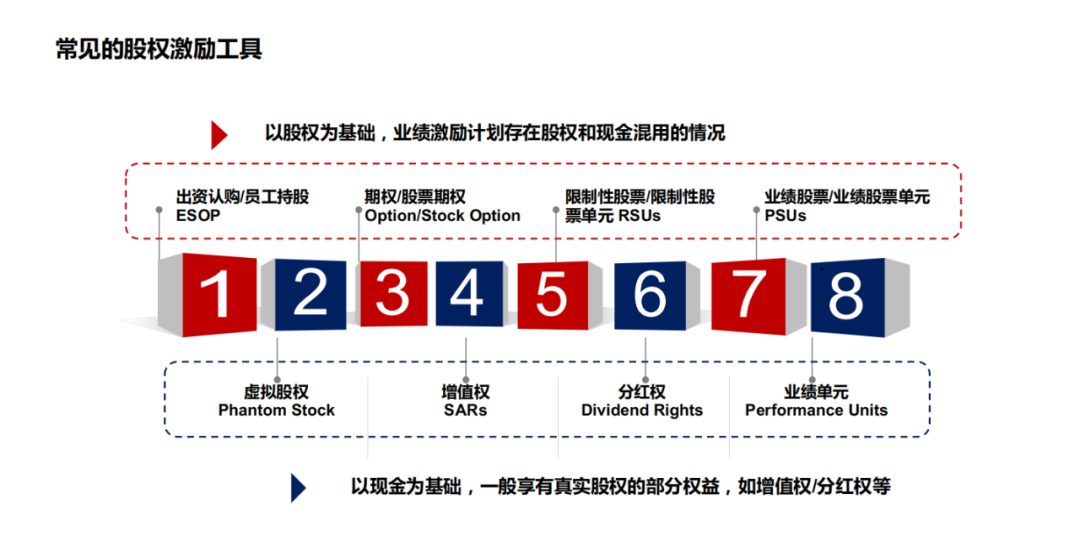
Restricted Stock: Shares granted with restrictions that are lifted only when the recipient meets specified company conditions, which may include service duration or performance targets.
Options: The right to purchase company shares at a predetermined price set at grant, exercisable in the future.
Performance Shares: Shares granted (typically at no cost) based on performance achievements, with the quantity tied to performance outcomes. More commonly used by U.S. companies.
Employee Stock Ownership: Employees purchase shares at company valuation, enjoying shareholder rights including voting and dividends.
2. How to Select Incentive Instruments?
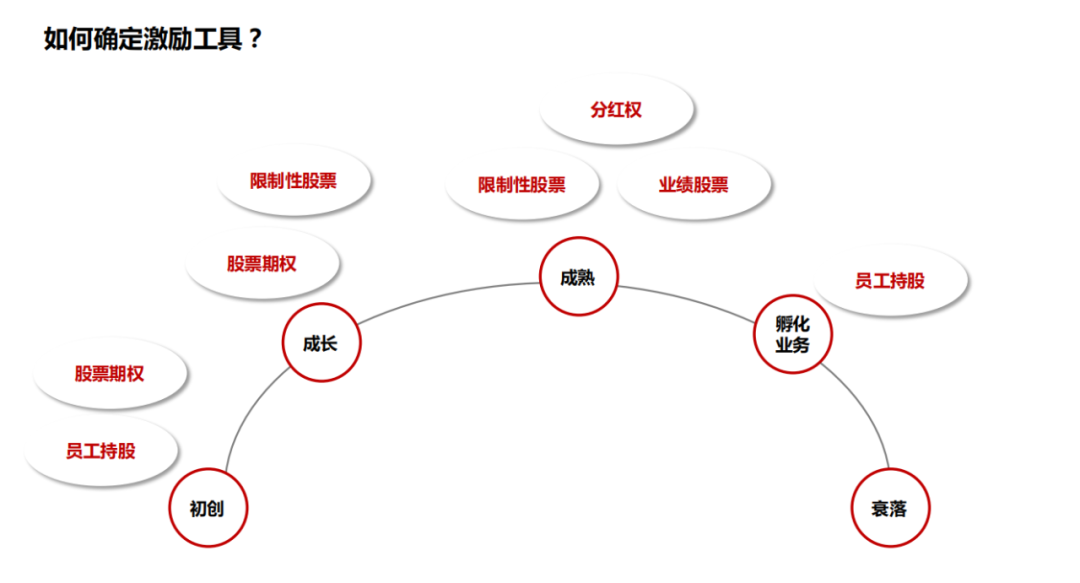
The choice of incentive instruments is closely tied to the company's developmental stage. During the startup phase, when neither the company nor employees have substantial capital, core employee stock ownership and options can serve as dream drivers. In high-growth phases, options remain highly effective — as long as the overall trend is upward, even significant volatility is acceptable. Employees and the company ride the same boat; stock options are inherently high-risk, high-reward instruments. At this stage, restricted stock can be added for greater stability. When the company matures, performance shares and restricted stock become more common, balancing performance and incentive stability. Companies with strong cash flow may also use dividend rights. When mature companies incubate new businesses, employee stock ownership or stock options can be deployed again.
3. How to Determine the Total Incentive Pool
Key dimensions for determining total incentive pool size include: employee incentive intensity, company financial capacity, market practice, regulatory policy, and shareholder willingness. For incentive intensity, assess both grant-date value and potential returns under various future scenarios, as well as the stringency of vesting conditions. Employee participation rates and grant standards vary significantly by industry, reflecting competitive intensity for talent. For example, tech and internet companies typically set total grant pools at 7%-15%, while retail ranges from 1%-6%. Equity incentives create financial cost pressure — for STAR Market companies, equity incentive costs average approximately 9% of net profit (P50 value). Thus cost is a critical consideration, while shareholder willingness refers to acceptable dilution tolerance after shares are distributed.
4. Grant Allocation & Grant Pricing
Equity incentive allocation demands greater attention to management logic and total compensation philosophy. How should structures be designed for senior, middle, and junior levels? How should front-office, middle-office, and back-office roles be treated? What is the management orientation? Only when management philosophy and logic are clearly thought through can equity incentive allocation proceed smoothly. Equity incentives are merely a tool serving corporate management philosophy; the management message you want to convey matters far more than the tool design itself.
For specific grant allocation, equity incentives are an integral component of total compensation. Only by scientifically combining base salary, variable bonuses, equity incentives, and benefits can maximum synergistic value be achieved. Grant patterns are generally irregular or annual, with considerations including the completeness of existing talent pipelines, sustainability of performance, and total compensation philosophy.
Grant pricing must account for regulatory policy, timing of grant, financial cost, incentive intensity, and employee capacity to invest. For listed companies, flexibility is limited; pre-IPO companies have substantial room for flexible arrangements.
5. Share Source, Funding Source & Holding Structure
Incentive shares primarily come from three sources: existing share transfers, capital increases through new share issuance, and share repurchases.
Existing Share Transfers: Total share capital unchanged; transferring shareholder's stake reduced.
Capital Increase: Total share capital expanded; all shareholders diluted proportionally.
Share Repurchases: Total share capital unchanged; treasury shares can be held for three years.
For funding arrangements by incentive recipients, comprehensively assess employees' capacity and willingness to invest. If the goal is zero or deferred employee contribution, consider stock options and Type II restricted stock as instruments; the company may also match shares or grant milestones. Some companies prefer partial employee contribution to create tighter bonds and greater belonging, especially for partnership-model equity incentive plans where co-investment embodies the philosophy of shared risk, shared creation, and shared rewards — itself a management statement.
Holding structures generally include: direct individual holding, indirect holding through partnership enterprises, and third-party entrustment (trusts, asset management plans).
6. Vesting Schedule, Vesting Conditions & Vesting Metrics
Vesting schedules are typically determined by IPO timelines or specific management objectives, with most companies completing vesting over 3-4 years. Vesting conditions generally include service duration and performance targets. Design philosophies may include easy-in-strict-out, strict-in-easy-out, or strict-in-strict-out approaches.
For vesting metrics, U.S. companies most frequently use TSR (Total Shareholder Return). A-share companies commonly use revenue, profit, and return on net assets — these targets must be achieved for vesting. In recent years, many A-share equity incentive plans have fallen short of original design intentions: sometimes targets were unattainable, or vesting occurred with minimal stock price appreciation, or employees made repeated contributions with restricted liquidity, creating financial burdens. These are all worth considering in design — how to balance employee incentives with shareholder returns.
7. Establishing Change-of-Status Rules
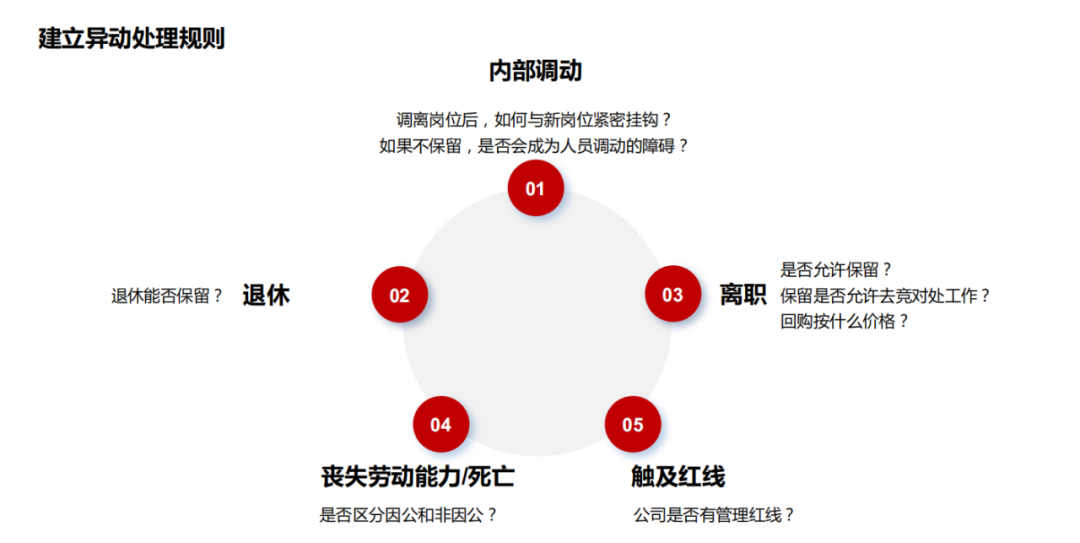
During equity incentive implementation, the most dispute-prone scenarios involve employee status changes. Companies must establish comprehensive rules covering internal transfers, resignation, policy violations, disability/death, retirement, and other status changes, with all conditions clearly specified to avoid disputes.
03
Learning from Others: How Microsoft, Goldman Sachs, and Amazon Do It
1. Microsoft: Compensation and Equity Incentives During Transformation
From 2014 to present, Microsoft has shifted from product focus and operational efficiency to cloud and AI. Before we even noticed, it had completed its business transformation.
Before 2014, Microsoft compensation comprised fixed pay and restricted stock. After 2014, it adjusted by reducing fixed pay and cash bonuses, adopting a combination of restricted stock and performance shares tied to time and performance respectively. Starting last year, even restricted stock for core executives was eliminated — long-term incentives became 100% performance-linked, with increasingly long-term oriented performance shares adjusted by three-year composite TSR. This tightly links shareholder returns to equity incentives. Across two to three performance cycles, core transformation metrics became equity incentive vesting conditions: core cloud revenue and subscription metrics carried two-thirds weight. Through each three-year cycle, organizational transformation was progressively guided. Additionally, they annualized performance shares — a significant portion of annual compensation depends on the prior three years' performance. At any given year, three years of tranches overlap, all simultaneously evaluated against prior three-year performance. Thus the metrics and mechanisms clearly demonstrate long-term and transformation orientation.
2. Goldman Sachs: A Model for Modern Partnership
Many domestic companies are currently exploring partnership models. The essence of partnership is completing the closed loop of empowerment, profit-sharing, and authority-sharing. Many domestic partnership schemes only implement profit-sharing — the easiest part — without empowerment and authority-sharing, which is why most partnership mechanisms fail. The real challenge lies in selecting the right people and managing partners correctly.
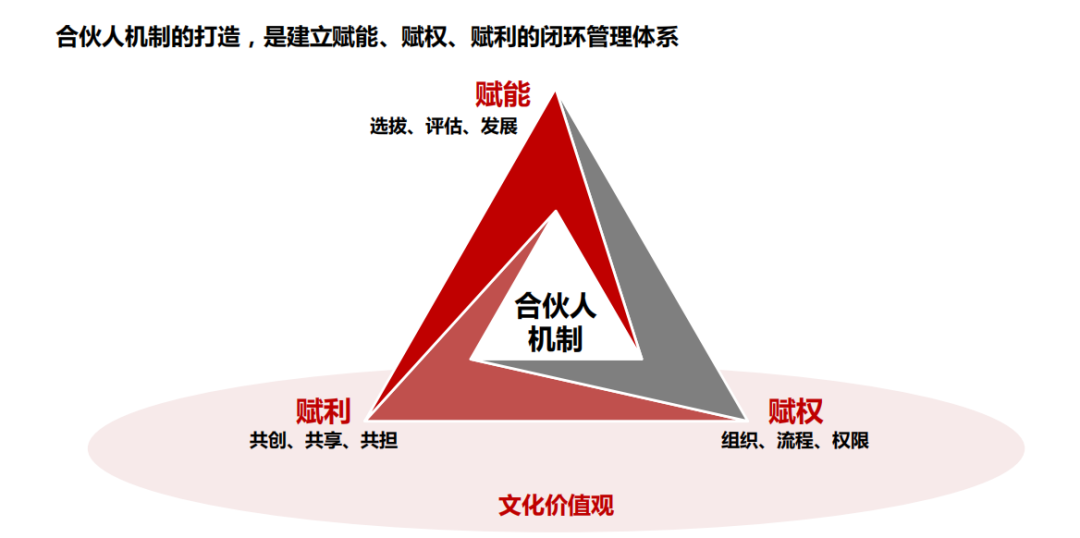
Goldman Sachs is the paragon of modern partnership. It was a classic partnership structure before IPO and maintained partnership culture afterward. Goldman partners represent approximately 1.5% of total employees, selected every two years based on commercial contribution, management and innovation capability, and cultural values alignment. Goldman partners have explicit performance metrics, are not tenured for life, and must adhere to 14 business principles — violation of any principle leads to elimination in the next election.
Of Goldman Sachs' fourteen business principles, talent management is mentioned most frequently. Through a series of committee structures, partners are fully authorized to manage business operations, given complete trust and authority to truly become company managers.
Finally, compensation: Goldman partner pay is tightly linked to overall firm performance. Through annual bonus-to-stock conversion, most variable compensation becomes equity. Partners also gain access to exclusive investment fund opportunities, further tying partner interests to firm returns, forming a tight community of shared interests and shared enterprise.
3. Amazon: Equity Incentives Amid Diversified Rapid Growth
Amazon's evolution from bookstore to ever-expanding business scenarios stems from long-term thinking and a culture of bold experimentation. Under this philosophy, compensation structure doesn't tie to short-term, individual business or financial metrics. Compensation is primarily base salary plus restricted stock. Base salary is minimal, approximately 2.2%; restricted stock comprises 97.8%. Base salary covers basic living; there are no short-term incentives; equity incentive proportion is extremely high.
Amazon encourages innovation and bold experimentation. Its incentive tools are simple and direct, emphasizing long-term enterprise value and total compensation competitiveness. Restricted stock grants follow total compensation philosophy, categorized as new hire, promotion, and periodic grants. Vesting periods are long, requiring 5-10 years. The company regularly reviews stock price changes, employee share value, and potential total income to determine whether to make additional grants or discontinue them.
4. How to Incentivize Subsidiaries/Innovative Businesses? — The Midea Group Example
As companies grow, many face how to implement equity incentives for subsidiaries and innovative businesses. Midea Group has continuously implemented equity incentives since IPO, establishing a multi-layered incentive system. Midea's partnership plan is essentially also equity incentive.
Midea Group has 15-20 global partners, with per capita annual grants of 10-14 million RMB in shares from net profit over the past four years. Business partners number around 50, primarily core managers important to overall performance and long-term development, receiving 2-3.5 million RMB in shares annually from net profit. Core employees receive restricted stock and stock options, approximately 1,500-2,000 people. Midea's equity incentives are tightly performance-linked, with three-year vesting tied to company, business unit, and individual assessments — achieving aligned goals, co-creation, and shared rewards. This is also common practice among A-share listed companies.
For Midea's innovative business Midea Intelligent Optoelectronics, the group holds 50%, while employee stock ownership and co-investment platforms hold over 40% — with strong potential for independent IPO. This arrangement achieves large-scale original shareholding by core employees and stakeholders, tightly binding employees to the new business with substantial incentives, while key group stakeholders also hold shares ensuring support and synergy for the new business. Similarly, Hikvision's innovative business subsidiaries granted employees 40% stakes to support incubation, successfully spinning off Ezviz as a listed company.
5. How Do STAR Market Listed Companies Implement Equity Incentives? — The Amlogic Example
STAR Market equity incentive policy has several breakthroughs, including closed-loop principles, IPO with options outstanding, and Type II restricted stock. We'll illustrate with semiconductor company Amlogic and biotech company Junshi Biosciences.
Amlogic operates in the semiconductor industry,典型的技术密集型和资金密集型行业, with high talent dependence and mobility — making talent attraction, motivation, and retention critical, and equity incentives virtually standard for market-oriented semiconductor companies. Amlogic's predecessor, Amlogic CA, was established in California in 1995, maintaining an offshore structure with multi-phase option plans: 1995, 2007, and 2014 plans covering both Chinese and non-Chinese employees. Recognizing domestic semiconductor opportunities, the company restructured to a domestic architecture in 2017 as Amlogic. With the red-chip dismantlement, employee option plans were migrated to domestic holding platforms. For Chinese employees, options above certain thresholds converted to equivalent-priced restricted stock; for non-Chinese employees, buyouts or cash compensation, with overall employee holding migration completed in 2018. Amlogic's case offers significant reference for companies with historical red-chip structures and outstanding unexercised options considering domestic listing — balancing employee interest protection, participation morale, and legal compliance.
Post-IPO, like many STAR Market companies, Amlogic implemented multiple incentives using Type II restricted stock, covering approximately 50% of employees (400-600 people) at roughly 2% per round with high incentive intensity. Amlogic's grant price is approximately 50% discount, determined — per its disclosure — by comprehensively considering incentive culture continuity, plan effectiveness, share-based payment impact, employee funding capacity, and historical experience, following incentive-constraint parity to both achieve motivational effect and binding function.
Junshi Biosciences similarly operates in a talent-dependent industry, with pre-IPO option plans and post-IPO Type II restricted stock plans helping bind talent.
04
Operational Execution of Equity Incentives
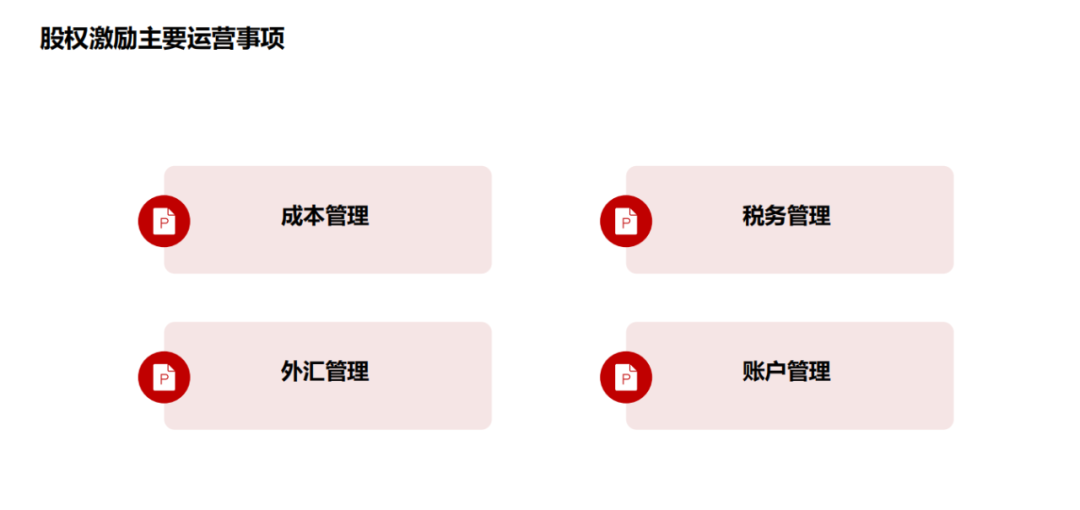
Key operational matters for equity incentives include cost management, tax management, foreign exchange management, and account management.
1. Cost Management
From the instrument perspective, here's a basic concept. For domestic companies, the fundamental policy is Accounting Standards for Business Enterprises No. 11 — Share-based Payment. For example, if A-share restricted stock is granted to employees at 50% discount, the other 50% intuitively enters company costs. This is the basic concept. Option costs or values are more complex, involving time value and probability factors of future returns. Options generally use models to calculate per-share option value, such as the Black-Scholes model and binomial tree models.
Financial cost is a critical consideration when designing incentive plans. Different instruments, grant methods, grant prices, vesting periods, and restriction conditions all impact valuation and cost. Pre-IPO companies must fully consider share-based payment expense erosion of reporting period profits — pre-IPO option plan cancellations or accelerated exercises impact expense recognition, requiring consultation with professional institutions.
2. Tax Management
Equity incentives involve individual income tax, with specific tax policies varying by listing status and holding entity. For listed companies, two instruments' tax rules:
Options are not taxed at grant, taxed at exercise, with tax payments at one, two, and three-year intervals. At exercise, the spread between market price and exercise price is taxed as wage income at applicable rates — typically 35%-45% given substantial equity income. Future sale is taxed as property transfer income at 20%, currently exempt for A-shares, similar to retail investor tax treatment.
Restricted stock follows similar logic, with the distinction that market price uses the average of registration date and release date prices.
Tax planning for employee equity incentive returns is a major project consideration — reducing tax base, altering tax timing, and researching tax jurisdiction can significantly impact incentive recipients' actual income.
3. Foreign Exchange Management
For offshore-listed companies with employee equity incentive plans, within three months of IPO or new plan launch, the company must complete SAFE Circular 7 registration. This registration addresses compliance for Chinese employees of offshore-listed companies obtaining offshore returns through equity incentive plans.
Incentive recipients must have their domestic employer collectively entrust a domestic agent to handle foreign exchange registration, account opening, and fund transfer and conversion matters, with a single offshore institution handling individual exercise, stock purchase and sale, and corresponding fund transfers. The domestic agent must complete initial filing and annual/quarterly reporting.
Foreign exchange matters related to equity incentive plans may be delegated to professional institutions for management.
4. Account Management
If grant recipient numbers are large, consider outsourcing routine equity incentive maintenance and operations to professional service companies, including system initialization, employee grants, online agreement signing, exercise window trading, and financial/tax reporting.
Closing Thoughts
Equity incentives have become a critical tool for attracting, motivating, and retaining talent, and may even influence future corporate governance structures. A good equity incentive plan must consider both current business and talent strategy while maintaining endgame thinking. Equity incentives are not simply an HR initiative — they span legal, regulatory, finance, and tax domains, requiring integrated consideration, professional design, and effective communication to ensure reasonableness, legality, and compliance.