Code Brain | User Acquisition Isn't Just Ad Spending—Startups Must Understand the Nature of Traffic to Drive Growth

The essence of traffic is users' attention accounts.

Today, with demographic dividends exhausted and user acquisition costs climbing ever higher, every company faces the practical challenge of user growth. To leap forward, businesses can't just focus on surface-level growth tactics — they need to understand the underlying logic driving growth.
Recently, Code Brain's "Growth Academy," zeroing in on traffic, brought MaHui member companies into Alibaba's Chaojihuichuan advertising platform. The program featured industry heavyweights including Yang Huaiyuan, General Manager of Chaojihuichuan; Yan Kai, General Manager of Alibaba Intelligent Information Business Group's Marketing Department; Pan Lan, General Manager of Chaojihuichuan's Marketing Strategy and Promotion Department; and Hanqing Yang, Chief Growth Officer at Dmall. They shared insights around the theme "Seizing New Traffic Growth Opportunities," aiming to help companies decode the traffic secrets underlying different platforms.
Today, we're sharing the first piece from this session — Hanqing Yang's live presentation.

Hanqing Yang has done chip R&D at Huawei's HiSilicon, founded his own mobile phone startup, earned an MBA from Duke University, and held roles at Amazon, Baidu, OFO, DiDi, and KE Holdings. He brings deep expertise across product, operations, BI, strategy, and team management. His book, User Growth on the Front Lines: Navigating User Operations in the Era of Stock Competition, has become a practical methodology reference for countless entrepreneurs navigating China's unique market.
His presentation covered four modules:
- What is user growth
- The nature of traffic
- Strategic growth planning
- How to build a growth engine
Selected highlights from the session
1 What Is User Growth?
To fundamentally understand this, we need to trace the concept's origins. In earlier days, the prototype of "user growth" came largely from FMCG companies like Procter & Gamble and Unilever. Their brand marketing departments focused on packaging and getting products onto shelves through offline channels — essentially, how to get goods into customers' hands. During the Mobile Internet era, to use the phone industry as an example, the pre-installed apps everyone knows were a microcosm of "user growth." The turning point came around 2016–2017, when simple app pre-installation no longer sufficed, and growth teams began building real internal capabilities.

My understanding of user growth: start with the end in mind, and use all available resources to get more users to use core product features more frequently. "More" means acquisition; "more frequently" means activation. And crucially, they must use core product features — that's what drives up LTV (lifetime value).
Achieving user growth typically requires mobilizing resources across the company: product, R&D, operations, BI, data mining, user research, brand, and PR. Put another way, user growth is a second-order team. Many companies operate fine without one, just less efficiently. You can think of it somewhat like a PMO (Project Management Office) in some organizations.
One prerequisite for user growth is product. Product is the 1. I'm not saying it needs to be industry-leading, but it must clear the bar. Because user growth adds zeros after that 1. If product is zero, no amount of zeros will help. Why do I emphasize this so much? Take the "find a bathroom" feature common in apps — both maps and DiDi's driver app have it. Imagine a user urgently needs it and it fails. That doesn't drive acquisition; it drives negative word of mouth. That's a product that hasn't cleared the bar. Or consider a non-gaming company designing a mini-game to get users to open their app, earn points, and redeem prizes in a mall. You need to think through the conversion path in the context of your specific product.
At KE Holdings, my operations team wanted to copy a gold-digging game others had made, but couldn't articulate how it connected to KE's core business flow. I killed the project. The core issue: how does this raise user LTV? Whether high or low frequency, you need to get users experiencing your core product. A home buyer typically follows certain listings or neighborhoods first. If the game could guide users to follow listings in certain communities, to use that feature repeatedly, it would increase transaction probability. That's where value lies.
For founders, you must ensure your growth features connect to your business flow. Don't just drive traffic, see visits, not know who visited, and end up unable to retain users or convert any sales.
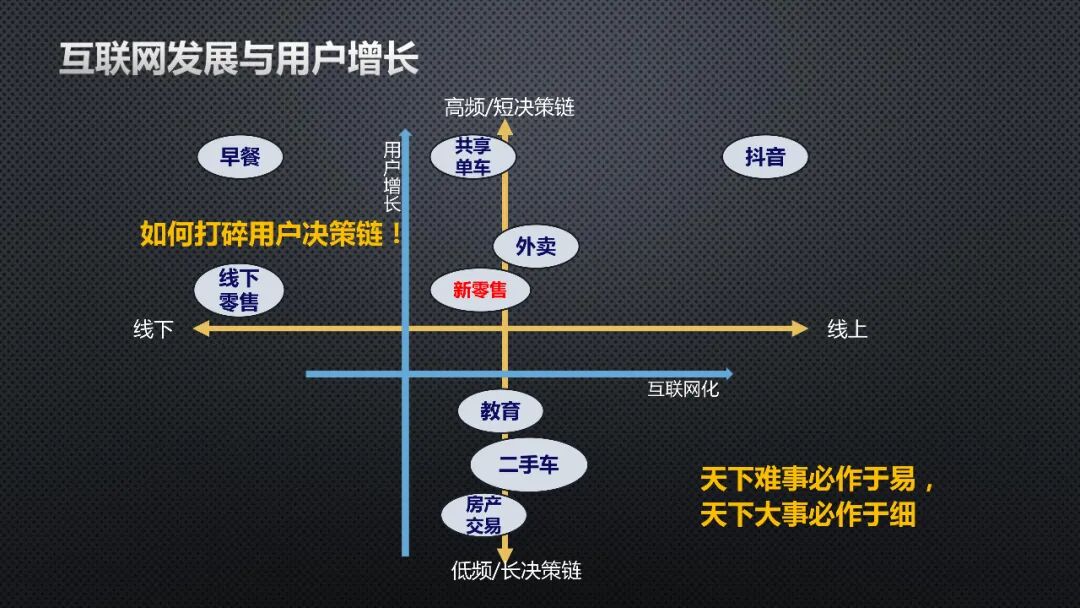
What's the relationship between internet development and user growth? The vertical axis runs from low-frequency/long decision chains at bottom to high-frequency/short decision chains at top. The horizontal axis is online to offline. Mapping common products looks like this. After the internet emerged, the left-to-right portion shows offline retail gradually becoming new retail. My user growth work moved bottom to top along the vertical axis. There are many low-frequency products; you want users higher frequency. Already high-frequency, you want even higher frequency. Moving along this axis, the core is guiding users through decisions one by one, all pointing toward one goal. The key is breaking decision chains into pieces. As the Tao Te Ching says: difficult things in the world must be done through what is easy; great things must be done through what is small.
Most entrepreneurs fall into several common misconceptions about growth.
First, when growth hits a wall, many want to hire a growth lead to fix it. This logic is wrong. When growth stalls, first analyze whether your product has problems. Is it a fake need? Is the difficulty lack of product-market fit (PMF)? Or is it simply not finding traffic right now? As CMO, CGO, or founder, you need to think this through yourself and plan what background your growth hire actually needs.
Second, many mistakenly equate growth acquisition with advertising spend. In reality, paid acquisition is just a small slice of user growth. Early on, perhaps that's the case. But later, it's more about data-driven iteration combining product and operations — about mechanisms and methodology working together.
Third, finding one person, building a growth team, having them own a growth target and "flat management" their way to resources is a massive cognitive error. Human nature is self-interested. Product people naturally want to demonstrate product team value. Everyone's friendly on the surface, but when decisions come, suddenly resources are tied up, no sprint capacity.
If you're the CEO or CMO, match growth talent to your strategic and business characteristics. Know what your business is, what's missing. If your product is somewhat weak, you need a growth lead stronger in product than you are — not someone purely business or analytics background. And growth mechanisms matter. Growth is mechanized work; its essence is trading testing redundancy for growth certainty.
Take genetic mutation: genes mutate massively, randomly. Mutations that aid survival are preserved, cycling onward. The underlying logic of user growth is the same — the more you test, the more certain your growth becomes.

As CEO, the most important work — and only you can do it — is designing the interface between your growth team and other teams. There are four models.
Model 1: An existing product, marketing, or operations team takes on user growth as a secondary role.
Model 2: A new user growth team is formed, but without a closed-loop product/R&D team; they coordinate resources from elsewhere as needed.
Model 3: A user growth team exists, with other functional teams assigning BPs (Business Partners) to growth using dual reporting — functionally to product, etc., but 100% dedicated to growth, with the growth lead having significant performance weight over these BPs. Product BPs, marketing BPs, etc.
Model 4: A fully self-contained user growth team with all needed functions internally. Facebook uses this hard closed-loop.
Model 4 is most efficient, but faces problems: if product functions are closed-looped and the company isn't large enough, that person's career development suffers. Most companies, balancing efficiency and feasibility, choose Model 3.
2 The Nature of Traffic
To understand traffic's essence, consider where it comes from. Simply: traffic is the attention we capture when our products, content, or services meet some user need. Users arrive, not necessarily converting, but their attention is here for a period. So traffic's essence is users' attention accounts — accounts you can deposit to and withdraw from. Traffic operations are attention account operations. In detail: if users come normally, you've acquired that traffic. If every visit is pleasant, building strong dependency and expectation, they'll return more willingly — like they've opened an attention account with you. We deposit value through product features, service, and content; occasional commercial monetization, advertising, leverages attention diffusion effects. Each monetization is a withdrawal; good products and services are deposits. But withdraw without depositing, and the account empties fast.
Ideally, good products always keep deposits ≥ withdrawals. So whether building private traffic or a traffic ecosystem, balance withdrawals and deposits. Only when deposit speed exceeds withdrawal speed does a virtuous cycle form.
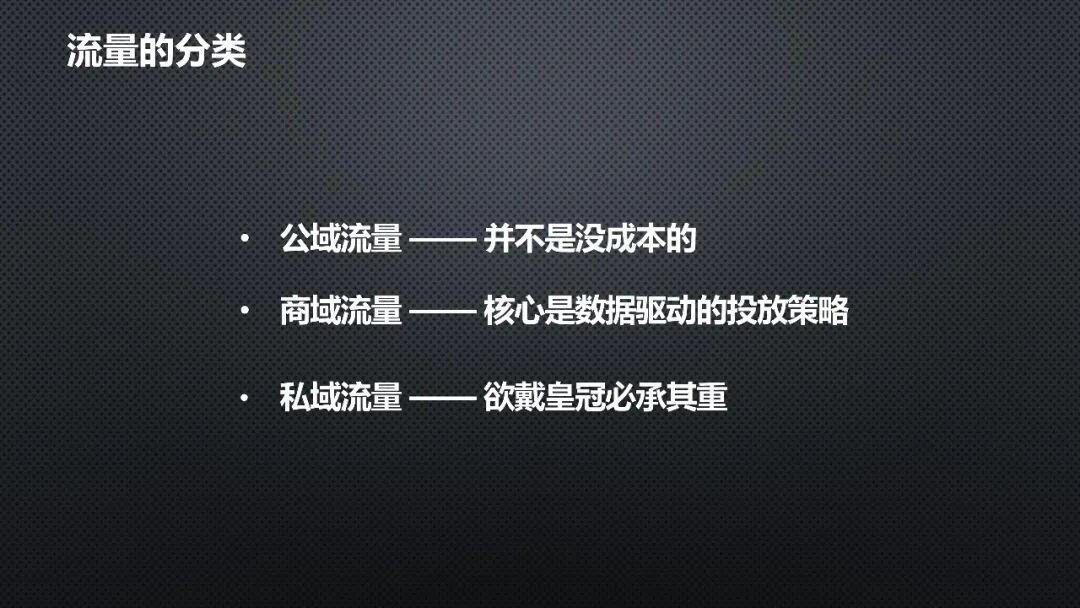
Traffic broadly divides into public domain, commercial domain, and private domain.
Posting good content on Douyin that gains traction through algorithmic recommendation — content production is our cost. Without paid placement, this is public domain traffic on Douyin's platform. But many overlook something: everyone asks if we can growth-hack free traffic. From our perspective, Douyin recommendation is public domain; but from Douyin's perspective, we're their private domain. If Douyin let you easily arbitrage their private domain into your public domain, that undermines their commercialization.
So acquiring any platform's public domain traffic has costs, sometimes substantial. Building followers on Douyin requires sustained content creation, and that content and team have costs. So public and private domain efforts carry high content and operations costs. Do the math carefully — sometimes it's cheaper to just buy commercial domain traffic. Which type to focus on should be an ROI-driven decision.
Chaojihuichuan and Ocean Engine are typical commercial domain traffic. Within Alibaba and ByteDance ecosystems, they build traffic through content and product services. Their services deposit into users' attention accounts; they withdraw occasionally through commercial monetization. Even as advertising, as long as it's not excessive, keeping withdrawal speed below deposit speed, it can work.
A major problem with commercial domain: many founders hire BD-background people to run it. Commercial domain's core strategy is data-driven. Negotiating lower prices through business development isn't reliable. The reliable path is making the model work through data — how to track, evaluate, calculate LTV and CAC (Customer Acquisition Cost) — all critical.
Early advertising focused on minimizing CPM, CPC, CPA. As ROI attention grew, we wanted higher LTV/CAC ratios. But at the CAC stage, user data tracking chains become increasingly difficult.
LTV is a long-term target. If a user's LTV spans two years, it's not operationally useful — the company may not exist in two years. Especially gaming companies, where product lifecycles run two years, three years, even six months. Here, regression analysis can reveal correlation between short-term and long-term indicators, producing an equation to predict long-term from short-term metrics. If weekly revenue predicts long-term well, just use 7-day revenue against CAC.
So the optimal commercial domain strategy is ELTV (Expected LTV) — calculating LTV expectation from short-term indicators, then comparing to acquisition cost to see if the model sustains. For channels, we can advertise across Ocean Engine, Guangdiantong, WeChat, Chaojihuichuan, using tracking systems to see which platform delivers higher ROI, dynamically adjusting, doing multi-platform arbitrage based on data.
Another approach: marginal cost and marginal ROI. Marginal traffic costs rise fast — first 100 users at ¥100, users 101–110 at ¥150. Measuring marginal requires strong BI testing support. Without that, blend channels including near-free viral referral channels, looking at blended CAC to guide strategy.
In short, as you scale, plan ahead and gradually build your optimal traffic acquisition matrix.
Private domain, to summarize: heavy is the head that wears the crown. Two years ago private domain was hot; why quieter now? Consider: private domain lives in apps, mini-programs, Douyin accounts, Baijiahao, Toutiao accounts. Whatever platform, you need content and operations teams — high-quality ones are expensive. Total costs jump; ROI may not beat commercial domain.
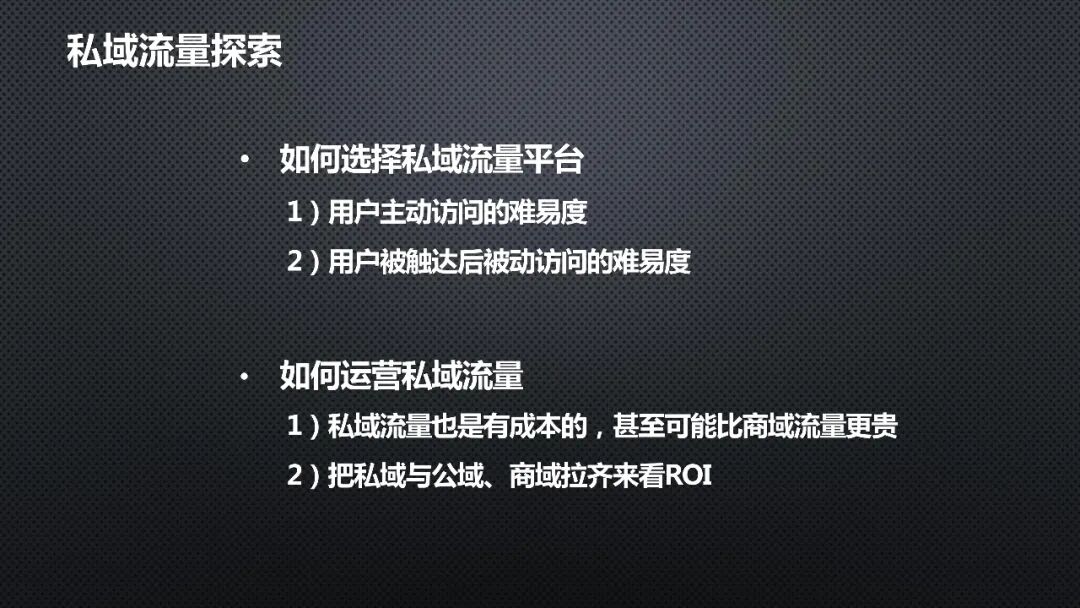
Two key points for private domain exploration. First, platform selection: consider ease of user-initiated access. An app gives maximum control — the only constraint is app store discovery. But Douyin accounts, WeChat official accounts, or mini-programs face restrictions or bans for rule violations. Second, after reaching users, how easy is access? If users don't open your app, how do you get them to? So consider: do you need active user-initiated access, or passive reach after establishing contact? If passive reach dominates, WeChat ecosystem official accounts and mini-programs may be optimal.
For startups, don't start with an app. Plan mini-programs, official accounts, and app as a matrix. Start with lighter mini-programs or official accounts for less committed users. Filter by need intensity, then develop a fuller-featured app, connecting mini-program and app for a tiered approach. Mini-programs and official accounts lower acquisition barriers versus app downloads; at appropriate moments, guide users to download the app for advanced features.
For private domain operations, still focus on sustainability and steady growth. Know your deposit methods — think deposit before withdrawal. But deposit costs are high, so creating user value matters. Spend heavily but deliver value, and traffic accumulates. Evaluate private, commercial, and public domain on equal ROI footing. Don't prejudge; test to see which delivers highest ROI.
3
Strategic Growth Planning
Here, defining conclusive targets matters. For startups, deploying limited resources effectively is critical. First, learn planning: what's your growth framework? Traffic system? Is conversion team in place? Prioritize traffic or service team?

Take online education: most models attract users to trial classes, then sales converts to full-price courses. This requires matching sales staff to traffic expectations. When traffic and sales capacity mismatch — a sudden traffic spike with no sales to handle it — acquired traffic is wasted. How to break this?
Address through growth experiment target calculation, incorporating sales labor costs rather than viewing acquisition cost in isolation. Shift from pure acquisition metrics to residual acquisition value after sales costs, giving more flexibility, ultimately seeing if incremental residual acquisition value is generated. This gives more elasticity in acquisition. Founders can build an integrated business-finance model for their industry to aid decisions. But this model typically can't be built by finance alone — best built by business people or founders themselves.
Beyond product details, technical implementation matters. Having done product and tech, I knew how to use low-cost methods for data filtering, achieving optimal balance between feature implementation and results. Without BI, product, and tech understanding, how would you?
Take my current company's user value growth product "Duozhangdian." Traditional supermarkets face pain from e-commerce and new retail competition: how to get users shopping more. We help supermarkets build user value growth products, with an industry-first performance-based pricing model — our founding intent.
From a growth perspective, only by delivering growth to supermarket clients can they sustainably generate greater revenue for us. We applied C-side growth experience, centralizing and cloud-enabling BI, product, and other dimensions into a black box simply callable by supermarket users. The critical piece: how operations tools decouple from and coordinate with data. This growth product requires growth people with more product background — hire BI or business background, and the problem won't be solved.

In summary: First, growth strategy must connect to company stage goals. In expansion, think how to spend via highest-ROI methods to accumulate maximum users. If funding confidence is low, focus on profit, prioritize损益最优 channels, tighten budgets.
Second, growth serves goals; growth and goals shift each stage, and growth teams must be flexible.
Third, if you hire growth people, judge whether their words match actions, and how they choose when personal interest conflicts.
Fourth, data-driven decisions: BI must deeply couple with business, not just write reports proving growth work.
4
How to Build a Growth Engine?
If building a growth team, it must understand diverse growth scenarios and add strategic planning per business conditions. In极限竞争 environments, can short-term growth targets be met? Need performance advertising for acquisition? What activation methods? How to plan referral/viral acquisition? For low-frequency products, what's your growth approach?
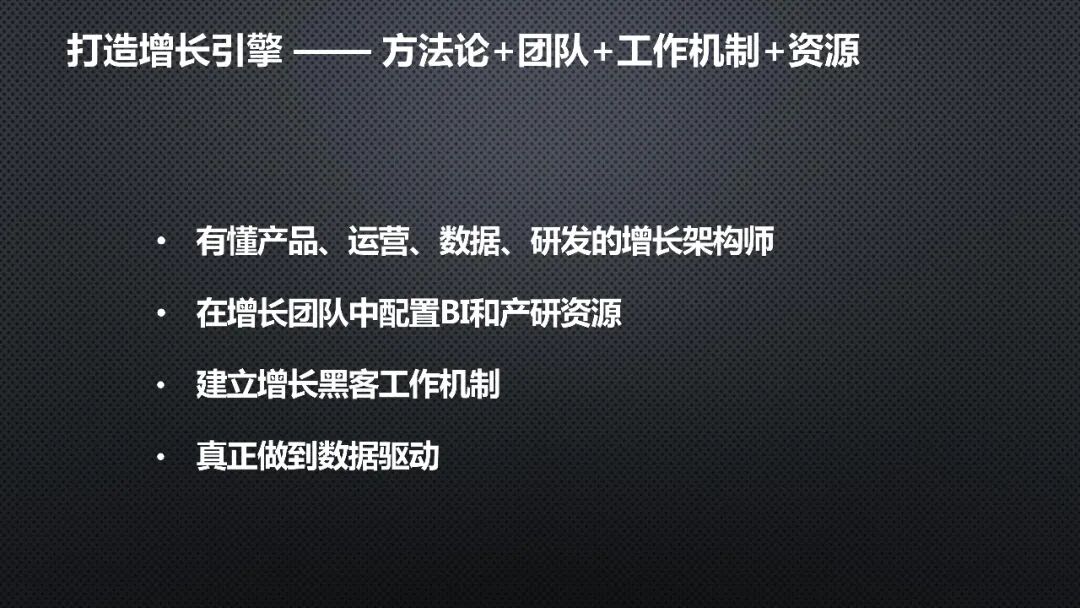
To achieve these, first master growth operations methodology, plus team working mechanisms and resources. You need growth architects who understand product, operations, data, and R&D — possibly your CGO or growth team lead. Not necessarily one person; could be multiple. But one person handling it is most efficient; two if not. More people, lower efficiency.
Second, configure BI and product/R&D resources in the growth team, either hard or soft closed-loop (BP model). If you make them coordinate product/R&D through big release cycles, this becomes nearly impossible — you need testing redundancy. Without properly allocated product/R&D resources, how can you test at scale and high frequency?
Third, establish growth hacking working mechanisms: rapidly form experiments to test, use scientific measurement to evaluate results. The familiar A/B test is one common measurement method.
Finally, be data-driven. Revenue targets often require modeling for projection. Different industries have unique aspects; not everyone can model. If you can't, at minimum get BI and finance teams involved, using reasonable data to guide correct decisions. Don't let data teams become tools for proving your work performance.
The above covers only portions of Hanqing Yang's live presentation. For more, we recommend his book User Growth on the Front Lines: Navigating User Operations in the Era of Stock Competition.