Code Brain | How to Align Corporate Business Strategy with Financial Strategy



At year-end, companies typically consolidate their finances and review cash flow. They use multidimensional financial data to assess how well they've met annual business targets, reflect on the past year's strategy, and adjust future direction. In the current environment, financial health is an especially visible lifeline for startups.
In early December, in Hangzhou, Code Brain invited Xu Wei — former CFO of Yonghui Superstores and founder of Caideide — to lead a custom year-end finance workshop. The session focused on financial strategy formulation and cash flow management for companies. Over 80 CEOs, CFOs, and finance leads from more than 30 MaHui companies attended.
Over the course of one day, Xu Wei used rich case studies and practical tools to show how startups can develop financial strategies suited to their situation; how financial strategy connects with business strategy; how to design expense reimbursement systems and management reports; and how to properly control cash flow and avoid risks.
This article is an edited excerpt from the workshop, focusing on aligning strategic goals with financial targets:

01 How to Align Strategic and Financial Goals
What happens when a company's business strategy and financial goals are misaligned?
Let's examine a negative case: a multinational coworking space provider headquartered in New York, founded in 2010. Its business strategy was rapid expansion and market share capture to become a global leader. The plan was to lease and fit out office spaces, then attract corporate and individual users with related services.
Its financial goal was profitability and investor returns, to be achieved through higher rents, expanded membership, and value-added services. As you can see, there was a clear conflict between strategy and financial targets. At the time, the business was in a high-growth phase. In the end, financial goals gave way to strategic goals — but what happened to the company?
1. Overexpansion: Driven by the rapid-growth strategy, the company entered multiple countries and cities within just a few years. This brought enormous operating costs — rent, fit-outs, employee benefits. But fierce market competition and failure to achieve timely profitability caused finances to deteriorate rapidly.
2. High debt burden: To fund rapid expansion, the company borrowed heavily and issued bonds. But when expected profits and cash flow failed to materialize, it couldn't service its debt, triggering a debt crisis.
3. Stock price collapse: Deteriorating finances and market concerns about the coworking industry sent the stock plummeting. This inflicted massive losses on investors and shareholders, and damaged the company's reputation and market position.
4. Layoffs and restructuring: To address financial distress and reset strategy, the company was ultimately forced into large-scale layoffs and restructuring. This caused job losses and uncertainty for employees, while weakening operational capacity and competitive strength.
So the question becomes: how can companies align business strategy with financial goals?
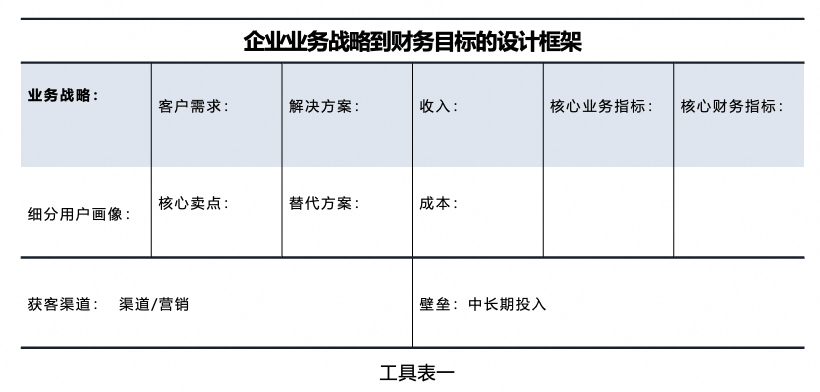
I'll share a tool framework — look at the table above from bottom to top: financial metrics are generated by business metrics; business metrics are generated by business actions; business actions are driven by business tactics; and tactics are determined by strategy. Therefore, aligning strategic and financial metrics is critical. Try filling out this table yourself to see whether your financial and strategic goals are truly in focus and properly connected.

02 Eliminate Costs That Don't Serve User Needs
When it comes to designing specific business and financial targets, let's look at two more cases.
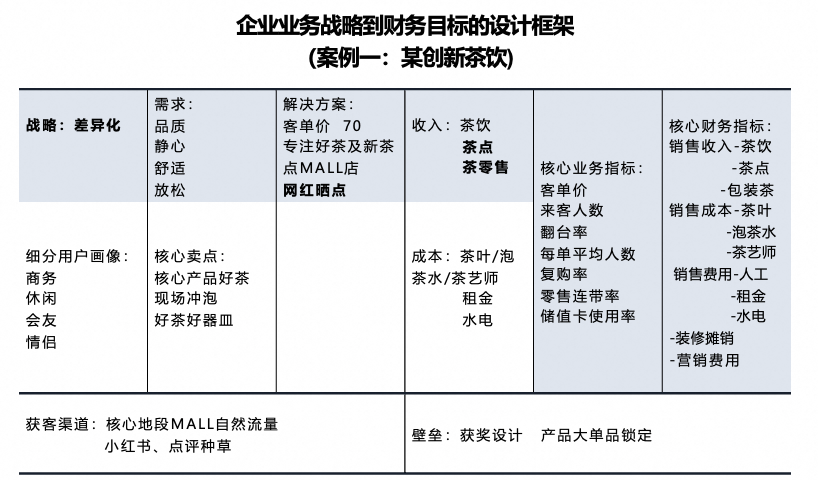
Here's an innovative tea brand — it doesn't sell milk tea, only pure tea, pursuing a differentiation strategy. For any company on a differentiation path, you'll typically see one particular cost or expense running high. How to handle this? My recommended approach: customer-validated ultra-high gross margin. Only when gross margin covers those higher costs can financial health be maintained.
This tea shop, for instance, had beautiful interiors and attractive tea artists as service staff. After years in finance, I knew immediately that decoration, rent, and labor costs had to be high. But its average ticket was also high — 70 yuan — because it offered tea ceremonies and a differentiated experiential setting. Beyond that, revenue came from tea snacks and packaged retail tea, supporting the entire business model.
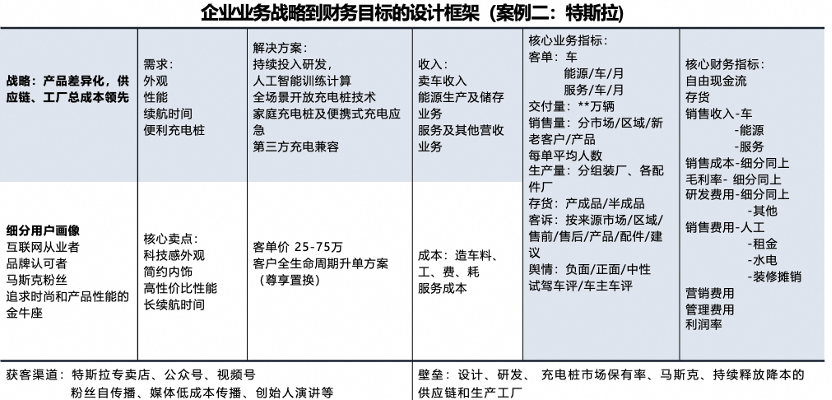
Now consider a company everyone knows — Tesla. Truly skilled players differentiate on what users value most in their minds, then layer cost leadership behind it. So Tesla's strategic direction is product differentiation plus overall cost leadership.
Look at the needs column — appearance, performance, range, convenient charging infrastructure. Each need corresponds to specific costs. But in reality, many companies have high costs that, on closer inspection, have nothing to do with user needs. Those costs represent ineffective actions.
Take a Chinese restaurant that offers shoe shining and nail services, but serves poorly tasting, poor-value set meals. This looks like differentiation, but it's actually无效成本 — costs that don't map to core customer needs. So company strategy and business model are both tied to financial metrics. Looking at financial numbers in isolation can feel meaningless, but putting strategy and financial data together reveals: some customer needs receive no investment, while other areas get heavy spending that doesn't actually serve customer needs. This requires company-wide alignment.
03 Financial Principles for Different Business Strategies
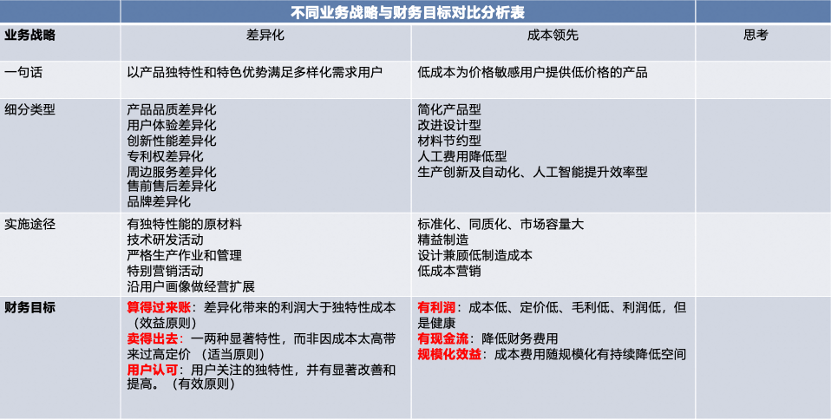
From a broader perspective, most companies choose between two strategic directions: differentiation or cost leadership. Differentiation means using product uniqueness and distinctive features to serve diverse user needs. But all differentiation comes with higher costs or capital investment across several dimensions:
First, product quality differentiation. R&D-driven brands are representative here, ensuring product quality and uniqueness.
Second, user experience differentiation. Five-star service means higher costs.
Third, innovative performance differentiation.
Fourth, patent differentiation. Owning patents that competitors lack means holding pricing power to some degree.
Fifth, peripheral service differentiation. Years ago, Haier differentiated on after-sales service with its "fastest repair" promise. Later, as appliance industry gross margins declined, service differentiation eroded net profit. The company eventually launched a premium brand — Casarte — to cover those high after-sales costs.
There are also pre-sales and after-sales differentiation, brand differentiation, and more. Under a differentiation strategy, financial targets should follow three principles:
First, the math has to work — differentiation profit must exceed uniqueness costs.
Second, it must sell — the product needs 1-2 clearly differentiated features. Too many features lead to excessive pricing, lower market share, and unsold inventory.
Third, users must recognize the value — they must appreciate the uniqueness with clear improvement. For a hot pot restaurant, customers come for hot pot; nail service is secondary. Get the hot pot right first, then add extras if you have capacity.
By contrast, when a company pursues cost leadership, it means providing low-priced products to price-sensitive users through low costs. With current consumption downgrading and shrinking markets, more companies are focusing on price-sensitive users — the largest segment. How to execute?
Simplify the product. Don't have too many SKUs; don't make services too complex. Perfect one product. Too many products drive labor costs, and when you're already pursuing low prices in a shrinking market, high costs make profitability harder. Improve design. Save on materials. This year the airline industry has struggled badly, but Spring Airlines was the only one to turn profitable. How? One factor: they only buy one aircraft model, minimizing maintenance and parts costs...
The core is this: focus on scaling growth while driving operating expenses, costs, and management fees as low as possible. So under cost leadership, financial metrics focus on three areas:
1. Profitability. Don't aim for maximum profit at this stage, but be profitable.
2. Cash flow. Capital costs are unsustainable — financial expenses are a major cost, minimize them.
3. Economies of scale. Have you looked at your management expenses at 100 million versus 1 billion in revenue? They should decline. If not, you're over-resourced.
So first clarify which business strategy your company is actually pursuing, then match the appropriate financial strategy.

04 Financial Data Can't Be Judged by Size Alone
Therefore, I keep emphasizing: when designing year-end targets, companies must carefully align every resource input with the need behind it. Resources aren't the problem — misdirected resources are. If spending aligns with all operational needs and core strategy, then spending is effective investment.
Because every action in operations corresponds to a cost, and every action corresponds to strategy, business, and customers. Align these relationships, and every dollar spent feels valuable. Without alignment, you can't judge whether money should be spent, or how much.
A simple example: last year costs were 8 million, this year only 5 million — is that saving? Last year 8 million, this year 10 million — is that waste?
Not necessarily.
We often use "comparison analysis" in finance — year-over-year, quarter-over-quarter, benchmarking against peers. But comparison analysis doesn't align with strategy. Once aligned, you'll see that financial data isn't purely about bigger or smaller — it's about strategy-to-finance correspondence, making it immediately clear which spending is justified.