Code Brain | How Do You Move Strategy from "Paper" to the Ground?

Many companies have adopted OKRs without truly understanding or effectively implementing them. Rather than becoming a lever and compass for strategic execution, they've devolved into a tepid performance evaluation tool.

At the end of every quarter or mid-year, most companies have a fixed ritual: gather executives and core team members for a strategy offsite to review progress against strategic goals and set targets for the next phase. Some particularly committed organizations even bring in external consultants. The output is usually a polished strategic plan that looks crystal clear on paper.
But here's the reality — for many companies, there's always a gap between strategy and execution. The plan looks beautiful, but the follow-through falls short. In today's market, when execution goes off track, the cost isn't just money; it's precious time. For many companies, that can mean life or death. How do you turn a "lofty" strategy into something actionable, executable, reviewable — something that actually guides teams to deliver results? It's an age-old question, and a persistent headache for founders. Everyone knows OKRs are supposed to solve this, but the problem is, many companies adopt OKRs without truly understanding or using them properly. Instead of becoming the engine for strategic execution, they devolve into yet another tepid performance review tool...
What follows is written by Huigang Tao, founder of Loho OKR, on how companies can use OKRs effectively to translate strategy into a goal management system that actually drives execution. (A quick note: Tao is himself a serial entrepreneur with a technical background, and serves as a strategic organizational advisor to multiple companies. He's particularly skilled at using OKRs for strategic decomposition. He once led a strategy execution workshop at Code Brain for Source Code Capital portfolio companies, which received excellent feedback.)
1
Strategy First, Battle Second — Making Sure Strategy Can Land
People often talk about "strategy," but many misunderstand the "strat" part of the word. Its first meaning is omission; only then does it mean approach.
In practice, this means you omit first — then, based on extremely limited objectives, you devise approaches and actions. Strategic thinking is active trade-off in the face of scarce resources. It's the advanced discipline of focusing limited resources on what matters most.
A strategy offsite shouldn't produce a forty-page plan or a dizzying array of strategic goals. Overly complex plans become impenetrable. Too many goals scatter finite resources, plunging the organization into the trap of egalitarianism — mediocrity and death.
Take a company Loho OKR once served. The founder had previously worked at a top-tier global strategy consultancy and now ran a tech company of several hundred people. He came to us because his strategy had failed to land for years, and he wanted an external diagnosis.
At our kickoff, we discovered the company had eleven strategic goals for that year alone — and the founder was convinced every single one was critical and non-negotiable. After we decomposed the company strategy using OKRs, he began to accept that the company simply didn't have the resources to support so many initiatives. In practice, our rule is: every OKR owner, every cycle, gets one, at most two OKRs — because during execution, good outcomes only come when you invest enough time and energy managing your stated goals, and our time and energy are finite.
This constraint forces the tension between unlimited ambition and limited resources into the open. Leaders either respect reality and make trade-offs, or they violate OKR principles and overload people with goals. The latter is usually why strategy fails to land and teams don't own results.
So under the OKR system, we require prioritizing strategy and focusing cyclically on a tiny number of strategic goals to set objectives, approaches, and action plans — enabling the entire organization to align its force at a single point.
A special note: For most companies, we don't recommend company-wide OKRs. OKR owners must be accountable for outcomes and results, whereas most employees can only be accountable for actions. Our recommended management structure: OKRs for business units and middle-to-upper management; PDCA for middle-to-lower levels, especially functional departments.

2
Translating Strategic Intent into Quantified Strategic Goals
Strategic intent is the qualitative description of a chosen strategy. It should be simple and easy to understand — ideally one sentence, one diagram. Complex intent intimidates people and makes it hard for subordinate departments to take ownership.
Strategic goals are the definition and quantification of that intent. Why translate intent into clearly defined, quantified goals? Because without definition, you get divergent interpretations. Without quantification, you can't measure. Without measurement, you can't manage.
For example: we often see strategies like "become number one in such-and-such region or industry." This is neither defined nor quantified — it's intent, not an executable goal. Number one by sales? Profit? User base? Something else?
Different "number ones" pull the organization in different directions. And "number one" itself isn't quantified. Without shared consensus, finite resources get wasted, the organization tears in different directions, and value creation and performance evaluation get misaligned.
So how do you translate qualitative intent into quantified goals, then into executable action plans?
We recommend OKRs, because OKRs are the best tool for strategic translation and goal cascading. Take the example above: if the strategic intent is "become number one in such-and-such China industry," that becomes the qualitative O (Objective) in your OKR. But in the OKR structure, we also need defined, quantified KRs (Key Results) that specify what this O means. For example:
- O: Become No. 1 in such-and-such China industry
- KR1: Sign XX enterprise clients with contracts over RMB 1 million. Weight: 80%
- KR2: Annual delivered order value of XXX. Weight: 20%
From this OKR, we see that enterprise client count (enterprise capability) and delivered order value (delivery capability) define "number one" for this company. Based on this definition, KR1 and KR2 become two clear, quantified strategic goals the company must achieve.

3
Using OKRs to Align with Strategic Goals
Completing strategy formulation doesn't guarantee good results, because business results = strategy × execution.
If we quantify strategy and execution numerically: strategy is either 1 (correct) or -1 (wrong) — it determines whether success is possible. Execution ranges from 0 to 100 — it determines how fast you succeed or fail.
The worst execution is 0. Weak execution dooms you regardless of strategy. The best execution is 100. Strong execution means even wrong strategies yield quick feedback and timely correction. In this sense, execution matters more than strategy.
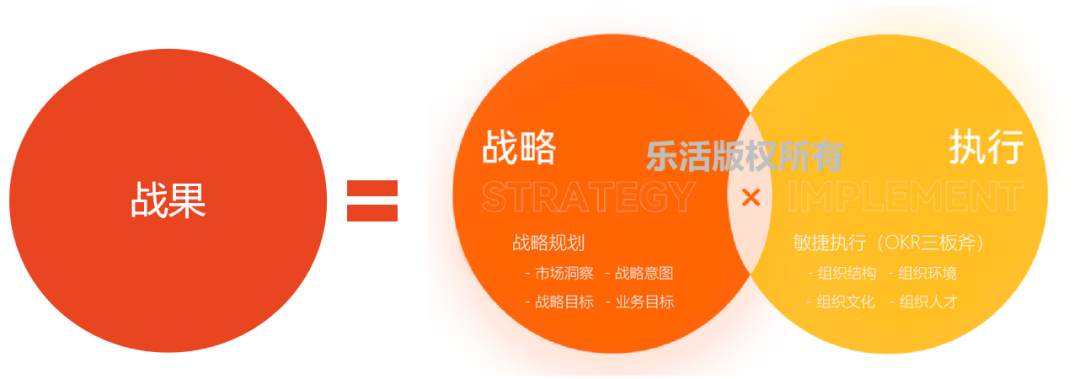
The most critical link in improving team execution is high-quality strategy decoding — setting departmental goals and ensuring all goals align with strategy. The clearer and more focused the goals, the stronger the execution, because:
- People always prioritize simple, clear goals and set aside complex, ambiguous ones
- When goals are ambiguous, departments interpret and execute them their own way. This doesn't create organizational alignment — it creates organizational tearing.
We recommend OKRs for strategy decoding because traditional approaches often fall into these traps:
First, reducing strategy decoding to a math problem of indicator decomposition — everyone "divvying up the pork" to claim targets. Second, tightly coupling goals with performance, stripping goals of their motivational power. When employees see goals as unreachable, they simply check out. Third, goals handed down entirely by superiors, or execution beginning before both sides reach consensus.
4
Leveraging Aspirational OKRs and Committed OKRs
To address these common pitfalls, our recommendations:
First, manage business goals differently based on business stage — no one-size-fits-all approach.
Business goals directly carry company strategy, so their formulation is a process of logical deduction, not simple indicator decomposition. The O-KR structure and upward alignment rules in OKRs ensure strategy is logically achievable. The relatively mature and stable parts can then be managed through simple indicator breakdown.
In the OKR system, we manage the logically deductive, challenging parts with "aspirational OKRs" and the mature, stable parts with "committed OKRs" — each with different management approaches.
Take a sales department. Here's an aspirational OKR structure:
- O: Improve sales team's enterprise account capability, achieve sales of XXX
- KR1: Mature products achieve sales of XX. Weight: 60%
- KR2: New products achieve sales to XX S- and A-tier enterprise accounts. Weight: 20%
- KR3: Develop and maintain enterprise relationships, sign XX alpha customers for products in development. Weight: 20%
As you can see, this OKR directly aligns with company strategy — it's not simple indicator decomposition. Here, the KRs don't sum to the O, but each KR supports the O. The benefit: it covers traditional sales work while better motivating sales to engage with and influence product R&D planning — taking a higher vantage point to help achieve strategic goals. Aspirational OKRs must include all collaborating departments in their creation, or limited perspectives will produce one-sided OKRs.
Here's a committed OKR structure:
- O: Mature products achieve sales of XXX
- KR1: North China region achieves sales of XXX
- KR2: East China region achieves sales of XXX
- KR3: South China region achieves sales of XXX
In this structure, KRs sum to the O or are strongly coupled with it. This applies where a mature sales system already exists. Sales target decomposition is more like arithmetic — slightly processing the higher-level number and distributing it downward. A critical warning: without an established business logic system behind it, committed OKR structure is a mirage. And that business logic system is precisely what's built during the aspirational OKR phase.
Second, separate the goal system from the operating indicator system
Traditional goal management systems typically tightly bind performance to goal completion rates. This works for committed OKRs because they're backed by mature methodology — resources invested and returns achieved can be scientifically measured. But when you directly tie aspirational OKRs to performance, people become demoralized by difficulty or uncertainty, and start blaming superiors for unachievable goals.
One of OKR's most important improvements over traditional systems is distinguishing the goal system from the operating indicator system.
— During the aspirational OKR phase, the goal system helps us find the path to success faster, to achieve better operating results (measured by operating indicators), and ultimately build a mature operating indicator system. So OKR owner performance is tied to the outcomes their OKRs produce (systems, processes, methods that create long-term organizational value) and improvements in operating indicators — not OKR completion rate. This design makes OKRs more than simple goal management; by involving stakeholders, it makes goals more motivating.
Note: The management consensus for making goals more motivating: Goal-driven = goal management + team collaboration + shared accountability
— During the committed OKR phase, the operating indicator system has been established through aspirational OKRs. Now we can set certain key operating indicators as goals and directly tie them to performance — essentially traditional KPIs.
Returning to the sales example: under aspirational OKRs, sales team performance links to operating indicators (sales) plus subjective scoring on aspirational KR implementation, affecting bonuses through coefficients or other mechanisms. Under committed OKRs, bonuses simply tie to sales.
Third, use OKR consensus meetings to build team alignment
We often see superiors writing out goals and numbers, then assigning them downward. This is deeply harmful — it strips goals of motivational power and robs subordinates of ownership and the courage to course-correct. People take responsibility for goals they helped create; they blame failure on unreasonable targets handed down from above.
Without thorough discussion and consensus, OKR drift is likely — wasting precious resources and preventing fair value assessment of OKR owners. Another pattern: OKRs created entirely by subordinates without upward alignment. This risks consuming scarce resources on goals misaligned with company strategy, harming both organization and individual.
The best solution to both problems is the OKR consensus meeting — ensuring through process and structure that OKRs are thoroughly discussed and agreed upon. Think of it as a pre-battle wargame based on logic and objective facts. It maximizes the probability of victory and minimizes unnecessary resource expenditure.
Source: Loho OKR WeChat Service Account | Author: Huigang Tao