Code Brain | How Should Startup Enterprises Do Strategic Management Well?

Strategy determines which battles you fight, and with what resources.


Entrepreneurship is an endless journey of self-cultivation. For core management teams, mastering the fundamentals of business operations and organizational management isn't just a required course — it directly determines how long and how far a company can go. In August 2022, Code Brain launched its "Management Fundamentals" series, designed to provide comprehensive management methods and practical tools that leaders could apply immediately, helping founders build their basic management capabilities. We identified three foundational and core management competencies for entrepreneurs — people, finance, and operations — breaking each down into sub-topics. This yielded ten thematic directions: personal leadership, talent assessment and selection, performance management, compensation and incentive design, business-finance integration, comprehensive budget management, goal management, and strategic management. Through rolling surveys, we continuously refined our approach to match entrepreneurs' real needs.
Ultimately, over the six-plus months from August 2022 to March 2023, the "Management Fundamentals" series ran one session every two months, with two themes per session and two days each time. In total, we delivered eight thematic courses covering personal leadership, talent assessment and selection, performance management, compensation and incentive design, business-finance integration, sales management, strategic management, and equity incentive design. The program reached four cities — Beijing, Shanghai, Shenzhen, and Hangzhou — covering 80+ companies and 650+ CEO and executive participants.
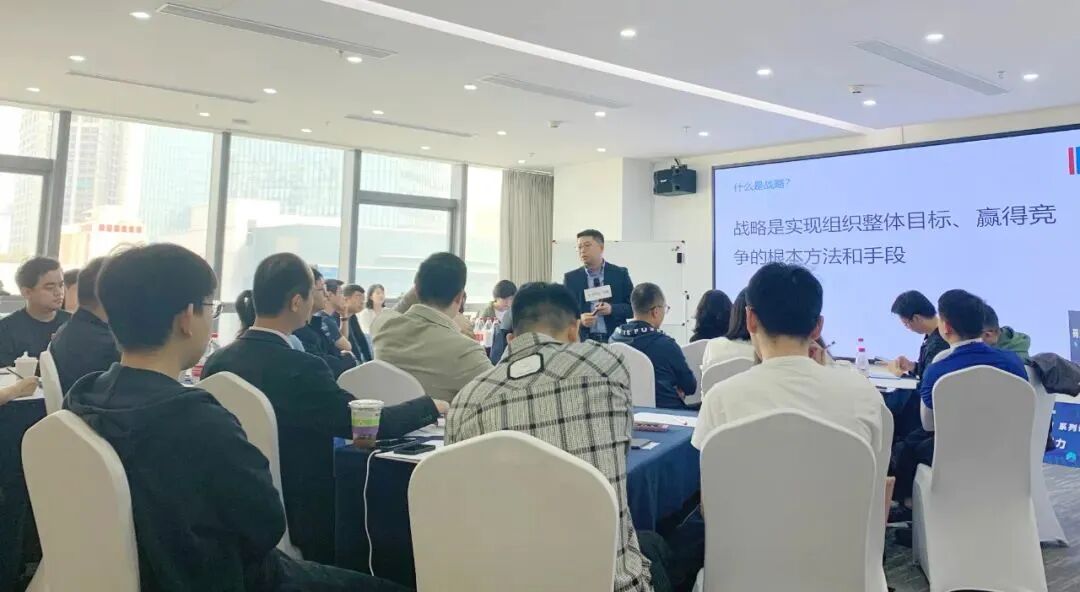
This final course in the series featured Wang Yue, founder of WayLeader consulting and author of The Three Rings of Strategy. Using concrete case studies, he spent a day with 20+ companies (both in-person and online) explaining how startups should approach strategic management.
Below are selected highlights from the course:
01 How Startup Teams Build Strategic Consensus
1. The Growth Dilemma for Startup Enterprises
Strategy must first be understood by those who execute it. Today, many companies don't lack strategy — they lack strategy that can be executed.
What are the pain points in startup growth?
First, choosing the wrong track.
Some people pick the wrong track from the start and only later realize their mistake. When a track's ceiling has dropped extremely low and market capacity is tiny, while it won't disappear immediately, you've chosen a small pond that's drying up. Sustained growth becomes a strategic question with no good answer.
Second, lacking strategy that can be firmly executed.
Even the smallest companies have no shortage of grand strategy. Yet those that actually monetize and drive operating performance growth are few and far between. Most founders, looking back two or three years later, feel like strangers to the strategies they once wrote.
Third, failure to sustain technological innovation.
We're in a technology era where every industry has been rewritten by digitalization. With demands to both improve efficiency and achieve sustained innovation, growth depends heavily on technological power.
Fourth, inability to scale product-market combinations.
This is what most Series A companies struggle with most. We've all heard miraculous stories of 3-5 years of doubling year after year, but this exponential growth only happens in certain tracks under specific market conditions. For most other tracks, it's an unrealistic expectation. If a company can maintain 35%+ compound annual growth for 3-5 years, that meets the general definition of high growth. For startups, you must force yourself to subtract and focus, quickly finding product-market fit to achieve operating cash flow, revenue, and gross profit — only then can you enter the next development stage.
Fifth, teams that don't deliver, talent that can't keep up, incentives that miss the mark.
By Series C, many founders' biggest pain point is knowing something can be done while the team simply can't execute. Or having a product with hit potential, but because incentives are off, finding no one to run it. Many founders think equity incentives work well, but often the incentivized party doesn't actually see it as incentive — rendering it ineffective.
Sixth, inability to raise capital.
Entrepreneurship requires two wings: technology, and the ability to dance with capital. You need both.
Seventh, the founder's drive, evolution capability, and leadership.
In rapid growth, the hard part is maintaining ambition. Once someone becomes content with modest success, growth slows. Next is evolution capability. If you came from a major tech firm and can't shed the halo or reset to zero, you'll lose to grassroots competitors. Finally, leadership — strategy's ultimate test for founders. You must be forward-looking, perceptive, and constantly influence those around you to build a culture of "dare to dream, dare to act, dare to win."
2. What Is Strategy?
At the early startup stage, your strategy must tell everyone how to achieve growth.
The reasons we start companies are limited. First, targeting industries with future trends. When others are willing to invest, three scenarios apply:
First, it's a track they want to invest in, and the founder is basically credible — they'll invest;
Second, you're a serial entrepreneur with prior success — they'll bet on you;
Third, you have something exceptional: outstanding technology or a great idea. But this phase is brief. Once the bet is placed, you must deliver. The only proof of delivery is paying customers. Then it's about revenue generation.
For example, we once helped a tech company with strategic planning. After more than a decade, profits never materialized, user growth stagnated, and many areas shrank. Built on various halos and endorsements, it was now being pushed to IPO by investors — likely with substantial post-IPO valuation decline. Though going public, the founder felt deeply disheartened.
Founders seeking commercialization scenarios and paths to scale must force themselves to focus on driving sales revenue.
What is strategy? Strategy is the fundamental method and means for achieving organizational goals and winning competition.
The key word here is "organizational" — shared consensus on goals across the entire company. Try asking people in your company what's most important to them. Everyone has their own turf; not everyone shares the founder's big-picture view. Founders pursue organizational goals. Without consensus, you've merely proposed a grand slogan.
Moreover, "strategy" derives from military science — the art of war, the fundamental method of fighting. To win wars, the key is "winning." In strategic implementation, we need fighting spirit and focus on key competitors. Approach business with humility. When formulating company strategy, first communicate that we face fierce competition. Then we must eliminate or surpass comparable competitors to stand out.
Many are self-deluding, not studying competitors or even knowing who they are. Every industry is hyper-competitive now; outside monopolies, it's cutthroat competition. So startup strategy must aim to help you win.
Strategy is fundamental method and means.
When Jack Ma started Alibaba, the company created Singles Day to change consumer habits. Singles Day was strategy — the top-level initiative. Later events like 618 were growth tactics and reactive responses.
Strategy demands extremely high cognitive capability. Get one critical point right, and everything wins; get one wrong, and total failure is possible.
3. Pain Points in Corporate Strategy
First, poor strategic planning quality.
We should prevent problems before they arise. Many companies lack strategic planning, and the starting quality itself is low. If founders have no strategy or strategic management experience, neither employees nor investors will be convinced.
Second, "one-person" strategy.
Even small companies leave people unclear about what the leader is thinking. When companies grow quickly, two traditional approaches to strategy emerge: hiring consulting firms to write PowerPoints, or one person deciding unilaterally and acting on gut instinct without any consensus-building.
Third, the relationship between strategy and business model.
In recent years, Chinese business models were somewhat demonized, with belief in "wool from the pig's back." Strategy is going to Beijing; business model is your operational design — the different ways to get to Beijing. The business model is part of strategy, but don't reverse priority, or you'll start believing "the model changes everything."
Fourth, strategy that's hard to execute.
You should design for executability.
Fifth, how to measure strategic execution. What can't be described can't be measured; what can't be measured can't be managed.
Sixth, the leader's role.
What's your decision-making mechanism? Who calls the shots? When strategy cascades, what's the state of all middle managers? Who's in this with you as a fellow entrepreneur? In this process, rethink and reshape the employee mindset.
4. Correctly Understanding Strategic Levels and Focus Points
Strategy is about doing the right things at different stages and time points. The world's most complex enterprises are non-related diversified global organizations. For these, strategy focuses on portfolio composition. For more related diversified conglomerates, strategy focuses on horizontal and vertical development across the value chain, and ecosystem/platform building. For single-business companies, strategy should focus on product-market combinations. Startups as SMEs fall into this last category.
02 How Strategy Effectively Decomposes into Execution
Strategy is a system with three interlocking components: strategic planning, strategy decoding, and strategic execution.
1. Strategic Planning
If a company undertakes strategic planning, the starting point of thinking determines organizational character, even DNA.
The first principle of enterprise existence is creating value for customers. Don't arrogantly claim you can create demand. First see if customers exist, understanding their pain points and latent needs. All customer needs combined form your market. Customer needs are the cake of entrepreneurship; we must analyze cake quality and how to compete for slices.
Strategy operates in cycles and requires staged goals. This differs from vision, which can be purely aspirational, while staged goals are brutally realistic. Actually, the hardest part is setting staged goals — they can't be too distant. Typically, people set three-year staged goals. The essence of planning is finding commercial opportunity. Strategic planning must answer several key questions: How to conduct market and customer insight? How to build competitive advantage? How to design business model? How to set staged goals?
2. Strategy Decoding
What is strategy decoding? Simply put, it's the process of clarifying strategic paths and key initiatives based on company development goals, identifying battles the company must win and describing them clearly, then translating them into concrete actions. Strategy decoding is the effective tool for "turning strategy into action."
After front-end analysis and target locking, three-year strategic priorities can be established, with one-year work clarified, action plans specified, and owners assigned.
In strategy implementation, avoid three disconnected layers: strategy, budget, and performance management (KPI or OKR). Always put strategy first — strategy determines what battles you fight and with what resources; budget aligns immediately. In the process, set performance metrics for key people.
Two criteria distinguish quality strategy decoding: first, shared fighting spirit — everyone's combat desire is mobilized; second, strategic tasks assigned to people — everyone clearly understands their role in battle and what outputs support victory.
Strategic priorities are decisive strategic tasks, critical to whether overall strategic goals can be achieved. To reach strategic goals, three-year priorities must be clarified.
Then identify the coming year's must-win battles. Strategy is like rock climbing — the route looks beautiful, yet many companies falter in year one and drift increasingly off course. Thus, year one is crucial.
If year one fails, team fighting desire drops significantly. Market opportunity windows are fleeting, and competitors won't give you chances — they're waiting for your mistakes. For founders, this means pushing yourself and everyone hard. After year one ends, everything changes — morale surges. This is why past entrepreneurs succeeded: "the power of believing in belief."
Action decomposition and performance commitment: To decompose action plans, break things down further — specifically what to do. In military terms: three major campaigns, each with specific battles, each with critical points. To decompose action plans for a must-win battle, first describe what battle this is, with quantifiable targets. Then identify key actions — timing, metrics, owners.
3. Strategic Execution
The final loop is execution, which tests organization, talent, atmosphere, and culture.
When people hear "organization," 90% think of structure. But structure is a result — the part of deployment most conducive to running your business. Many first-time bosses copy competitors, mostly conventional thinking. After struggling, they realize they created fake business units that don't work. Midea Group started with naked product business units — given six months to form, fail to hit revenue targets, and you're immediately dissolved. So organizational development must follow the "from strategy to organization" principle in design.
Second, organizations need people — the right people. When people come together, cultural issues arise: either old-new integration or groups banding together. Beyond conventional equity incentives, see if cultural values are injected to create cohesion — forming a cycle.
Finally, organizational climate — how people feel working in an environment — directly affects performance. Founder leadership style decisively shapes organizational climate, which directly relates to organizational effectiveness.
Summary
Battles require courage, campaigns require wisdom, and long wars require vision. Founders must maintain clear granularity. Simultaneously, organization, talent, atmosphere, and culture must align with strategy. In startups, because companies are small, everyone charges outward actively but may neglect internal coordination. So don't wait until departmental walls have grown before addressing them. To maintain organizational vitality, like a pond needing flowing water to prevent stagnation, you must both bring people in and actively淘汰 underperformers.
Today isn't about giving you fish, but teaching you to fish. Following rigorous steps and logic, you can derive what strategic content fits your current stage, build consensus around it, and truly achieve precise, clear decomposition — connecting those three layers.
Strategy requires management, and it's mobile warfare.
Strategic resolve is relative, not fixed.
In the historical drama The Long River of the World, Emperor Kangxi governed with three must-win battles posted in his sleeping quarters: first, eliminating feudal princes to remove internal rebellion risk; second, taming the Yellow River for people's welfare; third, Grand Canal transport to secure supply chains. After eliminating the princes, he replaced it with recovering Taiwan.
As founder, always grasp the big picture while letting go of small details, remembering the three most important things for three years and for year one, keeping yourself highly focused.
Having strategy doesn't guarantee success, but lacking it guarantees failure. First figure out your three-year path, go all-in on revenue — that's my advice to you all.