Code Brain | How Should Startups Manage Cash Flow Properly?

8 Recommendations for Financial Management at High-Growth Companies


At year-end, companies typically consolidate finances and audit cash flow. They use multidimensional financial data to review annual business targets, reflect on the past year's strategy, and adjust future direction. In the current environment, financial health is an especially visible lifeline for startups.
In early December, in Hangzhou, Code Brain invited Xu Wei — former CFO of Yonghui Superstores and founder of Caidede — to lead a customized year-end finance course. The session focused on financial strategy and cash flow management, drawing more than 80 CEOs, CFOs, and finance leads from over 30 MaHui portfolio companies.
Over the course of a day, Xu Wei used rich case studies and practical tools to address how startups should craft financial strategy based on their circumstances; how financial and business strategy should align; how to design expense reimbursement and management reporting systems; and how to manage cash flow and mitigate risk...
What follows is an edited excerpt from the course, focusing on financial management strategies at different company stages and cash flow security:
01
Financial Management Strategies for Different Stages
At different stages of development, companies face different financial priorities. But many struggle because their various business lines are at different stages — one financial playbook can't cover everything.
Early-stage businesses are always messy and hard to control. High-growth companies change daily, with urgent payment requests constantly coming through. Only mature, stable operations are relatively manageable. The reality is that most business lines tend to be in startup or growth mode.
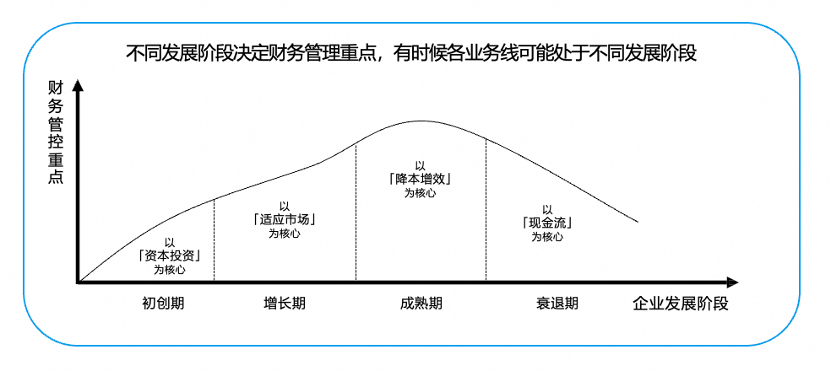
In financial terms: early-stage companies resemble investment vehicles. Financial control mainly means monitoring data during the "investment" process, conducting post-investment reviews, and using those reviews to determine whether the model is ready to advance to a growth phase. For growth-stage companies, the priority is adapting to the market. When explosive growth opportunities appear, finance needs to move with the market — capital and financial management require flexibility, not rigidity. For mature companies, the core is cost efficiency and refined operations. Most companies don't do refined operations when chasing market opportunities; they only control basic actions. Micromanaging too much often hinders execution.
We often joke: to tell what stage a company is in, just look at which department head holds their chin highest. At startups, it's usually R&D — they always feel like "the world depends on me to carve out something new." In high-growth companies, sales definitely has its chin up highest; most companies at this stage are sales-driven. When a company enters a stable phase, mid- and back-office leaders gradually gain voice, because the business has patterns that can be managed with precision.
But always remember: all financial results are determined by business management actions. High-growth companies are mostly sales-driven, and sales-driven models have several key indicators:
1. Rapid accounts receivable growth. AR management isn't about managing the receivables themselves — it's about managing credit. Receivables are just an outcome.
2. Rapid inventory growth.
3. Rapid prepayment growth. Most companies here today are or will become high-growth businesses. Let me share a few important reminders:
1. At this stage, focus on controlling "sunny day" development risks, because revenue easily masks everything.
2. Watch total AR scale. If revenue doubles but AR triples, what does that prove? Either delivery has problems, or AR management has problems, or credit has problems.
3. Don't treat customer prepayments as profit. Prepayments aren't profit — they're liabilities. Once a run happens, it's trouble.
4. Control prepayment timing against delivery and invoicing.
5. Deploy capital flexibly according to business changes.
-
At scale, management expense ratio and operating expense ratio should trend downward over time through improving operational efficiency. If they don't, organizational capability hasn't kept up and processes are bloated.
-
Maintain at least 24 months of safe cash flow for self-operated models; at least 12 months for franchise or distributor/agent-funded models.
02
Four Essentials for Effective Cash Flow Control

Cash flow is a major concern and headache for many startups, especially given this year's market environment, which demands a lot from company cash positions. How to control cash flow effectively? Four suggestions:
First, cash flow forecasting. The hardest thing for high-growth companies is prediction. I recommend dynamic forecasting — project cash inflows and outflows 3 to 6 months ahead. Most problems can be resolved within a six-month window. If projected inflows exceed outflows, you can plan capital management moves early. If outflows exceed inflows and fall below your safety threshold, seek funding early.
Second, cash flow alerts. When finance sees cash fall below the safety balance, warn the founder early. Finance may not make the business more successful, but it can make it more resilient.
Third, cash flow reporting. Tailor this to your business. B2B companies can manage cash flow weekly; B2C needs daily cash reports; B2G companies have relatively stable cash flow and can use longer cycles.
Fourth, safety cash balance. For startups, I recommend keeping enough cash to cover one R&D cycle. High-growth companies are more complex — generally prepare 12-24 months of safety cash. But if you're in an industry consolidation phase, capital needs increase. Different strategies require different capital levels, but generally keep at least 12 months.
I hope all of you will audit your company's cash flow from these four dimensions when you return. At minimum, know where you stand, then prescribe the right remedy. Don't panic, but don't be careless either. Cash flow is financial data you need to watch long-term, now and in the future.
03
The Prerequisite for Business-Finance Integration Is Data Connectivity
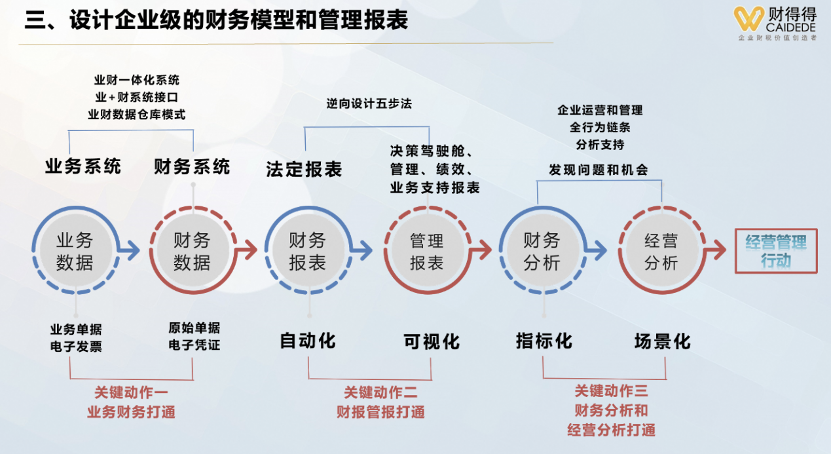
Many companies talk about business-finance integration, but for any company, building and implementing a financial model must first solve the problem of connecting business and financial data.
What finance fears most is business running one system, finance running another, with no standardized interface. Typically, companies have multiple business systems — some self-built, some third-party — then a separate financial system, a separate OA system... The result is disconnected data, barely held together by countless Excel spreadsheets. So the first step toward efficient collaboration is connecting the data.
Next, connecting financial statements with management reports — this is step two after data connectivity.
As finance professionals in your companies, have you asked founders "what data do you need to make decisions"? Have you asked business colleagues "what data do you need for business analysis"? Excellent finance professionals should initiate these conversations.
When designing enterprise-level financial reports, first solve the data source question. Let's look at this case to see where report data comes from.
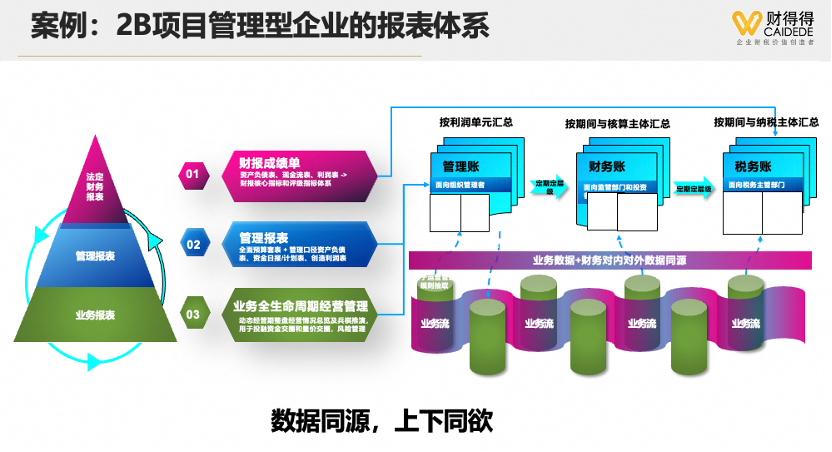
This is a B2B company. As you can see, finance keeps three sets of books: management accounts, financial accounts, and tax accounts. Management accounts are the most granular. The prerequisite for good management reporting is solid business data, with business and financial data connected in the backend.
Business data comes from project management, so the smallest unit for capturing business data is the project. If you haven't been exposed to the business side, my suggestion is to embed yourself in a small project — one project is your smallest accounting unit. Run through a project once and you'll basically understand how the accounting works. First understand the business, then management reporting becomes clear, and financial reporting naturally follows.
Finance leads often tell me: I produce 100 financial reports a month, but nobody in the company reads them — not even the CEO.
Ask yourself: why is nobody reading? Because financial analysis isn't connected to business needs. Some managers simply don't like tables, they're numb to numbers. In that case, finance can convert data to charts, visualize it, or distill findings into text...
Constantly remind yourselves: the ultimate purpose of your financial analysis is to be useful to the company, to help managers translate it into management action. So financial analysis must be combined with business analysis.

04
How to Design Management Reports That CEOs Actually Understand
On management reports: same data source, shared purpose — that's the basic logic. I have a five-step method for management report design:
Step one: who is the audience? What's the header?
Management reports need user thinking. One company's finance team was particularly good — after designing their management report, they went one step further: they tracked how many people viewed it. If nobody looked, they investigated why. This user interaction is excellent for ensuring effective data circulation.
Step two: where does the data come from?
Establish company-wide unified data extraction rules and口径. Extraction rules must be standardized.
Step three: what to look at? what to do?
Many people don't know what to look at in reports. Many high-growth founders just look at the P&L. But many key indicators need attention and must translate into daily management actions.
Step four: what gets discussed in meetings? what gets tracked?
The most core company meeting is the business review. Issues needing CEO support or cross-functional discussion go to this meeting, and resolutions must be tracked — including timelines, owners, and completion dates.
Step five: what gets measured? what gets iterated?
Measure key driver indicators — not too many.
And the single most important management report is the "Decision Cockpit Report" for the founder — presenting core business indicators at a glance, so the founder knows exactly which key data must be monitored.
Below is a sample for reference; each company can recombine based on their own business.

1. Budget management overview. Mainly sales, gross profit, profit margin budget completion rates, year-over-year, month-over-month, and benchmark comparisons. For high-growth companies, month-over-month usually deserves more attention.
2. Cash flow overview. Every company needs to watch this. When finance looks at data, don't just compare magnitudes — provide standard values, warning values, and safety values.
3. R&D overview.
4. Market and customer overview. Markets can be segmented into mature, emerging, and validation markets; customers into existing, new, and high-value — each requiring different maintenance approaches.
5. People efficiency overview. Don't just look at business team efficiency; management efficiency matters too — sometimes management costs are substantial.
6. Accounts receivable overview.
The power of this report is that it connects all business and financial data. Its greatest value: each company can gather the most critical business-finance indicators for their current strategy and situation onto one page, letting decision-makers see priorities, focus on what matters, and provide rational data support for business adjustments.