Code Brain | Integrated Business-Finance Operations, Achieving a Unified Internal Data Language

#Code Brain — Ecosystem Connection, Cognitive Resonance
Entrepreneurship is an endless journey of self-cultivation. The solidity of one's fundamentals directly determines how far a company can go. Under the pandemic, startups' weaknesses and blind spots in business operations and organizational management were laid bare, making management fundamentals a critical test and mandatory course for core leadership teams.
Therefore, in the second half of 2022, Code Brain launched the "Management Fundamentals" series, targeting three foundational yet core management capabilities for founders — people, finance, and operations — with ten themes including personal leadership, talent identification, performance management, compensation and incentive design, high-performance teams, goal management, and business-finance integration. The series provides comprehensive basic management methods and practical, ready-to-use tools, enabling leaders to learn and apply immediately, helping elevate founders' fundamental management cognition and capabilities.
Starting in August 2022, the "Management Fundamentals" series ran on a schedule of once every two months, with two sessions each time. In the December session on "Business-Finance Integration," we specially invited Xu Wei, former CFO of Yonghui Superstores and founder of Caidede, to lecture on top-level financial model design for startups, financial organization building, and business-finance integration process system construction. Over 80 CEOs and executives from 35 companies in the MaHui ecosystem participated in the one-day online program.
The following content is selected from the classroom:
01
Company Financial Management Self-Assessment
The self-assessment is divided into three parts.
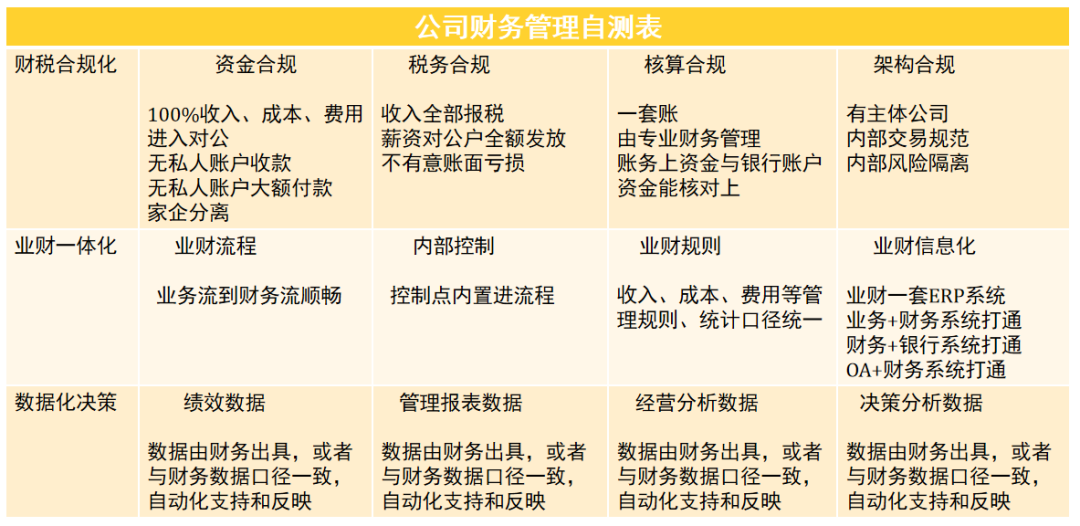
1.1 Tax and Regulatory Compliance
Four areas of compliance must be achieved:
- Capital compliance. 100% of revenue, costs, and expenses must go through corporate accounts — no private account collections, no large private account payments, complete separation of household and business finances. This is especially critical for companies planning an IPO. During IPO audits, capital reviews are particularly stringent.
- Tax compliance. All revenue must be reported for tax purposes; salaries must be paid in full through corporate accounts; do not intentionally show book losses. Tax regulation will only become stricter going forward. The good news is that preferential tax policies continue to emerge, which benefits compliant enterprises.
- Accounting compliance. Maintain a single set of books under professional financial management, with book balances reconcilable to bank account balances.
- Structural compliance. Have a principal company with standardized internal transfer pricing and internal transactions. Do not arbitrarily use transfer pricing between different companies under common control to manipulate tax burdens. Appropriately isolate internal and external risks at the structural level to avoid pitfalls in a future IPO.
1.2 Business-Finance Integration
Business-finance integration encompasses four dimensions:
- Business-finance processes. When designing processes, don't forget the financial flow — ensure smooth flow from business operations to financial operations.
- Internal controls. Build financial control points into processes upfront, so compliance happens as business occurs, avoiding the cost of secondary internal controls.
- Business-finance rules. Unified management rules and statistical口径 for revenue, costs, expenses, etc. Under the same roof, speak the same data language.
- Business-finance informatization. Current accounting is basically done through information systems, with financial data sourced from business systems. Without connecting financial and business systems, integration is impossible. Similarly, without connecting financial systems to banking systems or OA systems, companies will suffer greatly as they scale — slow data acquisition, difficult reconciliation, and high management costs.
1.3 Data-Driven Decision Making
Once data is connected, the greatest benefit is that finance can produce unified reports, or data consistent with financial口径, that can automatically support and reflect performance data, management reports, operational analysis, and decision analysis.
Through data analysis, discover and solve problems; identify opportunities and help the business capture them.
In companies with strong financial management, when business happens, they already know the financial impact.
Whether conducting external due diligence or IPO audits, what people see is financial data — so you must understand the connection between financial data and business actions.
02
Business-Finance Integration Panorama
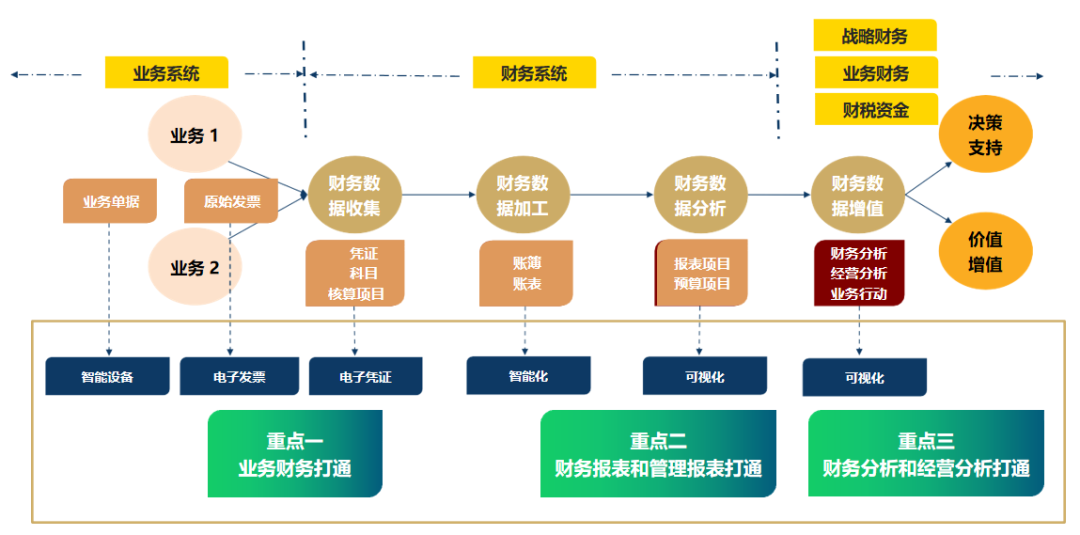
If financial management is done well, you can know the financial result when business happens, because financial data is business data.
The path from business data to financial data involves accounting processing that transforms business data into a universal language that external auditors or due diligence can understand — the so-called accounting statements. Some financial data can serve as analytical indicators.
Combined with operational analysis, this can form actionable guidance for business, supporting rapid decision-making and value creation.
There are now many efficient methods and tools to assist with accounting. In the future, all transactional work will become electronic; paper will disappear. Data will remain, but for some companies, its generation, circulation, and application are fragmented — data between systems will show discrepancies and require "connection."
The business-finance integration panorama has three focal points:
- Business and finance connection
- Financial statements and management reports connection
- Financial analysis and operational analysis connection
03
Business-Finance Integration
3.1 Company-Level Financial Model Design
① Starbucks vs. Luckin Coffee
In the financial models of Starbucks and Luckin Coffee, the per-cup financial model can basically be used to validate the company's financial model because coffee accounts for a relatively high proportion of their product mix, with other categories like merchandise and snacks representing a smaller share.
However, a company's financial model will show changing data at different stages under different business and management strategies.
First, let's look at Starbucks in 2019.
Starbucks has multiple products, with a weighted average price of approximately 32 RMB per cup.
- Material costs refer to coffee bean costs;
- Gross profit means price minus material costs;
- Gross profit divided by price equals gross margin.
- For physical coffee chains, a gross margin of 60% or higher doesn't mean much, because substantial costs aren't included in gross margin — such as rent, utilities, labor, and other operating expenses.
- Starbucks' marketing expenses are low because its store locations are its best marketing.
- Correspondingly, Starbucks' operating expenses run high. High-traffic locations bring high rent costs; refined décor increases fit-out costs; emphasizing "barista culture" leads to higher labor costs alongside higher product prices; many customers buy Starbucks coffee to "do business" there, so the social/business meeting attribute increases floor area, which again raises rent and labor costs. Additionally, hardware like espresso machines isn't cheap — after deducting residual value over useful life, depreciation is amortized monthly.
- Administrative expenses refer to back-office HR, finance, general manager costs, etc.
After deducting taxes and other items, profit per cup is approximately 6 RMB.
Now look at Luckin Coffee in 2019.
Early Luckin attracted customers through low prices, but with small scale, supply chain costs couldn't come down, so material costs were high — 6.1 RMB in materials for a 9.7 RMB cup of coffee.
Operating expenses started high then decreased. During early expansion, there was an industry rumor that if you knew where Luckin wanted to open a store, you could lease it first and sublease to Luckin at double the rent for easy profit. After the initial crazy expansion and advertising effects subsided, Luckin's stores gradually shrank, repositioning as "delivery coffee" with much lower rent and staffing needs than Starbucks.
Similarly, at smaller scale, coffee machines and other hardware hadn't achieved procurement advantages of scale, so depreciation was also higher.
Meanwhile, heavy investment in the technology team meant administrative expenses were very high as well.
But after deducting all the above and taxes, the cost per cup was 14.87 RMB — losing 7.9 RMB on every cup sold.
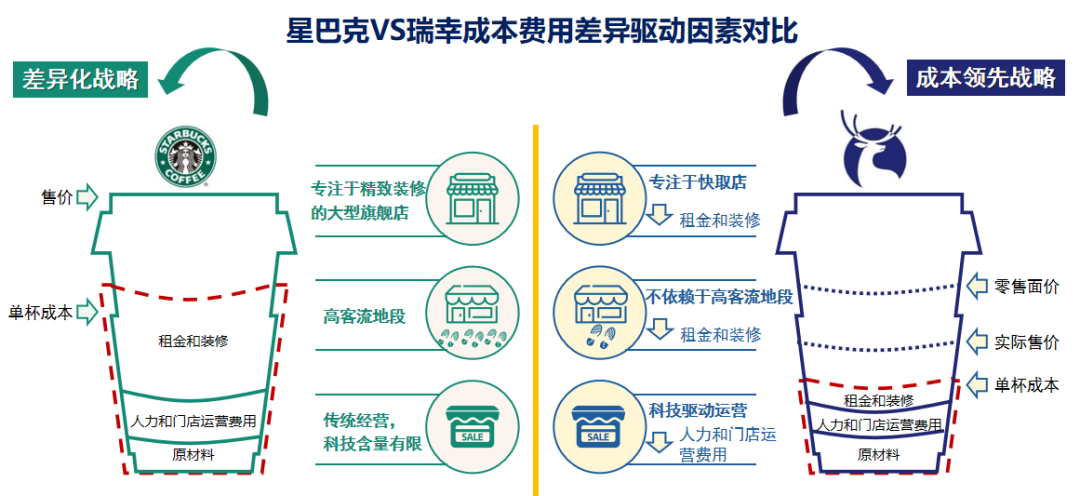
One is a long-lived, relatively steady traditional enterprise; the other is an internet company burning money for scale. The directions for refining business quality, cost, and management quality are completely different.
Starbucks pursued a differentiation strategy — focusing on large flagship stores with refined décor, high investment costs, high rent, and high-traffic locations. This approach is relatively traditional with limited technology content.
Luckin pursued a cost leadership strategy — focusing on pickup stores with dramatically reduced store models, not dependent on high-traffic locations, significantly lowering fit-out costs, using technology to drive operations, and minimizing labor costs.
Later, after fundraising stalled, Luckin's operations returned to business logic — achieving cash flow-positive and profitable growth — by adding several new moves.
- New product development. The added value from new products doesn't make customers feel rapid price increases; customers are more willing to pay for new products.
- High growth through low-cost marketing. No more celebrity endorsements — now just scan-to-join community groups. Leveraging accumulated technology, the entire post-scan marketing sequence is fully automated, highly precise, can record user data, and costs almost nothing.
- Supply chain scale effects. Continued store growth drove ongoing supply chain cost reductions, combined with upstream supply chain positioning that pushed suppliers closer to origins and sources, leading to dramatically lower raw material costs.
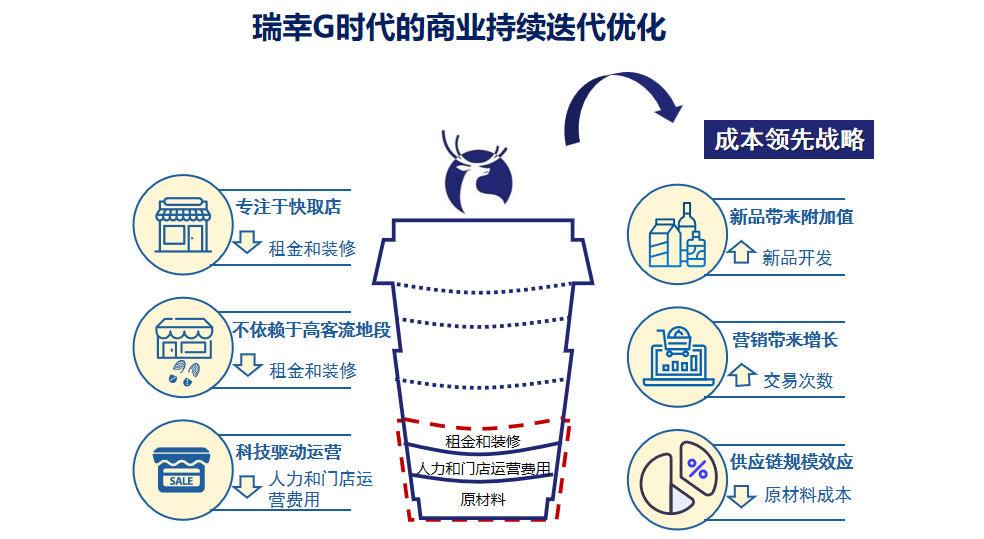
Through these iterative moves, the per-cup financial model changed dramatically between 2019 and 2021.
Luckin became profitable, and it's foreseeable that in coming years, costs will continue declining due to scale and technology, while profits continue rising.
Under fundraising logic versus business profit logic, Luckin's approach was completely different.
For enterprises, the key is still to find ways to actually make money from all angles. With cash flow, a company can endure.
② Company-Level Financial Model Design
Many founders have the following understanding of finance.
First, the company doesn't need overall budgeting. Especially startups can't make granular budgets, and even rough budgets are often dismissed by founders who prefer project-by-project approval — approve when appropriate, spend when appropriate.
Second, opening new revenue streams beats cutting costs, so cost and expense control isn't that important. Controlling expenses means treating spending as investment behavior — figuring out how to spend money correctly, how to accomplish more with less, or what optimizations can make spending more worthwhile.
Third, business and finance are severely disconnected. Finance doesn't grasp business conditions, operating as a "materials-in, processing-out" model. Working hard all year yet not making money, without even understanding why.
③ Designing Financial Models for Companies at Different Stages

Startup phase. With no large-scale investment yet, you can treat the entire company as a capital investment project. Apply investment logic to calculate where each project should be at each stage, what milestones to hit, how much capital is needed, and how much total funding is available.
- Minimize capital investment;
- Create a "capital budget" with cash flow control as the top priority;
- Spend within limits. R&D project budgets carry high uncertainty — add a 50% buffer. For example, if the budget is 10 million, plan for 15 million to guard against overrun risk;
- Reduce fixed and rigid costs (e.g., rent and labor costs);
- Ensure fundraising pace stays ahead of capital deployment pace;
- Maintain at least 12 months of safety cash flow.
Growth phase. Adapt to the market as the core imperative. Even in a tough market, some sectors still present major opportunities. The financial challenge is to follow the market closely and truly understand it.
- Control "sunshine-style" growth risks as the top priority;
- Revenue growth % vs. receivables growth % — monitor total accounts receivable;
- Cash collection ratio % and delivery satisfaction metrics;
- R&D project ROI control;
- Ensure fundraising pace stays ahead of growth requirements;
- Maintain at least 24 months of safety cash flow.
Maturity phase. Focus on cost reduction and efficiency improvement. Obsess over driving down supply chain costs, and preemptively cut prices to suppress growth.
Decline phase. Make cash recovery the core priority. The business is already declining — there's no point in sustained investment. Yet many companies keep burning money even after entering decline.
The core financial management priority differs at each stage. In company management, if you're clearly in the startup phase but some people think you should apply growth-phase or even maturity-phase management methods, that's a mismatch.
④ How to Control Financial Models Across Multiple Business Lines
Suppose a company has two business lines:
One is stable and mature, with clear strategy and proven playbooks. It can produce matching cash flow budgets, making control straightforward.
The other is a new business, highly uncertain, with no clear strategy — figuring things out as it goes. Business and finance are deeply misaligned. Finance says even without clarity, you need to hit key milestone targets. Business says current milestones don't need to be shared with finance.
This is when the founder needs to lead both sides in joint discussion.
This situation is very common in high-growth companies. In this real case, after discussion among the founder, business, and finance teams, they decided to manage the two portfolios separately.
First, the mature business with clear strategy — the "marathon business" — will continue generating returns for the company long-term. It has two simple metrics: profitable growth and cash flow-positive growth. While supporting revenue growth, obsessively drive down costs and expenses.
Specifically: grounded commercial targets, from budget to execution and adjustment; execution of business strategy, business plans, and organizational plans; complete financial budgets including profit budgets and cash flow budgets.
Second, the highly uncertain "crossing the river by feeling the stones" business can be broken into small, discrete tasks with timelines, cash flow inputs, and deliverables or milestones.
If at the third milestone you discover the direction is wrong, you can at least save the money planned for phases four and five. Three keys here: roughly correct direction, an organization full of vitality, and flexible cash flow budgeting.
3.2 Building a Finance Team for Rapid Business Growth
① Founders' Misconceptions
First, founders don't need to understand finance. Many founders have strong professional expertise and impressive backgrounds, but haven't invested much energy in finance. They see it as specialized work — hire specialists and you're done. The founder doesn't need to understand it.
Second, finance doesn't need to participate in business. They believe finance doesn't understand business or R&D, so participation is useless. The more involved finance gets, the more they get in the way — better to let business decide on its own.
Third, audit equals finance. Audit is not finance. Audit checks compliance against accounting standards. Beyond financial accounting, finance encompasses substantial financial management work — it requires understanding the business and having real insight into the enterprise.
Fourth, just get it right before IPO. They think IPO is still far away, so just have the investment bank bring in an accounting firm to sort it out beforehand. Doing anything earlier is pointless.
② Financial Organization Types for Different Business Development Stages
Overview of each finance module:
Accounting and cashiering are the most basic internal financial controls — one manages the books, the other manages the money, with mutual oversight between them.
The tax specialist handles tax filing and coordination. At early-stage companies, they're often given external liaison work as well. This person needs equal parts external relationship skills, communication ability, and professional expertise.
Many early companies don't have a financial BP role. Everyone is a "business-oriented finance person," growing alongside the company.
Once a company reaches a certain scale, more advanced roles emerge.
Accounting needs a finance manager leading several accountants — some as revenue accountants, some as cost accountants, some as accounts-receivable accountants managing payables and receivables.
Team structure can be modularized into revenue, cost, and expense accounting, managed by a capable finance manager.
Finance managers command higher salaries. The accountants underneath can be recent graduates or less experienced hires responsible for a single module.
If financial accounting and SOPs are clearly defined, they can become competent quickly. You can also create growth plans for them — revenue now, cost in six months, payables/receivables six months after that.
If after one rotation they've had room to learn and can grow quickly, the overall organizational stability and talent pipeline become much easier to build. Hiring pressure decreases, and salary costs don't balloon.
Because the company provides a strong learning environment, and most finance professionals are lifelong learners — as long as they keep learning and growing, they'll be happy to stay. Their stability is high too.
Cashiering advances to fund manager or fund supervisor, then to manager level.
The fund manager doesn't just handle simple receipts and payments anymore — they're responsible for fund planning, forecasting, allocation, financing, and other supporting work.
As tax specialists advance to tax supervisor and tax manager, their external liaison capabilities need to strengthen further. Beyond routine tax filing, they need to handle tax planning well, balance tax burden, secure favorable policies, and so on.
Financial BP — the business partner in finance.
In high-growth industries where business evolves too fast, you need a team that understands both business and finance embedded at the front lines, working alongside business to turn non-standard processes into standardized ones. For example: modeling new business models, supporting business decisions, backing business analysis — rapidly importing company standards into front-end non-standard scenarios to help them achieve compliance while operating smoothly and efficiently.
On one hand supporting business, on the other hand importing financial requirements. This is the financial BP the company needs — such people can grow into an important pipeline of management-oriented finance talent.
Now let's look at the distinctions among finance leader roles.
- CFO: Manages capital markets operations, coordinates the full process from strategic decoding to budget execution.
- Finance Director: Manages budget, accounting, treasury, analysis, tax planning, and other management-oriented work.
- Finance Manager: Manages daily work from accounting, fund receipts/payments to tax filing.
At different company development stages, different people need to join.
Functions of each finance module:
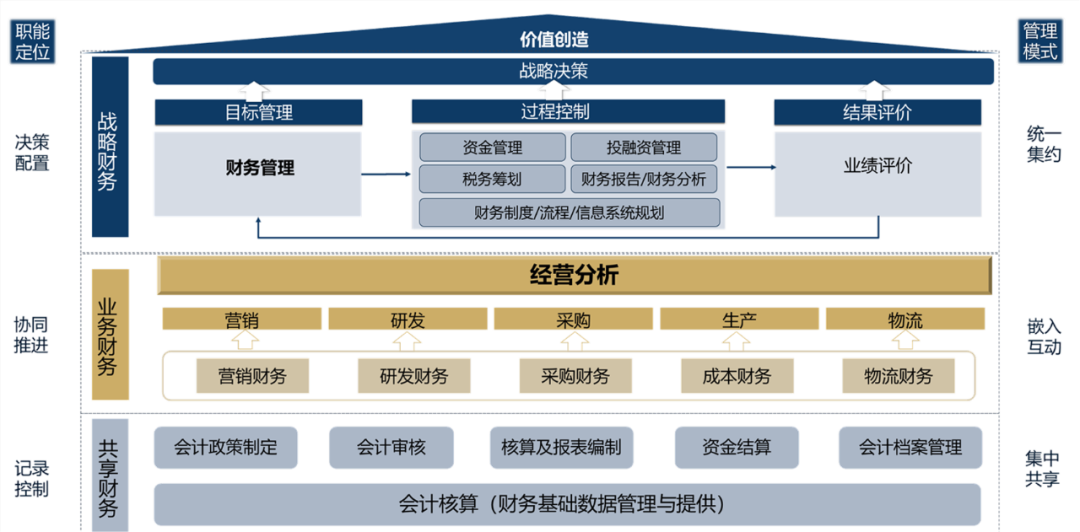
Part one: Accounting finance. Commonly understood as bookkeeping, including accounting (financial data management and provision), accounting policy formulation, accounting SOP development, accounting review and other foundational work. Also includes reviewing vouchers for compliance, checking whether vouchers meet standards, and archiving all electronic or paper documents per national regulations.
Part two: Business finance. This goes by different names at different companies — some call it business-finance integration, some call it financial management, some management accounting, some management finance.
Business finance doesn't do bookkeeping or handle money. It manages company value. You can assign different people to different business segments. You don't necessarily need to hire purely finance-background people. When first building this out, look at which cost category has the highest proportion in your company and deploy financial BPs there first. Second, business teams and finance need to complement each other, able to sort out the non-standard parts of business and turn them into solidified processes that can be implemented in systems.
Part three: Strategic finance. Anything involving management policy formulation, planning, and analysis — this advanced work generally sits in strategic finance. At most early-stage startups, the finance leader and founder handle this together. Here, "finance" isn't the finance department's finance — it's the company's financial management. The founder definitely needs to participate; at least one co-founder needs to be involved.
Investment and financing, tax planning, financial reporting, information systems, process planning, and performance support all fall to strategic finance. It also includes performance evaluation for the entire team — OKR and KPI policy development needs strategic finance participation.
The ultimate goal is creating company value, helping the company create more value, not just profit. Because for early-stage companies, company value matters more than profit.
Part four: Cost finance. Cost finance is a relatively general role, critical in manufacturing companies.
Many manufacturing companies now use outsourced processing models, but still need to understand production progress, materials, inventory, and delivery status.
If you leave appropriate profit for upstream and downstream partners, you'll find overall costs become controllable.
Cost accounting is essential whether for outsourced processing or self-operated factory models. As long as it's involved, you must hire a cost accountant. After so many years of development, China has cultivated plenty of such talent — relatively easy to hire, though talent supply still varies by region.
Cost finance has two key objectives:
- Provide accurate, reliable financial data for product and channel decisions.
- Improve financial accounting accuracy, identify root causes of accounting inaccuracies, and resolve them one by one.
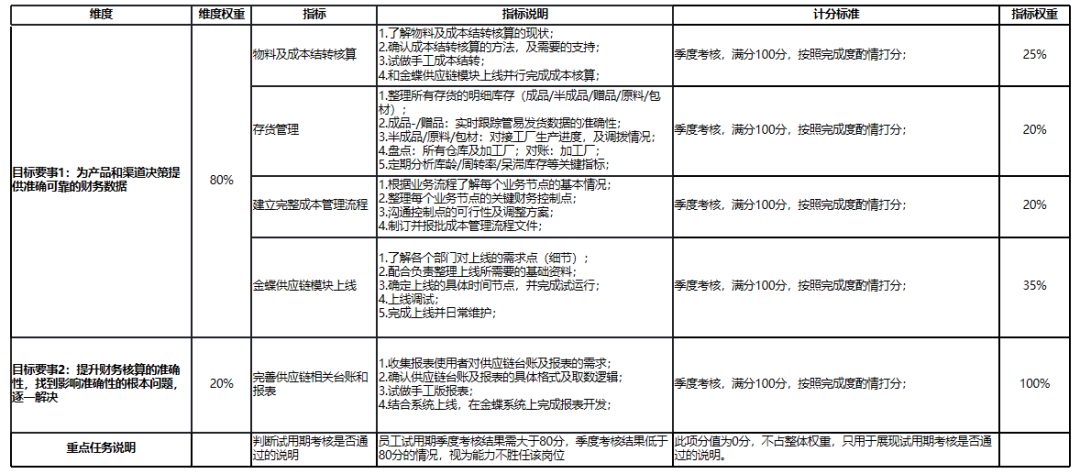
In high-growth companies, you often find organizational roles and system roles don't match or have gaps.
If you can get cost figured out, you've mostly figured out manufacturing. Cost is relatively more complex and harder to manage than expenses, especially for some B2B companies with longer production and delivery chains.
Startup-stage companies need to build financial organizations aligned with strategy and business planning.
At the startup stage, finance needs to support operations while gradually building internal controls and establishing simple, agile, and actionable policies and procedures.
Cash management, accounting, and tax administration are table stakes. Business partnering can be built incrementally based on the company's situation.
Tax planning, business analysis, and finance-operations systems can be deprioritized when revenue is still small.
③ A Four-Step Approach to Managing the Finance Team
Step one: The founder or a third-party firm assesses the existing finance team to understand the current state of management — what work can they handle well? Where are they struggling?
Step two: Based on the company's strategy and business plan, design a new finance organization that can support that strategy. What should it look like? How many people are needed?
Step three: Inventory existing talent and map it toward the new finance organization, categorizing people as accounting-oriented, business-oriented, or strategy-oriented.
Business finance talent that can truly support operations is scarce in startups. They need deep understanding of the company's end-to-end processes and current operations, plus "causal thinking" — the ability to spot problems by observing data.
Strategic finance talent brings systems thinking. They don't just identify problems; they think ahead about how to optimize processes and design rules so issues don't recur.
Step four: Three key actions to complete finance talent pipeline building.
- Fill gaps through hiring;
- Retain strong performers, move quickly on poor fits;
- Cultivate people who identify with the company, learn fast, and work diligently but lack professional depth.
Early-stage startups most need generalists — not one person per role, but one person covering multiple roles. Versatility matters more than specialization.
So companies should design their finance organization based on their own circumstances. At larger scale, roles can become more specialized and finely divided.
3.3 Building an Integrated Finance-Operations System for High-Growth Business
① How to break through communication barriers between founders and finance, and between operations and finance?
Why build finance-operations integration? It fully connects business and finance, enabling efficient execution around the founder's strategy.
In our research, many companies mentioned communication problems between founders and finance, and between business teams and finance. This may not apply to everyone here.
- Founders view of finance: I have no idea what finance is doing. Leave specialized work to specialists — I don't need to manage it. In early-stage companies, R&D and business matter most; finance doesn't. Finance is simple, not worth the effort.
- R&D view of finance: We're a group of returnee PhDs working on cutting-edge technology. Finance doesn't understand us; no need to communicate.
- Business view of finance: Business is hard enough already, and finance is nagging about invoices and payment collection. In this situation, founders usually side with business — because the founder is the biggest business person.
- Finance view of finance: Weak influence in the company. We've given advice before that wasn't taken. Feels like low presence, low impact.
What to do? In our research, we found one company with excellent finance-business communication.
Culturally, all business department meetings were open to finance. In the company's internal system, finance could apply to participate in any business department meeting, helping finance quickly understand operations.
If finance doesn't understand the business, you must bring them in more.
Starting from the founder, the entire company valued finance-business integration and established good communication mechanisms.
For long-term stable development, strong business needs strong finance.
In marketing operations, when confusion or problems arose, either finance or business could directly communicate across departments and hierarchy with the marketing lead or finance lead — simple, direct, and efficient. As long as the company's core values are sound, everything can be discussed together.
Day-to-day, several approaches maintain this.
- Cross-training. Business learns finance knowledge; finance participates in business operations. Don't just focus on financial metrics — pay attention to leading non-financial indicators too.
- Proactive communication. Multi-channel, multi-form communication. Learn business knowledge from the other side, but more importantly understand their current difficulties and pain points, then find ways to help solve them from a professional angle.
- Speak truth, speak plainly. Translate professional jargon into language each other can understand. This helps both sides quickly grasp each other's work and support each other efficiently.
How to break through these communication barriers?
Finance-operations integration = business integrating into finance + finance integrating into business + finance's own transformation = integrated finance-operations.
Domestic companies pursue finance-operations integration two ways: finance proactively understanding business, or business proactively understanding finance.
Whoever steps forward first — the more capable party should be more proactive. Three priorities:
First, optimize resource allocation.
High-growth companies constantly pursue value maximization, and resource efficiency is a critical path. This requires value analysis and management across all operating activities.
When business and financial management are tightly integrated, information on costs, expenses, marketing, capital, and operational risks across all business segments can flow accurately and timely to finance. Through technical analysis, resource allocation can be optimized to improve economic returns.
Second, strengthen risk control.
Today's external business environment changes constantly, and companies face growing risks. This demands higher standards for risk control and internal controls. Achieving finance-operations integration enables comprehensive monitoring of business activities from both business and financial perspectives, improving weak links in risk management and effectively raising risk control levels.
Third, enhance decision support.
Through finance-operations integration, consolidated business-finance information provides managers with effective strategic decision support. Companies can then formulate operating plans, participating in business plan preparation, execution, and analytical decision-making from both financial and business angles, optimizing efficiency across all segments.
② Methodology for connecting business processes to financial processes
When team capability is strong, use a project-based approach.
Manage projects from lead generation through delivery and collection, by stage: opportunity conversion, project execution, and handover/closure.
In the opportunity conversion stage, consider both financial data and the data that precedes it. Contracts, invoices, and collections are outputs of business work — what happens before that, finance doesn't see.
Here you can add a project workflow — bring together project managers, finance staff, and IT personnel to map the process end-to-end, filling in what people in different roles at each stage need to do. Confirm whether BP involvement is needed for project financial target analysis, discuss whether quotes are accurate, whether expected returns can be achieved, what uncertainties might increase costs, and whether to build buffer into the pricing model.
Project-based management is end-to-end integration. Problems solved at the front end carry the lowest cost.
In the project execution stage: sales and marketing tracks progress, bid decisions become bids, with project communication, project handover, preparation, etc.; supply chain handles procurement planning; finance handles project budgets, payments, etc.; resource management handles staff deployment, third-party staffing, and project material preparation; operations management handles quality management, complaint management, and process oversight for everyone.
Many companies experience deviations during project execution. Without finance involved, this leads to loss of control and poor coordination.
This breaks into several steps.
Step one: Process integration kickoff
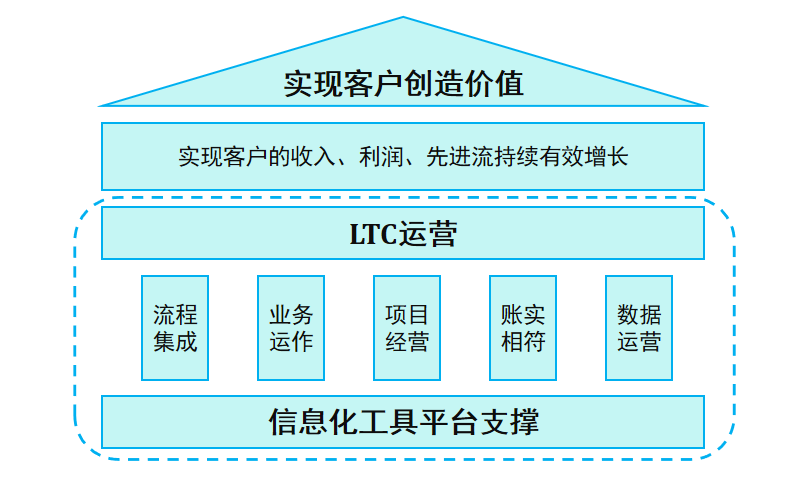
Key points:
- Connect by business cycle, end-to-end from business to finance, with all departments discussing together — not mapping individual department processes then trying to integrate them;
- Process participants include business leads, finance leads, and IT leads from all process stages;
- If iterating existing processes, inventory all current process problems in advance, as detailed as possible;
- The party with the most transactions serves as overall process owner; if that party lacks full-process organizational capacity or time, designate a specific person;
- All processes are company-level processes, not department processes — everyone is just an executor within one link of the process.
Step two: Establish company-level rules
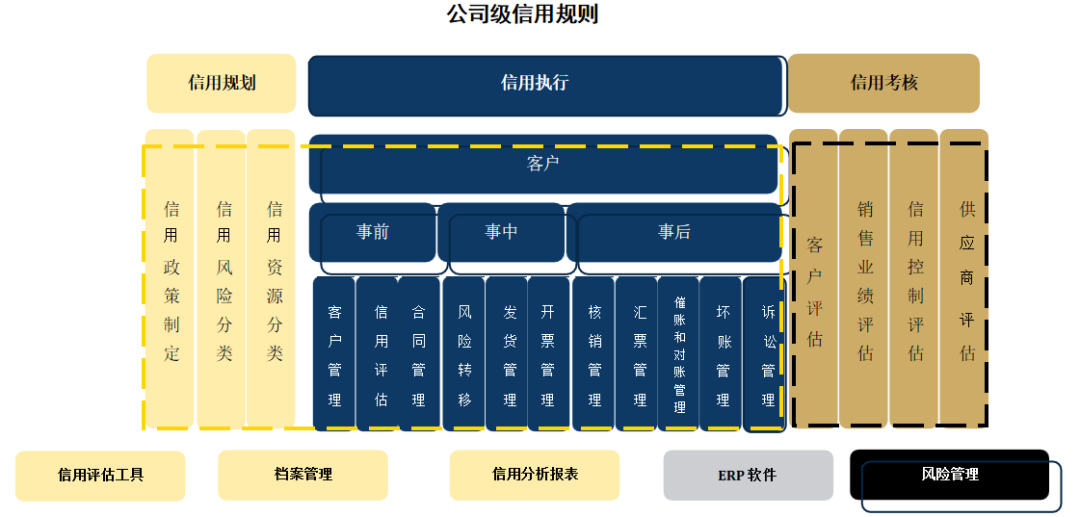
During high-speed growth, establish credit rules for customers as company-level rules, not finance department or business department rules.
In execution, manage customers by first assessing their credit — do they qualify for Policy A, B, or C? After contract signing, enter the contract directly into the system where all departments can see the terms.
Key points:
- Establish company-level rules applying to all departments in the process, not individual departments;
- Once company-level rules are set and approved, all departments must comply; changes require collective discussion;
- Finance-related company-level rules, such as revenue recognition rules, must align with accounting standards to avoid IPO pitfalls;
- Embed rules in processes, embed processes in systems — goal: compliance at the moment of occurrence;
- Use information systems to automate as much as possible, replacing manual oversight.
Step three: IT implementation
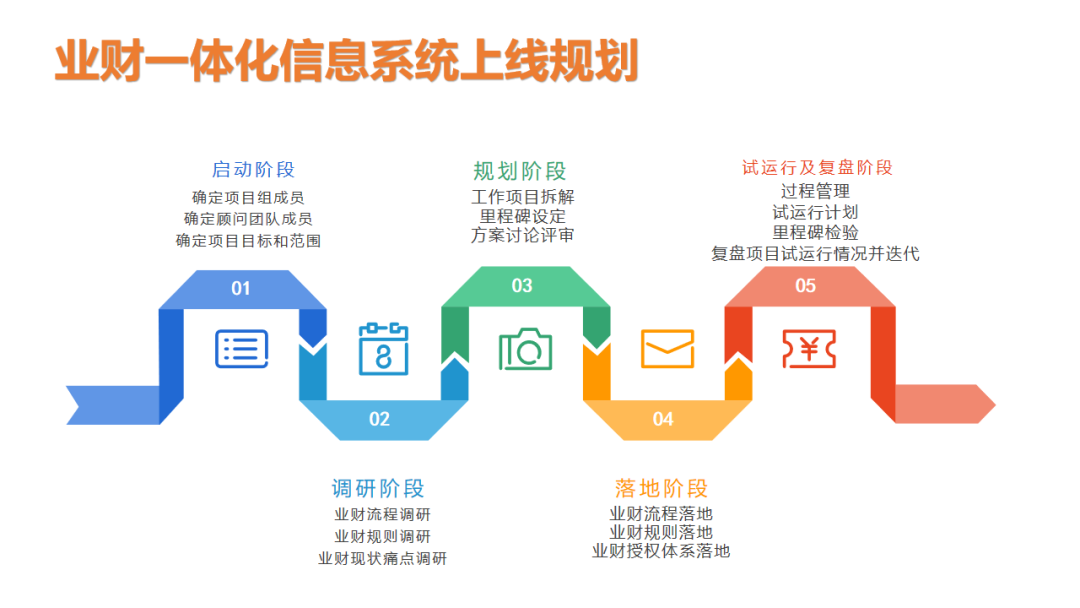
This is a sample timeline for integrated finance-operations system rollout, for reference.
It can be divided into: kickoff, research, planning, implementation, and pilot/review stages.
In the kickoff stage, first establish a steering committee, designate a lead, coordinate with the advisory team on collaboration, arrange for advisors to interview relevant personnel, define project goals and scope, assemble the core project team, jointly develop a preliminary action plan, and communicate the project plan to core members through a kickoff meeting.
The kickoff meeting's purpose is to explain why we're doing this, what the goals are, who is involved, how they participate, and how we'll act.
The founder must personally attend the kickoff.
In startups, the founder has the most influence. Anything the founder doesn't personally show up for loses corresponding execution power.
Entering the planning stage, break down the work, establish process management mechanisms and budgets, design a series of milestone events, and conduct detailed plan reviews.
Once the review is complete, the execution phase revolves around a series of key milestone events. The first step is mapping out the current state of the business-finance data flow system. After documenting these company-level rules and specific financial management methods, there will be a testing phase. Only after successful testing does the system go live.
For the wrap-up, design a small motivator — something like a virtual "cloud toast" celebration for the whole team — and then the project is done.
③ Key Points for Implementing Business-Finance Integration
First, business-finance integration must be the top priority. You have to invest enough time in this. If you shortchange it, you'll keep seeing the same errors crop up repeatedly in subsequent financial work, wasting enormous energy.
We'd rather focus that time on the actual business itself than spend more energy on internal management.
Managers don't solve transactional work — they figure out how to reduce the volume of transactional work, how to make sure difficulties and problems don't recur. Startups can hand off normal transactional work to team members and focus first on business-finance integration. If you can get this right, you've solved half your problems.
Second, the IT department must be involved. Because all requirements need IT to implement them — especially IT teams focused on processes, informatization, and software. They have to participate.
Finally, the founder must be the primary owner. Finance can be the executing department, but the worst thing you can do with a business-finance integration project is toss it to the finance department to manage.
At a startup, if the founder doesn't take this seriously, then when several parallel departments are discussing it, there's no referee — no one who cares, no one who can make and confirm company-level rules. And then it's impossible to break through the silos.
The earlier you achieve business-finance integration, the more unified your internal data language becomes, the more efficient your business-finance collaboration, and the lower the cost of integration.
Code Brain Issue 39 | Studying the 20th Party Congress: Grasping the Economic Trajectory and Startup Opportunities for the Next Five Years
Code Brain Issue 38 | Riding the First Wave: 10 Action Items for Founders
Code Brain Issue 37 | Compensation Incentives: Both Science and Art
Code Brain Issue 36 | The Essence of Performance Management Is Unlocking Human Potential
Code Brain Issue 35 | Hiring and Talent Deployment Starts Here: How to Interview Scientifically
Code Brain Issue 34 | How Far a Team Goes Depends on These 6 Points
Code Brain Issue 33 | A Founder's 11,626.5 Hours
Code Brain Issue 32 | Leadership Is Guiding People to Places Unvisited
Code Brain Issue 31 | Amazon's Ten Compliance Lessons for Going Global
Code Brain Issue 30 | 60 Hours of "Practical Leadership": Full Highlights Recap!
More MaHui members can click "Read More" to view