Code Brain | Is Your Cash Flow Still Healthy in the Pandemic?

Stay confident in building, keep strategic focus, and move steadily toward the future together.
Code Brain
Ecosystem connections, cognitive resonance
Since the beginning of this year, international dynamics have shifted profoundly, while domestic COVID pressures have intensified. In response, Source Code Capital has organized the "Together for a Shared Future" lecture series. From April to June 2022, we hosted online sessions covering macroeconomics, sector-level industry trends, and micro-level business operations — sharing insights to help founders stay confident, maintain strategic resolve, and move forward steadily toward the future.
*Content from the "Together for a Shared Future" series will continue to be shared.
Guest Profile

Bin Yu, former CFO of LAIX. Previously served as CFO and Executive Director at Star TV, CFO at Innolight Technology (Zhongji Innolight, SZ: 300308), Senior VP at Youku Tudou Group, and CFO at Tudou Group; currently serves as independent director and audit committee chair for multiple U.S. and Hong Kong listed companies.
A U.S. Certified Public Accountant and Global Chartered Management Accountant, Yu spent over 10 years at KPMG, giving him solid financial fundamentals and extensive industry resources. He holds a Master's in Accounting from the University of Toledo and an INSEAD EMBA from Tsinghua University.
Guest Presentation
Cash Management Methods for Different Business Situations
- Financial forecasting and financial stress testing
- Q&A
Lately it's become popular to describe today's complex and volatile macro environment using the term "VUCA era." VUCA stands for Volatile, Uncertain, Complex, and Ambiguous. With the ongoing global pandemic, a complicated international landscape, and unclear developments in the Russia-Ukraine war, the overall economic and business environment is highly turbulent. As a result, some industries have taken hits, and some have essentially ceased to exist.
The intensified outbreak in the first half of this year slammed the brakes on many businesses. Revenue dropped sharply, while costs couldn't be adjusted quickly. Cash flowed out daily, and balances dwindled. Against this backdrop, cash flow management has shifted from a routine concern for finance staff to perhaps the most pressing issue for founders. It has become the most urgent priority — for some companies, even a matter of survival. Today I'll share the underlying logic and core elements of cash flow management from a CEO's perspective.
Cash Management Methods for Different Business Situations
1. Sufficient Cash If your company just completed a funding round, or if operating cash flow is positive, and you judge that cash is currently ample, I recommend building 12-24 month budgets and cash flow projections. In these plans, consider how to deploy cash efficiently. Depending on your situation, you might use surplus cash for wealth management, launching new businesses, or making strategic investments along your industry chain.
For example, one offline fresh grocery chain had just completed a funding round last year and decided to build a second growth curve through online business, actively laying the groundwork. When offline business suffered this year due to intensified outbreaks, their timely planning from last year and ample preparation in online business helped offset their losses.
Founders might also consider investment opportunities, setting up industry funds and leveraging fund and shareholder leverage to make a series of upstream and downstream investment moves. In today's difficult environment, many upstream and downstream companies are also seeking financing opportunities — a good time for cash-rich companies to position themselves along the industry chain. Companies that were highly valued before the pandemic have typically seen valuation adjustments over the past two to three years, creating many investment opportunities for cash-rich enterprises.
2. Limited Cash When cash is limited, you need to clarify your 12-month budget, business development plan, and cash flow projections, with monthly reviews and adjustments.
At the same time, cut non-essential, non-urgent businesses to ensure adequate cash balances and sustain normal operations. Such companies should reserve at least 6-8 months of operating cash to allow sufficient time for necessary fundraising or working capital arrangements.
3. Insufficient Cash Companies with severely insufficient cash need rapid revenue-boosting and cost-cutting techniques and methods, which I'll focus on in a later section.
Financial Forecasting and Financial Stress Testing
1. Financial Forecasting
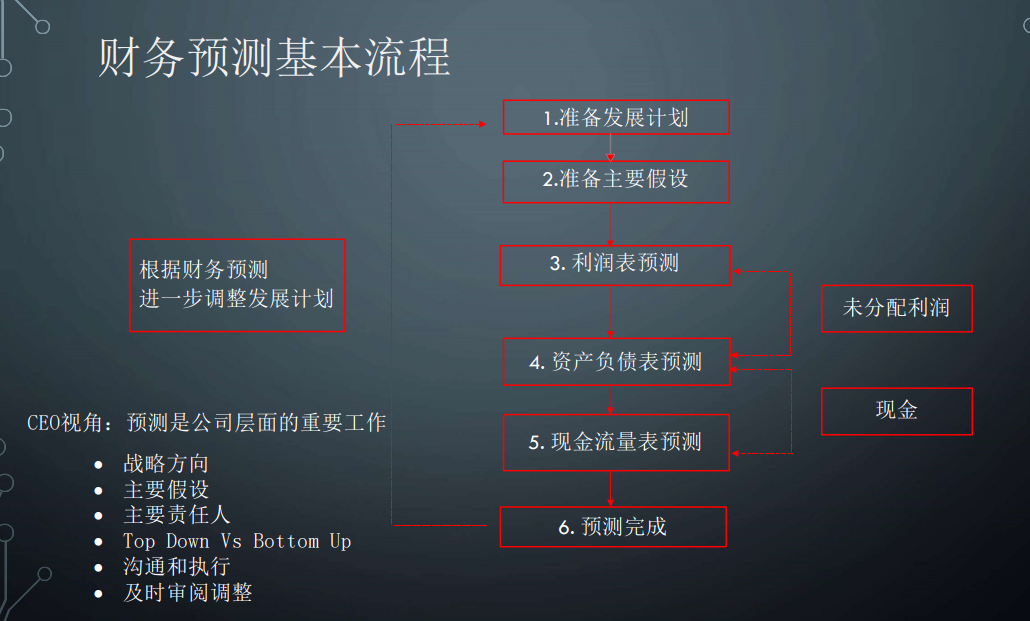
Image source: Speaker's presentation
First, financial forecasting needs to be based on analysis of historical data and current actual conditions, developing the company's growth plans for the forecast period (including sales, production, capacity expansion, cash and credit policies, etc.). All financial forecasts are built on the company's strategy and development plans for the coming year. Many CEOs think budgeting and forecasting are finance department matters, but the numbers are all about the business.
The second step is determining the main assumptions and core metrics for financial forecasting. For B2B companies, for example, revenue drivers might be forecasts of new customer numbers, new product development speed, etc. Cost drivers might mainly be R&D headcount investments. After determining these core metrics and assumptions, compile projections for next year's financial statements.
The final step is crucial: adjusting the initial development plans based on forecast results. In today's rapidly changing business environment, financial forecasts need to be updated cyclically. Traditional enterprises and manufacturing companies typically used to review and adjust forecasts and business plans on an annual cycle. Today, however, many companies — especially internet and high-tech firms with dramatic changes — operate on a quarterly cycle, or even adjust forecasts monthly when under significant cash pressure.
CEOs need to recognize that all financial forecasting is based on company strategy and development plans. While financial forecasting is typically led by the finance department, CEOs need to be more hands-on and involved in the process, carefully reviewing strategic direction and key assumptions. The CEO's level of attention also determines whether financial forecasts can be smoothly implemented across the company.
CEOs also need to designate a financial forecasting lead and form a working group, with thorough communication with sales, production, product, procurement, and R&D colleagues, followed by regular review, feedback, and timely adjustment of forecasts.
2. Financial Stress Testing Financial stress testing is a commonly used tool when company cash is insufficient. In corporate finance applications, it's often built on top of budgets, using estimated parameters and data to calculate the breaking points a company can withstand under various assumptions and certain extreme scenarios.
The steps for stress testing are as follows:
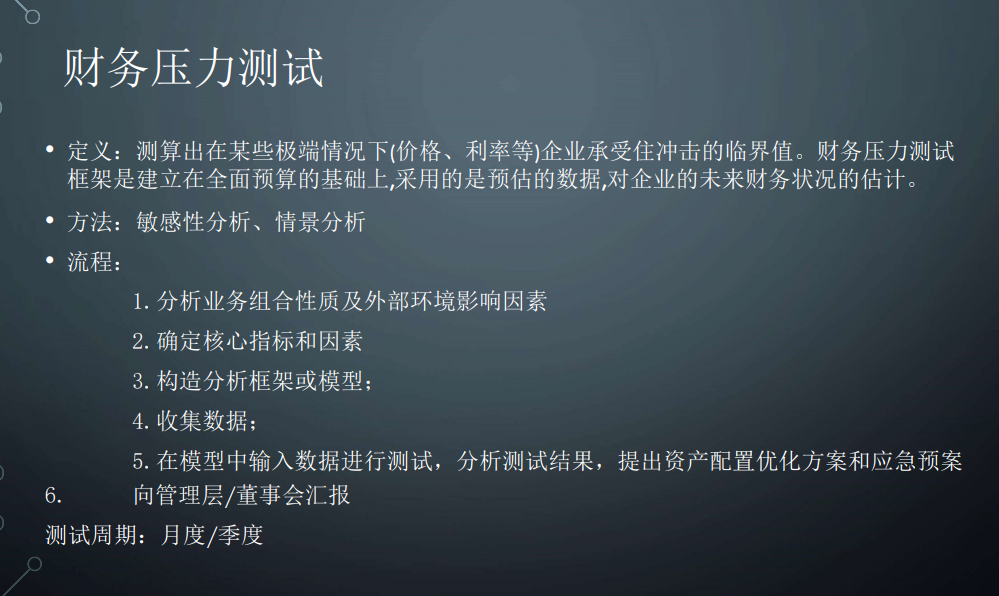
Image source: Speaker's presentation
Here's a company case study: Company A went public and successfully raised funding in 2019, but because its operating cash flow had remained negative, cash burned very quickly. At this point, the founder faced the question of whether to proceed with original plans to add new products and build a second growth curve to increase revenue. The company conducted sensitivity analysis, allowing management to see through intuitive results the impact on revenue and cash under different scenarios.
Analysis Method:
First, they divided business modules. Below is the product with the largest revenue share. The left column shows core financial data and metrics, including revenue, major costs, and key operating data such as user volume and conversion rates. The second column shows actual 2019 financial data for each item, and the far right column shows estimated results for the first half of 2020.
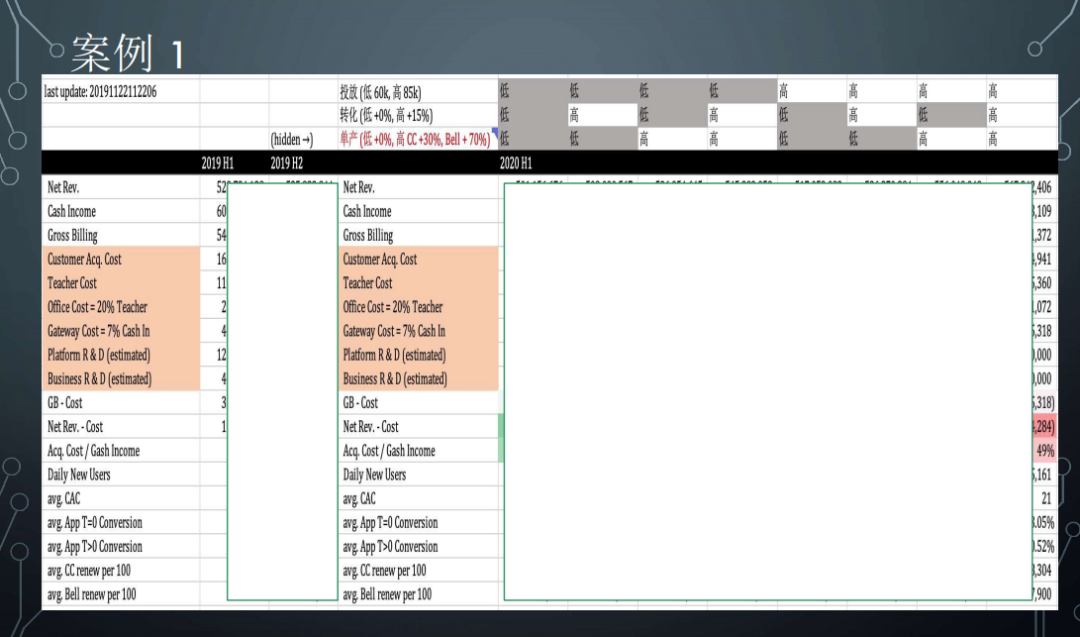
Image source: Speaker's presentation
The three rows at the top right of the table are the three parameters most affecting the business based on company circumstances, including marketing spend, user conversion rate, and product unit economics. Under each parameter, different sensitivity combinations were created, and under each sensitivity level, the impact of changes in core financial data was calculated. Management could intuitively see what results company financials would produce under worst-case and optimistic scenarios. In this case, the company's overall situation was not optimistic, and management ultimately not only abandoned developing a second curve but also implemented certain contraction and layoffs.
From the CEO's perspective, you don't need to master so many operational details, but you need to judge whether parameters and metrics align with company conditions and industry standards, and whether they fit company strategy. Ultimately, the CEO also needs the courage to make decisions after analysis reaches conclusions.
3. Quick Revenue-Boosting and Cost-Cutting Techniques for Severely Insufficient Cash For companies with severely insufficient cash and fundraising time, the priority is survival. The techniques introduced below are all based on practical experience. When founders consider using them, beyond short-term cost expenditures, while urgently trying to save the company, you must weigh whether these approaches will damage long-term interests in actual practice.
① Increase advance collections. I recommend doing a deep review of customers. For some larger, well-performing companies less affected by the pandemic, you may appropriately request higher advance payment amounts on top of contract terms. Additionally, many state-owned enterprises have internal policies supporting private enterprises; companies need to proactively seek opportunities from all directions to increase cash income.
② Activate accounts receivable. During the deep customer review, understand customer current situations, such as whether their industry is affected by the pandemic. A customer's past good payment record doesn't represent their financial capacity today. The earlier a company discovers problems and pursues collection, the greater the likelihood of recovery.
③ Distinguish between bad debt provision and actual loss. Bad debt provision is a financial statement concept. When discovering potential bad debt from a customer, first exclude it from the current period's financials, so when bad debt actually occurs, it won't impact the financial statements. However, after provision, bad debt may or may not occur. From a cash flow management perspective, you still need to analyze based on actual bad debt loss probability.
④ Revenue tool — accounts receivable pledge loans. When customer accounts receivable are high quality with low bad debt rates, and the company is asset-light with no collateralizable assets, you can apply to banks for accounts receivable pledge loans.
⑤ Revenue tools — accounts receivable bill discounting and factoring. Both of these accounts receivable collection methods carry certain costs.
When applying the above tips, companies need to start from revenue and expenditures, analyze in detail, and actively pursue opportunities, not neglecting any small channel. Business operations are continuous; there's no instant cure for improving cash flow difficulties. Survival comes from opening revenue sources and reducing outflows through all channels, letting trickles converge into rivers, gradually completing self-rescue. At this time, if founders lead by example, tighten their belts, colleagues below will also brainstorm ways to increase company cash inflows and delay outflows as much as possible.
Additionally, for larger B2B companies with certain industry influence, such as technology companies with significant personnel costs, there are two more common solutions:
① Use stock options combined with cash to adjust compensation structure. Together with HR, explore option-cash combination packages applicable to different employee levels, maintaining morale while letting everyone know the company needs to weather difficulties together.
② Salary financing plan. The specific approach is to reduce a certain portion of employee compensation during the most difficult months; the reduced portion should be developed by HR based on different levels and positions. The reduction doesn't equal a pay cut, but rather deferred salary. For example, for the next three months employees only receive 80% of salary, but after three months the company will provide certain compensation to employees, with a compensation plan showing genuine good faith. Note that if implementing a salary financing plan, it needs to be top-down, with management taking the lead and adjusting their own salaries more significantly.
When using the above methods, you need to start from your industry, customer types, and actual business, comprehensively balancing and considering how much cost-cutting support the company needs in the long and short term. What are unnecessary expenditures that can be reduced? Which government support policies does the company qualify for? How should company divisions unify KPIs and stabilize company culture after cost-cutting? Additionally, founders should pay attention to hidden impacts not visible in the numbers when making decisions. A low-cost measure after implementation may bring more negative impacts, even increasing costs. For example, some industry clusters with abundant human resources may appear to have low labor costs, but after relocating there, companies may find it's easier to job-hop within the park, and internal talent turnover actually becomes more severe than before.
Q&A
Question 1: If quarterly targets aren't met, how should annual targets be reasonably adjusted, and do you have specific suggestions for monthly flexible budget management and control?
Bin Yu: First, you need to analyze in detail the reasons for missing targets. Which specific customers? Is it a special case or a long-term change? For example, if a customer contributing over 10 million in revenue dropped to a few million, the question is why such a large customer stopped doing business. You need to follow the trail and dig deep. Beyond external reasons, you should sort out short-term, medium-term, and long-term factors — what exactly is causing the settlement amount decline — and further find responses to avoid repeating such problems.
Only then comes the question of whether to adjust overall targets, and to what extent. If analysis concludes it's pandemic impact, you need to judge whether this impact will end in Q2, and whether there will be continued ripple effects in Q3. Simultaneously consider how upstream and downstream suppliers and customers are affected by the pandemic, and after complete analysis, make corresponding monthly, quarterly, or even annual adjustments.
Question 2: In startup budget management, combining top-down and bottom-up approaches feels difficult. Any suggestions on this?
Bin Yu: Startups have several characteristics: 1) relatively small scale; 2) rapid change; 3) immature back-office systems and staffing. Based on this, top-down effectiveness is greater than bottom-up. If you feel top-down is currently the most suitable and effective approach, management can grasp overall company strategy and business planning, making top-down relatively low-cost and efficient; the finance department develops specific financial budgets based on management's business planning, assigns them to various departments to receive targets and develop execution plans.
Even in the top-down process described above, bottom-up feedback is indispensable. In communicating budgets with various business departments, you need to listen to various situations and problems encountered in actual operations and execution — which factors were unforeseen — this process is an important part of correcting budgets.
Question 3: You just mentioned the CFO-founder partnership. What frequency should founders communicate with their finance lead, what are the main topics, and could you give some typical approaches?
Bin Yu: First, look at the finance lead's specific situation. If they haven't yet reached the level of discussing strategy with you, and are more operations-focused, the CEO needs to establish a process, such as weekly or biweekly communication, depending on the company's reliance on finance. Communication content includes two parts: first, the CEO communicates company strategy and recent plans, specific requirements for the finance department, and problems you've identified. For example, when it's nearly year-end and time to do budgets, what are this year's requirements? The second part is the finance lead's feedback to you, reporting on recent finance department routine work, including personnel arrangements. This can also take the form of weekly reports combined with face-to-face meetings.
If it's a more comprehensive CFO, beyond weekly management meetings, your one-on-one communication should be ongoing anytime. The content focuses more on company-level strategy, investment and financing, budgets, systems, processes, etc.
Question 4: If the company isn't short of money now, does that mean we shouldn't start debt financing, and when is the right time to start?
Bin Yu: First, you need to distinguish what this "not short of money" state means. Is cash flow positive? Self-sustaining? Or is it just not short of money until the next funding round, and how long can this "not short of money" situation last?
If company cash flow is positive, that's truly not short of money. Because after leveraging financing, cash continues to flow in, and with this financing money, you can remain self-sustaining — in this situation I don't recommend bond financing, because there are still costs, but you can establish bank credit lines for emergencies.
If the company's actual operating cash flow is negative, and it's just temporarily not short of money because of this large funding round, then I suggest after today's session, go back and do a 12-24 month cash flow projection to see how quickly the money will burn. Additionally, if there are large business expenditures or major development projects, you can use some bank loans as supplement, since it's also more convenient to get bank loans when cash is relatively ample. Especially many companies that raised USD overseas can do pledge loans domestically.
Question 5: We're a manufacturing company. When considering future funding gaps and surpluses, we use base working capital to measure. I'd like to ask about reasonable methods for planning and utilizing base working capital.
Bin Yu: Compared to internet companies, manufacturing enterprises have many fixed costs. Base working capital occupation includes raw materials, WIP, inventory, and production manufacturing costs, etc. Generally manufacturing companies have relatively stable orders — what were several customers' orders like last year, and what is customer growth like this year? First, you need to do good customer order demand analysis; after analysis, production plans emerge, and you can list out the core costs of base working capital. First, ensure minimum order demand from customers; calculate clearly what state production base working capital and finished goods need to be maintained at to avoid supply disruption, while refining labor costs. All of this needs to be based on order forecasts, building a model. After completing this model, you'll know how to account for this capital, then ensure doing an annual review or semi-annual review.
When first starting without experience, if funds allow, you can prepare more, prioritizing meeting customer demand; when the finance department is more experienced, you need to refine processes and improve capital efficiency. For example, if you find some projects have high inventory capital tie-up, you need to break down which customers' tie-up it is, and why extra inventory needs to be prepared? Adjust based on specific circumstances.
Question 6: Following up, we have a model, but factors may differ somewhat. Is there a standard to measure whether base working capital is conservative or aggressive?
Bin Yu: The methodology is what was described above. The core consideration is deployable working capital, and whether there's flexibility to reallocate. If production and manufacturing have very high flexibility for reallocation, then of course this is optimal — money can go in and come out quickly to restore production. If manufacturing variability is low, because production cycles are relatively fixed, then I suggest being more conservative, because your ultimate goal is letting customers receive good products, meeting their order demands on time.

Follow the "Together for a Shared Future" series
- Cash flow management
- How startups can maximize their HR lead
- Macroeconomic trend interpretation
- Macro strategic environment interpretation and PA strategy discussion
- Equity financing market trends and response recommendations
- Industry trend sharing and discussion
- Marketing strategy and traffic trends
- Cloud office + cost reduction and efficiency improvement, how to maintain team morale
- Individual stress relief and emotional management

Issue 19: Founders Must Learn to Let Go Appropriately
Issue 18: Time Management for Founders: "Two Must-Learns, Three Principles, Four Quadrants"
Issue 17: Your Core Startup Team Needs a "Deep Dialogue"
Issue 16: Three Keywords for Corporate Crisis Management from the 3·15 Perspective
Issue 15: The New Evolution of InsurTech
Issue 14: "Small" Trademarks, "Big" Trouble — How to Effectively Avoid Pitfalls on the Startup Journey
Issue 13: Financial Opportunities in Industrial Internet
Issue 12: Top-Level Logic Thinking on Douyin Promotion for Consumer Brands
Issue 11: Inclusive Finance Under the New Economic Situation
Issue 10: Brand: Meaning, Symbol, Value
More MaHui members can click "Read Original" to view