Code Brain | Leadership Is Guiding People to Uncharted Territory

#Code Brain — Ecosystem Connections, Cognitive Resonance
Entrepreneurship is an endless journey of self-cultivation. How solid your fundamentals are directly determines how far your company can go. Under the pandemic, startups saw their blind spots and weaknesses in business operations and organizational management laid bare. Management fundamentals have become a critical test and mandatory course for core leadership teams.
That's why Code Brain is launching its "Management Fundamentals" course series, targeting three foundational and core management capabilities for founders — people, finance, and operations — with 10 themes including personal leadership, talent identification and selection, performance management, high-performance teams, goal management, and business-finance integration. The series provides comprehensive basic management methods and practical, ready-to-use tools that leaders can apply immediately, helping elevate founders' fundamental management awareness and capabilities.
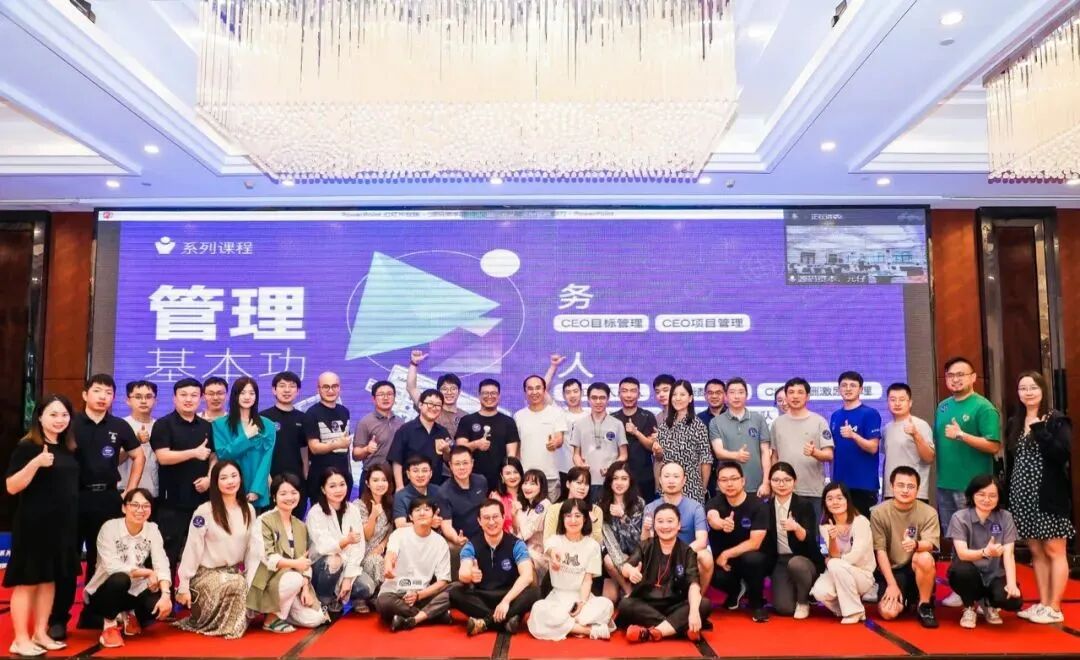
Starting in August 2022, the "Management Fundamentals" series will run monthly, with two sessions each time. On August 27–28, the first course successfully launched in Hangzhou, focusing on "Personal Leadership" and "Identifying and Selecting Talent." A total of 170 participants — CEOs and core executives from Source Code Capital portfolio companies — joined the two-day program.
For the "Personal Leadership" session, we specially invited Xu Yifeng, partner at Chief Organization Officer. He spent a full day comprehensively explaining his understanding of leadership, with particular emphasis on how leadership standards can be implemented in companies and deeply linked to their organizational talent systems.
There are many different interpretations of "leadership." Two definitions particularly resonated with me:
(1) The ability to lead people to places they've never been before
(2) The process of one life influencing another life
However, such definitions are rather abstract, so everyone has a different imagination of what leadership means. Without unified leadership standards, a company's talent selection, cultivation, and retention system lacks a shared "reference point." Everyone pursues their own "optimal solution," and as a result, the entire company fails to achieve even a "passing solution."
When a company reaches a certain scale, it's extremely valuable for the founder/number one leader and core leadership team to spend time discussing and aligning on unified leadership standards. Only by establishing consistent talent aesthetics within the leadership team can discussions about hiring standards and talent development avoid becoming like blind men touching an elephant, with everyone talking past each other.
The resulting leadership model is widely used in more mature companies, setting clear standards for employees' soft skills. Leadership typically encompasses "six capabilities" — inspirational appeal, learning agility, decision-making, organizational ability, coaching, and execution. Leading companies at home and abroad each have their own leadership models, such as Amazon, Procter & Gamble, GE, and ByteDance.
So as a startup, how can you quickly distill leadership standards that fit your needs?
01 Four Dimensions for Distilling Leadership Standards
More and more companies are using leadership standards to replace traditional "general competency models," such as Amazon's 14 Leadership Principles. But when building your own leadership standards, you can still draw on the construction approach of general competency models, considering the following dimensions:
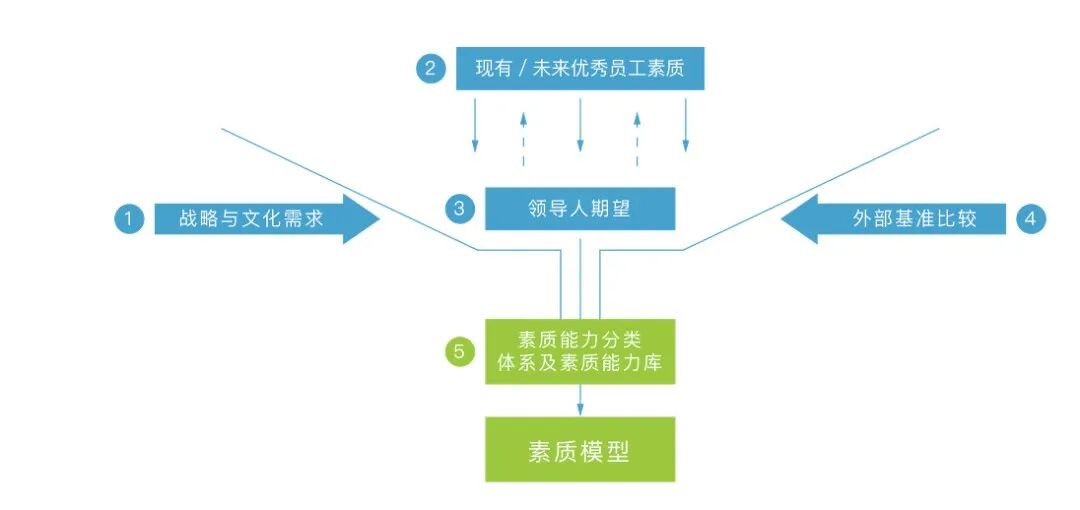
- First, align with the company's business strategy and cultural characteristics
- Second, extract key competencies through interviews with high-performing employees
- Third, incorporate the founder/number one leader's expectations and aesthetic preferences for talent
- Fourth, benchmark against external leading companies
This produces a leadership competency library (perhaps twenty to thirty items), from which you then distill and summarize the 5–7 most important leadership competency items.
A word of caution: merely listing leadership items (such as visionary thinking, leading by example, collaborative win-win, seizing victory, etc.) is far from sufficient. You also need to define each item clearly and describe corresponding behavioral standards. Because behavior is what can be observed and given feedback on. Some companies further refine these into positive/negative behaviors (or "insufficient"/"overused"), making it easier for employees to understand which behaviors the company encourages and which it opposes.
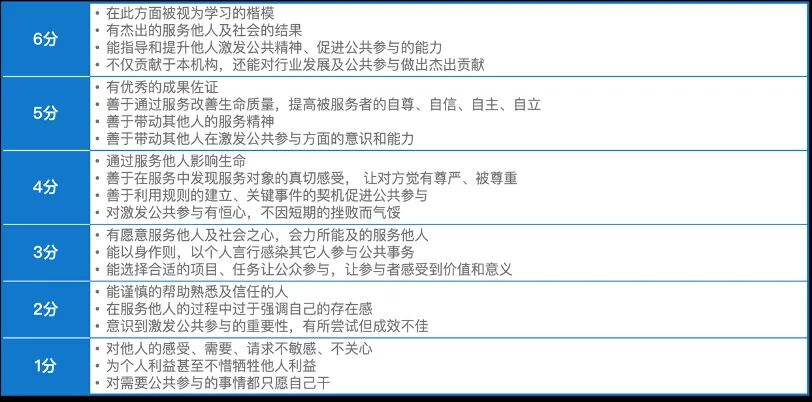
As for graded descriptions of leadership items, these can be used for hiring, feedback, and development assessment. Why graded descriptions? Because everyone's understanding of excellent, good, average, and poor differs. Without standards, evaluating people becomes overly subjective.
The hardest part of graded descriptions is achieving a sense of progression. I recommend using 6 levels rather than 5. This allows for more precise assessment and avoids the tendency of some managers to choose the middle level (3 points) to maintain "moderation" and "flexibility" in their views.
The following example shows the graded evaluation standard for "service orientation" capability (levels 1–6). Of course, achieving truly distinct levels requires a certain degree of writing skill.
When a company actually implements a leadership model or principles, having a perfect set of descriptions alone is far from enough. You need to consider how it matches with the company's talent system.
As one of the starting points for HR work, leadership standards need to connect with and remain consistent with various company systems. This includes their relationship with strategy, company mission, and vision; with the capabilities of existing middle and senior management; and with talent systems such as recruiting, training and enablement, and appointment and development.
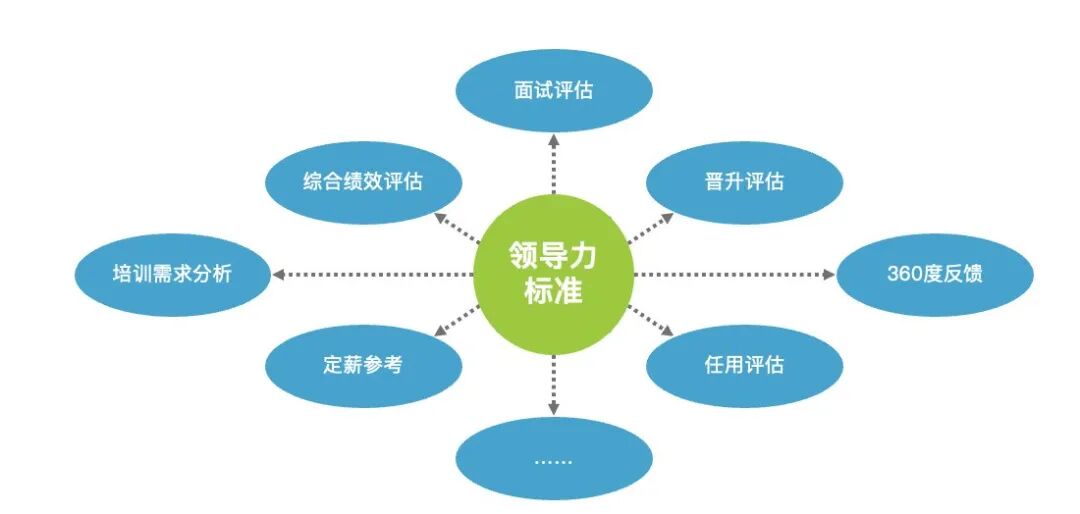
02 Applying Leadership Standards to Recruiting and 360 Feedback
Many managers, when interviewing, first look at candidates' professional capabilities and work experience — which is understandable. But attention to soft qualities is at least equally important.
Leadership standards need to appear in interview forms, with interviewers scoring candidates against graded descriptions. When different interviewers have divergent evaluations, they can review specific cases provided by candidates during interviews, reach a consensus, and then make the hiring decision.
Leadership standards can also be used for employee 360 feedback. Feedback providers (superiors/peers/subordinates) can assess and score the feedback recipient against each leadership item's behavioral description. A single person's assessment of someone's strengths and weaknesses may not be comprehensive or objective, but combining evaluations from superiors, peers, and subordinates often gets closer to the truth.
Employees themselves also need to conduct self-assessments against leadership behavior items. If self-evaluation aligns closely with others' evaluations, it indicates good self-awareness. If self-evaluation is higher than others' evaluations (by more than 1 point), it suggests possible overestimation of oneself. I recommend proactively and sincerely seeking further clarification from feedback providers to help identify "blind spots" and continuously improve.
High-quality feedback is a gift. Feedback on specific behaviors is less likely to trigger emotional reactions. For example, "I think you're too lazy" or "I think you have a bad personality" — such feedback is worthless. But if changed to "I think you can further improve your proposal capabilities" (one of the behavioral requirements for "efficient communication and collaboration" in the company's leadership standards), "That proposal last time was below our standards; you didn't explain XX clearly. Next time, I expect you to reference some excellent proposal templates to improve quality" — this is very concrete, behavior-specific feedback, and the recipient can find a clear direction for improvement.
As a management tool, the primary purpose of 360 feedback is for employees to make targeted improvements based on feedback from collaborators. If many people complete evaluations perfunctorily (for example, giving 4s and 5s across all items), that's not a problem with the tool but with the attitude toward using it.
How to avoid this? Here's one piece of experience to share: don't directly tie 360 feedback results to performance evaluations. Instead, conduct 360 feedback after performance reviews are complete. Only then can the tool be truly utilized and achieve its purpose. Because when feedback happens before performance is determined, people have concerns and tend to "give face" to each other; when it happens after performance is set, the purpose is primarily to help others continuously improve, conveying a completely different set of values and producing different results.
03 Leadership for Training and Appointment Development
A company's leadership standards must also align with talent cultivation and appointment development. Training design for different groups needs to reference graded leadership requirements.
For example, Training Program 1 targets new employees and new managers, Training Program 2 targets director-level staff, and Training Program 3 targets general managers and above — course content needs differentiated design accordingly. Communication and collaboration training at the director level differs in depth from that for supervisors/managers; one set of teaching materials is definitely insufficient. Only by designing leadership training courses at different levels can you achieve relevance for different groups.
Regarding application in appointment development, I think we can draw on Procter & Gamble's Work and Development Plan tool. It mainly consists of the following components:
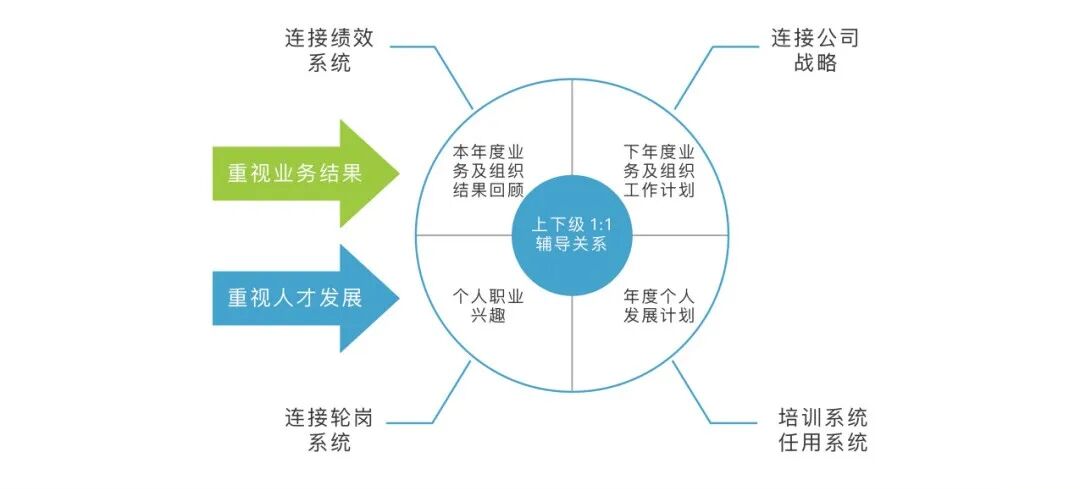
- Next year's business and organizational work plan: The employee's annual work plan (covering both business and organizational dimensions), which needs to connect with company strategy.
- Annual personal development plan: Through 360 feedback, the individual identifies 1–2 leadership behavior items most in need of improvement, such as proactive initiative or cross-functional communication and collaboration skills, thereby linking to the company's training and appointment systems.
- Personal career interests: Most people need rotation every 2–3 years to develop comprehensive experience and capabilities. Employees can write down 1–3 desired positions based on their strengths and interests. Company HR coordinates to match suitable positions based on this information. In principle, outstanding talent is prioritized for more challenging assignments.
- Review of this year's business and organizational results: Used for performance scoring, linking to the performance system.
The company requires that managers have at least quarterly one-on-one conversations with their direct reports, providing feedback on work progress and performance, and through necessary coaching, enhancing employees' awareness and leadership capabilities required for their positions.
04 The Key to Leadership Implementation Lies in Performance Evaluation Dimensions
For employees at different levels, the focus of performance evaluation also differs.
Evaluating a person's performance purely on business results isn't a major problem in a company's early stages; but as a company grows to a certain scale, if it still lacks attention to organizational dimension contributions, this creates many hidden risks.
For example, using performance as the sole basis for promotion can easily lead to wrong promotion decisions. Taking an outstanding salesperson who excels at opening new markets and winning clients and making them a sales manager — if they lack the ability to develop subordinates into equally or even more outstanding performers — then they haven't fulfilled the "selecting and cultivating talent" responsibilities required by that position.
Procter & Gamble's performance evaluation is divided into business contribution and organizational contribution. Of course, the definition of organizational contribution differs by level.
For new employees and junior managers, the focus is mainly on whether the individual achieves better business results through capability improvement. At middle management levels and above, more organizational contribution dimensions are added to evaluation:
- Time spent on campus recruiting
- Time spent on internal training / training effectiveness
- As department/team leader, what proportion of high-performing employees? How many outstanding talents exported to other company departments?
- Whether they led the design or optimization of company-level or department-level organizational processes and mechanisms
So how to emphasize organizational contribution in evaluation? One借鉴 method is: give two performance scores. Business contribution counts as one evaluation, organizational contribution as another, and as level rises, the weight of organizational contribution needs to continuously increase (for director level, it can be set at 50/50). Only those excellent in both business and organizational contributions are candidates for future department heads and general managers.
What's the benefit of this? Because with pure business result orientation, someone might have outstanding business results but actually make no organizational contribution, or even be an organizational rule-breaker. Separate scoring can mitigate the talent selection risks brought by one-sided evaluation.
Some companies conduct values assessments for employees beyond performance results, which is also an approach that balances results and process. One thing to note: if values are used for evaluation, values must have graded descriptions. Vaguely saying someone "has values problems" often creates even bigger problems at the values level.
05 Leadership Creates Organizational Competitiveness for Companies
Another function of leadership cultivation is that while achieving results, employees at all levels have the willingness and capability to simultaneously build and enhance the company's organizational capabilities.
Organizational work often doesn't show results in the short term. For example, upgrading the company's recruiting system or optimizing performance management mechanisms requires not only professional capabilities but also enormous effort and time spent on repetitive work. And you can't be too focused on short-term results or returns; you must be good at facing various misunderstandings and criticisms. These often require exceptional "leadership."
Companies that survive long, endure, and thrive all continuously invest in organizational building. And leadership determines the underlying temperament of a company's talent. The deliberate cultivation of employee leadership, over a longer time horizon, can create organizational competitiveness that cannot be easily replicated.

(This article was compiled and edited by Biji Xia)

Code Brain Issue 31 | Amazon's Ten Compliance Experiences for Going Global
Code Brain Issue 30 | 60 Hours of "Practical Leadership" — Full Highlights Review!
Code Brain Issue 29 | Zheng Yunduan: What Really Drives Organizations?
Code Brain Issue 28 | Understanding Human Nature to Build a Strong "Vanguard" for Going Global
Code Brain Issue 27 | The Origins and Destinations of Carbon
Code Brain Issue 26 | All About Overseas Marketing
Code Brain Issue 25 | Mastering Liu Genghong's Traffic Code
Code Brain Issue 24 | The "Changes" and "Constants" of Equity Financing
Code Brain Issue 23 | Eight Questions on Going Global: Where Are the New Business Opportunities?
Code Brain Issue 22 | Dealing with Supply Chains in "Turbulence"
Code Brain Issue 21 | Clear Despair Beats Vague Hope: On ToB Sales During the Pandemic
Code Brain Issue 20 | Is Your Cash Flow Still Healthy During the Pandemic?
More MaHui members can click "Read More" to view