Code Brain | Li Lu's Peking University Speech: The Puzzles of Our Era, Their Causes, Essence, and Value Investing

Value investing, wherever it's practiced, is always closely tied to the era in which it operates.

In today's era of uncertainty, investors face unprecedented challenges and confusion. This article is adapted from a speech by Li Lu, renowned investor and founder of Himalayan Capital, at the tenth-anniversary salon of the Value Investing course at Peking University's Guanghua School of Management. Drawing on over 30 years of investment experience, Mr. Li delves into the relationship between global value investing and the evolution of our times.
Starting from the perplexities of the era, the article systematically analyzes deep-seated issues in China's and the global economy. Through an examination of the three stages of civilization's evolution — hunting-gathering civilization, agricultural civilization, and modern technological civilization — the author explains the particular historical juncture China currently occupies and the challenges it faces. On this foundation, the article proposes approaches to overcoming the "middle-income trap" and offers unique insights on how to practice value investing amid a complex and shifting international environment.
As a practitioner of value investing, Mr. Li Lu's perspective profoundly reflects the vital role of value investing in the modern economy and its positive significance in promoting sound economic development. This piece carries important implications for understanding the current economic situation and seizing investment opportunities.
Originally published by Munger Academy. Full text approximately 27,250 words. Estimated reading time: 55 minutes.
Thank you, Professor Guohua Jiang, and thank you, Jing Chang, as well as all the teachers, colleagues, and students who made this course possible! When Professor Jiang visited the United States earlier this year, we discussed how this course, over its decade of existence, has made a certain impact in both academic and industry circles. This year, online applications to audit the course have exceeded 1,000.
Ten years ago, our decision to collaborate with Peking University and support this course stemmed largely from my personal experience. Thirty-five years ago, when I first arrived in America, Columbia University happened to offer a course that gave me the opportunity, within a year or two of coming to the US, to meet the master of value investing, Warren Buffett. This changed the trajectory of my life for the next three-plus decades. So we hoped to pass on such opportunities and ideas to young Chinese students.
I have many friends and students here today, both on site and in Beijing. Thank you all very much!
I'll skip the pleasantries and get straight to the topic. In my first lecture in 2015, I spoke on "The Outlook for Value Investing in China." Five years later, in 2019, I discussed "The Unity of Knowledge and Action in the Practice of Value Investing." Earlier this year, Professor Jiang specially came to Seattle to discuss ideas for commemorating the tenth anniversary of the value investing course, and invited me to lecture again. The topic I want to address today is "Global Value Investing and the Times."
In the five years since 2019, both China and the world have undergone many changes that have left investors with considerable confusion. Value investing, wherever it is practiced, is inseparable from the era in which it operates — this is unavoidable. Although value investing generally emphasizes bottom-up fundamental analysis, the companies we invest in exist within a specific era and are more or less affected by macro factors. We cannot escape the age we live in. I'd like to take this opportunity to share some of my personal views.
My presentation today will revolve around four themes:
First, what are the main perplexities of our era. Second, reflections on these perplexities — their causes and essence. Third, views on the middle-income trap, how middle-income countries have made the leap, and some thoughts on current international relations. Fourth, returning to our theme, how to respond to the challenges of our era as a global value investor.
Each of these topics is vast, so I won't be able to go too deeply into any of them, but I will try to cover the key points of each. If there are things I don't get to, I welcome questions during the Q&A session, and I will do my best to share my thinking.
 Seattle event venue
1
The Perplexities of the Era
Let me start with the first theme: what are the perplexities of our era? I'll address this from both domestic and international perspectives.
On the domestic front, everyone has felt this firsthand, especially younger students who have experienced it more deeply — employment has indeed come under tremendous pressure. Data from the National Bureau of Statistics of China shows that unemployment among 16-to-24-year-olds has reached roughly 20%. Behind the employment problem lies the issue of private enterprise confidence. Today China has approximately 700 to 800 million employed people, of whom 80-90% of jobs are provided by non-state enterprises and individuals, mainly private enterprises. State-owned enterprises account for only about 10% of employment. So the employment problem primarily reflects problems in the private economy. In recent years, private entrepreneurs have also faced a series of issues regarding the security of their property and even personal safety.
Of course, the employment problem also reflects consumer confidence issues, which in turn stem from the substantial shrinkage of wealth assets, particularly real estate. Real estate once accounted for roughly 70% of Chinese household wealth; it still stands at about 60% and remains the primary source of household wealth. Therefore, sharp declines in real estate prices and capital market prices inevitably affect people's consumption confidence and expectations for the future.
Over the past few years, because the economy has encountered some problems, we have implemented certain economic policies focused mainly on the supply side. Yet the current problems lie primarily on the demand side, which has also led to the emergence of deflation. The popular domestic term "neijuan" (involution) actually refers to cutthroat competition in a deflationary environment. Competition under normal economic growth conditions doesn't take this form of involution; it's spiraling upward. Additionally, in the current tightened environment, the bureaucratic system lacks effective positive incentive mechanisms, giving rise to the "lying flat" phenomenon, which has also affected policy transmission and implementation. These are some of the perplexities we face domestically.
After more than 40 years of development, China accounts for over 30% of global manufacturing value-added, yet its own consumption represents only about half of that. This means that roughly half of what China produces must be sold to other countries, with developed nations being the largest customers. Although Southeast Asia has become China's largest export trading partner, much of the final consumption doesn't actually occur in Southeast Asian countries — it's transshipment trade, and a significant portion of final consumption still ends up in developed countries.
Internationally, China also faces a series of challenges, particularly in its relationships with developed countries, such as China-US and China-Europe relations. Over the past five or six years, the biggest variable internationally has been the fundamental questioning of the role the United States plays in international society. After World War II, the US has consistently played the role of "anchor" in global affairs, maintaining peace, stability in international trade, freedom of the seas, and international capital flows. It built what could be called the "American order" — an international system encompassing a series of institutions, laws, and dispute resolution mechanisms. In every respect, the US played a central role. Yet in recent years, from elites to the middle class to ordinary citizens, Americans have begun to fundamentally question whether this role is worthwhile. The US bears roughly 80% of global military expenditures, while also serving as the ultimate purchaser of the global economy, provider of currency, and final consumer market, acting as the "anchor" that stabilizes global order. But now Americans broadly believe that the US has gotten the worse end of this deal — that China's rise free-rode on the American order, and that after rising, China has posed a fundamental, even hostile challenge to that order. Regardless of whether this view is right or wrong, it has led the US to begin re-examining its role and resource commitments in the international order. This has not only triggered profound changes in China-US relations but also posed a fundamental question to the international order: how will the international order evolve going forward? Who will invest in and maintain public goods in international trade, such as peace and freedom of navigation? Against this backdrop, what challenges will Chinese industries face, and what role will they play?
To summarize, both domestically and internationally, a series of problems have emerged in recent years that can be called "the perplexities of the era." This perplexity is not limited to one time or place, nor is it merely a short-term phenomenon — rather, it has triggered considerable anxiety about the uncertainty of future prospects.
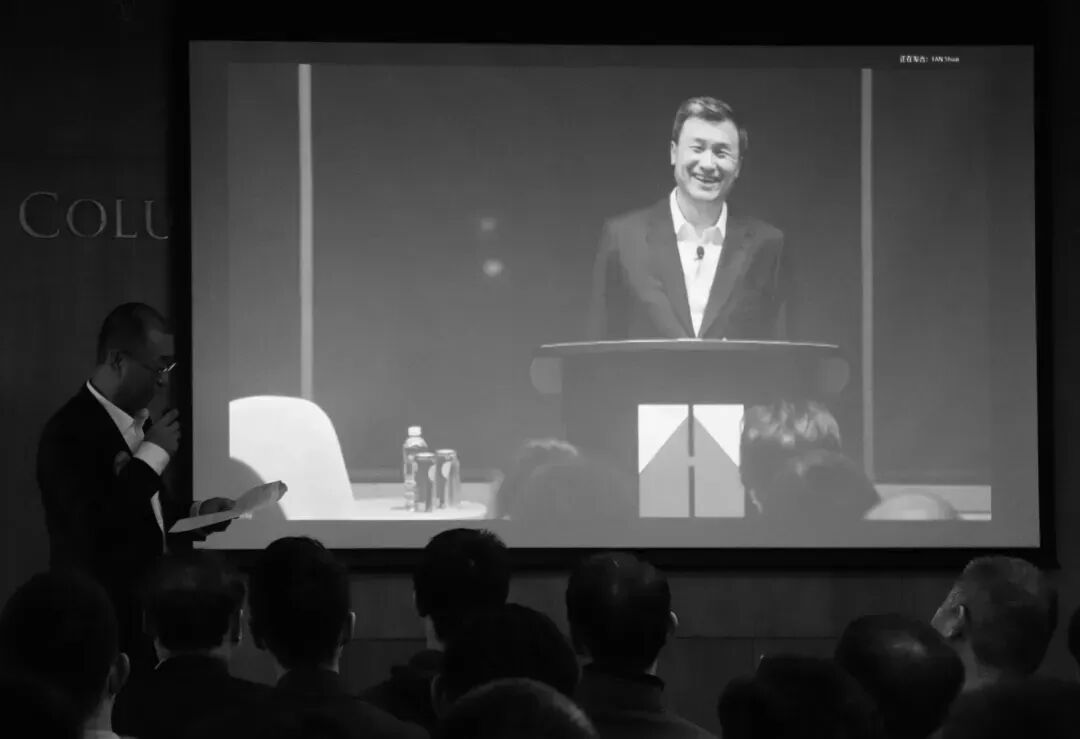 Beijing event venue
2
Reflections on These Perplexities
Next, I'd like to share my reflections on these perplexities.
In fact, these perplexities are not unique to China. Looking back at world history over the past 500 years, all countries, after industrial takeoff and upon entering the middle-income stage, enter a period of intermediate consolidation. This is a universal problem that all countries face in the development process.
In Civilization, Modernization, Value Investing and China, I divide the evolution of civilization into three stages: 1.0 hunting-gathering civilization, 2.0 agricultural civilization, and 3.0 modern technological civilization. The intermediate consolidation period, I call stage 2.5. China is today at stage 2.5. All countries that have undergone industrialization takeoff — Germany, Japan, some countries in South America and Southeast Asia — have gone through similar stages and faced the challenges China faces today. Some countries successfully made the leap; others remain mired in the middle-income trap to this day. Each country's path through this stage differs. Moreover, from the perspective of international order, in the entire history of human international relations, there has never yet emerged an international relations model for the "3.0 technological civilization era."
Now let's return to the root causes of the problem. The essence of modernization is the automatic, compounding, and sustained economic growth brought about by the combination of market economy and modern technology. Compounding economic growth is a terrifying mathematical concept. Compared to the early reform and opening-up period, China's actual economic growth has reached several dozenfold or even a hundredfold; the nominal growth figures are even more staggering. Yet while the economy experienced compounding growth, social governance, cultural psychology, and political institutions did not undergo equivalent compounding change. The fundamental reason is that human nature has not fundamentally changed in the 200,000 years since the emergence of Homo sapiens. By contrast, our economy has undergone three great leaps: from hunter-gatherer civilization to agricultural civilization, and then to modern technological civilization. Therefore, after the early industrial takeoff phase ended, an inevitable and enormous gap emerged between the reality of compounding economic development and the slow or nonexistent change in social, psychological, and political governance methods. This gap triggers various problems — something all countries experience at this stage.
So is China unique in having achieved such massive economic development in just three to four decades? Not at all. Historically, Britain was the only country to independently complete industrialization and modernization, and its timeline was indeed quite long. But all other countries achieved this through catch-up, and catch-up typically requires only three to four decades. Japan, for instance, went from the Meiji Restoration in 1868 to defeating industrialized Russia in 1905 — a span of just over thirty years. Germany's industrialization from unification to World War I took roughly three to four decades. The United States began large-scale industrialization after the Civil War and became the world's largest economy by the 1890s — again, three to four decades. South America's high economic growth after World War II until falling into the middle-income trap in the 1980s and 1990s also spanned three to four decades.
Three to four decades of compounding growth is sufficient to produce enormous economic changes in an economy, especially during the takeoff phase. This economic change creates a significant gap with the reality of social governance, posing major challenges. The various problems triggered at this stage typically represent a comprehensive challenge to society. Some societies can organize themselves to cross this stage; others require a long period of consolidation; and some even go astray during adjustment, leading to serious tragedies. The backgrounds of World War I and World War II were somewhat related to this. But history has proven that war itself cannot solve this problem; what truly solved it was the postwar transformation in governance.
Next, let's analyze the changes in thinking during this process through several specific examples. The first example concerns the concept of "land." In the 2.0 agricultural civilization era, land and population were the primary determinants of an economy's scale — together they essentially constituted an economy's total output. But agricultural economies had a ceiling: the Malthusian trap. Land expansion led to population growth, but when population growth exceeded the land's carrying capacity, the land could no longer support more people. Therefore, territorial expansion has always been the most important demand of communities, ethnic groups, and nations. Many figures who left their mark in history are associated with either territorial expansion or defending land from invasion.
However, in the 3.0 technological civilization era, as the economy enters a stage of sustainable, compounding growth, the causes and drivers of economic growth are no longer land and population, but rather the size of markets and the degree of free flow of production factors. This difference between old and new concepts was the most important cause of World War I and World War II.
When World War I broke out, all sides expected the war to end within weeks. But once a war for land began, the deeply rooted concepts in popular psychology were fully activated, and the result was that industrialized Europe rapidly plunged into total war. This war ultimately caused fifty to sixty million deaths; none of the empires that participated survived — all collapsed. The demands these empires pursued in the war also ended in failure. Had such an outcome been foreseeable, presumably no party would have been willing to launch or participate in this war. Even the victorious nations paid enormous costs and suffered heavy losses.
World War I and World War II were essentially one war, with a brief dozen or so years of peace in between; World War II was fundamentally a continuation of World War I. People's deeply rooted demands for land and psychological dependence on it led to the persistence of both wars. But the enormous destructive power brought by industrialization made the results of these two wars especially catastrophic. In World War II, global population losses exceeded one hundred million; all empires and participating nations suffered severe devastation.
By contrast, Germany and Japan after World War II, though defeated countries, saw all their wartime demands realized through the forced reforms that followed defeat. Germany was the principal instigator of both wars, and Japan was the principal instigator in the Pacific theater of World War II. Their pursuit of territory was essentially a pursuit of so-called living space, and their mobilization of the populace for war was launched from the perspective of national living space and racial economic development. Yet the demands these two countries failed to achieve through war were realized in the peace that followed defeat. After World War II, both countries welcomed sustainable and boundless growth opportunities.
The most important event was that after World War II, the United States became the first country in human history to return all territory gained in war to the original countries without compensation. This had never happened in previous wars. But in exchange, the United States established an international trade, commodity exchange, and capital exchange system based on American ideals. All American allies joined this system. It was precisely the formation of this system that enabled these countries and the United States to achieve borderless economic development together. This was because in the 3.0 technological civilization era, land was no longer the most important factor for economic growth; it was replaced by market scale and the free flow of economic factors, including technology, human resources, and capital.
Today our obsession with land still exists. At the current 2.5 stage, this is the most dangerous factor. The obsession with land can still ignite the national emotions of a population or a country at any moment, because this concept has been deeply embedded in human thought for tens of thousands of years.
Let me give a second example. In recent years, many government policies have frequently distinguished between the "real economy" and the "virtual economy," emphasizing concentrated support for the real economy and a shift "from virtual to real." This conceptual distinction genuinely existed during the agricultural era and industrial takeoff phase, because industrial takeoff essentially meant using industrialization to solve agricultural resource problems. But after entering the 2.5 stage, especially after entering the mature economy stage, this distinction no longer holds; it is a false concept.
For example, are games part of the virtual economy or the real economy? Many people consider them a typical example of the virtual economy. But on today's battlefields in Russia and Ukraine, what determines victory or defeat is no longer tanks, machine guns, or even unintelligent missiles, but intelligent drones. The operators of these intelligent drones are all gamers. There are roughly one to two million combat drones on the Russia-Ukraine battlefield today, and the primary "warriors" of these drone forces are gamers. Viewed this way, the boundary between so-called virtual and real economies has actually become quite blurred.
Consider software — is it real economy or virtual economy? In fact, software is the most important element controlling today's global economy. Without software, neither the world economy nor the Chinese economy could function normally.
Semiconductors are a real industry that China has focused on developing in recent years. Today the world's most famous semiconductor company is NVIDIA, and NVIDIA is clearly a real economy company. But in the 31 years since its founding in 1993, NVIDIA has never produced a single wafer — all production is outsourced to TSMC. NVIDIA is essentially a software design company; its products are software for chip operation, which gives it characteristics of the so-called virtual economy. Before AI applications emerged, NVIDIA's largest customers were gaming companies.
Speaking of the real economy, Germany is often regarded as a model; its industrial model retains strong real economy strength without being hollowed out, and is frequently used as evidence to support policy arguments. Yet today, the market cap of NVIDIA, this "virtual economy" company, has exceeded the combined market cap of all listed companies in Germany, and even exceeds the combined market cap of all stocks in Germany and Italy together, exceeding the total stock market value of more than 100 countries worldwide. In fact, calculated at today's stock prices, only five countries have total stock market values higher than NVIDIA's market cap. Of course, NVIDIA's market cap as a "virtual economy" company may be full of bubbles. But today, whether in gaming, cloud computing, or especially AI, no company can operate independently of NVIDIA. The virtual and real economies have become inseparable, and this distinction is no longer even necessary. This is another example showing how many old concepts still profoundly influence our judgment of today's economy.
The final example concerns the function of government. In the process of economic transformation, what should the government's function be?
At the domestic level, in the agricultural economy era, both centralization and decentralization had certain benefits; in the planned economy, government basically had a command function, and after reform it transitioned to a guidance function. But the basic essence of market economy is this: all major economic decisions need to be made independently and separately by entrepreneurs with personal stakes, in a fully competitive environment. Today China's economy has reached $18 trillion in scale, with over 100 million enterprises, making billions or even tens of billions of dollars in economic decisions daily. The complexity and scale of these decisions far exceed what any small group of people can influence, plan, or guide.
At the international level, half of the products China produces must be sold worldwide; China has become the first or second largest trading partner of 120 countries, and the combined economic output of these 120 countries accounts for over 80% of global economic output excluding China. The lives of billions of people in these countries are also deeply influenced by billions of private decisions in China. If the Chinese government still thinks about and responds to problems using command or guidance functions, those affected will include not only the 1.4 billion people of China, but the lives of one to two billion people worldwide.
Today, virtually all major global media have China-related content on their front pages almost daily. This is because many decisions by the Chinese government already have broad and profound global effects, directly related to the livelihoods and interests of at least several billion people. In most countries' transitions from agricultural economy to modern technological economy, government functions have gradually shifted from command and guidance types to republican, consultative, supportive, and service types. The transformation of government function is not only a practical requirement of China's current development, but is also determined by the nature of the Chinese economy itself. China's need to trade with all countries and sell half its production worldwide means that our thinking about government function must fully take into account the interests, ideas, and economic reality requirements of these people.
These three examples illustrate that after entering the middle-income stage, the reality of cumulative economic growth creates many conceptual gaps with traditional thinking, governance structures, and the slow change in human nature. These gaps manifest in all aspects of the economy. Therefore, we need to constantly re-examine those old concepts that have hindered economic development and make adjustments.
On the Middle-Income Trap, the Crossing of Middle-Income Countries, and Contemporary International Relations
Looking back at the modernization process of the past 500 years, both China and other countries have accumulated a series of experiences and lessons that provide us with much useful guidance. On this basis, we turn to our third theme: whether China can cross the middle-income stage, and how China should respond to today's international environment.
First, the reason 3.0 economy can sustain continuous, spontaneous growth is primarily because all economic factors within it can engage in full exchange and circulation. Every process of free trade and free exchange produces a 1+1>2 effect, while exchanges at the knowledge level can even produce a 1+1>4 effect. Therefore, the more and the fuller the free exchange of goods, services, and ideas, the greater the incremental value they create. Truly modern, sustainably growing 3.0 economies all possess this most important characteristic: full exchange and circulation of all factors in the economy, without blockages.
Looking at China's current situation, which factors have not yet achieved this full exchange and circulation? Here I give two examples.
First, personal consumption in China accounts for only 40% of the overall economy, and this share has been declining in recent years. At the same time, the savings rate has been rising, from 40% to roughly 50%. The vast majority of these savings remain within the banking system, which is dominated by state-owned banks. Can the state-owned banking system fully channel these savings into economic circulation? The answer is no — there has never been a successful case of this, anywhere in history, in any country. To direct savings into systems that truly benefit economic growth requires a modern capital market and a modern, efficient financial system to promote effective allocation and circulation of capital.
Looking back at the history of modern economic development, the earliest financial system was born in a very small country: Venice.
Venice was the longest-lasting republic in human history, enduring from the mid-Medieval period through the Napoleonic era — more than a thousand years. Between 1000 and 1500 AD, despite having only a few hundred thousand people, Venice virtually monopolized the most important trade connecting Asia and Europe, becoming the largest trading empire of its time.
What was the key to Venice's success? Venice's greatest achievement was being the first to invent a crucial part of the modern financial system: double-entry bookkeeping, followed by the joint-stock company, insurance systems, and modern banking institutions related to modern trade.
Venice relied primarily on finance and trade. It had limited hinterland, lacked agriculture and industry, and other countries remained in the agricultural age. So Venice could not develop a true 3.0 modern technological civilization. But the financial institutions and tools Venice invented were soon further developed and extended in the next country: the Netherlands.
In 1581, the Netherlands declared independence, then endured 70 years of war. Yet in the 17th century it rose to become the most important long-distance trading empire, with roughly one-quarter of global trade carried on Dutch ships. The Netherlands had only a few million people — not much larger than Venice — but it produced the complete embryo of the modern financial system. Most importantly, it invented the limited-liability joint-stock company with public participation. The world's first public company was the Dutch East India Company. The Netherlands also established a central bank and stock exchange. Its securities markets developed to such an extent that they produced the first speculative bubble in human history: the tulip mania. Because of these innovations, Dutch per capita GDP far exceeded that of other European countries by more than tenfold, and remained in the global top ten for the next four centuries. Today the Netherlands remains one of the world's largest trading nations, having sustained prosperity for more than 400 years.
Of course, the Netherlands also failed to develop a 3.0 economy in the standard sense. The 3.0 economy with industry, technology, and manufacturing was completed by Britain. How did Britain accomplish this? The most important event in British history was the Glorious Revolution of 1688. The Glorious Revolution achieved two things. First, it adopted a republican, constitutional monarchy in governance. From then on, Britain no longer had fully autocratic power; royal authority was constrained by various forces. The second achievement may have been even more profound: it completed a "merger" — the Netherlands and Britain became one in financial markets. William III, the de facto leader of the Netherlands, and his wife Mary II became co-monarchs of Britain. So William III was simultaneously the de facto supreme leader of both the Netherlands and Britain. He transplanted the entire Dutch financial system to Britain — a merger of institutions.
The direct effect of this merger was to bring Britain a complete modern financial system. So what is the ultimate product that a complete modern capital market and financial system provides?
What capital markets provide is not merely capital, but more importantly, a credit system. Banks can also provide capital, but they cannot provide a credit system. What is a credit system? Entrepreneurs must have entrepreneurs' credit, investors must have investors' credit, intermediaries connecting savings and investment must have intermediaries' credit — ultimately converging into one result: aggregating the small sums of ordinary savers who know nothing about business into enormous investment power. The result of this investment power is the generation of effective productivity, effective supply and demand, effective profits that flow back, forming an overall, fully fluid process. In this process, every industry is an independent, specialized node, not directly connected to the final outcome but all highly correlated. Their correlation is established indirectly through credit. So even an ordinary small saver can ultimately participate in a small piece of a successful company — buying one share contributes to the whole. Throughout the entire process, every creditworthy intermediary plays the role it should play, and on the foundation of credit, aggregates these resources toward the most deserving ultimate enterprises and consumption.
What this entire process establishes is a complete credit system. Connected to the credit system is a complete set of legal institutions, dispute resolution, customary practices, and mutual trust. This system is extremely difficult to build and requires constant trial and error. After Britain transplanted and established this system, it never lost another war with Europe. In the past, Britain had supported war through royal power, its own assets, revenue, and territory, bearing unlimited liability. Now this was replaced by the new credit system. Through this system, British debt issuance at one point exceeded its GDP several times over. It attracted global investment and never went bankrupt or defaulted. This was the first truly modern capital market system.
When technological innovation began to emerge, this modern system enabled Britain to rapidly establish the first modern, sustainable, modernized country in the modern sense — a 3.0 economy, a self-generating, spontaneous, continuously growing economic system. This is what we define as a modern nation.
Returning to the two figures from earlier: personal consumption in China accounts for only 40% of GDP, with nearly 50% going to savings. Savings are almost entirely controlled by the state-owned banking system, whose efficiency is limited and which cannot establish a credit system. The capital market system we have built, still in its infancy, has also been shrinking in recent years. China's existing system is far from a modern capital market system in the true sense, and currently lacks the capacity to convert massive savings into potential consumption and get the economy running.
But China and Britain share a similar historical opportunity. What is this historical opportunity? Britain left China a gift: Hong Kong.
Hong Kong possesses all the elements of a modern capital market: complete institutions, laws, historical traditions, dispute resolution mechanisms, credit intermediaries, and the traditional trust of international investors and the international community. But these advantages have not yet been truly utilized.
If the Netherlands and Britain represented a merger of equals, China's relationship with Hong Kong is more like an acquisition — and acquisitions are often not sufficiently cherished. This is a crucial difference. If Hong Kong's advantages could be truly utilized, it could serve as an important embryo for getting China's capital markets functioning again. Hong Kong and mainland China's capital markets could operate separately. This is like the early Shenzhen Special Economic Zone, which operated under an entirely different system, with the two systems running in parallel, ultimately catalyzing the wave of reform. The principle is the same. Stock Connect was an important innovation, but only a beginning. If we could fully utilize this Hong Kong market system obtained through acquisition, we could establish a modern capital market system with credit functions. The gap between today's actual state and this goal remains considerable, and understanding and appreciation of it are far from adequate. Moreover, some practices in recent years have threatened the foundation of Hong Kong's existence as an independent financial market. If not corrected in time, the consequences would be incalculable.
Therefore, the gap between our economy and its potential real growth level remains substantial. Currently we can only rely on policy stimulus, but stimulus is not very sustainable. Only sustainable growth brought about through stimulus is effective. If stimulus fails to produce sustainable growth, then we can only depend on new stimulus every year.
We have been talking about "Chinese-style modernization." This is correct, because every country has its uniqueness. But the essence of Chinese-style modernization is also modernization, so it possesses many commonalities. We must promote modernization on the foundation of these commonalities. Commonalities and particularities complementing each other — this is true practice.
Commonalities are consensus formed over the past several centuries from lessons of failure and experience of success, about what approaches work and what do not. As Charlie Munger said, common sense is the most scarce form of cognition. Because this cognition is often formed only after paying the price for violating common sense.
The modern market economy has been operating for four or five hundred years. There is no need to discuss or question certain consensus points about it, much less casually criticize or deny them. This consensus was first summarized by Adam Smith in The Wealth of Nations, published in 1776. At that time, the market economy system he observed was gradually maturing from the Netherlands to Britain, having already been practiced for one or two centuries. He perceived that although human nature is selfish, the greatest aspect of the market economy is that through division of labor and free competition, it transforms individuals' pursuit of private interest into public benefit for society as a whole, achieving optimal allocation of social resources, promoting continuous economic growth, bringing benefits to all social classes, and promoting healthy mobility between classes.
We often speak of the ideal of "all for one, one for all." In fact, this has already been realized in the market economy. The market economy system achieves the social good of "one for all" through the incentive mechanism of "all for one." This system is certainly imperfect, but among the various imperfect institutions humans have invented, the market economy is undoubtedly one of the greatest institutional inventions. This has been repeatedly proven by various successful and failed social practices over the past several centuries. There is no need to criticize and deny these already-formed consensus points, no need to pay the price of violating common sense again.
Second, in a market economy, decisions on allocating the vast majority of resources need to be made by private individuals. As a certain elder entrepreneur put it, let the frontline soldiers who can hear the gunfire make the decisions. Those in the rear cannot hear the gunfire, so it is difficult for them to make correct decisions. Therefore, the success of China's market economy was achieved through a process in which the government continuously relinquished power, continuously withdrew, and transformed from command to service functions. Technological development is also the result of a highly marketized economy, not its cause. These are not only familiar truths about the market economy, but also basic consensus widely recognized.
Furthermore, basic guarantees for personal safety and property must be provided. For private enterprises to develop, entrepreneurs must first have guarantees of personal safety. Without guarantees of personal safety, no one can build a successful enterprise. Resolution of legal disputes requires procedural justice. The difference between what we call "rule by law" (fazhi) and "legal system" (fazhi) lies largely in whether government power is checked by law, and whether legal procedures are just. If phenomena such as "arbitrary enforcement," "selective enforcement," or "long-distance fishing" occur, do entrepreneurs have the right to defend their legitimate interests through law? Will officials who break the law receive due legal punishment? Will officials who condone illegal acts be punished by law? Can ordinary citizens and entrepreneurs effectively protect their own interests through law and procedure, rather than only through administrative intervention by higher-level leaders with greater power? This is what we mean by procedural justice. These are the most fundamental needs of social development.
At the same time, a sound, complete capital market is the most important guarantee for the full circulation of economic factors. Today, without such a market, the result is that personal consumption accounts for only 40% of GDP, while the savings rate hovers near 50%. These figures show that resources are not flowing completely and efficiently. In fact, all countries that have taken off industrially and then entered a period of intermediate consolidation have faced the same problem — this is not unique to China. Some countries successfully navigated this stage; others experienced great tragedies, even descended into war, and ultimately escaped their predicament only through defeat in that war; still others remain trapped in this process. How do we get through it? We must maintain the universal characteristics of a market economy while also respecting the particular qualities endowed by Chinese tradition — that is, achieving truly Chinese-style modernization. Achieving this goal ultimately depends on the test of practice and continuous correction. There is no fixed model of modernization that can be copied wholesale.
Looking back to the beginning of reform and opening up, Deng Xiaoping said that practice is the criterion for testing truth — whether something works depends on results. He also said we must keep exploring, "crossing the river by feeling the stones," with no fixed rules. At this stage, much top-level design often proves not particularly applicable; it needs continuous adjustment through practice. What is the KPI of practice? Achieving true modernization. And what is true modernization? It is China being able to rely on spontaneous, endogenous forces to generate sustainable economic growth. Spontaneous, original, sustainable economic growth is the KPI.
The greatest driver of this comes from personal consumption as a share of GDP. This is the most original, spontaneous, and sustainable source of economic growth; everything else serves it and is not sustainable. What is sustainable is continuous, improving, newly emerging demand — this is the most enduring, most original, never-marginal source of growth power in a market economy. Today, personal consumption in China accounts for only 40% of GDP, yet there is savings as high as 50% that could be converted into drivers of economic development, into new services, new products, and the birth of new enterprises. China has the most outstanding entrepreneurs, the most outstanding engineers, the largest and most unified market of individual demand and supply, no shortage of creditworthy investors, and appeal to global professional institutions along the credit system chain. These conditions provide enormous potential for achieving spontaneous, sustainable economic growth.
By comparison, personal consumption in India accounts for 60% of GDP, and this growth is sustainable; in the United States this proportion exceeds 70%, and its growth is sustainable as well. Once China enters this stage, its growth will likewise be sustainable. But we have not yet entered this process. This is both our present challenge and an important opportunity.
To reignite the engine of economic growth from its current sluggish state, we need to find a leverage point. But if we try to grasp everything at once, it is difficult to succeed — "wanting both this and that" is hard to achieve, so there must be breakthroughs, there must be priorities. Where, then, lies the breakthrough point?
The economy as a whole is an interlocking chain involving many nodes: entrepreneurial spirit, consumer confidence, positive incentives within the official system, foreign capital's trust, improvement in China-US relations, optimization of the international trade environment, or making use of Hong Kong's capital market, protecting its independence, restoring its dynamism, and so on. All of these are nodes on the chain, and these nodes are interconnected with one another. So the question is: which is the chicken, and which is the egg? Where do we begin? The answer is simple: every node is both "chicken" and "egg," every node can "lay eggs," any node can initiate a chain reaction because they all interact with one another. Stimulating any one point can ignite the entire economic chain. But right now, all nodes on our chain have problems — this is the confusion of our era.
However, starting from September this year, we have at least seen a major shift in policy. As long as we adhere to the principle that practice is the criterion for testing truth, keep trial and error, and persevere, we will eventually ignite some node. Once ignited, each node will drive other nodes, because the various nodes on the chain are all connected, form a whole, and are mutually cause and effect — every node is "chicken," and every node is also "egg." So we need not be rigid about some fixed direction; as long as the environment is relatively relaxed, for an economy as massive as China's, many moments that truly trigger enormous change often occur by chance.
For example, at the beginning of reform and opening up, who could have predicted that several dozen farm households signing a blood oath among themselves to implement the household responsibility system would ignite forty years of magnificent reform in China? This single reform measure solved the food and clothing problem of that time within a short year — at least in certain localities it did. Similarly, reform in the Shenzhen Special Economic Zone alone quickly ignited a nationwide wave of reform, solving in a very short time problems that China had been unable to resolve for decades. The facts have proven that many major changes do not require advance planning, and cannot be planned in advance, because China is simply too large.
China's potential remains enormous. The problems we face at this stage are those that all countries that have experienced industrial takeoff have encountered — there is nothing special about them. These problems stem to a large extent from our deep-rooted concepts — formed during the agricultural civilization period, or even earlier — creating a massive gap with the new economic reality brought by huge, compounding growth. We need to re-examine past concepts within this gap, testing which are right and which are wrong? In practice, I believe Mr. Lee Kuan Yew's philosophy is correct — resolutely copy and implement what has been proven to work; resolutely avoid what has been proven unworkable. This is a very simple yet profoundly deep principle of governance. Ultimately, we must still adhere to the principle that practice is the criterion for testing truth, using practical results to test our ideas and approaches. At the present stage of development, the most important practice is promoting China's spontaneous, externally unaffected, sustainable economic growth, and the most important variable in this is personal consumption as a share of GDP. If this proportion rises from the current 40% to India's 60%, China's sustainable economic growth will have enormous room for development and prospects.
In this process, we must reignite, activate, and reconnect all the elements on the chain. This chain has many nodes: entrepreneurs, consumers, capable officials, foreign capital, investors, professional creditworthy institutions, as well as China-US relations, China-Europe relations, China and Southeast Asia, China and all other trading partners, and so on. These nodes are all "chickens" and all "eggs," all "chickens that can lay eggs." Any node that is ignited can drive the operation of the entire chain. And the problem now is that the whole chain is relatively static, not yet in motion — including the special gift to China that we just discussed, Hong Kong, equivalent to what the Netherlands gave Britain.
The credit system produced by a modern capital market is something that a state-controlled banking system cannot provide — this is not what banks can or should do. Banks cannot assume the role of venture capital; if banks were made to do venture capital, people would not feel secure depositing money in banks, and then banks would cease to exist. And a listed company like NVIDIA was born and developed precisely by converting savings bit by bit into capital through a series of intermediary institutions and a credit system. This system also includes legal institutions, routine norms, dispute resolution mechanisms, historical conventions, and trust accumulated over the long term. At present, only Hong Kong's capital market in China possesses all the elements of a modern financial market system. If its independence cannot be guaranteed, this market cannot function effectively. Shenzhen succeeded back then precisely because of the special zone's independence. We must make good use of Hong Kong — at least in the capital market and rule of law spheres, truly implementing the promise of no change for fifty years. Because the characteristic of credibility and credit systems is that they take a very long time to build up, but can be broken in a very short time, by very few things. Hong Kong's market and system need to be cherished and protected, and the prerequisite for this is understanding their importance.
4
How Should Global Value Investors
Respond to the Challenges of the Era?
Why have I spent so much time on the preceding content? Because the biggest change in the five years since my last speech is that everyone's confusion and anxiety have clearly increased. And carrying confusion and unease, wanting to hold stocks firmly, to truly do long-term investing well, is extremely difficult. Finally, we return to the fourth theme: as global value investors, facing today's changes in the international and domestic situation, how do we respond, how do we invest?
First, our basic attitude is: the macro environment exists objectively, we can only accept it; it is at the micro level where we can actually accomplish something. This is the fundamental attitude of a value investor. The world is an objective existence; it will not change because of our wishes, assumptions, or subjective judgments. Our investing must be to take the world the way it is, not what we wish to be, what we want to be. It is what it is, take it. (Accept the world as it is, not as we hope it to be, not as we want it to be. Everything is as it is; accept it calmly.) On this premise, we act at the micro level, on specific companies.
The question is: under such macro confusion, can we truly hold these companies firmly? Even after careful research and analysis, feeling fully confident in the companies themselves, can we hold them firmly under these circumstances? With the foregoing as foundation, this is precisely the core issue we want to address today.
To answer this question, we must first answer: in the long-term, large-scale evolution of the world from agricultural civilization to modern civilization, the entire world including China has undergone enormous changes. Against this historical backdrop, what is true wealth? The purpose of investing is to preserve and increase wealth, so we must first answer: what is wealth? What are we investing in? What is our investment target?
For example, in the agricultural civilization era, wealth was land and population. So, is land still wealth today? Looking back over world history, especially in Europe, the feudal system lasted hundreds or even thousands of years; many countries' feudal systems were dismantled through revolution, with one exception — Britain. Over these several centuries, Britain did not experience major revolution, and many nobles who originally owned land still retain much land and magnificent castles. In the past, they were the wealthiest people. Yet, are these nobles still wealthy today? The answer is no. Most nobles who own only land and castles are no longer wealthy, and have even become relatively poor. Only a few nobles remain affluent because they have other investments, not merely relying on their original land and castles.
Why is this? Because maintaining land and castles requires enormous manpower. A large castle easily needs dozens or even hundreds of servants to keep running. Yet over the past several centuries, the value of people has changed enormously, to the point that nobles today can no longer afford so many servants. Similarly, land also requires hired labor to cultivate; the value of people has increased, while the output increase of land itself is relatively small, and the value increase of country houses is also slight, with maintenance costs instead being very high. So this land and castles, not converted to industrial or commercial use, have become burdens for the nobles rather than assets. Today, British nobles who can still maintain their land and castles mostly do so by opening them to public visitors for income. For example, opening the castle as a park and charging five pounds admission per person. I believe many of you here have traveled to Britain and visited similar castles, and some have even rented castles to hold birthday parties, company dinners, weddings, and so on. This is an example of the changing relative value of land and population.
Here’s another example. Cash certainly has value, but is cash wealth? Perhaps students today have no memory of this, but those slightly older should recall that in the early days of reform and opening up, there was a term called "ten-thousand-yuan household" — owning ten thousand yuan was considered remarkable. Ten-thousand-yuan households were seen as the wealthiest people of their time. Yet suppose we had deposited that ten thousand yuan in a bank back then; with principal and interest combined, would it still make you wealthy today? Obviously not — many people now earn more than that in a single month. So if you simply hold onto cash, over time it ceases to be wealth.
Whether land, cash, or real estate (especially properties requiring many servants to maintain), none can serve as enduring wealth. Then in modern society, what is wealth? What is its function? The essence of wealth is for consumption. An economy’s aggregate, at its core, is either total production or total consumption. Therefore, wealth is your share of purchasing power within the entire economy. In the era of agricultural civilization, per-unit economic output barely grew; the economic total had a "ceiling." Under such conditions, an individual’s share of purchasing power in the economy remained relatively fixed, achieved mainly through land, population, and real estate — these constituted wealth.
When the economy enters a phase of sustained cumulative growth, despite periodic fluctuations, the long-term trajectory is unidirectional upward. At this point, if your wealth is static, it will gradually erode as the economy grows. The faster the economy grows, the faster your wealth shrinks. Over the past forty-plus years, China’s nominal GDP has grown hundreds or even thousands of times over, so the ten-thousand-yuan households of yesteryear are no longer rich. Similarly, in the United States, "millionaire" was once an impressive concept, and just the other day Warren Buffett noted in his letter that a millionaire in the past roughly equates to a billionaire today. This shows that cash-based, static wealth is not sustainable cumulative growth wealth. When the economy enters an era of sustained cumulative growth, true wealth should be measured by the share of purchasing power you command in the entire economy. And your effective wealth is the share of purchasing power you possess in the economy where you are willing to consume.
Therefore, the fundamental purpose of investing is to preserve and increase your purchasing power. The standard for measuring wealth is your proportion within the economy, not absolute numbers. One person is richer than another because their share of purchasing power in the economy is higher. Having ten thousand yuan today carries none of the significance it did for the ten-thousand-yuan household, because real purchasing power has changed exponentially compared to forty years ago. True wealth is your share in the overall economy. As long as you maintain your share unchanged, you have preserved your wealth — even if the entire economy shrinks due to war or other factors, your wealth has not actually decreased. And if your share rises, your wealth may still be growing. But after entering modern civilization, the "pie" grows in waves yet with sustained cumulative growth, and this continuous growth is the most fundamental, defining characteristic of the modern economy.
Of the eight billion people on Earth today, roughly ten-plus percent have entered an endogenous, self-sustaining, non-dependent growth stage; about fifty percent are in an intermediate transitional state, China included; the remaining population is still in the initial stage of taking off from an agricultural economy toward industrialization. This trend is a centuries-long, ongoing process that cannot be reversed by anyone’s will — a transformation of civilizational paradigm. So as a value investor, you must understand what value is, what is the wealth truly worth pursuing, protecting, and growing — that is, your share of purchasing power in the economy. For global value investors like Himalaya Capital, as fiduciaries, our responsibility is to maintain and enhance our share of purchasing power on a global scale. Specifically, this means representing our investors to find the most dynamic, most creative companies in the world’s most vibrant economies, and by owning their shares, ensuring our purchasing power is preserved and grown.
This way, when the entire economy grows, your wealth naturally grows with it; if your share increases, it means your growth has exceeded the average. And even if the entire economy contracts for various reasons, as long as your share rises, your wealth is still increasing. With this understanding of wealth, you will better grasp the meaning of this statement: the macro is what we must accept; the micro is where we can act. Maintaining this perspective, you can calmly hold shares in the most creative, excellent enterprises without being shaken by fluctuations in the macro environment. Inner calm enables you to hold your chips — your purchasing power — with conviction. This is why we first explored the macro topics earlier, but ultimately we must return to the core of investing.
Moreover, after entering this civilizational paradigm shift, the world economy will continue to grow — a trend that cannot be altered by any country’s will. Countries that stagnate at the middle-income stage, if unable to cross over, will see their relative economic proportions gradually decline. Take South America as an example: at the end of the nineteenth century, both Brazil and Argentina were among the most promising developing countries. Yet they tried multiple times and failed to successfully cross the "middle-income trap." After World War II they had another opportunity, but by the 1980s growth stalled once again. Meanwhile, the world economy as a whole kept growing. These two countries once ranked among the global economic leaders, but today they are barely visible. This is precisely because when they fell into stagnation, other countries and the global economy continued to grow rapidly, causing their share of the global economy to keep sliding downward. This is why we must maintain a certain sense of urgency.
As a global investor, you need to invest in what you consider the most dynamic economies, while also attending to your own practical needs — maintaining your purchasing power where you need to consume. As a global investor, Himalaya Capital’s goal is to select the most dynamic, creative, and competitive enterprises in the most vibrant economies worldwide, hold their shares, and thereby achieve the objective of maintaining and increasing wealth within the global economy. But for individual investors, you need to maintain your purchasing power in the economies where you are willing and need to consume — this is your true wealth. For instance, many Chinese investors’ primary purchasing power needs are in China; they may not need purchasing power in Europe or South America.
In today’s environment, can this goal be achieved? Let us review the origins of value investing. Value investing was born precisely during a period of extreme turbulence and profound confusion in the overall economy and macro environment. The first person to fully articulate the concept of value investing was Ben Graham — Warren Buffett’s teacher. So when did Graham begin to understand and practice value investing? He first started investing in 1926; in his first three years, like many investors, he experienced the "Roaring Twenties" and engaged in much speculation. However, during the Great Depression of 1929–1932, his investment partnership lost 70% of its book value. After deep reflection on this painful lesson, he truly began to practice value investing, and from 1932 to 1935 successfully made up his previous losses. In 1936, he launched a new closed fund, which he ran until 1956; over twenty years it achieved extraordinary returns. During this period, in 1949 he published The Intelligent Investor, for the first time fully articulating the three most important concepts of value investing.
Graham, the founder of value investing, discovered the methodology of value investing precisely when the macro economy faced enormous challenges. What he experienced in that era was far more difficult than the challenges we face today. At that time, unemployment in the United States reached 25%, and the entire economy contracted by roughly one-third to one-half, depending on the assessment method. People generally felt hopeless, as if the world were heading toward apocalypse. By the time he finally broke even and started his new fund, the world quickly plunged into a global war launched by fascism — a war that ultimately caused over one hundred million deaths, several hundred million injuries, and the complete destruction of most of the world’s industrial systems. Against this backdrop, he created outstanding investment performance.
Looking at the era we are in today, compared to the thirty-year period when Graham created and practiced value investing, which period would you choose to build your career in? It is precisely in such turbulent, confusing macro environments that value investing can demonstrate its advantages and play its role. But the prerequisite is that you understand what you are guarding and what your investment objectives are.
Another figure who made enormous contributions to the theory and practice of value investing was the economist John Maynard Keynes. Many are familiar with Keynes’s macroeconomic theories and his contributions to designing the postwar Bretton Woods system and global financial architecture, but few people know that Keynes was also an outstanding value investor. From 1921 until his death in 1946, Keynes managed the endowment fund of King’s College, the most important college at the University of Cambridge, accumulating outstanding investment performance over twenty-five years. Keynes also engaged in much speculation in his early years, but through continuous lessons learned, he began to distill the core concepts of value investing. Keynes’s and Graham’s career trajectories overlapped considerably — both experienced the "Roaring Twenties," the Great Depression, and the world wars. However, unlike Graham, Keynes was in Britain, which stood on the front lines during World War II, while Graham was in the United States, in the war’s rear. Thus Keynes’s performance created against this backdrop carries even greater significance.
Keynes and Graham shared many conceptual commonalities, but Keynes’s investing placed greater emphasis on examining the quality of the companies themselves. Warren Buffett and Charlie Munger later converged with him on this point, and from 1957 to the present, over more than sixty years of investment practice, they have further developed and carried forward this idea.
There was also John Templeton, who played an important role in value investing and in extending it to other countries. In 1939, during the war, many American stocks fell below one dollar. Templeton, adhering to the principle that "cheap is the last word," bought 100 shares each of every stock trading below one dollar in the U.S. market, investing a total of ten thousand dollars. Four years later, when he sold, 100 out of 104 stocks had risen substantially. In 1954, he created the Templeton Fund, beginning to spread value investing to many other countries. By 1992, after thirty-eight years of development through all manner of market changes, this fund had achieved returns of more than ten times.
I founded Himalaya Capital in 1997. Before that, in 1993, I bought my first stock — starting with buying cheap companies. In the process of investing in cheap companies, I gradually built my circle of competence, and slowly transitioned from seeking cheap companies to seeking good and cheap companies. When the fund was founded in 1997, I immediately experienced the Asian financial crisis. In recent years, the China market has undergone a significant drawdown of capital and assets; many people have suffered declines in real estate, stock, and other security prices. Yet the magnitude of this decline still cannot be mentioned in the same breath as the Asian financial crisis of that year. During the 1997–1998 Asian financial crisis, major Asian markets generally fell more than 70%, and in the most severe cases dropped over 90%. Our fund also faced enormous challenges and experienced considerable volatility, but the cumulative performance of those years was precisely one of our periods of very high returns — the market then was truly strewn with gold everywhere.
Here's a story. I was in New York talking with several fund managers, one of them a Korean American. We got to discussing our investments, and he said he was very interested in South Korea. I said I was too. At the time, the Korean stock market had fallen 80-90% in dollar terms — not only had stocks crashed, but the won had depreciated 40-50% against the dollar. He told me about a trade he was putting on: going long POSCO, which was trading at a P/E of just 2x, while shorting Samsung Electronics, which was trading at a P/E of 3x. He said this trade was fantastic, the best investment opportunity he'd found. This vividly captures the state of markets back then. It sounds insane today, but it perfectly represented the prevailing mindset on Wall Street and the alternative investment styles that existed outside of value investing. As an aside, this man's name was Bill Hwang, who later became infamous and nearly brought Credit Suisse to its knees, and was just sentenced to eighteen years in prison by a U.S. court for fraud.
This is why true value investors can achieve long-term returns in the market. No market is perfectly efficient, because a market is not an abstract concept — it is made up of individual people. Many of you probably think the U.S. market is highly efficient, but in my thirty years in this industry, and twenty-seven years managing the fund, I've personally experienced the U.S. stock market falling more than 50% on at least several occasions. During the 2008-2009 financial crisis, the U.S. market fell even harder than China's, and at the time people believed the entire financial system would completely collapse. When COVID first hit, the U.S. market also dropped roughly 30%. In fact, these kinds of severe declines happen almost every few years. During the 2001-2002 dot-com bust, even companies like Amazon fell 90%. The United States is already the most mature and efficient market in the world, yet it still cannot avoid this.
So the fundamental principles of value investing, based on my several decades of practice, are absolutely viable. The pioneers of history all discovered and practiced these basic tenets of value investing during periods when the macro environment faced unprecedented challenges. Let me summarize their most important contributions here.
Ben Graham articulated three important concepts. First, a stock is not just a piece of tradable paper — it is legal proof of ownership in a company. As we discussed earlier, in the process of sustained economic growth, equity can protect your purchasing power. This is important: the essence of investing is preserving and growing purchasing power. Second, markets are composed of individuals, and human nature seeks short-term gains, so people tend to treat stocks as chips for short-term trading while neglecting that they represent long-term ownership in a company. You can think of the market as "Mr. Market" — a very neurotic person whose function is not to tell you true value, but merely to provide prices at which to buy and sell. These prices are often far below or far above value. For the value investor, he provides a service, not guidance. Third, the future is difficult to predict; cheapness is the hard truth, and you must have an adequate margin of safety. Because you may not fully understand a company, nor clearly predict its future. But if you buy at a low enough price, leaving ample margin of safety, your investment will be more secure, and you will be better able to hold for the long term.
For example, the Chinese stock market experienced a major rally from 2005 to 2007. After 2007, it fell continuously for seven or eight years, entering a prolonged bear market. This cycle was highly correlated with the U.S. stock market and the 2008 financial crisis, yet during that period China's economy performed relatively well, and many companies demonstrated strong fundamentals. After seven or eight years of bear market, that market could truly be described as strewn with gold everywhere — many excellent companies' stocks had fallen to levels with very strong margins of safety. Therefore, when people are fearful and anxious, you will often find many opportunities. When these investment opportunities with enormous margins of safety appear, whether you can seize them largely determines whether you can truly create wealth.
Warren Buffett and Charlie Munger, through sixty years of practice, further enriched the philosophy of value investing and provided another principle: Long-term investment returns come, in large measure, from the value created by excellent companies through their long-term performance. Excellent companies can continuously increase intrinsic value, which precisely aligns with the nature of the modern economy itself — that a company's intrinsic value can grow cumulatively and without limit along with the cumulative growth of the economy. These quality companies have long-term returns on capital that exceed industry averages and those of competitors. So investing in such companies, the speed of wealth growth will also outperform the market average. However, selecting and understanding these companies is not easy, so investors must build their own circle of competence, clearly knowing what they understand and what they don't, knowing where the boundaries of that circle lie, only investing within their circle of competence in quality companies they can understand, and holding them for the long term. This is the important contribution of Buffett and Munger. In fact, Keynes had already begun this kind of practice in his era.
The fifth point is Mr. Munger's contribution. I had a twenty-year relationship with Mr. Munger — as friends, as partners, he was my teacher and also my family. Every summer, Mr. Munger and his family would vacation and fish at a small island in Minnesota (Star Island). Fishing was one of Mr. Munger's favorite activities. My wife and family and I attended every year for the past two decades. Minnesota has roughly ten thousand lakes, and Star Island sits in the middle of a large one. But interestingly, every time we went fishing, Mr. Munger would take us to a different place — first boating out from the island, then transferring on shore to a truck towing a fishing boat, then driving an hour to another lake to fish, and each time the location was different. Later I asked him, Charlie, there's this huge lake right next to Star Island, why not just fish here? He said, you can try it. I actually tried once, and found there were almost no fish in the lake, very difficult to catch anything. But those small lakes we went to — every time we came back with full catches.
Later I also discovered that Mr. Munger never knew beforehand which lake we'd go to when fishing — it was always led by a fishing guide. His name was Leroy, whose family had run a bait business for two generations, so he spent all year going to different lakes looking for bait. Through searching for bait, he learned which lakes had fish, and how the species, growth, seasonality, and locations differed in each lake — this was his proprietary knowledge. So many people bought bait from him in order to find out where the fish were. Mr. Munger always had Leroy take us, and every time we caught many fish. I initially assumed every lake had that many fish, but my failed experience at Star Island Lake made me realize each lake truly was different.
So Mr. Munger distilled a fifth principle: Investing is like fishing — you have to fish where the fish are. He said there are two rules of fishing. First, fish where the fish are. Second, never forget the first rule. For investors, this fifth point is also important. Minnesota has over ten thousand lakes, but we don't need to fish in the biggest lake. For individual investors, including institutional investors, it's the same — you don't need to fish in the biggest lake. China's GDP is $18 trillion, with numerous industries and companies. Some perform poorly, but there are also many excellent companies, companies not fully understood by others, and many companies that are completely mispriced. Investors don't need to understand all companies, don't need to master all macroeconomic parameters or government macro policies, and certainly don't need to accurately predict the next ten years. The key is to find that "lake" where you can catch fish. So Mr. Munger's advice to fish where the fish are emphasizes the importance of selection. Later I also noticed that every time we went fishing with Leroy, our group was the only one on the lake the entire day, which guaranteed that we could catch the most and biggest fish there. Insufficient competition is a very important cause of mispricing.
So, investors don't need to over-study macroeconomics, don't need to figure out all ten thousand lakes in Minnesota, and don't need to thoroughly research China's economy or the world economy. But you need to know which lake has fish, where competition is insufficient, and where you understand deeply enough to build your circle of competence — just like Leroy. Leroy built unique capabilities through searching for and raising bait, enabling him to find those unknown lakes teeming with fish. Once everyone knows there's fish somewhere, it becomes hard to catch them — this is his unique circle of competence.
The sixth point is what I've shared with you today, a summary based on the transformation of the entire civilizational paradigm: The essence of wealth is one's share of purchasing power in the economy. The goal of value investing is to hold shares in the most dynamic companies within the most dynamic economy, thereby preserving and growing wealth. This is also the experience and contribution distilled from the Himalayan fund's three decades of practice.
I have been obsessively thinking about and studying the phenomenon of modernization for over forty years, and have gradually discovered that what each country has experienced over the past several centuries is not a unique phenomenon, but rather a shift in human civilization's paradigm. This shift is not subject to the will of any country, individual, or small group — the global economy exhibits a unidirectional, wave-like growth, with rises and falls in the short term, even cyclical fluctuations, but the long-term trend is unidirectional sustained growth. Even during periods when the total global economic pie is shrinking, if you can maintain your share of purchasing power, you preserve your wealth. Then, when the economy begins growing again and the pie expands, you can maintain and continue increasing your wealth. This principle is my personal summary, which I hope to confirm or falsify through future practice.
Let me repeat these six basic principles of value investing:
1. A stock is not just a piece of tradable paper — it represents partial ownership in a company.
2. Mr. Market provides a service to the value investor, not guidance.
3. Investing must have an adequate margin of safety.
4. Investors must clearly define their circle of competence.
5. Fish where the fish are.
6. Wealth is your share of purchasing power in the economy. The goal of value investing is to hold shares in the most dynamic companies within the most dynamic economy, in order to preserve and grow wealth.
My personal experience over these thirty years can also be considered an annotation of these six principles. When I first arrived in the United States, I was penniless, with only negative net worth. To have the opportunity to share our experiences with you today is truly attributable to the practice of value investing. The philosophy of value investing can be practiced, and can be practiced successfully and for the long term. I hope that, like Mr. Buffett and Mr. Munger, I will have another thirty years ahead to continue practicing value investing. Today I am still as passionate about this industry as I was thirty years ago. It is a way to breathe and grow together with the times, and so it is full of attraction.
Finally, let me tell one more small story. Everyone knows that Mr. Munger invested in very few stocks in his lifetime, but he persisted in research his entire life. He once shared that he read Barron's for fifty years, and from it found only one investment idea — but on this investment he made dozens or hundreds of times his return: he first made nearly ten times on this investment itself, then invested the proceeds into our fund and made another ten-plus times. At age 99, Mr. Munger discovered another very interesting stock, somewhat "politically incorrect," that was extremely mispriced, so at 99 he made his only stock purchase in nearly a decade, and lived to see the stock double.
Today happens to be just past the one-year anniversary of Mr. Munger's passing. Last Thanksgiving, Thursday evening, Charlie was having dinner with his family. He felt unwell while eating dessert, so he excused himself early to rest. Friday morning he was hospitalized, Saturday he woke to say his final goodbyes to his family, and Sunday he passed away peacefully. Until the very last moment of his life, his life was peaceful, and he was still engaged in the work he loved most, never stopping.
Such a life inspires and invigorates us. Through his own life and more than sixty years of investment record, Mr. Munger demonstrated this truth to us: the macro is what we must accept; the micro is where we can act, and act with great effect. Engaging in value investing allows us to breathe and grow alongside the times. I believe that those committed to value investing, regardless of where they are or what circumstances they face, can make a difference. I sincerely hope everyone will continue to devote themselves to this wonderful endeavor. Thank you!
Q&A Session
Question 1: When holding quality companies, if the market offers a clearly overvalued price, at what point would you consider reducing your position?
Question 2: Few people manage to hold quality companies for the long term and achieve sustained returns. Is this related to luck and courage? When young people face insufficient information or need to overturn their existing understanding, how can they make investment decisions amid uncertainty? Did you experience such confusion when you were young?
Li Lu: Regarding selling, my considerations are mainly as follows. First, if I discover I've made a mistake, I sell immediately. Second, when there's a better investment opportunity with superior risk-reward and downside-upside profiles, I choose to swap. Third, when the market exhibits extreme overvaluation bubbles. But valuation is often a concept in the dimension of time, largely depending on a company's long-term growth capacity. A common human failing is to magnify short-term factors while diminishing or ignoring long-term ones. So you need to build your circle of competence — the deeper your research, the more thorough your understanding. Short-term overvaluation becomes less significant when compared to long-term growth. However, finding and understanding companies capable of long-term growth is extraordinarily difficult. Such companies possess sustained competitive advantages that outpace rivals over time, have vast room for growth, and demonstrate excellent returns on capital. They are exceedingly rare, which is why we call them the "holy grail." The best investments are often made in companies with enduring competitive strength and growth potential. Once you truly find and understand such a company, I generally advise against casually discarding this chip. If you sell because it seems overvalued and then want to buy back, you'll find yourself facing the same problem — it's still overvalued, and you'll have to keep waiting. In the waiting, its growth may have far exceeded the value you originally estimated. With truly excellent companies, this is even more likely to happen. With less excellent companies, that's a different matter entirely.
In one's entire investment career, truly finding such companies isn't easy, because they're inherently scarce. A quality company that you've thoroughly researched and that also happens to be cheap — this kind of opportunity is extremely rare. In my 30 years of investing, I've only encountered it a handful of times. At the same time, whether you can hold such companies for the long term also matters. No matter how long you've held them, you must keep learning.
Take Berkshire Hathaway as an example. We all consider it a fortress company, managed by the world's finest investors, standing unshaken for over 60 years. Yet its stock price has also fallen more than 50% on three or four occasions. Whether you could continue holding at those moments depended largely on whether you deeply understood the assets this company possessed. This depth of understanding isn't simple, because Berkshire owns numerous excellent assets and subsidiaries; truly figuring them out requires long-term research and accumulation.
To give another example, we've held BYD for 22 years. During these 22 years, its stock has fallen more than 50% at least seven or eight times, and once even dropped 80%. Each significant price decline tests the authenticity of your circle of competence's boundaries. Do you really understand? Do you truly know what its value is? How much value has it created? In a given year, BYD's created value may have increased, yet the stock fell 70%. This is when it truly tests whether you possess a circle of competence — only by touching the boundary can you confirm whether this circle exists. During our holding period, BYD's sales grew from one billion yuan to nearly one trillion yuan, and it hasn't peaked yet; it continues to grow and create value. This is what makes investing fascinating.
So the length of time you hold a stock and the timing of selling depend largely on whether your circle of competence is genuine and whether you truly understand a company. Investing isn't as simple as buying a stock and resting easy. If it were that easy, the wealthy would be everywhere. Investing isn't easy, but it is interesting and challenging work.
A fourth situation is that as fiduciaries, sometimes we sell out of necessity. If fully invested and facing redemption requests, because our fundamental principle is not to borrow, we may need to sell part of our holdings. We adhere to the principle of not borrowing because only without debt can I withstand extreme scenarios where the entire portfolio drops 50%. Significant individual stock declines are perfectly normal in investing. If you haven't gone through several such tests in your investment career, it's hard to determine whether your circle of competence is real or fake, whether you're truly understanding, truly courageous, or truly reckless, truly lucky.
The stock market truly tests human nature. If you don't understand your investment, sooner or later the market will defeat you at some moment. So truly understanding matters; you must continuously deepen and expand your circle of competence, and persist in lifelong learning. That's why at the end of my speech just now, I shared with everyone that Mr. Munger bought a stock at age 99, and he had been studying that stock's industry for at least sixty or seventy years. What matters is that your capabilities can indeed compound. So when young, you can start with simple things — for instance, buying the cheapest stocks first. Because only when the price is cheap enough can you hold with peace of mind for the long term, thereby having ample time to understand the business and the enterprise. Once you understand the business, then go on to own those truly excellent companies. The premise of long-term holding is genuine understanding, not holding for the sake of holding. The core of value investing is understanding value; you pay a price to buy value, and it's best to buy value that can continuously grow, or at least buy at a price far below value. Build your circle of competence bit by bit — no need to rush.
Question 3: How do you view the path for the United States entering the 3.0 era? Beyond referencing Hong Kong's development, can China still draw on some experiences from America's rise? Moreover, to what extent did top-level decision-making determine economic success during the processes of reform and rise?
Li Lu: From a long-term perspective, what we see today is a paradigm shift in civilization, not subject to the will of any individual or any nation, but determined by the laws of sustainable, cumulative economic growth within modern technological civilization. If a country stands still, it falls behind, because other countries continue growing — for instance, in recent years China's economic scale has actually contracted relative to the United States. Sometimes we also need to observe whether this is a successful people, whether everyone is still earnestly striving to get things done. Currently China affects over a billion people domestically, plus over two billion people worldwide — we are a community with a shared future. Sometimes indeed circumstances are stronger than individuals.
For 3.0 economy to truly establish itself in this era, many contingent factors were at play, the greatest being the founding of the United States. The United States is indeed uniquely blessed — geographically vast, culturally diverse, able to accommodate large multi-ethnic populations, and remains so to this day. So America's practice is not merely its own national practice, but a shared practice of all human ethnic groups exploring 3.0 civilization, with broad significance for the world. Currently, about 10% of the global population across economies has entered 3.0 civilization, but international relations have not yet reached this stage. The iron law of modern economic development is that the largest market eventually becomes the only market. Despite many fences between markets, various barriers, tariffs, and restrictions, in reality through third parties the entire market remains connected and circulating — no one can do without anyone else, and temporary wars and conflicts will eventually end.
Human organization today still takes the form of governments and nation-states. Although economically the globe has formed a common market, in international relations it remains a loose system of nation-states without an international political organizational form. The fundamental reason is that 3.0 civilization's economy grows at compound interest, with rapid growth speed, yet human nature basically doesn't change — human organizational patterns, psychological structures, cultural aspirations, and religious beliefs change very slowly. This gap is long-standing. Whether changes in international relations or internal national governance, both are very lengthy processes. If you understand other countries' modernization journeys, you'll realize that many of China's difficulties today are not insoluble. Tracing China's modernization practice since 1840 and comparing it to challenges of the past few years, you'll find current difficulties are merely a tempest in a teacup — no need for excessive worry. As investors, what matters most is finding that lake with fish but not many people, and going there to fish. You don't need to clarify everything, nor compete with crowds in the largest lake. This is the beauty of value investing.
Question 4: How do you understand what constitutes a cheap company — do you look at P/E? Companies have a P/E range, and P/E relates to growth rate; how should this be viewed?
Li Lu: Cheapness is a multi-dimensional concept, relative to value. In Ben Graham's era, he focused on tangible asset value, looking only at immediately liquidatable cash-like assets, marketable securities, immediately recoverable receivables — not even real estate. During the Great Depression of the 1930s, many such stocks existed. In 1993-1994, when I first started investing, there were also very cheap stocks in the U.S. market. My first "ten-bagger" had a market cap of $300 million with a book value of $500 million, of which $400 million was stock in a listed company, TCI, which later became America's largest cable company. At the time I didn't look at P/E, nor did I understand what the remaining $100 million in assets were. Later I discovered this $100 million in assets was extraordinarily valuable — all satellite communications and wireless network licenses, the cornerstone of America's earliest wireless communication systems. I didn't understand this at the time; I bought it somewhat by accident, then resolved to deeply study cable companies before realizing the true value of wireless network licenses. So buying cheap sometimes brings unexpected gains, but after buying you must research deeply — the more you understand, the greater the value you harvest.
Using P/E as a metric to measure company value, what matters is understanding the quality of this earning. For instance, does the earning have cyclicality? If P/E is low, is it because it's at the peak of a cycle, with earnings containing many one-time or cyclical components, or because its earnings are genuinely long-term, stable, and sustainable? Only after clarifying earning quality can you judge a company's long-term growth capacity. Every company's value is somewhat different; you must understand what you're investing in.
Question 5: What characteristics do excellent entrepreneurs have, and are there commonalities?
Li Lu: This question is quite interesting. Over 30 years I've known many successful entrepreneurs. Once you've experienced enough, you'll discover that these successful people, like you, all started from nothing in their early days. When I met Jeff Bezos, he was like me — a startup founder — and we hit it off immediately. He invited me to speak at Amazon, when the company had just over a hundred people and he had just rented his first warehouse. Truly every generation has its own success stories; talented people emerge in every era.
Every generation of outstanding entrepreneurs shares certain traits, but they also differ in ways that resist easy categorization. If there is one common thread, perhaps the most important is perpetual optimism. Every situation in the world is a glass half full and half empty — no glass is completely full or entirely empty — and successful entrepreneurs choose to see the full half. Because building a company means facing endless difficulties and challenges. If you obsess over the empty half, telling yourself and everyone around you how discouraging things are, how could you possibly find partners? One must analyze rationally, but entrepreneurs must choose to believe in the power of belief. The future is inherently unpredictable; often you simply have to choose to believe. This belief is especially valuable amid the paradigm shift to what I call Civilization 3.0. Why? Because a rising tide lifts all boats — when the economy itself is growing, it rewards those who choose to believe. So never admitting defeat is the first step to success. All successful people share this fundamental temperament: never admitting defeat, staying optimistic, believing in the future.
The strength of a market economy is that it doesn't know — and doesn't care — which kind of person will succeed. Someone like Elon Musk would find it very difficult to succeed in China, very difficult to be widely accepted. Whether Jack Ma could succeed today is also an open question. Only a highly inclusive society can allow people to fully realize their potential. Because a market economy is determined by competitive outcomes, not by predetermined judgments. No one knows which kind of person is especially suited for success, and besides, the criteria change over time. So freedom matters, providing space matters, and everyone has opportunity in a market economy. This is why a market economy transforms "every man for himself" into "I am for everyone" — starting from self-interest, it ultimately achieves tremendous public good. It circulates all economic elements; talent is always in short supply in a market economy, always insufficient no matter how much exists. So you must keep learning, constantly improving yourself. Even the most successful entrepreneurs must keep learning, or they will succeed only momentarily. Staying optimistic, never admitting defeat, continuous learning, earning others' trust, integrity — these all matter. But beyond that, it truly is about letting people realize their full potential without rigid constraints, so the broader social environment needs inclusivity.
Question 6: What is the meaning of investing? Individual investors improve their understanding and circle of competence, they obtain investment returns, but what other value is there?
Li Lu: Finally, let me address this rather philosophical question. Are investors parasites, or do they benefit society? Value investing particularly emphasizes buying cheap — buying at low prices. Every purchase means someone is selling. So does your investment profit come from the seller's loss? The answer is no. Value investors are absolutely not parasites. I touched on this in my speech earlier — why capital markets are a necessary prerequisite and cornerstone of the modern economy. To elaborate further: the existence of capital markets is the most important guarantee that all economic elements can circulate efficiently. For capital markets to ultimately be effective, they must channel money to the most productive companies — those that provide the products and services the market needs most. Suppose an ordinary person earns a thousand yuan a month and saves five hundred, wanting to invest in the best companies. This requires passing through a long chain, and every node in that chain is crucial, indispensable. At the end, the capital market, the public stock market, its most important function is that it can price things reasonably. Reasonable pricing means that ultimately, price and value should roughly correspond.
When we say capital markets are not always efficient, we mean they are sometimes inefficient in the short term. Over the long term, market prices must float with value; value is the anchor. Only then is the market efficient. What transforms prices from short-term inefficiency to long-term efficiency is most importantly fundamental investors, value investors. Value investing is what gives markets price discovery, the crucial link connecting the most worthy, most valuable companies with non-professional individual savers. Every link in the capital market chain matters — lawyers, brokerages, analysts, managers, and so on. Never lightly assume that anyone working in finance at any link is inherently guilty. These professionals and institutions provide credit. Of course there are parasites in this industry. Only those who truly possess fiduciary responsibility can generate credit, and only when every link has trustworthy intermediaries can the overall financial market generate credit. Free competition, survival of the fittest, plus legalized regulation and long-term practice — these produce truly efficient, trustworthy financial markets.
I generally don't discuss holdings. Since everyone knows about our investment in BYD, I'll use that as an example. We've owned it for 22 years. During that time, its stock price fell 50% on eight occasions, and once fell 80%. Without value investors like us, BYD might have faced broken capital chains during certain crises. As you know, many high-growth companies experienced capital chain ruptures this year. If we hadn't brought in reputable investors like Berkshire Hathaway in 2010, BYD's success would have faced more challenges. I'm not saying BYD wouldn't have become what it is today, only that it would have endured more challenges. This is a realistic assessment, a very vivid illustration. Without value investors, capital markets lose their price discovery function, become ineffective, and can no longer serve as a true system for mobilizing savings. So outstanding value investors earn their returns honorably; they are indispensable partners to excellent enterprises — not just important, but critically important.
This is why, when I first heard Warren Buffett speak, I decided to enter this industry. He answered precisely your question. Personally, I've always been more interested in morality and social justice than in making money — especially when I was young. My earliest understanding of Wall Street was like the cunning parasites depicted in Sunrise — backroom dealings, secret collusion, contemptible. Buffett helped me understand that the essence of value investing is mutual benefit, that investors are actually an important part of a company's growth. In my early investing career, I also did some venture capital, serving as an angel investor and helping more than ten companies successfully launch and develop. For VC and PE, the investor's role is even more obvious. A truly reputable, credible public market investor provides equally important long-term endorsement for a company. And the existence of public companies is crucial for transforming savings into effective social resources, for enabling these companies to grow. This is the most important link allowing our entire modern economy to enter a self-sustaining, sustainable long-term growth path. So every person in every link plays an extremely important role.
These are commonsense truths, yet they are scarce. Your question is important; this knowledge takes time to truly understand. This is why we offer this course, why we teach these things, why Teacher Chang, Teacher Jiang, teaching assistants, and volunteers spend so much time on education — to transform commonsense into consensus, so that society doesn't casually demonize people in capital markets or impose guilt on this industry. Without such consensus, a country gets trapped in the middle-income trap, unable to form a positive cycle. When personal savings rates rise from 40% to 50%, GDP contracts by 10%. GDP reduction lowers expectations for the future, which further reduces consumption, triggering company layoffs. That is, when the economy starts contracting, it contracts more and more; when it's expanding, it expands more and more. So rescue measures are needed, stimulus is needed. But problems on the consumption side cannot be solved by increasing supply; they require increasing substantive, sustainable demand. These elements are the basics of the modern economy, and scarce commonsense.
The most important thing education can do is truly transform this commonsense into consensus, allowing the economy to develop sustainably on this foundation. But this scarcity is also natural. We evolved from agricultural civilization over tens of thousands of years; most people's wealth view is static. We assume anyone who makes money has earned ill-gotten gains. This is the inertial thinking of static Civilization 2.0. I named hunting-gathering civilization, agricultural civilization, and technological civilization as 1.0, 2.0, and 3.0 precisely to distinguish them sharply, because our concepts often lag behind in previous civilizational states, failing to understand dynamic economic growth, compound growth. Wealth is dynamic, constantly created. Recall the British aristocracy, recall the "ten-thousand-yuan households" — this becomes clear. So many of our concepts need to change.
Let me also end today's speech with this point: True value investors possess fiduciary consciousness. They make important contributions to enterprises and capital markets and are an indispensable part of modern economic development. I hope every practitioner can truly live up to this responsibility. Thank you!