Code Brain | Navigating Supply Chains Amid "Volatility"

"Together for a Shared Future"
#Code Brain Ecological Connections, Cognitive Resonance
Since the beginning of this year, the international landscape has undergone profound changes, while domestic pandemic pressures have intensified. In response, Source Code Capital has curated the "Together for a Shared Future" lecture series. From April to June 2022, we hosted online sessions covering macroeconomics, industry trends, and enterprise operations — all aimed at bolstering entrepreneurial confidence, maintaining strategic composure, and moving forward steadily toward the future.
*Content from the "Together for a Shared Future" series will continue to be shared.
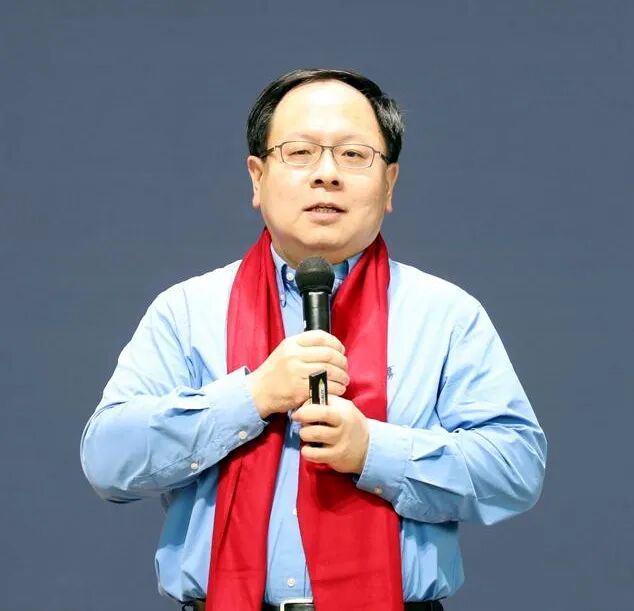
Xu Bo丨Senior Vice President, Focus Technology
Mr. Xu Bo has held positions at multinational corporations including General Electric, Johnson & Johnson, and Honeywell International Inc., where he led supply chain management for Greater China and the Asia-Pacific region. He achieved breakthroughs in strategic supply chain deployment, business expansion, product strategy, process reengineering, and team building for multinationals operating in China and Asia-Pacific. He established the strategy and investment division for DHL's supply chain business, steering strategic planning and M&A initiatives. He also served as General Manager of Modern Logistics at Bailian Group. At Focus Technology, Mr. Xu serves as Senior Vice President and previously as President of Focus Technology USA, accumulating extensive experience in cross-border strategic deployment, business launch, resource integration, M&A, and cultural integration between China and the United States.
Key Topics
- Supply chains "in turbulence"
- Finding enterprise positioning and competitiveness through supply chain
- Supply chain management: turning variables into constants
- Credit and contracts: new supply chain partnerships
Supply chain is a management science rooted in practice. For business operations, the core of supply chain is "planning." Planning is the transmission and feedback of forecasts. If a company's supply chain underperforms, it is fundamentally a planning failure — errors get amplified and passed down through every layer.
I come from a manufacturing background, have worked in internet information services, and third-party logistics. In recent years, I've been examining what problems companies actually face from a supply chain perspective, how these problems form into systemic issues, and how to build systematic solutions through supply chain thinking.
It's evident that supply chains will grow increasingly complex. Entrepreneurs can develop a matrix and modeling mindset for supply chains. Applying this framework to view both supply chains and enterprise positioning allows companies to gradually build core competitiveness and expand their capabilities.
Supply Chains "in Turbulence"
When we speak of supply chains "in turbulence," we're addressing two dimensions: enterprise-level and societal-level turbulence. In the past, a company's supply chain functioned as a constant, much like Sales and Marketing; but it has gradually shifted from constant to variable, making it difficult to predict which direction the turbulence will take next.
At the enterprise level, change is driven by a confluence of factors: the complex international situation, the global pandemic, capacity optimization needs, competitive risks, and credit backing. From a financial perspective, visible costs are rising across the board — procurement, transactions, internal operations, quality, and more. Meanwhile, hidden costs such as after-sales service, what we might call "costs beneath the iceberg," are also rising across the board. From an operational standpoint, business continuity and stability face enormous challenges. From a compliance angle, deliveries between countries and between companies fluctuate. These operational conditions all pose challenges to supply chain management. As forecasting and planning become increasingly difficult, we need to find underlying logic and solutions to make predictions and corresponding plans.
At the societal level, supply chains have moved from continuous to "intermittent." During these pandemic years, we've seen supply chains become stop-and-go — not broken, but "intermittent." Starting in May 2020, U.S. ports developed problems, peaking between July and October last year. China's upstream supply chains didn't break, but goods shipped circuitously by sea and air would get stuck at American ports. This year, pandemic-induced "intermittence" has hit the upstream of supply chains, primarily in the "trade flow" upstream — manufacturing and logistics shipments. We can expect that numerous industries and companies will undertake supply chain adjustments going forward. With so many variables叠加, supply chains have moved from a period of stability into a period of turbulence.
Every company faces different specific problems, but I believe that thinking about supply chains from first principles, mastering supply chain logic, and grasping problem-solving frameworks can give entrepreneurs the angles they need to find appropriate solutions. As supply chains grow more complex, companies need to form supply chain capabilities through deep integration and consolidation — making supply chains an engine of success rather than a drag.
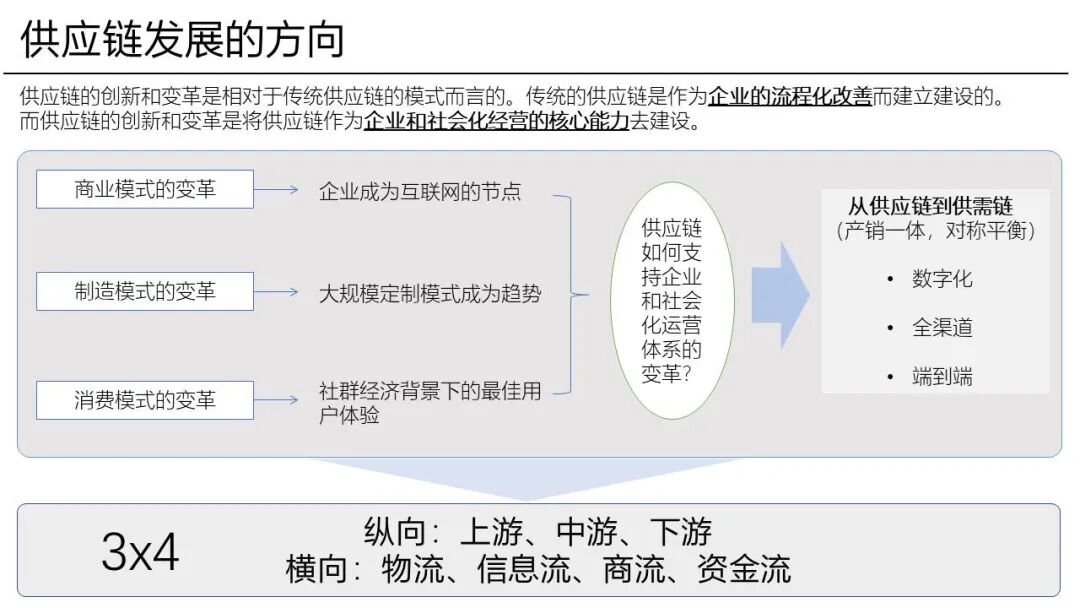
Image source: Speaker's presentation
Finding Enterprise Positioning and Competitiveness Through Supply Chain
Supply chain development represents a major trend. In 2017, supply chain was incorporated into GDP accounting categories and became an important guiding force in China's transition from high-speed, extensive development to high-quality, intensive development. Meanwhile, business models, consumption patterns, and manufacturing models are evolving with societal development. The Internet of Things, internet technology, artificial intelligence, big data, 5G, and carbon neutrality are all becoming drivers of supply chain innovation, transformation, and development.
At the macro level, to analyze the impact of these changes, we need to identify the forces supporting enterprise development. From a supply chain perspective, this is the "3 Streams" × "4 Flows" model, or the 3×4 supply chain model. Traditional supply chains encompass procurement, production, and delivery. Viewed more broadly, they comprise logistics flow, trade flow, capital flow, and information flow — four flows combining from different angles to serve enterprises; plus the enterprise's position within its industry, namely upstream, midstream, and downstream.
If you internalize this 3×4 model and map your company onto it, you may find your current positioning. This is the starting point for analyzing supply chain logic, and it extends to how we view core enterprise capabilities and development logic — essentially a second development of enterprise resources.
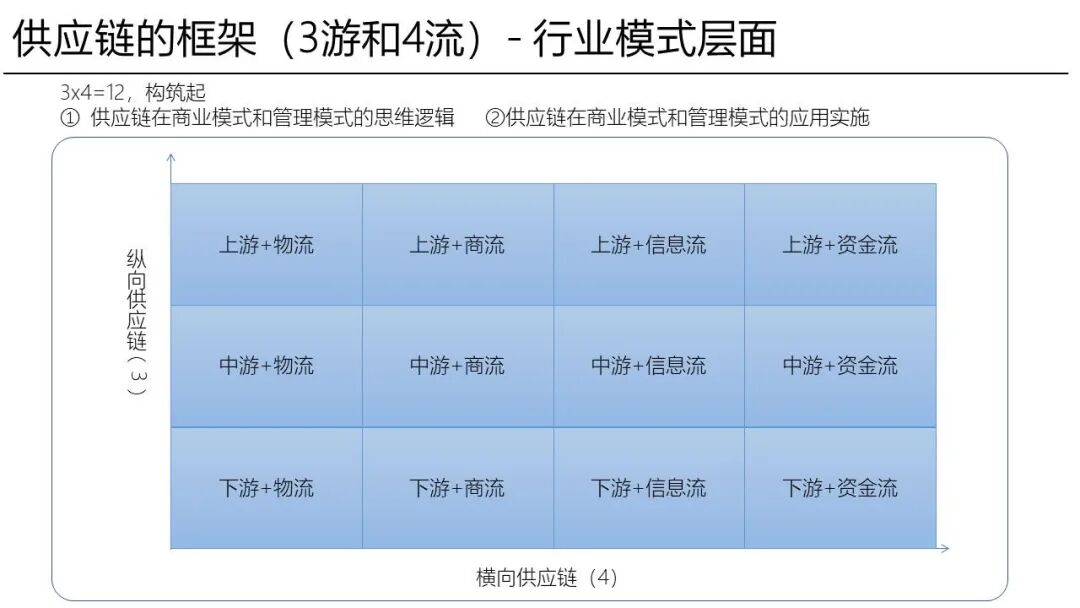
Image source: Speaker's presentation
At the micro level, pure supply chain consists of a company's procurement, production, and delivery processes. Serving this process requires planning, hence SIOP (Sales, Inventory & Operations Planning). The market offers many supply chain management and optimization tools, as well as supply chain management systems — JD.com and Alibaba each have their own. As the scope of management expands to include raw material suppliers, logistics providers, and eventually corporate capital and personnel management, certain core nodes of supply chain management gradually emerge.
From the 3×4 model, we can see that different logistics, trade, information, and capital flows have many intersecting nodes. No matter the company, it's impossible to control all nodes across every module. A company's core capability is its ability to control its essential supply chain nodes — this capability determines its foundation for survival in the industry. And with this foundation, you can see the company's future expansion space and the reach of its core capabilities. This is the basic logic of supply chain-driven development.
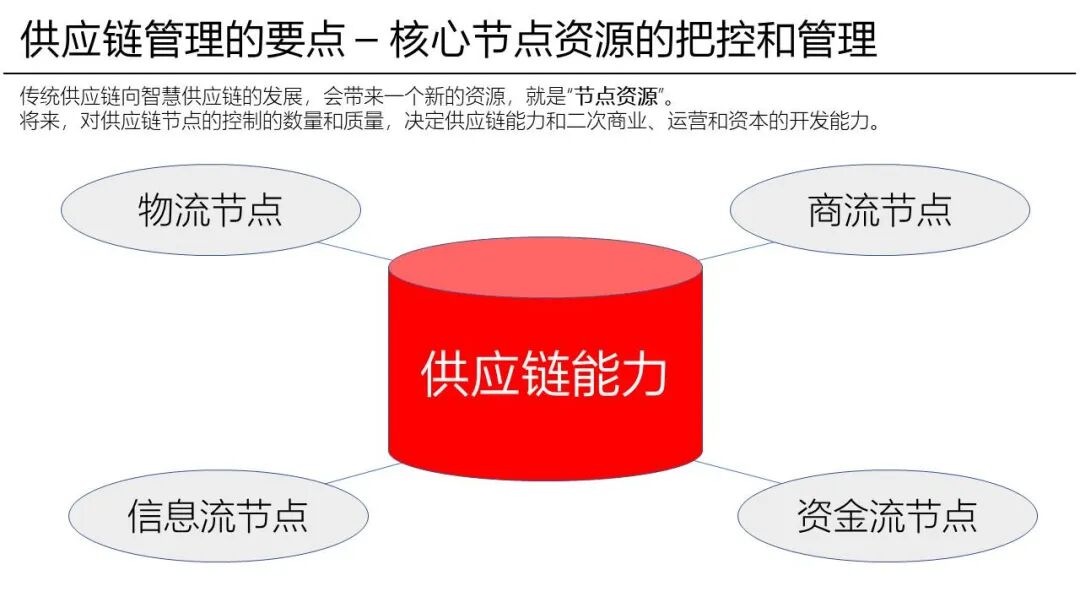
Image source: Speaker's presentation
Taking Alibaba's domestic business as an example, we can see the 3×4 model in action. Alibaba's domestic business evolved from Taobao to Tmall, then from Tmall to New Retail through Freshippo and the acquisition of Sun Art. This represents the trade flow development stage. During this evolution, the massive express delivery demand generated by Taobao and Tmall led to the creation of Cainiao. But Cainiao is not merely a logistics platform — it's also an information flow platform. Alibaba moved from holding shares to full ownership of STO Express, continuously extending its warehousing and distribution system. Trade flow as the core extended into logistics and information flow. Information flow services also include Direct Train, Alimama, and others, which represent a very high proportion of total revenue.
Through trade flow in the supply chain, Alibaba extended into the highest value-added information flow services, which then extended upstream. Because trade flow also drove capital flow, Alipay was created, becoming a bridge of trust between buyers and sellers. In this process, trade flow extended further upstream to the recent Xiniu Intelligent Manufacturing — trade flow extending to the manufacturing end, which then extends to procurement.
Viewing Alibaba's development from a supply chain perspective: starting with trade flow as the core, generating massive traffic, monetizing both on trade flow itself and on logistics, information flow, and capital flow, while gradually expanding its territory. The analytical anchor point is Taobao — this is Alibaba's domestic business.
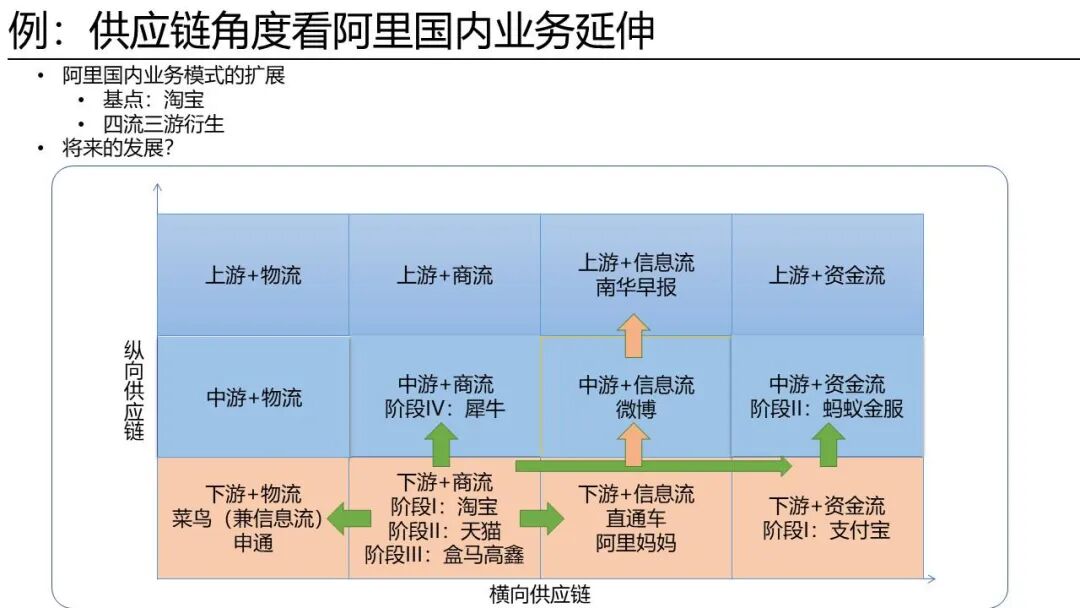
Image source: Speaker's presentation
Similarly, looking at Alibaba International. Alibaba International's earliest business was Alibaba.com, which didn't generate transactions itself — it was an information flow matching business connecting upstream and downstream. Taobao is a transaction platform, but because information flow brought massive aggregation of upstream and downstream participants, it could do trade flow, hence AliExpress. AliExpress is currently a small-batch wholesale platform, but in Russia and South America, it's essentially the largest local e-commerce platform.
With AliExpress came the discovery of cross-border logistics demand. International logistics couldn't replicate the domestic approach of acquiring or investing in the "four connections and one delivery" network. So Alibaba started with customs declaration, integrating customs clearance through OneTouch, then consolidating trade into OneTouch. Later, OneTouch encountered numerous issues — credit problems, tax rebate problems, and others. But the massive traffic aggregation and logistics aggregation that OneTouch generated gave Alibaba enormous space in international logistics. So two years ago, they acquired World Logistics — comparable to Maersk's acquisition of LF Logistics. Maersk extended from trunk line logistics to shore-based logistics; Alibaba extended from an international trade platform to international logistics. Through information flow, they also identified capital flow demand: for small and medium-sized payments, bank transfers were costly and inconvenient, so they built WorldFirst, forming a capital flow channel. This is Alibaba International's business, viewed from a supply chain perspective on how to make horizontal and vertical extensions. With this logic, we can analyze many companies — seeing how they move from trade flow to logistics, from logistics to capital flow.
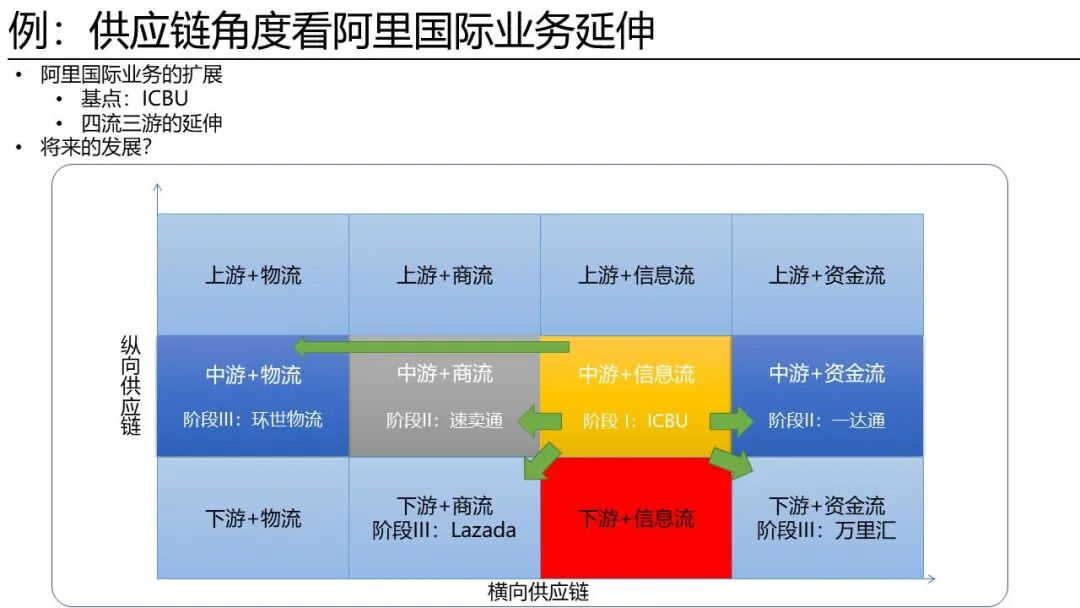
Image source: Speaker's presentation
Supply Chain Management: Turning Variables into Constants
Applying supply chain thinking to enterprise top-level design encompasses business opportunities, business models, and strategic planning. Applied to operational execution, it means procurement, production, and delivery — in other words, bringing the highest delivery fulfillment rate to the enterprise at the lowest cost. Fulfillment rates are composed of different costs, both low and high.
But because supply chain is no longer a constant but a variable, there's a massive gap between ideal models and the complex realities companies face. Therefore, turning variables into constants and narrowing the distance between ideal models and reality becomes the core capability of supply chain — and its highest value. When this value is realized within an enterprise, that enterprise gains core capability. In short, the core of supply chain is planning; planning is the transmission and feedback of forecasts — the core of the core.
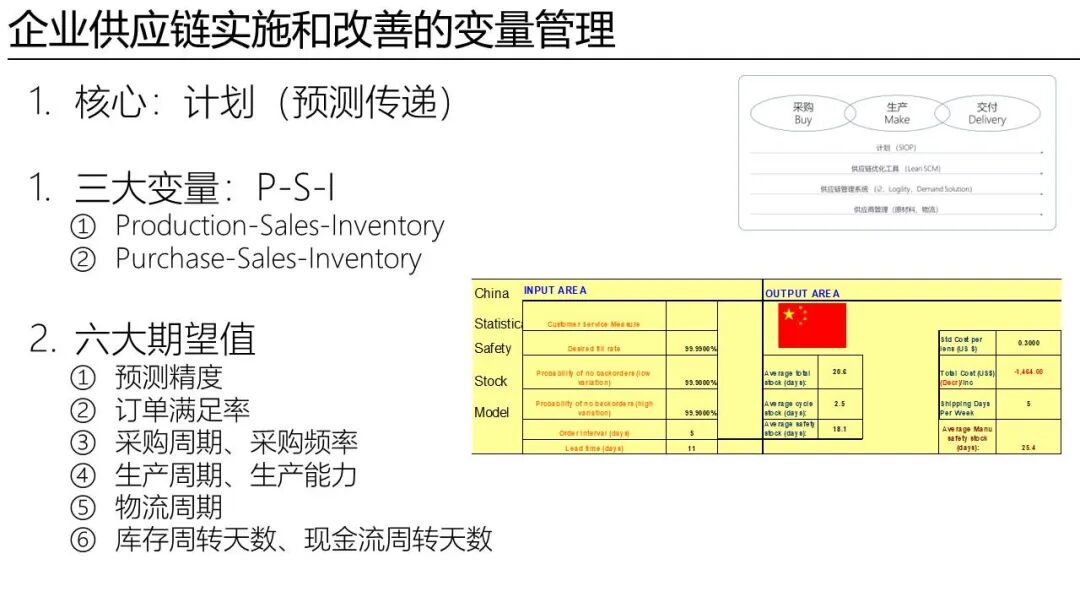
Image source: Speaker's presentation
The three major variables P-S-I: for manufacturing enterprises, P is Production, S is Sales, I is Inventory. For trading enterprises, P is Purchase, S is Sales, I is Inventory. So P-S-I represents the three variables of supply chain.
What secondary variables generate these three major variables? Six key expectations. Forecast accuracy, order fulfillment rate, procurement cycle and frequency, production cycle and capacity, logistics cycle, inventory turnover days, and cash flow turnover days. In summary, there are 12 variables producing six major expectations. Take forecast accuracy: predicting at 99% versus 70% creates different levels of supply chain损耗. For order fulfillment rate, achieving 99% versus 80% — 99% is costly, but at 80%, while supply chain costs may be lower, customer experience suffers.
Procurement cycle combined with procurement frequency equals procurement control capability, yielding procurement cost advantages. Production cycle and production capacity — production has now become a supply chain capability, whereas previously it stood independent of supply chain. High capacity, quality equipment, skilled workers, short changeover times between different products, and the ability to run 8, 16, or 24 hours continuously all bring enormous supply chain advantages. Logistics cycle: shorter logistics cycles mean improved inventory turnover. If logistics costs rise, you must balance inventory costs against capital costs — this is where technical optimization can occur in supply chain.
Finally, inventory turnover days and cash flow turnover days — these are costs beneath the iceberg, invisible to others. Reducing inventory turnover days significantly benefits corporate cash flow and capital costs. The same applies to cash flow: assuming six turns per year, or one turn every two months, 100 million RMB can generate 600 million in sales. Looking purely at goods turnover, excluding other costs, at 12 turns per year, 100 million generates 1.2 billion in sales; at 24 turns, 100 million generates 2.4 billion. This is the tremendous support supply chain provides for capital costs and its enormous impact on enterprises. This is supply chain thinking from the enterprise perspective, from the operational and tactical angles — applicable to manufacturing enterprises, trading enterprises, information enterprises, and R&D enterprises alike. The logic is the same.
Credit and Contracts: New Supply Chain Partnerships
Supply chain is a collaborative relationship. With technological development and evolving operational models, we can anticipate that many enterprises are now developing supply chain relationships along credit and contract dimensions, not merely contractual relationships.
If you're a rapidly growing enterprise with substantial capital backing, and you're bullish on your sector — call it "barbaric growth" or "high-speed growth" — you cannot build supply chain capability purely through contractual relationships. You must also build credit relationships. Contracts and credit form two dimensions of upstream supply chain capability or service capability. Service capability refers to using external logistics services and upstream procurement services to support the supply chain system. Within this system is a pyramid structure: strategic partnerships, and capital.
If you have capital capability, moving core purchased components into capital relationships allows you to control their raw materials. Without such production and R&D component manufacturing capabilities, supply chain control capability — through capital relationships and information service relationships — creates upstream-downstream对接 relationships. Strong supply chain performance, offering various cooperation incentives, then leads into resource integration and operational coordination.
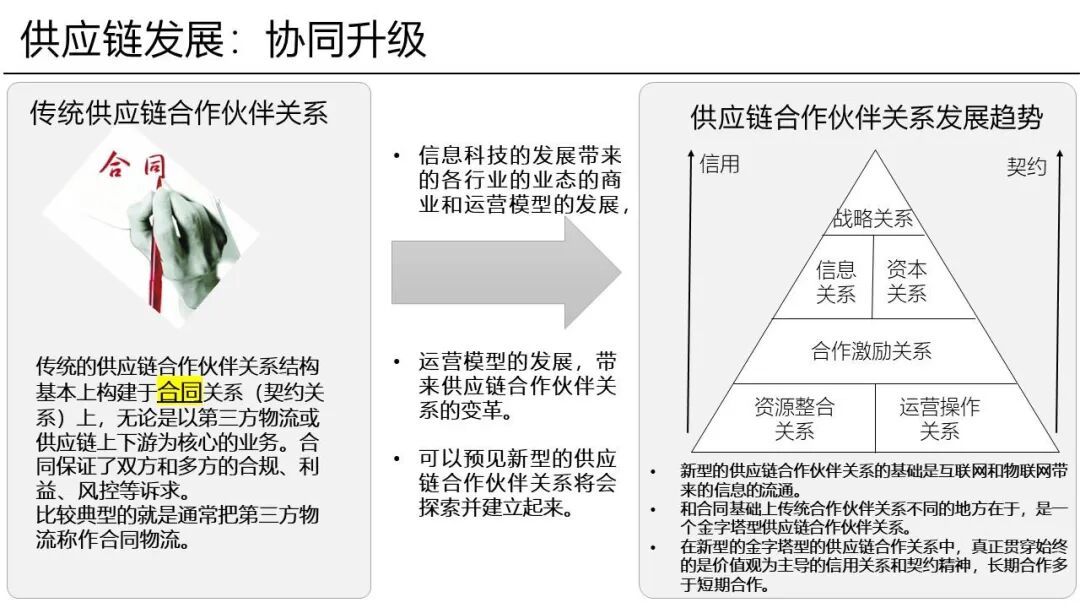
Image source: Speaker's presentation
Future supply chains will grow increasingly complex. Supply chain efficiency-cost analysis is a dynamic analytical method encompassing various complex analyses. In multinational corporations, finance departments traditionally had dedicated FP&A (Finance Planning and Analysis) functions. I now also specifically configure such a role in finance departments, with the purpose of translating entire supply chain efficiency costs into financial analysis. Both visible and hidden costs must be made clear at a glance.
As supply chains evolve, developing supply chain relationships already encompass 70+ variables. Alibaba previously built a model using roughly 70+ variables in an intelligent algorithm, including inventory, production, and procurement. In fact, those 70+ variables simplify to 12 variables, which further simplify to 6 core variables. Through continuous big data feeding and system training, this eventually forms supply chain intelligent algorithms.
No matter how complex future supply chain changes become, for enterprises, the essence is how to form supply chain capabilities through deep integration and consolidation, then extend this capability into business models — monetizing from trade flow to information flow and capital flow. If a company hasn't achieved this, its supply chain remains underdeveloped, dragging the business down. In the digital and intelligent era, when supply chain becomes a core enterprise capability on par with sales, finance, and marketing, the company will mature from startup to established enterprise, bringing improved end-to-end capabilities and service capabilities. This is the major trend in supply chain development.
Looking ahead, we can see supply chains will first, move from constants to variables — with supply chain work turning variables back into constants; second, move from back-office to front-and-center in enterprise management; third, evolve from flexibility to "flexibility + resilience" — turbulent times demand "flexibility + resilience" from supply chains, with resilience being even more critical than flexibility, achieved through strategic partnerships, capital cooperation relationships, and supply chain itself.


Issue 21: Clear Despair Beats Vague Hope — On ToB Sales During the Pandemic
Issue 20: Is Your Cash Flow Still Healthy During the Pandemic?
Issue 19: Entrepreneurs Must Learn to Let Go Appropriately
Issue 18: Entrepreneurs' Time Management: "Two Learnings, Three Principles, Four Quadrants"
Issue 17: Your Core Startup Team Needs a "Deep Dialogue"
Issue 16: Three Keywords for Corporate Crisis Management from the 3·15 Perspective
Issue 15: The New Evolution of InsurTech
Issue 14: "Small" Trademarks, "Big" Trouble — How to Effectively Avoid Pitfalls on the Entrepreneurial Road
Issue 13: Financial Opportunities in Industrial Internet
Issue 12: Top-Level Logic for Consumer Brand Promotion on Douyin
Issue 11: Inclusive Finance in the New Economic Environment
Issue 10: Brand: Meaning, Symbol, Value
More MaHui members can click "Read Original" to view