Code Brain | One Step Closer to Colonizing Mars: China's Latest AI Breakthrough

The future lies not only on Mars, but also among more distant stars.


How can artificial intelligence assist scientific research? Chinese scientists, who recently made breakthrough progress in Mars exploration, have offered a practical case study. A recent report in the United States' Nature magazine concisely laid out how this case unfolded.
To realize humanity's dream of colonizing Mars, water and oxygen are both indispensable. Not long ago, scientists discovered groundwater on Mars. As Andy Cooper, a chemist at the University of Liverpool, put it: "If you're thinking about the challenge of going to Mars, you have to use local materials." Producing oxygen from Mars's existing resources has become a new challenge facing scientists worldwide.
A new research paper published in Nature Synthesis has pushed the solution to this problem significantly forward.
A team led by University of Science and Technology of China (USTC) professors Yi Luo and Jun Jiang, associate professor Weiwei Shang, and Zhang Zhe, a researcher at China's Deep Space Exploration Laboratory, collaborated to use their previously developed robotic chemist platform "Xiao Lai" to produce a practical oxygen-generating catalyst from Martian meteorites — and "manufacture" oxygen. This research can supplement existing oxygen production technologies and further improves the feasibility of sustaining future crewed deep-space missions. A robot autonomously discovering and developing chemicals opens a new path for humanity's exploration of the stars.
"This is the first oxygen-producing catalyst prepared from Martian materials. This study not only validates the extraordinary capability of artificial intelligence in creating new materials, but also takes a very important step toward Mars colonization and interstellar exploration," said Yi Luo, co-corresponding author of the paper, in an interview with China Science Daily.
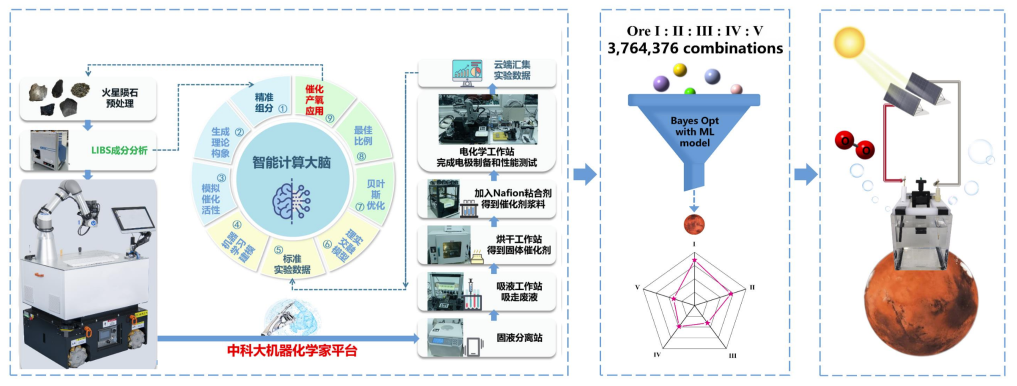
Schematic diagram of the full catalyst development process by the "robotic chemist" (Image provided by USTC)
The robotic chemist "Xiao Lai" is roughly the size of a refrigerator. The research team had "Xiao Lai" use its robotic arm to analyze five meteorite samples — either from Mars or collected on Earth with compositions similar to the Martian surface. The task assigned to "Xiao Lai" was to produce the catalyst needed for oxygen generation from these materials.
The AI-driven system used various acids and bases to dissolve and separate the materials, then analyzed the resulting compounds. Based on the available materials, there were over 3.76 million possible combination formulas. Had a human research team tested each one, it would have taken more than two millennia. After studying over 50,000 relevant chemistry papers, "Xiao Lai" first conceived and designed a base formula, then continuously adjusted the ratios through experiments, ultimately identifying the optimal formula within six weeks — an oxygen evolution reaction catalyst that can release oxygen from water, with potential applications in future Mars missions.
The research team explained that for future crewed Mars exploration missions, oxygen is essential, as both rocket propellant and life support systems for human activities require substantial amounts. From a long-term cost-effectiveness perspective, the simpler and more economical approach is to produce oxygen using resources already present on Mars, rather than transporting materials by the ton from Earth. Recent evidence of water on Mars, combined with elemental analysis of Martian meteorite compositions, may offer opportunities for using Martian resources to manufacture oxygen-producing catalyst materials.
"We developed a robotic AI system with a chemical brain," Jun Jiang told Nature. "Our machine can use compounds from Martian ores without human guidance."
Interstellar voyages are a shared exploration goal for all humanity. Researchers across nations are attempting to use extraterrestrial resources to address fundamental challenges — oxygen and water. Before this breakthrough by the Chinese scientists, NASA had made the furthest advances.
NASA's Perseverance rover landed on Mars in February 2021 and successfully demonstrated oxygen production from the Martian atmosphere. Due to Perseverance's limited power output, its Mars Oxygen In-Situ Resource Utilization Experiment (MOXIE) could only produce a few grams of oxygen at a time. In a previous paper published in Science Advances, the research team showed that MOXIE achieved its target of producing approximately six grams of oxygen per hour across multiple experiments under various atmospheric conditions — roughly the rate of a small tree on Earth.
MOXIE and the Chinese team's research each have their strengths. In the future, a scaled-up version of MOXIE is expected to produce oxygen at the rate of hundreds of trees, thereby supporting activities in human settlements. MOXIE could also generate sufficient gas to serve as an oxidizer for rocket fuel, helping spacecraft return to Earth. "Two to three kilograms per hour," said its principal investigator Michael Hecht. "There's no obstacle to scaling up."
Jun Jiang noted that his team's robotic chemist could also be used to produce other useful catalysts. "This robot can make different chemicals," he said, and Mars isn't the only place it could prove useful.
"Perhaps lunar soil is another direction," Jiang suggested.
In the future, if humanity wishes to conduct in-depth research on Mars — or go further still, to survive on planets beyond Earth — producing oxygen on Mars is only the first step. How to utilize various resources on Mars and other extraterrestrial bodies to push deeper into the solar system will present increasingly numerous challenges along humanity's path of exploration.
The achievements of robot "Xiao Lai" offer entirely new possibilities for solving these unknown problems and provide fresh ideas for humanity's cosmic journey. Hope may not be far away — perhaps one day, humans will build cities and thrive on Mars, this currently uninhabitable planet.
Original report link: This AI robot chemist could make oxygen on Mars
References: Zhu, Q. et al. Nature Synth. https://doi.org/10.1038/s44160-023-00424-1 (2023). http://www.news.cn/tech/2023-11/14/c_1129973808.htm