Code Brain | PEDaily: Legendary Investor Charlie Munger Passes Away — "My Sword I Leave to Him Who Can Wield It"

What Did 99-Year-Old Charlie Munger Leave Behind?


No equal business partner was ever better at playing the supporting role than Charlie Munger.
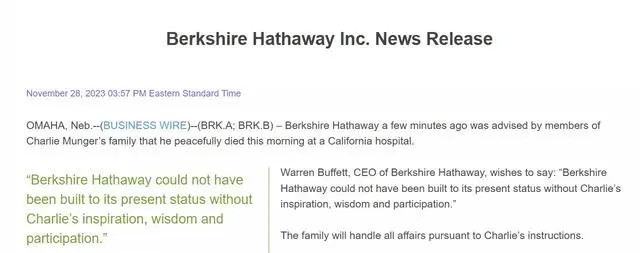
On the morning of November 28 local time, U.S. investment conglomerate Berkshire Hathaway announced in a statement that Vice Chairman Charlie Munger had passed away peacefully at a hospital in California. He was 99.
In today's world, perhaps no one is more famous for making money than Warren Buffett. But without Munger, Buffett might never have built his investment empire into what it is today. Buffett has said on many occasions: "It was Charlie Munger who broke my habit of 'cigar butt' investing and set out to build a large, wonderful business."
"Berkshire Hathaway could not have been built to its present status without Charlie's inspiration, wisdom and participation," Buffett said.
Munger was born on January 1, 1924, in Nebraska. At the University of Michigan, he majored in mathematics. During World War II, Munger left school to enlist. The military first sent him to the University of New Mexico and Caltech to study thermodynamics and meteorology, then assigned him to a U.S. Air Force base in Nome, Alaska, as a weather forecaster. After the war, Munger enrolled at Harvard Law School. Following his graduation in 1948, his first job was as a lawyer in California. Buffett and Munger met in 1959 — long before either had formally begun their investing careers.
In 1962, Munger founded his own law firm. That same year, Buffett began buying shares of Berkshire Hathaway, then a textile manufacturer. Munger officially joined the company in 1975.
Buffett once gave Munger a nickname — "the abominable no-man" — for his sharp rejections of potential investments, including some Buffett himself might have made. Yet Munger was often the driving force behind Berkshire's investments, such as his passion for engineering that helped push Berkshire Hathaway to invest in Chinese automaker BYD.
01
The Aphorism Maker
Munger's idol was Benjamin Franklin, whose curiosity, ingenuity, and wit he admired. The Wall Street Journal described him: "Munger's common sense, caustic humor, morbid bluntness, and disdain for conventional wisdom made him a cult figure among investors." In public settings, especially at Berkshire Hathaway's annual shareholder meetings, people grew accustomed to seeing Buffett speak at length, after which Munger would often rasp, in his hoarse voice, "I have nothing to add." Those nine words became virtually synonymous with Munger.
At an annual meeting of Daily Journal, Munger explained his relationship with Buffett this way: "An old couple who have spent most of their lives together rarely get divorced. Warren and I are the same — we've long since adapted to each other. After all these years, we've worked together in partnership, and there's no separating us now. In our partnership, I merely play a supporting role. Albert Einstein needed someone to discuss ideas with; the investment master Warren needs an advisor too. I help out in other ways sometimes, but mainly I serve as Warren's advisor."
But when Munger did speak, his carefully considered "golden quotes" often rang with such force that people wanted to hear more. Poor Charlie's Almanack became a global bestseller, with essays written by or about Munger.
To mine Munger's wealth of wisdom, beyond the indispensable Poor Charlie's Almanack, there is another rich "treasure trove" — his speeches at annual meetings of Wesco Financial Corporation and Daily Journal since 1987. As chairman of both companies, he became the star of the show, much like Buffett. Last year, the 98-year-old Munger stepped down as chairman of Daily Journal, though he continued to advise the publisher's investment portfolio.
He hosted a weekly "Friday lunch club" and regular dinners with guests that included the founder of online payments company Stripe, the CEO of gaming company Activision Blizzard, the chancellor of UC San Diego, and the CEO of Portland General Electric, Oregon's largest utility. Visitors came to his weekly lunches mainly to hear him expound on the "latticework" of "mental models" — frameworks he said helped explain his and Berkshire Hathaway's success.
02
The Tao of Munger
Earlier this month, Munger gave an interview to CNBC ahead of his approaching 100th birthday. In the interview released on the 28th, Munger summarized the company's success in characteristically self-deprecating terms: avoiding mistakes. "We were a little less crazy than most people; we were a little less stupid than most people. That really helped us," he said. The best way to honor Munger is to put his wisdom into practice. We've selected some of his "golden quotes" that may offer guidance for us today.
Learning from others' experience matters, but business lessons must be learned firsthand. I have indeed learned a great deal from others' experience. Someone who cannot learn from others' experience is destined to keep stumbling through life. But there are many lessons I only understood after suffering losses myself. — 1994, Wesco Financial shareholder meeting
Speculative trading, done frequently, does society no good. In our society, many talented people sit around all day trading pieces of paper, with various middlemen dealing and handling chips like croupiers in a casino. What good does this do for our civilization? I really can't think of any. — 1995, Wesco Financial shareholder meeting
Our progress comes from taking losses, gaining insight, and adapting to our environment. Warren has said that being a professional investor made him a better business manager, and being a business manager made him a better investor. I very much agree. Running a business and investing in stocks reinforce each other. We've also learned profound lessons from our mistakes. A child touches a hot stove — do you think he'll dare touch it again? Having suffered, can he not learn his lesson? — 1998, Wesco Financial shareholder meeting
Keep reading and thinking, and draw wisdom from biographies. People are always giving me books, and I consider that a great happiness. Almost without noticing, I've become the person I am now, and I'm quite satisfied with that. — 2014, Daily Journal shareholder meeting
The principles of investing are simple: don't be foolish, don't fantasize, maintain a margin of safety. I made my fortune through the stock market, but I don't recommend that everyone follow my path. It worked for me, but it's impossible that anyone, simply by reading Charlie Munger's stuff, could become rich. — 2015, Daily Journal shareholder meeting
Life is challenging and meaningful precisely because it is hard. I've discovered something in this life: friendships forged through shared hardship and struggle, through building something together from nothing, are the closest bonds of all. Such bonds cannot be formed in days of stability and abundance. — 2017, Daily Journal shareholder meeting
In the end, there is only one kind of investing: value investing. Every investment we make, every dollar we put in, is for the purpose of obtaining more value in return. In the process of investing, we cannot divide our attention — just as you cannot run marathons in twelve different places simultaneously. So you need your own method, find an area worthy of your deep study, and make that your hunting ground. Whatever area you choose to cultivate, what you pursue is value. — 2020, Daily Journal shareholder meeting
We invested in China because we could buy more value there. Who is right and who is wrong can only be tested by time. China is a modernized great power. It has a vast population. Over the past 30 years, China has rapidly joined the ranks of modernized nations. The reason we allocated some of our capital to China is that compared to investment opportunities in the United States, the opportunities in China were better — we could buy at cheaper prices and obtain higher company value. — 2022, Daily Journal shareholder meeting
"As long as shareholders are willing to listen to us, we'll keep talking year after year," Munger said at the end of the 2022 Daily Journal shareholder meeting. "Warren and I never wanted to become gurus — it was everyone else who elevated us. Answering so many questions at shareholder meetings, I used to feel somewhat unaccustomed to it, because I don't normally talk this much. Now, I've grown used to it, and I hope everyone else has too."
Next year, we'll need to get used to shareholder meetings without Munger. Perhaps the only constant in this world is change itself. At least we can still draw from the wisdom of those who came before us the strength to face that change.
At the end of his commencement address at the University of Southern California, Munger concluded with words from a swordsman in Pilgrim's Progress: "My sword I leave to him who can wear it."
May we too be able to wield Munger's sword.
References:
- Charlie Munger, Titan of Investing, Dies at 99 https://www.wsj.com/?mod=nav_left_section
- [US] Charlie Munger: Munger's Way: Charlie Munger's Shareholder Meeting Speeches 1987-2022, Citic Press Corporation, June 2023