Code Brain "Standing Together Against COVID-19" Series Session 1: Employer Compliance and Practical Guidance During the Novel Coronavirus Outbreak (Beijing, Shanghai, Guangzhou, and Shenzhen Case Studies)

Speaker: Hu Chongchong, Partner at Beijing Zhonglun W&D Law Firm
As the pandemic intensified, every sector of the national economy came under enormous strain. On one hand, healthcare systems and logistics supply chains urgently needed expanded capacity; on the other, online education and remote work became essential needs. Market demands and business models were quietly shifting — new opportunities were emerging from the crisis. To address this new landscape, Source Code Capital's post-investment services team designed the Code Brain "Standing Together Against COVID-19" webinar series. From February 3 to 11, we invited leading experts to share insights online on topics including employee leave and return-to-work policies, startup fundraising, remote collaboration, financial and cash flow management, and policy analysis — hoping to provide intellectual support for Source Code Capital community members from multiple angles, ease their concerns, and help them face these challenges together.
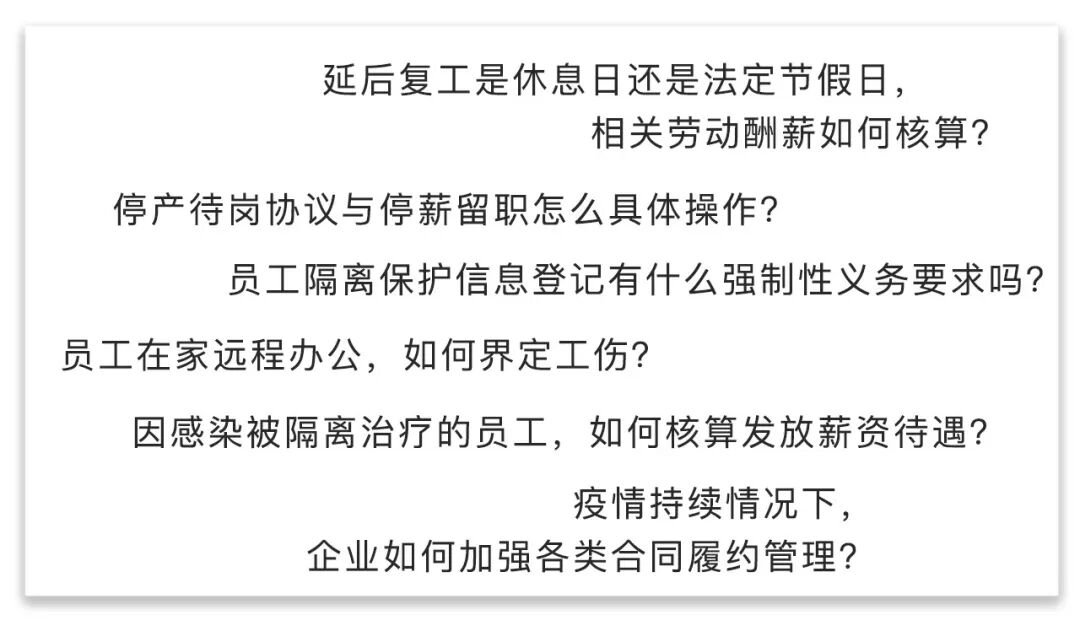
With these questions in mind, drawing on years of labor law experience, attorney Hu Gaochong began with the latest relevant regulations in Beijing, Shanghai, Guangzhou, and other cities, offering targeted responses to several compliance questions facing employers during the pandemic. His presentation covered contract performance analysis, employment compliance, and practical operational guidance — providing entrepreneurs with support in navigating compliance management and labor issues during this period.

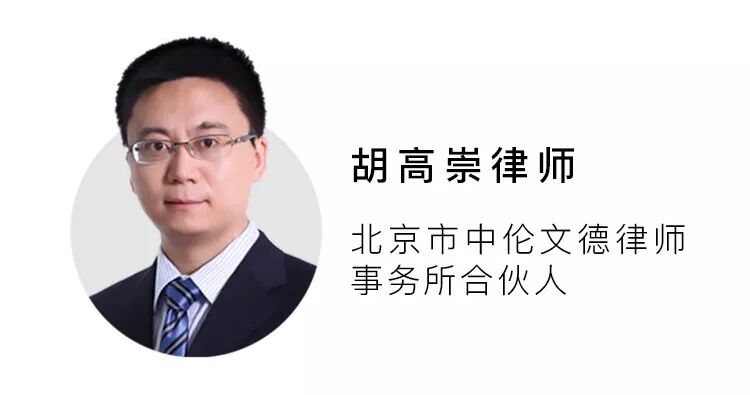
Before joining Zhong Lun W&D Law Firm, he worked at a leading domestic law firm and has extensive trial experience in the judicial system. His practice covers labor and employment, employee incentives, corporate compliance, and dispute resolution, with particular expertise in labor disputes, corporate disputes, and contract disputes. His clients include major internet companies, foreign enterprises, and state-owned financial institutions. He was named a "Recommended" lawyer in China labor law by The Legal 500 - Asia Pacific for three consecutive years (2018–2020).

I. Interpreting New Local Regulations: Beijing, Shanghai, and Guangdong as Examples
I've long known that Source Code Capital's post-investment services are excellent, and I've been working with Source Code Capital for three or four years now. Thank you all for participating in this learning session during the outbreak prevention and control period. Of course, during this special time, CEOs and HR professionals should indeed understand and keep up with these new developments. Let's move on to today's content.
First, at the policy index level, what are the national-level regulations and policies? And what are the main local policies?
At the national level, one regulation concerns the extension of the Spring Festival holiday. The holiday was actually extended by two days, with two working days converted into rest days, and Sunday was folded into the holiday — this was stipulated by the General Office of the State Council. Separately, the Hubei Provincial People's Government issued its own notice extending the 2020 Spring Festival holiday, which with the State Council's approval, directly extended the holiday to February 13. Although this was a provincial-level regulation, Hubei's rule had broad coverage. It wasn't limited to employers and workers in Hubei; it also expanded the scope of the extended holiday to include out-of-province visitors who came to Hubei during the Spring Festival to visit relatives and friends. If someone had returned to Hubei before the Spring Festival to visit family or friends and remained there, they too would have their holiday extended to February 13. And this was a statutory holiday, treated as a paid rest day. These are the first two national-level holiday regulations.
Next is the Ministry of Human Resources and Social Security's Notice on Properly Handling Labor Relations During the Novel Coronavirus Pneumonia Prevention and Control Period. This covers certain special populations whose wages must be paid normally. For patients with pneumonia, suspected patients, and close contacts during isolation treatment or medical observation periods, as well as during other emergency measures implemented by the government, even if they cannot work normally, they should still receive their labor remuneration. Moreover, employers cannot terminate labor contracts under Articles 40 or 41 of the Labor Contract Law, and if a contract expires, it must be extended. This is the unified national-level regulation.
In the same notice, the Ministry of Human Resources and Social Security included a principle-based regulation on wage calculation during work stoppages and production suspensions: within one wage payment cycle, even if operations are halted, wages must still be paid normally — typically one month. After one wage payment cycle, there are two scenarios: first, if normal labor is performed, meaning some positions continue with maintenance operations and employees provide normal labor, employers can pay no less than the local minimum wage; second, if there is a complete shutdown with all employees on standby, the employer pays a living allowance at a certain percentage of the minimum wage, with varying local regulations.
National-level regulations also include the Notice by the Ministry of Human Resources and Social Security, Ministry of Finance, and National Health Commission on Protection for Medical and Related Staff Infected with Novel Coronavirus Pneumonia in the Course of Work Duties. Currently, at the national level, those who can have COVID-19 recognized as a work-related injury are mainly limited to medical and epidemic prevention personnel. Those infected due to business travel or after returning to work in the workplace generally have a low or very low probability of being recognized as work-related injuries.
The above covers national-level regulations. Now let me share some distinctive local regulations from Beijing, Shanghai, and Guangdong.
First, Beijing. Beijing's main regulations are largely consistent with national-level rules, but the Beijing Municipal Human Resources and Social Security Bureau's document specifies that during standby periods, enterprises should pay a basic living allowance of no less than 70% of the city's minimum wage. This is the core distinctive content of Beijing's special document.
The second document is the Beijing Municipal People's Government's Notice on Flexible Work Arrangements for Enterprises During the Novel Coronavirus Pneumonia Prevention and Control Period. This notice is fundamentally different from Shanghai, Guangdong, and other regions. At the macro level, Beijing's statutory holidays only followed the State Council's three-day extension. From February 3 onward, these should be normal working days — this is Beijing's regulation, or the practical point to note for Beijing. During normal working days, according to this Beijing notice, work can be arranged through flexible employment or remote work — this is the core content. Comparing this with Shanghai, we find that Shanghai's regulations directly extended statutory holidays to February 9, with no return to work before February 9. Under current conditions in Shanghai, without new documents being issued, if employers arrange for employees to work from February 3 to February 9, they must pay 200% overtime wages.
But Beijing is different. Beijing must distinguish between Monday to Friday and Saturday to Sunday. Normally, for February 3–7, if employees work flexibly from home, regular wage payment is acceptable. For February 8–9, which were already Saturday and Sunday rest days, if employers still arrange for employees to work from home, they should pay wages according to rest day standards. Beijing's notice also addressed whether 14-day health monitoring must be implemented. Currently, without new documents from Beijing, starting February 10, those returning to Beijing from Hubei or with a history of contact with people from Hubei who have normal body temperature can report to work; but those returning from Hubei, or who have had contact with people from Hubei, or who have abnormal body temperature upon return, must self-isolate and monitor their temperature.
Next, let's look at the Notice on Wage Treatment for Enterprise Employees Caring for Minor Children During School Delays for Epidemic Prevention jointly issued by the Beijing Municipal Education Commission and Human Resources and Social Security Bureau. The notice stipulates that if a family has one minor child, one employee should be arranged to care for that child with paid leave. During the care period, wages can be received normally, and the employer cannot terminate the contract under Articles 40 or 41 of the Labor Contract Law; if the contract expires, it must be extended. This is treated as equivalent to government-imposed isolation or other emergency measures, establishing what is called a minor child care leave.
Meanwhile, in the Several Measures by the General Office of the Beijing Municipal People's Government on Further Supporting the Fight Against the Novel Coronavirus Pneumonia Epidemic, Article 10 stipulates the implementation of flexible employment policies, allowing enterprises to comprehensively adjust and use rest days within the year. If an employee indeed needs to take minor child care leave, following the spirit of this document from the Beijing Municipal People's Government General Office, with mutual agreement, they can adjust and use rest days within 2020, using this more flexible approach to ensure the implementation of employees' leave entitlements.
Similarly, Shanghai also has some distinctive government documents. Let me share the notable local features with you.
First, the Shanghai Municipal People's Government's Notice on Delaying Enterprise Resumption and School Opening, which clearly stipulates that all types of enterprises in the municipality shall not resume work before 24:00 on February 9. Regarding whether so-called flexible work can be arranged from February 3 to February 9, the Shanghai Municipal Human Resources and Social Security Bureau gave a clear response: the delayed resumption is for epidemic prevention and control needs, and February 3–9 are all rest days — meaning this Monday through Friday are also rest days. Employees on rest are paid normally, and if they work, they are paid double overtime wages as rest day overtime work. This is currently a distinctive feature of Shanghai's regulations.
Here are some of Guangdong Province's distinctive regulations as well. In the Notice on Actively Responding to the Novel Coronavirus Pneumonia Epidemic and Handling Labor Relations-Related Matters issued by the Guangdong Provincial Department of Human Resources and Social Security, Article 3 stipulates that with mutual consultation with employees, paid annual leave may be prioritized. For employees who fail to return to Guangdong for work in a timely manner, annual leave may be taken after mutual consultation. Regarding work-related injury determination, Guangdong differs from Shanghai, Beijing, and other provinces and municipalities nationwide. Article 10, Item 4 of Guangdong Province's Work-Related Injury Reimbursement Regulations stipulates that if an employee contracts an infectious disease while on a business trip to an epidemic area, it shall be deemed a work-related injury. In notices jointly issued by the Guangdong Provincial Department of Human Resources and Social Security and other entities, it was clarified that if an employee dispatched by an employer to Hubei Province on business or for work contracts novel coronavirus pneumonia, it shall be deemed a work-related injury.
II. Event Classification and Contract Performance Analysis
Should this event be classified as force majeure or changed circumstances?
Let's examine the legal and judicial interpretation provisions. Article 117 of the Contract Law provides a clear definition of force majeure: it refers to objective circumstances that are unforeseeable, unavoidable, and insurmountable. At least for now, the prevailing tendency is to consider this as force majeure. However, in specific contract performance, not every contract can fully apply force majeure to lead to liability-free termination. If a force majeure event occurs during contract performance, after the basic contract is terminated, neither party bears any liability for breach of contract — this is the characteristic feature of force majeure.
Article 26 of the Interpretation of the Contract Law (II) stipulates that changed circumstances refer to changes after contract formation due to objective circumstances that the parties could not have foreseen when entering into the contract, which are not caused by force majeure and do not constitute ordinary commercial risk. Specifically:
For the first category, sales contracts. If the seller's factory is in Wuhan, and Wuhan has been locked down with transportation completely halted, the seller cannot ship goods or perform the contract — this should constitute force majeure, and the seller's liability should be exempted; this is a force majeure cause. Again considering sales contracts: if the seller is shipping from Hunan to Beijing, although transportation and logistics in Hunan have not been completely cut off, logistics costs may have increased significantly — previously 10,000 yuan in shipping fees becoming 100,000 yuan now. If the contract is still performed at such shipping rates with the seller bearing the freight costs, this contract is clearly unfair. In such cases, the seller has the right to adjust the freight standard provisions in the contract; this is the application of changed circumstances.
For the second category, venue lease contracts for restaurants and shopping malls. If customer traffic has significantly declined due to the outbreak, changed circumstances should apply, not force majeure — especially for places like Beijing, Shanghai, and Guangdong that are currently not epidemic areas. A currently much-discussed viewpoint is whether shopping malls and other venues can request rent reductions. Taking the SARS period as an example, rent reduction requests for shopping malls and restaurants were generally supported, with discretionary reductions up to halving; legal actions against landlords were also supported. However, during the SARS period, there were no cases supporting rent reduction requests for office buildings. This is the basic judgment and understanding that changed circumstances can apply to venue lease contracts.
For the third category, contracts for providing labor and services. If such contracts truly cannot be performed because the provider contracted the virus, or was isolated and treated due to close contact, or was subject to other compulsory measures, in such cases the service provider may terminate such contracts on grounds of force majeure without bearing liability for breach of contract.
For the fourth category, travel contracts. According to the basic provisions of the Tourism Law, if an epidemic affects the continued performance of a contract, the contract may be terminated, and the event will be considered force majeure — please refer to Article 67 of the Tourism Law.
For the fifth category, construction project contracts. Overall, this event is a force majeure event, but for individual contracts, it depends on where the parties are located, when, and what caused the issue — such as project delays. Regarding project delays caused by the epidemic, in construction projects, with reference to SARS-era cases, some courts held that this constitutes force majeure; this requires case-by-case analysis.
Additionally, regarding contract performance, beyond typological analysis, there are practical-level matters to note. If contract performance is truly affected by the epidemic — mainly referring to issues arising in commercial contract performance — if the performing party invokes force majeure or changed circumstances to seek judicial relief, three points require attention:
First, timely notification to the other party to reduce potential losses. If failure to notify in a timely manner causes the other party's losses to expand, or prevents the other party from mitigating losses in a timely manner, such losses will not be regarded as caused by force majeure; there is an obligation of timely notification.
Second, attention to collecting corresponding evidence proving the occurrence of force majeure. On January 30, the China Council for the Promotion of International Trade (CCPIT) explicitly issued a notice that force majeure certificates could be issued, mainly for international trade contracts. If international contracts stipulate application of foreign law and international treaties, then the specific international treaties and foreign law provisions on force majeure application must be examined.
Third, attention must be paid to force majeure events occurring after delayed performance. The force majeure event must occur before contract performance — that is, the inability to perform must be directly caused by the force majeure event — in order to exempt oneself from liability and terminate the contract.
III. Legal Analysis of Enterprise Employment Compliance
First, regarding epidemic prevention and control obligations, these are basically implemented in accordance with the Law on the Prevention and Treatment of Infectious Diseases and related regulations. At the implementation level, several points require attention: certain rules, systems, and management systems must be established, and safety prevention and control measures must be implemented. Violations of epidemic prevention and control obligations may result in civil, administrative, and criminal liability.
Second, regarding matters requiring attention in labor employment relationships, beyond calculation and payment of labor remuneration and flexible labor employment, I would like to re-emphasize some minor issues.
-
If employees are subject to emergency measures or isolation measures, wages and remuneration shall be calculated and paid normally during such periods. For example, during the minor child care leave period in Beijing, the delayed resumption leave period in Shanghai, and the Spring Festival extension leave period in Hubei — during these leaves or other emergency measure periods, wages and remuneration are calculated and paid normally.
-
If some employees, after returning to the employer's location, undergo self-isolation as required by local government. During this period, employers may flexibly calculate remuneration, either through remote work with reasonable work task arrangements, or standby leave. In Beijing, for example, annual employee rest days may be comprehensively adjusted and utilized.
-
For employees diagnosed with novel coronavirus pneumonia, there is a period of isolation treatment and a period of non-isolation treatment, during which normal protective rest and recuperation suffice. For example, if a patient has been treated in hospital for some time and then transitions to home treatment, this period may be calculated as sick leave for labor remuneration purposes.
-
Regarding calculation and payment of overtime wages: during the Spring Festival period, the 25th to 27th — that is, the first, second, and third days of the Lunar New Year — are statutory holidays. Work on these three days is paid at 300% of wages. Beyond this, other normal Spring Festival adjusted rest days, the nationally extended three-day leave, Shanghai's delayed resumption leave, and Hubei's Spring Festival extension leave — all these periods should be calculated as rest days for overtime wage purposes.
Third, handling of employees who cannot return to work in a timely manner due to illness or compulsory isolation.
The first category: individuals considered suspected patients. During this period, wages are paid normally, and medical benefits are enjoyed. During the medical period, basically employment contracts may not be terminated in accordance with Articles 40 and 41 of the Labor Contract Law.
The second category: employees who left Hubei Province or had contact with personnel from Hubei Province and are isolated. Flexible work arrangements may be made for them, and employers should pay wages normally.
The third category: employees compulsorily isolated by the government due to close contact with patients or suspected patients. During the compulsory isolation period, wages should be paid normally, and no work need be performed.
The fourth category: employees unable to return to work in a timely manner due to the epidemic. Such employees may take annual leave, go on standby, or work remotely, with labor remuneration paid normally.
Fourth, handling of work stoppages and production suspensions. Normally, if an employer is truly affected by the epidemic and faces operational difficulties or inability to operate, work stoppages and production suspensions may be implemented. However, after work stoppage and production suspension, normal wages should be paid within one wage payment cycle, and living expenses paid after the cycle. Currently, the government does not encourage work stoppages and production suspensions, hoping that various methods will be adopted to ensure production as much as possible and achieve stable employment. If there is insufficient demand or operational difficulty? Rotational shifts and rotational rest may be chosen as adjustment methods.
Fifth, notes on overtime and business travel. Overtime wages relate to the nature of the leave period; regarding business travel, if an employer's employee in Guangdong Province contracts illness while on business travel to an epidemic area, it may be recognized as a work-related injury. At present, whether from legal obligations or humanistic care considerations, it is recommended not to arrange for employees to travel to Hubei Province on business.
The above are compliance matters for enterprises during the epidemic prevention and control period.
IV. Six Practical-Level Guidelines
First, related to the Law on the Prevention and Treatment of Infectious Diseases, here are some practical guidelines for safety management.
-
Establish rules and systems; all law firms have established special-period safety management norms in accordance with bar association requirements, and other employers should do likewise.
-
Inspection and screening, provision of prevention and control supplies, information collection, activation of prevention and control facilities, and publicity and education.
-
Reporting and cooperation: timely reporting of cases or suspected cases to health and epidemic prevention departments, and cooperation with superior inspections and prevention and control measures.
Second, regarding flexible employment.
-
Approval of special working hour systems; I anticipate that local governments may subsequently open corresponding green channels to help employers more flexibly adjust working hour systems. The standard working hour system is five working days per week, with no more than 8 hours of work per day. Special working hour systems include: the non-fixed working hour system — work and rest at any time, self-arranged; or the comprehensive working hour system, basically calculating working hours by year, month, or quarter, with annual calculation not exceeding 2,000 working hours per year. Special working hour systems can to some extent alleviate difficulties during special periods.
-
Remote work; remote work involves issues of supervision and reasonable arrangement. Source Code Capital will subsequently provide some remote work ideas to share with portfolio companies regarding matters of concern. Specific arrangements are also recommended to be implemented through specific documents, and this opportunity may be taken to try fixing remote work methods as a rules and regulations system, which from a long-term perspective is also positive value.
Specifically, regarding remote work, first there is the definition of applicable personnel. It is recommended to supervise through work logs, daily reports, and weekly reports. During home office periods, employees must also comply with and learn about employer intellectual property and confidentiality requirements, and employers should also take measures to protect their intellectual property and trade secrets.
- Suspension of labor contract performance; currently there is no legal concept of suspended labor contract performance. How is suspension of labor contract performance carried out? First, there should be prior agreement. It is recommended to add a clause regarding suspension of performance in the labor contract. Or, after special circumstances occur, through mutual consultation with the employee, sign a Labor Contract Suspension of Performance Agreement.
Third, regarding return-to-work and care leave approval.
-
Regarding return-to-work of personnel from other regions, it is recommended that employers conduct isolation as appropriate. Currently, basically those returning from epidemic areas or who have had contact with personnel from epidemic areas require mandatory 14-day compulsory isolation. Apart from such persons, as long as body temperature is normal, normal return-to-work is permitted.
-
Employers may, for epidemic prevention and control needs, require employees to disclose infection status, suspected infection status, and suspected infection status, and master and compile relevant information. In individual extreme cases, employees may fail to return to work on time or refuse to travel on business as required by the employer due to fear of infectious disease. How should such situations be handled? In such cases, employers should handle the situation comprehensively, with relative flexibility, humanity, and warmth.
-
Approval issues for childcare leave; the applicable condition is definitely minor children, and the other parent lacks the ability or conditions to provide care. Employers may also require employees to follow specific leave application procedures and provide relevant supporting documents based on their circumstances. Employers can require employees to commit to guaranteeing the authenticity of submitted materials and the necessity of caring for minor children. If this commitment is violated, employers may take relevant disciplinary measures.
Fourth, wage payment issues.
The government has currently relaxed requirements on employers' wage payment cycles. If wages are not paid on the scheduled payment date, employers will generally not face consequences under these special circumstances—though they should resume normal wage payments once employees formally return to work.
Fifth, issues regarding onboarding and resignation
-
Regarding recruitment and hiring. Employers may not refuse to hire individuals who have recovered from novel coronavirus pneumonia or applicants from epidemic-affected areas, as this may constitute employment discrimination. If an employer has already issued an offer letter to an applicant, they cannot withdraw the offer citing epidemic prevention and control as the reason; in such cases, the start date may be changed first, but the offer absolutely cannot be withdrawn on these grounds, or the employer may bear liability.
-
Handling voluntary resignation by employees. In special circumstances, an employee may have submitted their resignation before the outbreak, but after the sudden outbreak, resignation procedures may not have been completed or timely processed. For example, if they submitted their resignation on January 5 with the labor contract originally set to be terminated on February 5, but operations had not resumed by February 5, we believe it would be acceptable to complete the handover procedures on February 10—though consideration must be given to how wages are calculated before the termination date, and the employer remains responsible for social insurance and housing fund contributions before the termination date.
-
Options for unilateral termination by employers. Although the epidemic has created some complications, the fundamental approach remains unchanged: employers must still follow the Labor Contract Law in selecting a path for contract termination. One option is mutual agreement through consultation—so long as both parties agree, however they arrange the rights and obligations under the labor relationship, this will generally not be challenged, provided the agreement represents genuine intent and is not grossly unfair. If consultation fails to produce agreement, the employer may need to proceed with unilateral termination in accordance with the law.
Sixth, issues regarding social insurance.
We have also been pleased to see that in recent days, particularly Shanghai and Beijing have introduced some new policies and regulations. To a certain extent, governments have also yielded some benefits to enterprises, or sought to minimize their burdens, or extended payment deadlines as much as possible. There are two levels of issues:
The so-called job stabilization subsidy. If an enterprise has not laid off employees or has made minimal layoffs during the period affected by the epidemic, it may enjoy the job stabilization subsidy. Shanghai has also explicitly stipulated that employers can receive a refund of 50% of the total unemployment insurance premiums actually paid by employees in the previous year. At the national level, there are provisions allowing enjoyment of job stabilization subsidies, and in Shanghai, specific proportions and ranges have been established, with measures such as refunding 50% of the total unemployment insurance premiums actually paid in the previous year clearly defined.
Regarding payment deadlines, in Beijing, the payment deadlines for social insurance premiums due in January and February 2020 have been uniformly extended to March for all employers, slightly easing financial pressure. Enterprises in more severely affected industries may further extend their insurance premium payments until the end of July. In Shanghai, the adjustment of social insurance contribution bases has been postponed—the 2020 social insurance contribution year for Shanghai employees has been delayed by three months; whereas the base was previously adjusted starting April 1 each year, this year it will not be adjusted until July 1, 2020. The above covers operational guidance for enterprise employment during the epidemic period.
That concludes the sharing on typical issues. I will now turn the time over to everyone for questions and discussion.

Question 1: After resuming work, do enterprises have any mandatory obligations regarding employee isolation protection information registration? If there are no mandatory requirements, what advice does Lawyer Hu have for enterprises?
Hu Gaochong: At the national level, there are requirements under the Law on the Prevention and Treatment of Infectious Diseases, which stipulates certain obligations. For example, for January and February, at least the past 14 days—say, the 14 days before returning to work on February 10—information about contacts, locations visited, and transportation taken should be required. But enterprises are not the government and do not have compulsory enforcement power; they can only request that employees provide this information. If employees refuse, the enterprise can report to health and epidemic prevention departments or the local street office about such employees. If the unit wants to understand the situation but the employee refuses to provide it, they can request government intervention to transfer this obligation. Generally speaking, the law does not specify the exact scope of information to be understood; typically, one can refer to the information scope understood by other employers and require employees of this unit to provide it. If an employee refuses the unit's request and does not provide the information, the unit can seek the involvement of health administrative departments or local government authorities to require disclosure.
Question 2: Regarding the extended holiday period from February 3 to February 7, can employees' annual leave be deducted first?
Hu Gaochong: In this situation, employers cannot unilaterally deduct annual leave; they must reach agreement with the employee through consultation. After reaching agreement, the employee needs to submit an application for annual leave, and arranging annual leave from February 3 to February 7 would then be acceptable—but the employer cannot unilaterally arrange this.
Question 3: Does standby leave (待岗) require signing a standby agreement with each employee, and what are the matters needing attention?
Hu Gaochong: This relates to one of the three issues covered in the final PPT slide I shared, regarding the relationship between standby leave and work stoppage or production suspension. If an enterprise has all employees on standby and is already in a state of work stoppage or production suspension, in this case simply issuing a standby notice suffices. Since operations have already halted and no employees are needed for work, only a notice proving the genuine state of work stoppage or production suspension needs to be issued; this can be done unilaterally.
If the company has halted work and production with all employees on standby, we recommend issuing both a work stoppage/production suspension notice and a standby notice. Wages should be paid as usual within one wage payment cycle, and standby wages can be paid after one wage payment cycle—this covers the all-employee standby situation. For individual employees on standby, a standby agreement must definitely be signed. If no standby agreement is signed and the employee ultimately does not accept the standby arrangement, the employer may face legal risks including making up wage payments and even paying economic compensation for termination of the labor contract. These are the matters needing attention for standby leave.
Question 4: Can contract workers be placed on unpaid leave (停薪留职), and what are the operational considerations?
Hu Gaochong: After the Labor Law took effect in 1995, there was no longer a concept of "contract workers"—all employees either establish a labor contract relationship with the employer by signing a labor contract, or a service relationship. I understand "contract workers" may refer to service relationships. If they have signed labor contracts as formal employees establishing formal labor relationships, the concept of unpaid leave can only apply as both parties suspending performance of the labor contract. This is essentially unpaid leave, achieved through prior agreement in the labor contract or through a separately signed agreement on suspension of labor contract performance. During this suspension period, whether one month, two months, or three months, neither party has any statutory labor rights or obligations—I may not pay wages or social insurance, and you need not provide labor; perhaps neither bears responsibility or each bears their own, at reduced standards. This is how employers can handle employees with labor contract relationships.
There is also the service relationship, so-called temporary employment or platform-based employment. If it is purely a service relationship with daily remuneration, under force majeure or changed circumstances, if it constitutes force majeure, the service contract can be terminated, or if no service is provided, no labor remuneration need be paid, and no additional agreement needs to be signed.
Question 5: With flexible employment, for example resting the entire months of February and March, then starting work in April with six-day work weeks, should an agreement be signed with employees?
Hu Gaochong: This is also in the spirit of a document recently issued in Beijing—essentially, rest days can be shifted. Signing an agreement is optimal, clearly specifying the rest period, clearly specifying whether they rested 20 working days or 40 working days in February and March. For example, if 20 working days were rested, make up one day per week over half a year; if 40 working days were rested, nearly the entire year's rest days would be used to make up. The agreement approach is optimal, but it is not limited to agreements. Currently, directly signing a written agreement is somewhat unrealistic; we suggest using relatively formal methods such as email, or WeChat. After adjusting the terms, communicate via WeChat, or print out paper documents, sign them, and send scanned copies—these are all forms of written evidence. Directly signing a written agreement is written evidence; WeChat and email are also forms of written evidence. In any case, written evidence must be retained to fix the agreement reached by both parties, otherwise there may be future situations of reneging.
Question 6: An employee is normally based in Wuhan, but was quarantined in Xinjiang during the Spring Festival. How is the nature of this quarantine defined? Does the employee need to provide written proof, and should it be handled as annual leave?
Hu Gaochong: First, because Wuhan's holiday has been extended to February 13, 2020, February 14 is when the holiday ends. Whether quarantine or holiday, wage remuneration can be enjoyed under Hubei Province's policy, with their holiday extending to February 13. Check whether the quarantine period overlaps with February 13; if quarantine measures are lifted before February 13, it is basically acceptable and they can resume work. A relatively more complex situation is if the quarantine period spans February 13—for example, 7 days of quarantine before February 13 and 7 days after. In this case, written proof can be requested. Of course, in practice, the likelihood of employees providing written proof is low; perhaps the street or community office will not issue such proof. Under current circumstances, if an employee claims they were quarantined beyond the holiday period but cannot provide proof, we cannot immediately deem them absent without leave. Require them to verify, and after the epidemic stabilizes, contact the street office or government agency or community that imposed quarantine measures to request such proof, to retroactively confirm that their quarantine leave was genuinely taken.
Second, if quarantined during the holiday period, Guangdong allows priority use of annual leave, but this also requires mutual consultation. Currently, employers are not permitted to unilaterally arrange annual leave. If an employee's quarantine extends beyond the holiday period, on one hand request proof; if agreement is reached with the employee, they can apply to use annual leave to offset the quarantine period. In this case, the employee is not a patient or suspected patient, but undergoing routine quarantine—for example, simply because they were in Wuhan before the new year and were quarantined upon returning from Wuhan to Xinjiang. If the employee is quarantined or is already a suspected or confirmed patient, wages should be paid normally during this period, annual leave cannot be used to offset, and written proof need not be provided; medical records will likely suffice in the future.
Question 7: For January 31 and February 1, should holiday wage calculations be treated as weekend rest days or paid rest days? For local regulations such as Shanghai's February 3–February 7 period, should wage calculations treat this as weekend rest days or paid leave?
Hu Gaochong: Shanghai has been very explicit on this, because there's a local policy document addressing it. I understand what this person is asking, but I think these two concepts are difficult to clearly delineate. Take the five days from February 3 to February 7, for example. These five days should be treated as normal working days for wage purposes — if the employee actually worked, they should also receive overtime pay. This is how Shanghai calculates the holiday period for February 3–7. How should we understand these days? Calling them rest days is problematic because normally, for Saturday-Sunday rest days, you don't calculate wages if no work is performed — no pay is owed; overtime pay only applies if they work. But Shanghai stipulates that wages must be paid even if no work is performed from February 3–7, and 200% wages if work is performed. I believe the concept of "paid rest days" is more accurate here. February 3–7 are paid rest days; February 8–9 are unpaid rest days where only overtime pay applies for attendance. At the national level, January 31–February 1 are paid rest days, and February 2 is an unpaid rest day.
Question 8: Zhejiang Province's regulations state that knowingly entering public spaces while infected or possibly infected, or concealing one's condition and contacting others, constitutes a crime subject to legal liability. If an employee is discovered to have already been infected before starting work, can the employer terminate the labor relationship without bearing liability or paying compensation?
Hu Gaochong: This is also quite an interesting question, and it touches on personal information collection. This is where HR and legal teams are tested on whether they've designed sufficient information-gathering items in their employee intake forms. You need to have them confirm when they returned to Shanghai or Guangdong, their return route, whether they came from Hubei, whether they had contact with anyone from Hubei — as much as possible, document their return route and contacts in writing. Have them provide this information, and after that, also have them provide temperature monitoring records. If they confirm everything is accurate and truthful, have them make a commitment and guarantee confirming that all information provided is true and valid, and that they are willing to bear consequences for providing false information. This information can be incorporated as necessary information for performing the labor contract. Once it's within this scope, if the employee provides false information, you can cite Article 39 of the Labor Contract Law, one provision of which addresses fraud. If an employee's false information leads to an outbreak at your organization, or if they concealed that they were ill or had close contact with a confirmed case when joining, and this is later discovered, we can retroactively determine — even without criminal liability being pursued — that under the Labor Contract Law, they provided false information at hiring and committed hiring fraud, which can be addressed under the labor contract law. This is a viable path.
Question 9: Due to the outbreak's impact, if a business asks its landlord to reduce rent based on changed circumstances, what is the likelihood of success? If the landlord refuses, what departments can be approached, and how can a business prove it has been severely affected?
Hu Gaochong: This involves the state of contract performance and how the outbreak is legally characterized. Whether it's force majeure or changed circumstances — typically, unless directly related to an epidemic area, invoking force majeure is unlikely. The overall event is force majeure, but we say this force majeure creates space for applying the principle of changed circumstances. I have indeed been indirectly affected by the outbreak; if I were to perform the contract normally, it might lead to obvious unfairness. This is the broad principle.
Specifically regarding evidence: if you've communicated with the landlord and they haven't reduced rent, there are only two approaches. If you want to reduce costs — for example, you believe you should only pay 10,000 of your 20,000 monthly rent and the landlord should bear the other half because continuing to pay in full would be unfair — you could proactively reduce your rent payment and wait for the landlord to sue you. In that case, you would defend yourself by arguing that changed circumstances apply. For evidence of being affected by the outbreak: inventory records related to your business, company cash flow statements, and audit reports. If the impact is prolonged — say a quarter, half-year, or full year — these cash flow and audit reports can demonstrate your financial state and how business has been affected. Who you originally signed contracts with, some in epidemic areas and some not, may also be affected. The core principle is how to prove that because of the outbreak, your business was affected, leading to obvious unfairness if you continue performing this lease contract with the landlord at the original rental standard. Only in this situation can you justify proactively not paying and letting the other party sue you, then defending yourself in such a case to have the court recognize your request for rent reduction.
Another approach: if you normally don't want to offend the landlord, typically you would pay the rent and later request a refund. Or you could directly sue now, requesting the court to modify the rental terms in the lease contract — asking to change from 20,000 to 10,000. If the court later supports your request to modify the contract, you can follow the court-confirmed rental standard.
Question 10: If an employee has an accident during remote working hours, would it be recognized as a work injury? If so, how can this be minimized? If they fall, suffer sudden death, or become ill while working from home, how is this determined?
Hu Gaochong: Work injury recognition requires three elements: working hours, workplace, and work-related cause. You can use these three elements as a framework. Working hours would certainly apply if you've required them to work from home with defined hours, say 9 a.m. to 6 p.m. Work-related cause would normally apply for assigned work tasks — injuries sustained while providing labor also constitute work-related cause. The workplace is a relatively flexible topic, as is work-related cause. It depends on the factual circumstances, which tests your remote work monitoring capabilities. To give an extreme example: if the injury truly resulted from operating a laptop computer or power source — an injury sustained in the process of providing labor — it would be recognized as a work injury. If it's due to factors outside of providing labor, such as playing or interacting with children or others at home, we believe it would not necessarily be recognized as a work injury. This is a matter of specifics.
Currently, only extremely few places nationwide recognize contracting an infectious disease as a work injury. Taking Guangdong as an example, only employees arranged by their employer to travel to or work in epidemic areas who then become ill can be recognized as having a work injury. Outside of Guangdong, even in Beijing or Shanghai, if an employer arranges for an employee to travel to or work in an epidemic area and they become ill, it would not be recognized as a work injury. This is a macro-level issue. At the micro level, based on the above regulations and practical implementation, if someone becomes ill while working from home, it would certainly not be recognized as a work injury in Beijing or Shanghai; in Guangdong, as long as they're working from home and not in Wuhan or an epidemic area, it also would not be recognized as a work injury.
Comments and Discussion
This session also welcomes entrepreneurs to engage with us in the comments section. Leave your questions about post-holiday work resumption, labor relations, and contract management, and we will select representative questions for attorney Hu Gaochong to answer in follow-up guidance.