Code Brain | For Startups, Spending Money Wisely Is a Good Investment

Every penny spent wisely is the best investment a startup can make.


In the current environment, financial health is an unmistakable lifeline for startups. Revenue generation and cost control carry equal weight. "Lowering costs and improving efficiency" has become the prevailing trend across industries and company stages alike. "Spending every dollar wisely" is the ultimate test for founders.
In early August, in Hangzhou, Code Brain specially invited Xu Wei, founder of Caide De, to design a 2024 finance masterclass. A veteran financial expert who has advised multiple portfolio companies of Source Code Capital, Xu has collaborated with Code Brain annually since 2022, each year on a different theme. This session focused on two topics most pressing for startups today: profit-oriented cost management and cash flow control. Nearly 90 CEOs, CFOs, and finance leads from 40 MaHui companies attended.
Over one day, Xu Wei dissected startup cost structures through rich industry case studies and practical exercises, offering actionable cost control frameworks and methods, as well as strategies for mitigating cash flow risks.
This article presents selected excerpts from the course, focusing on how startups should approach cost management and where costs can be cut. Content has been edited for length and authorized for publication by the instructor.
1
Cost Control Tests a Founder's Strategic Judgment

Cost control at startups must be viewed from the top down. First examine whether corporate strategy and business lines can be adjusted, then move to operational specifics. Often, the greatest cost drain stems from strategy itself — something the CEO, as the company's "number one," frequently fails to recognize.
Recently I met with a company whose founder, a Tsinghua University graduate born in the 1990s, had invested 150 million RMB in a business unit that kept bleeding red ink while his other operations were solidly profitable. He had poured enormous emotional energy into it — you could see the passion in his eyes as he told me his story. The more he talked, the harder I knew the next steps would be, because attachment makes detachment difficult.
I later analyzed the situation with him: the output of that 150 million RMB asset could be replicated by three companies in the market available for acquisition. From another angle, this unit wasn't fully aligned with corporate strategy. His company was fundamentally a light-asset, knowledge-intensive business, yet this was a heavy-asset operation. The founder wasn't skilled at managing heavy assets, leading to massive investment and five rounds of management changes without results.
My recommendation: the most rational decision is to divest this asset, sell it to a listed company — one particular buyer seemed most likely — and at least open negotiations. Selling it, even at a discount, would immediately restore positive cash flow and profitability while drastically reducing management overhead. But the founder hesitated.
This example illustrates that in challenging times, companies must know how to shed non-core assets and concentrate resources on core operations. As long as the essential business survives with positive cash flow, everything else can be rebuilt. Trade-offs are essential, and they test a founder's resolve above all.
2
R&D-Intensive Companies Must Rigorously Calculate Resource Allocation
Let's look at a real company P&L — also called an income statement. Sales had hit a ceiling, basically flat or even slightly declining. Yet gross margin kept rising, indicating cost reduction efforts.
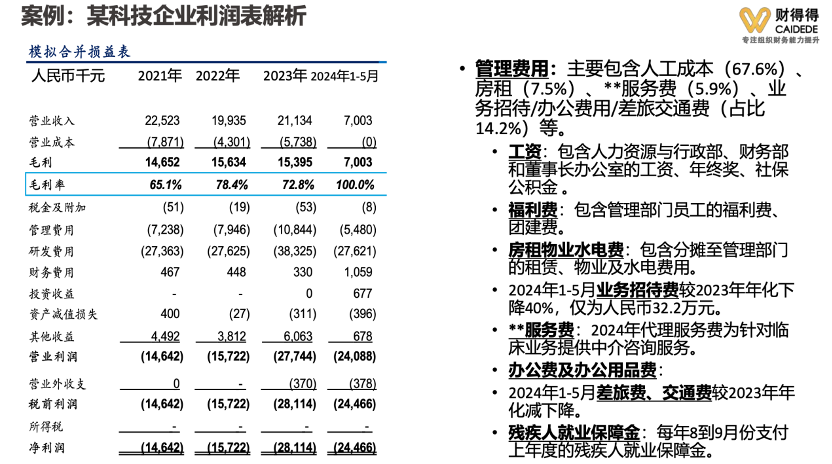
So when sales plateau, there remain numerous solutions to extract value. This company pursued domestic substitution of imported raw materials, lowering costs. Beyond this, many other cost-cutting techniques exist.
First, administrative expenses. Here's a question: for a company with steadily growing sales as shown above, should the ratio of administrative expenses to sales be rising or falling? Finance professionals generally sense that lower is more reasonable.
Yet I've seen many cases where it rises — running a 500 million RMB company as if it were 5 billion. Hiring only the best people, all top-tier talent at premium compensation, only to discover that when scale doesn't materialize, the administrative expense ratio balloons. This is strategic overreach manifesting in management costs.
What is economies of scale? It's when management expense ratio, operating expense ratio, and costs all decline as the company scales. Because at each stage, competitors differ — a 100 million RMB company faces different rivals than a 1 billion or 10 billion RMB one, and they compete ruthlessly on cost control.
I once served a home furnishings company in a sector that has broadly declined due to the real estate cliff. Yet this company's profits rose because they obsessed over cost reduction. Their management had previously been relatively粗放 (coarse/unsophisticated). If your company was粗放 in the past, don't blame yourself — good companies may prioritize growth while temporarily accepting粗放 management. But when growth slows or reverses, you must提前 (proactively) focus on profitability through精细化管理 (fine-grained management).
Looking at R&D expenses, they remain stubbornly high, continuing to climb. R&D projects must be managed by project, with milestone-based process control and aggregate resource constraints, like internal roadshows. With five projects but budget for four, let them compete — which deserves funding? Compared to across-the-board cuts, selective structural adjustment is more scientific.
Many companies are R&D-intensive, hoping to drive growth through technological innovation. Nothing wrong with this in principle, but it must match available resources. In today's environment, many investment debates aren't about right or wrong, but about how to optimally allocate limited current resources.
I once saw a typical medical technology company that had been R&D-driven at full sprint suddenly pivot to cash flow and profit orientation. It had been investing in virtually every promising area, hoping to capture market position through broad R&D, with extremely high talent density all on generous compensation, and long product development cycles.
On paper it looked decent — roughly 600 million RMB cash. But monthly net cash burn was about 60 million, meaning 600 million wouldn't last long. Fortunately the founder eventually relented somewhat, recognizing the need for R&D project controls.
Then there's financial expense — interest on loans. Consider whether lower-rate financing options exist, such as domestic letters of credit, bank acceptance drafts; some government interest subsidy policies may apply. Financial expenses must also be minimized aggressively.
3
Cost Control Can Extend From Administration to Operations in Every Link
Labor costs are the most critical to optimize and offer the greatest room for improvement. In most companies, this is the largest cost category.
I often say that companies which can't make money, have been flat for ages yet somehow survive, usually have plenty of cash on hand. Meanwhile companies that never faced major setbacks — graduated, started a business, succeeded immediately — tend to have no cash. Why? Because these companies tend to be optimistic. When cash is abundant, their first move is hiring, recruiting large numbers of excellent people rather than thinking structurally about deploying top talent where it matters most, leading to excessive labor costs.
In fact, labor costs can be structurally decomposed. It's not about rejecting talent, but recognizing some positions don't require such premium talent. As processes become optimized, standardized, and digitized, the employee profile for many positions should adjust accordingly. Right-sizing talent is correct; excellent people belong in the highest-value roles.
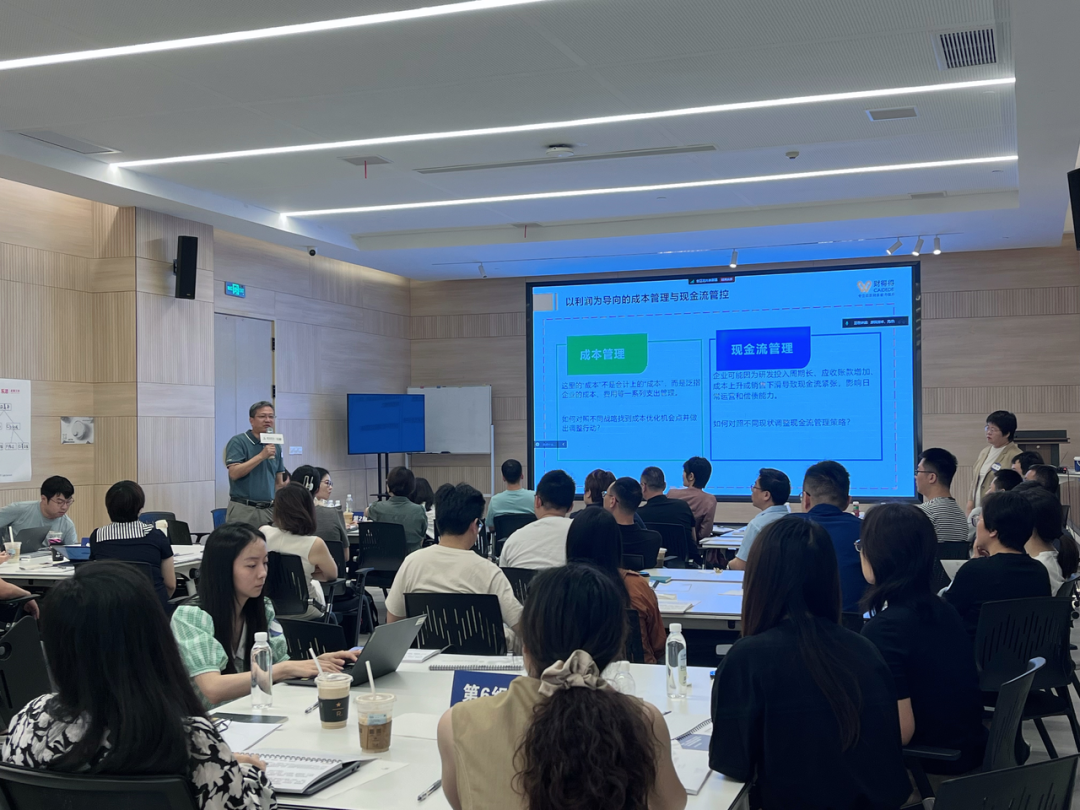
Of course, different industries require different approaches — no one-size-fits-all solution.
Take Luckin Coffee as an example — a classic case of lean cost management. From losses of hundreds of millions to annual profits of billions. Don't be fooled by it being a coffee seller; it's identical to a manufacturing enterprise, with each coffee shop functioning as a production workshop. For years now, this company has pursued continuous labor cost reduction.
Each coffee shop's peak hours differ — some in office parks peak at 2-3 PM, others at 9-10 AM. Like factories with varying capacity needs, they implemented a "1+N" staffing model. Each store has only 1 fixed employee; all others are hourly workers.
They even developed their own automated hourly worker scheduling app. Historical data plus forecasted data for each store informs peak-hour staffing configurations. Hourly workers open the app and know: morning two hours at this location, afternoon two hours at that location. Labor costs become segmented by time slot. They've pushed toward fully elastic labor costs, pursuing the extreme.
Then there are rent, utilities, property management — can these be reduced? Visiting many companies, I see high office vacancy rates. Departments with heavy external activity, like sales and procurement, could shift to hot-desking with only a few fixed seats.
Sales costs deserve special mention — many companies struggle here too. Once business strategy shifts and more R&D products enter the market, sales teams expand. Companies should consider optimizing channels, exploring whether a distribution system works.
I've encountered real cases where, examining financial statements, distribution performance was quite good with relatively light costs and fast viral growth, while direct sales networks underperformed. The solution: find someone excellent at building distribution channels, drastically reduce fixed headcount costs, and gain potentially unlimited marginal returns.
Always remember: saving money isn't shameful, spending isn't a "crime" — what matters is spending at the right points. Money spent well is good investment.
4
The More Competitive the Industry, the More Extreme the Cost Control
Many companies wonder: do we really need to control costs to this degree? My answer is absolutely yes. Industries and companies that truly practice cost leadership far exceed most people's imagination in saving money — cutting costs in every small way, with substantial aggregate returns.
Consider a budget airline example. Everyone knows airlines are heavy-asset, heavy-investment operations. During COVID especially, they faced extreme hardship — revenue collapsed while costs remained heavy, and airline personnel costs are notoriously difficult to cut. Yet this company's cash flow turned positive in the first half-year post-COVID, earning billions annually.
The founder once told me: "You can't imagine how frugal we are — others probably laugh at us."
For example, when COVID first hit, they owned an office building and optimized every rentable square meter, cramming their own employees into a small corner. Costs dropped dramatically. The founder told me: at the company's hardest point, office building rental income alone could support headquarters staff.
Even more remarkably, the company had a travel business originally focused on Japan-Korea tourism, which collapsed during COVID. After reopening, they rapidly pivoted from international to domestic city tours, creating a sightseeing bus product partnering with a comedy company where comedians introduced attractions through stand-up routines. It became a hit, and the company quickly recovered. They executed many such maneuvers.
Then there's Luckin Coffee mentioned earlier. Beyond its own cost reductions, it scrutinizes upstream BOMs, requiring all suppliers to have leading equipment efficiency and minimal equipment损耗 (loss/waste). After optimizing these to the extreme, they add a modest gross margin. They always leave margin for suppliers, even making this a deliberate policy.
Luckin's logic: start with external partnerships; when external costs hit a critical point where self-building becomes more economical, they self-build. The overall strategy is light assets first, then heavy assets. Heavy assets serve further cost reduction — many locations offer fixed asset subsidies, with government-built facilities and various preferential policies. Luckin calculates capacity precisely; wherever reasonable gross margin exists, they may consider self-building production lines.
So Luckin earns billions annually in an unprofitable sector by executing cost reduction and efficiency gains in every action to the extreme. I recommend studying highly competitive industries for cost control inspiration. When you break through differentiation thinking, you'll discover numerous adoptable methods.

Here's a simple formula for viewing corporate costs: the traditional accounting formula is sales revenue - costs - expenses = profit. What I'm presenting today is a "big cost" concept: sales revenue - profit = costs + expenses. Many entrepreneurs think: here's my revenue, subtract costs and expenses, whatever remains is profit — but that profit is often minimal or nonexistent. This new formula inverts the calculation: sales revenue minus profit equals what you can spend — your costs and expenses. Treat this as a limited resource, compare against actual spending, and you'll see more clearly how to adjust strategy. Which cost items have optimization room? I hope everyone will seriously pull out their financial statements, examine where every expenditure goes, item by item — you'll certainly find substantial cost reduction opportunities. Don't dismiss the small stuff; it often saves the most money and solves urgent needs.
5
How Manufacturing Can Reduce Inventory Costs
Let's examine cost control in manufacturing enterprises, where inventory is most representative.
Inventory is also a cost. Moving from粗放 R&D management to cost management, inventory appears as an asset on financial statements. But much of what's managed isn't truly an asset — it's expense. Inventory is an asset; each additional day isn't reflected on statements. It's just a number — 30 million, 20 million — but it ties up capital. More inventory means more capital tied up, preventing that money from earning returns elsewhere — opportunity cost lost.
The longer a company's inventory chain, the greater the cost impact. Beyond inventory costs themselves, there's capital tie-up cost affecting bank interest; plus management costs — more complexity means higher administrative expenses. This demands strategic shifts: partner with third parties, outsource low-efficiency segments that don't need to be自营 (self-operated), enabling socialized sharing to reduce costs and management difficulty. The result: not just lower capital costs, but lower management costs too.
But reality often differs, with common cost management errors. Business teams see revenue opportunities and believe more inventory means more safety. Additionally, many companies calculate sales commissions based on sales orders and shipping documents. The problem with this考核 (evaluation) method: no sales opportunity is missed, but many companies operate on sales-driven procurement and procurement-driven production. Once sales forecasts err, inventory balloons. Then all costs rise.
But examined closely, this seems correct — meeting sales demand. So sales processes must incorporate cash flow and cost concepts, or problems persist. Beyond satisfying sales order opportunities, which opportunities have good cash flow, which have good profit — can these be amplified? Which sales actions have both good profit and good cash flow — can these be scaled?
A second误区 (misconception): procurement follows sales' purchase requests. I've seen one company where sales performance was calculated on shipped orders, while procurement performance was based on fulfillment rate of sales' purchase orders. These two determine inventory and capital costs, yet neither is tied to inventory itself. Those with authority bear no responsibility; the company bears it, ultimately压 (pressing) onto the cash flow statement and inventory costs.
Then warehousing says: not my problem, I just manage receiving and shipping. Production says: I just follow requirements, manage scheduling and production, control order numbers. Finally nobody owns inventory costs — everyone thinks it's unrelated to them. This is the problem: cost control must exist at every link.
I've seen numerous companies calculate factory production costs based on standard cost capacity. One northern manufacturer had four production floors, so they calculated major customer customization costs assuming all four floors running. In reality, only three floors were used, yet sales abandoned certain orders deemed "unprofitable" based on this cost calculation. The correct approach: if an order can cover idle厂房 (factory space) and equipment, take it.
And the current environment is even more severe for many B2B companies. Because your major customers face enormous cost reduction pressure, inevitably pushing suppliers to cut costs — sometimes unconditionally. If you haven't预留 (reserved) cost reduction space yourself, profit disappears entirely. Without bargaining power, pressure intensifies.

How to reduce inventory costs? The more complex the business, the higher management costs, operating costs, sales costs, and inventory costs. Have you done detailed SKU analysis — which SKUs are profitable, which lose money, which must be自营, which can be outsourced? Combining higher-frequency sales forecasts with procurement for agile delivery enables minimal or even zero inventory.
Additionally, companies should consider how to reduce production complexity.
Many manufacturers are highly customized, even one-customer-one-order-one-BOM, which is disastrous for cost management. Control difficulty increases enormously — customized products require constant BOM changes, mass production data doesn't emerge, theoretical R&D costs diverge greatly from actual costs, causing pricing difficulties and potential losses.
I once asked a company how they addressed inaccurate customized costing. The founder told me he developed the R&D head into the sales head — R&D-sales integration. When sales negotiated with major customers, they discussed the R&D BOM directly. Developing the BOM according to customer specifications while having sales identity helped pricing coordination and made customized cost estimates more accurate. The R&D BOM then interacted efficiently with factory production for verification and correction, minimizing pricing deviation from cost variances.
In many companies, numerous non-value-adding activities and costs exist. If identified, anything unrelated to customer needs, development, or strategy can be eliminated.
6
Where Can Cost Reduction and Efficiency Improvement Begin?
What are the opportunity points for cost reduction and efficiency improvement? Let me show you a model diagram.
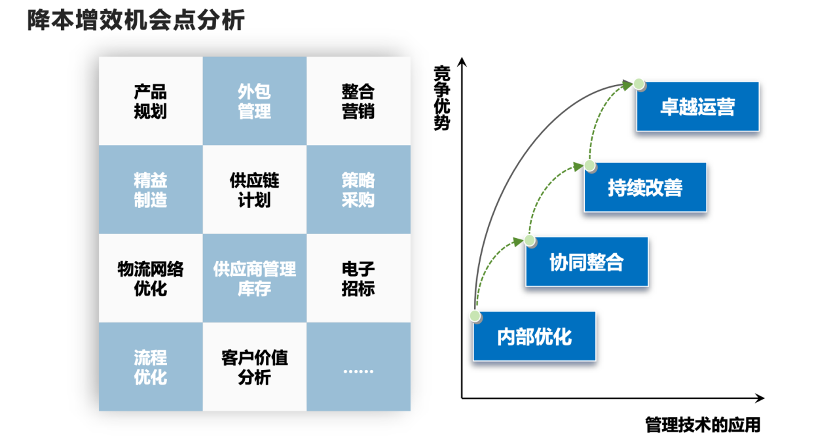
First, product planning is an opportunity point. Costs can be reduced at the product design stage. I served a process design company that later created its own razor brand, very successfully. Their brilliance lay in breaking traditional razor limitations at the design stage, creating a portable razor pocket-sized yet priced equivalently to traditional razors. This is typical product planning cost reduction, even creating a new category.
Second, outsourcing management. Luckin Coffee mentioned earlier exemplifies this — what to outsource, what to self-build, all calculable. For manufacturing: unless necessary, don't build heavy assets. Future capacity will only grow more abundant — of course referring to通用 (general-purpose) capacity. Customized products have no alternative but self-building. Even then, consider leveraging others' facilities, how to structure investment costs. This becomes uncontrollable cost and expense going forward; once invested, it remains fixed for extended periods.
Then there's integrated marketing, potentially co-developed with customers; in lean manufacturing, raw materials and labor all offer room, as mentioned earlier. Logistics network optimization too — warehouse placement, logistics methods — all can be finely controlled according to company circumstances.
Vendor-managed inventory is easily overlooked. For example, chip companies basically involve stockpiling, often unpredictably. Chip raw materials arrive for factory processing, so beyond self-management, companies must manage factories even if not owned. Many outsourced manufacturers completely ignore supplier inventory and related costs. In fact, helping suppliers reduce costs reduces your own costs.
One furniture company had reduced its own costs to the limit with no room remaining, so they dissected upstream value chains. Their main raw material was wood, subdivided into raw material and processing. They calculated which value chain segment offered better input-output and higher gross margin. Processing proved nearly profitless — just processing fees of a few RMB per square meter, with no benefit to bringing it in-house. Better to outsource processing.
But in raw materials, wood prices fluctuate like traditional agriculture, offering gross margin opportunity. Through this value chain analysis, the company later established a timber company for raw materials, gaining not just margin but also significant cost reduction space utilizing their relatively abundant capital.
Process optimization needs little explanation — well understood by all. Smooth processes improve efficiency and naturally lower costs. Customer value analysis, however, many companies don't execute well. Bind with customers for joint value analysis. Truly understand: what do customers value most? Where should differentiated costs and expenses be invested? What do customers value least? Where can costs and expenses be removed?
For example, entrepreneurs frequently stay at hotels — a classic cost-leading industry, especially business hotels. But what do real business travelers care about? Everyone knows Atour targets business clientele; they once researched customer needs. They found that fast-paced business travelers cared least about swimming pools — no time to swim, business trips are all work.
Additionally, every five-star hotel builds a lavish lobby on the first floor, double-height with extravagant lighting at enormous cost, yet fast-paced business travelers don't value this. It's equivalent to factory capacity waste — not a customer value point. So when Atour implemented cost control, the first thing they eliminated was lobby luxury costs. The company reduced costs, customer-facing prices became more competitive.
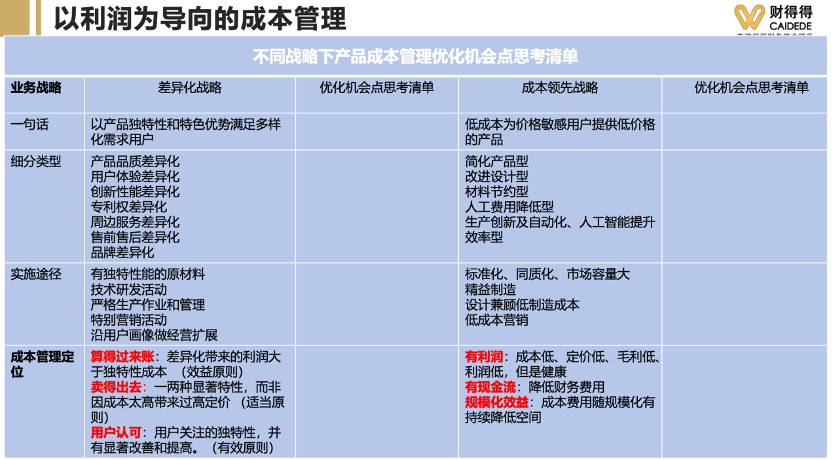
This checklist is for you — differentiation strategy on the left, cost leadership strategy on the right. I hope business and finance teams will jointly examine which optimization opportunities exist.
Simply put: cost management is about improving return on investment through spending correctly. Of course, within any company, whether adjusting business strategy or cost strategy, the number one must first have awareness, then achieve business-finance alignment. Projects driven solely by finance without business buy-in and founder support rarely succeed. So I encourage and urge founders to lead business and finance in joint participation, collaborative cost reduction — this is how to navigate cycles and increase profit and cash flow!