Code Brain | The Essence of Performance Management Is Unlocking Human Potential

Code Brain: Ecosystem Connections, Cognitive Resonance
Entrepreneurship is an endless journey of cultivation. Whether your fundamentals are solid directly determines how far your company can go. Under the pandemic, startups' weaknesses and blind spots in business operations and organizational management were exposed without mercy. Management fundamentals have become a critical test and mandatory course for core leadership teams.
That's why Code Brain is launching its "Management Fundamentals" course series, targeting three foundational and core management capabilities for founders — people, finance, and operations. Focusing on personal leadership, talent assessment, performance management, compensation and incentive design, high-performance teams, goal management, and business-finance integration across 10 major themes, it provides comprehensive basic management methods and practical tools for immediate application, helping founders elevate their fundamental management awareness and capabilities.
Starting August 2022, the "Management Fundamentals" series runs monthly with two sessions each time. For the "Performance Management" theme, we specially invited Bian Zhihan, former head of Huawei's financial transformation program and resident instructor at Gaowei Academy, to spend a full day teaching practical methods for organizational and individual performance management. Nearly 100 CEOs and executives from over 40 companies in the MaHui ecosystem participated both online and offline.

The following are selected highlights from the session:
01
Organizational Performance Management
1.1 Three Purposes of Organizational Performance: The Baton, The Lock, The Ruler
The Baton: Organizational performance is a conductor's baton — it must carry the company's strategy, not wear old shoes to walk the old road. Every year, organizational performance must look forward, based on the company's three-to-five-year plan. Goals should be set not only on departmental responsibilities but also on departmental weaknesses and the demands of neighboring departments.
The Lock: Setting organizational performance is about aligning vertically and connecting horizontally when carrying company goals. Without this alignment and connection, once battle begins, you'll either be short of soldiers or short of ammunition. So organizational performance must achieve "interlocking."
The Ruler: Another purpose of organizational performance management is to measure each organization's contribution. Based on planning or annual operating goals, set organizational performance targets or indicators, then execute and monitor. These two steps prevent organizational performance from going off track — correct deviations when they occur, with monthly business analysis, quarterly reviews, semi-annual debriefings, and year-end comprehensive debriefings to check completion.
1.2 Three Points of Attention for Organizational Performance: Process Control, Performance Evaluation, and Results Application
Process Control: Organizational performance process control requires regular reviews. Correct deviations when they occur during the process.
Performance Evaluation: With performance control comes organizational performance evaluation. Evaluation combines assessment and review — some departments are primarily assessed with review as supplement, others primarily reviewed with assessment as supplement. The more deterministic, standardized, and quantifiable the business scenario, the more it should lean toward assessment; the more uncertain, unpredictable, and difficult to quantify, the more it should lean toward review.
Departmental performance evaluation requires supervisor debriefings, including:
- External environment analysis
- Goal completion status, achievements and shortcomings
- KPI achievement level, performance completion level
- Core capabilities or competitive advantages, and improvement measures
- Customer satisfaction analysis (internal and external)
- Team learning and growth status
- Budget and next-period KPI commitments
- Requests for help and risks, requirements of neighboring departments, needed company support, and work advancement risks
Application of Performance Results: Performance results for a business or responsible segment become input for the next work plan — whether completed, and how well, become points for performance improvement or further breakthrough in the next period.
Organizational performance management must align vertically and horizontally. Don't make it Russian nesting dolls cascading down from the top (where subordinates have one set of indicators, and their subordinates have another). It must be decomposed — how to carry and support superior department goal achievement, not simply copying indicators over as assessment metrics.
02
How to Set Performance Indicators?
2.1 Three Sources for Performance Indicator Targets
Strategy Decoding: When a company is small, it may not have formal strategy decoding or annual targets. Even without these, departments have responsibility positioning, and the company has HR responsibility positioning (recruiting, training, performance, compensation, attendance, etc.). This is duty-bound work — look at whether there are targets that need emphasis as key drivers in this responsibility positioning, and if so, use them for performance indicator formulation.
Responsibility Center Positioning: Each department sits at a certain node in the company's larger processes. For example, in supply chain, sales may require 90% on-time delivery rate, complete shipments every time without missing items requiring supplementary shipping, and 95% kitting rate. These are sales' requirements of supply chain — performance indicators can then be set according to the department's role requirements.
Business Weaknesses/Management Demands: All management emphasizes being problem-oriented, and all management emphasizes addressing weaknesses. Huawei's philosophy is: in operations, leverage your strengths; in management, address your weaknesses. Performance indicators can thus be formulated based on management demands or management weaknesses.
2.2 Good Performance Targets Need Two Dimensions: Results and Path
Results aren't necessarily financial performance indicators — replicable, sustainable results are what count. Results orientation must also reflect value orientation. Sometimes we chase short-term targets where the performance results aren't replicable.
Assume two companies both hit their recruiting targets, but achieved them differently. One partnered with schools, launched campus recruiting, and established a campus recruiting operation process and mechanism. The other fought chaotically, recruiting people at high cost. Both recruiting managers hit their targets, but the value was certainly different. Only through systematic construction and process-based construction can you achieve replicable good results.
When setting targets, you must pay attention to the path. Especially during startup phases when business is unstable and much remains unvalidated, when things are unclear, don't simply decompose targets downward — process is a lever for performance management. You must ensure the atomic bomb explodes on the blackboard first before it can explode on the ground (a film about scientists building the atomic bomb showed the first half entirely of calculations on blackboards — once validated that it could explode, they began ground testing and reactor construction).
2.3 Organizational Performance Targets Fall into Three Categories: Strategic Targets, Operating Targets, and Management Improvement Targets
Strategic Targets: Major customer breakthroughs, deployment of new opportunities, exploration of new business innovation models, or major competitive projects or major customer breakthroughs, etc.
Operating Targets: Orders, revenue, profit, cash collection, waste control, extensions, etc. — continuing past patterns.
Management Improvement Targets: Internal weaknesses to support the two above targets, internal process construction, IT system construction, etc.
03
How to Achieve Target Decoding?
3.1 Strategic Target Decoding
Strategic planning and business planning together generate annual performance targets. Having a vision for the future, an innovation, a new idea — this is strategic target. Turning ideas into methods, this is strategy decoding.
Step one is clarifying strategy and strategic description. Step two is deriving key strategic initiatives. Step three is deriving strategic measurement indicators. Step four is annual business targets. Step five is annual business strategy and action plans. Step six is annual priority work and organizational KPIs.
I often communicate with entrepreneurs or founders and find they have endless ideas. Some ideas they basically mention in one or two meetings with employees and think they've been communicated — they assume the team knows. But when investigated, the team says they don't know; the boss mentioned it in a meeting, but his ideas change after some time.
Strategic planning mainly gives everyone a compass. If you're management, go align with the boss. If you're a founder, use this method to format your ideas. If ideas aren't described in a formatted way, they're hard for others to understand.
3.2 Business Target Decoding: Set the Algorithm + Set the Methods
Set the Algorithm: Addition/Subtraction First, Then Multiplication/Division. Ensure which business units will carry the targets. For example, a company making dryers divides into several dryer categories, with domestic, North America, Europe, and Japan teams. The company-wide target is derived from addition/subtraction of these business units. When setting targets, first think addition, then see if anything needs subtraction — subtraction is focus, some areas aren't needed, abandon them; the purpose of abandoning is better focus.
Addition/Subtraction Has Three Dimensions: First dimension is customer groups or customer categories. Second dimension is region — assuming a 10 billion target for China, distributed to various representative offices, with Shanghai municipality as one region. Third dimension is product line. Of course you don't necessarily need all three dimensions, but you need at least two — generally companies have product dimension and customer group dimension.
Then multiplication/division: along business process links, map targets to the performance equation to understand how targets are generated, with key links串联 or并联 to finally reach the target.
Set the Methods: Key Links, Risk Points, Key Bottlenecks. Opening new stores — where to open, when to open — these require setting methods. What are the key links, risk points, and bottlenecks in the methods? Define specific projects one by one. Do addition/subtraction along business units, multiplication/division along process links. If targets are distributed to customer groups, customer groups certainly require customer visits, intentions, bidding, contract signing after bidding, shipping after contract signing. The total performance volume for a customer group or customer equals how many customers visited, how many had intentions, what the intention conversion rate was, bidding, what the conversion rate was from bidding to contract signing, finally becoming performance volume.
Where are the key bottlenecks in the process, or where is the key effort space to complete this target, where are the leverage points? Performance always finds high-value links — where to invest minimal resources for maximum return.
Every company has a performance equation: Traffic acquisition × Conversion rate × Average order value × Repurchase rate = Performance. Compare with last year — how much does performance need to grow, where is there still room? Specifically, is traffic acquisition weak or is conversion rate weak? Is it sales capability, product capability, or delivery capability?
To summarize, target setting must transform the boss's ideas into employees' methods. The boss believes then sees — believing there's an opportunity, believing this can be done, believing there's grain to harvest there.
Employees generally see then believe, so you need to do推演. Otherwise, if you arbitrarily set a target and employees say it's too high, they won't have confidence to complete it. Why no confidence? Because they haven't seen. Why haven't they seen? Because you haven't explored with them the path, methods, strategy, resources to achieve the target, so they feel certain it can be done.
04
Individual Performance Management
Individual performance indicators come from three sources: superior department or supervisor performance targets, improvements required by personal job responsibilities or their processes, and indicators from certain processes.
4.1 The GROW Growth Model
Performance coaching includes daily coaching and periodic coaching. There's an important model here called coaching-style辅导, the GROW growth model.
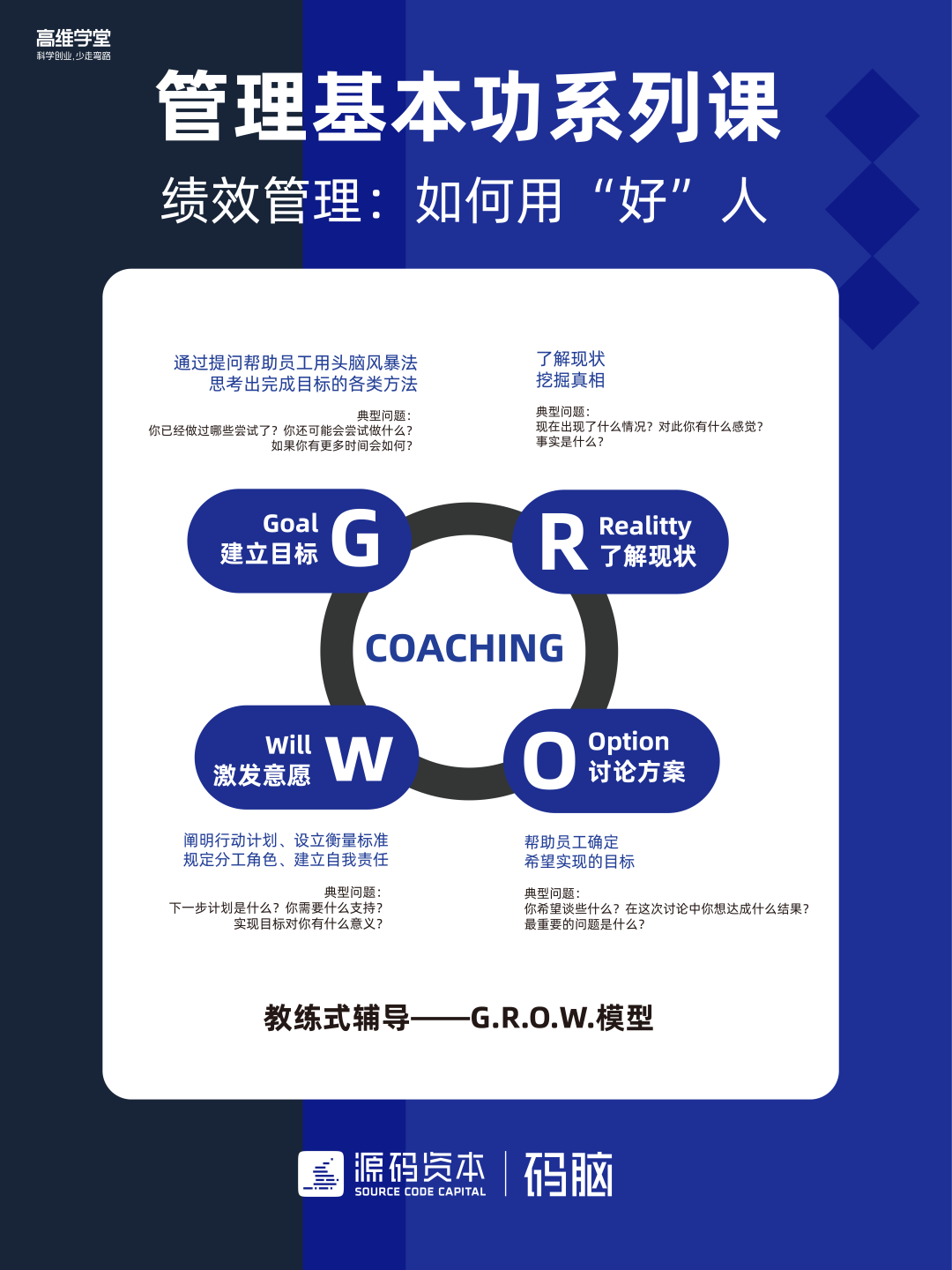
G — Goal: First establish the goal. Confirm with the employee whether they're confident about this goal, whether they can accept it, whether understanding is aligned. Discuss based on the goal, not based on goal performance.
R — Reality: After establishing the goal, next understand the employee's current situation — their business situation, capability situation, resource situation, whether these favor completing this goal. Based on understanding their situation, explore possible solutions.
W — Will: Often, employees expect the boss or leader to give direction — just listen and follow. You need to let employees express their voice first, finally let them decide, analyzing with them how option A is, how B is, how C is.
O — Options: After determining a solution, when there are optional solutions, refine: ask what the specific plan is for doing it this way, resources, risks, etc. The purpose of confirming with them is to let them see — once they see, they believe.
4.2 Performance Coaching Tool: Four Employee Types by Competency
The performance coaching tool uses capability and willingness dimensions to divide employees into four types, forming a four-quadrant grid.
- High willingness, strong capability, and confident
- Capable but lacking willingness, showing anxiety and restlessness about the future
- Low capability, willing, and confident
- Worst: neither capable nor willing
After categorizing employees, use different approaches when coaching them. This process is called situational leadership. That is, when coaching and managing subordinates, it's best not to have employees adapt to your style — adapt to the employees' characteristics.
First type: capable, willing, and confident employees should be directly delegated. Whether to give direct guidance to this type of employee, but give them lots of encouragement.
Second type: capable but lacking willingness — this employee group needs strengthened motivation and delegation, stimulating employees to challenge high performance.
Third type: willing but lacking capability — give specific guidance.
Fourth type: weak capability and weak willingness — give direct orders, no need for discussion, discussion is useless. Coach according to this categorization.
4.3 Performance Evaluation: To Force Distribution or Not?
Performance evaluation can skip forced distribution. According to Jack Welch's vitality curve, knowledge workers, core management cadres, and key core cadres are best evaluated using the vitality curve with forced distribution.
Without an elimination mechanism, without a ranking-based forced proportion distribution mechanism, everyone gives employees good scores or can't differentiate gaps, or in the process, without an elimination mechanism, then employees also have no pressure. Small and medium enterprises don't necessarily need to insist on 10% elimination rate — don't eliminate lightly without talent pipeline preparation; elimination isn't always easy to hire replacements. Key position redundancy should reach 20%. When coaching some small enterprises, I find elimination is sometimes hard to implement — be flexible then. Elimination doesn't necessarily mean firing; it also includes pay cuts, position transfers.
For example, a 100-person company with 20 key positions, needing 20% redundancy, means four redundant people. Four people is enough for one or two rounds of elimination to activate the entire organization's vitality, because with four people's redundancy, a bit more cost, the entire organization's vitality is activated and efficiency improves.
4.4 Individual Performance: How Exactly to Evaluate?
Chinese people are accustomed to emphasizing personal relationships. Evaluation needs to consider avoiding emotional confrontation between individuals. I suggest still having certain methods, processes, or standards.
Determine Proportion Allocation: Set a standard — how many As among ten people — this standard is determined by organizational performance.
Employee Self-Evaluation: Before self-evaluation, collect neighboring departments' opinions about them, especially if this employee collaborates frequently with other departments — collect more surrounding department opinions.
Pre-Evaluation Communication: Before evaluation, communicate with employees about their performance and facts.
Preliminary Ranking: Don't use indicator scoring as rigid evaluation criteria.
Collective Review: When evaluating someone, avoid forming a stereotype — collective review is more objective.
Superior Review: Many companies' sales departments have generally loose performance standards, R&D departments generally tight. The standards and scales differ between departments, so you need a skip-level or higher-level supervisor to do performance calibration. Otherwise, direct gaps between different departments are too large, and each supervisor's strictness with subordinates differs, making employees feel bad.
4.5 Employee Self-Evaluation Doesn't Match Reality — How to Handle?
For individual performance, first consider self-evaluation. Self-evaluation and others' evaluation often have gaps. Some employees are perfectionists — they think they did quite well but insist on scoring themselves low or not that high. Another employee actually didn't do well but gave themselves high scores.
For perfectionists, appropriately raise scores. If overconfident, examine whether the indicators only see achievements not problems, mistaking effort for results. Affirm their contribution, but still guide them toward results orientation.
For frontline operational position employees, don't make performance management too complex. Suggest using absolute assessment, especially for supply chain, production, and similar deterministic business scenarios. Set some absolute standards — performance results compared against standards, good is good, not good is not good. Don't do complex performance management, reduce human judgment, so employees have direction to strive for and won't feel insecure.
4.6 Relative Assessment Evaluation
Relative evaluation is hardest. Divided into five levels: A proportion range is 10–15%, B or B+ is 70–75%, C and D are 5–10%. If department performance is particularly good, A can be increased by 5% or 10% — this is just standard distribution.
Hardest is when results are good but process was bad, or results were bad due to many external uncontrollables — policy uncontrollable, pandemic uncontrollable — leading to bad results, but the person worked very hard.
I suggest following this principle: when results are good, whether the causal relationship between process actions and results holds. If it holds, then certainly good. If it doesn't hold, it means free-riding — then performance results should be adjusted downward. If performance results are bad but process efforts were made, certainly adjust performance results appropriately upward.
The relative assessment evaluation method focuses on both ends and grasps key points.
Determine employees with performance evaluation grade "A." For example, indicator scores must be above 80 to be a necessary condition for A — setting this broadly is fine. First determine the lower limit of indicator scores for grade A, then you can rank out the top 20–30% of employees. For example, if five people scored above 80, finally select three As from these five through differential evaluation, then do collective review. This avoids simple ranking by score.
Determine employees with performance evaluation grades "C, D." Determine the upper limit of indicator scores for grades C and D. Scores not reaching above 60 are candidates for C and D, i.e., the bottom 20–30%. Similarly, assume the bottom five are ranked out, then select two as C and D employees, then do collective review, while avoiding any single person forming a单一,刻板 impression — more people means more perspectives, ensuring objectivity and fairness.
Delegate "B, B+" grading to supervisors as much as possible. After selecting both ends, this can't be decided by one person. Giving As and giving Cs and Ds are serious matters requiring公信力, so differential evaluation is necessary, then collective review after differentiation.
In collective review of employee performance facts, scoring status, and performance status, at this time you should align — for similar achievements, similar work nature, best avoid pulling their gaps too large or inconsistent.
Higher-level management teams must review, and after review, align and calibrate overall. This action is very important — skip-level alignment and calibration is essential to avoid differences caused by varying strictness. Additionally, if performance results are publicized, establish channels where employees can appeal.
4.7 Performance Results Communication
After performance results come out, to promote performance improvement, you must communicate, thereby ensuring company performance objectivity and fairness, strengthening employees' recognition of performance responsibility, and strengthening performance management seriousness.
The origin point of performance management is to create value for customers — all pointing to this, not for assessment, not for scoring, not for ranking people into excellent/good/average/poor grades. The principle of performance management is to unleash employee potential — all management actions are to let employees improve performance, achieve company targets, and grow capabilities.
The principle of performance management is sustainable enterprise development. Whether performance management is good or not, the final test is whether the organization has vitality and whether business is growing. If business is growing and the organization has vitality, performance management direction is correct — then don't obsess over whether to use KPI, OKR, or BSC; whichever you use well works.


Issue 35 Code Brain | The First Step in Assessing and Deploying Talent: How to Interview Scientifically
Issue 34 Code Brain | How Far a Team Can Go Depends on These 6 Points
Issue 33 Code Brain | An Entrepreneur's 11,626.5 Hours
Issue 32 Code Brain | Leadership Is Leading People to Uncharted Territory
Issue 31 Code Brain | Amazon's Ten Compliance Lessons for Going Global
Issue 30 Code Brain | 60 Hours of "Practical Leadership" — Full Highlights!
Issue 29 Code Brain | Zheng Yunduan: What Drives Organizations?
Issue 28 Code Brain | Understanding Human Nature to Build a Good "Vanguard" for Going Global
Issue 27 Code Brain | Where Carbon Comes From and Where It Goes
Issue 26 Code Brain | All Things Overseas Marketing
More MaHui members can view by clicking "Read Original"