Code Brain | The Gap Companies Can't Cross May Come Down to Running Bad Meetings

If you can run key meetings well, managing a company becomes much easier.


For entrepreneurs, the three keywords — "strategy," "organization," and "people" — are deeply familiar yet somehow still feel like a fog. Any company that's still alive will encounter internal and external challenges as it grows. When these challenges hit, how should you respond in ways that actually help the organization develop?
Xia Ruibin, former senior organizational development expert at Alibaba, former HRVP at Renrenche, and founder of Ruiyi Development Consulting, believes the answer lies in returning to the essence of management and the fundamentals of the business, achieving an integrated, highly synergistic alignment of strategy, organization, and people.

At a Code Brain session on July 1, Xia Ruibin delivered a talk titled "How Strategy, Organization, and People Can Achieve Integrated, High-Efficiency Synergy" to MaHui founders, systematically breaking down how these three elements can work as one. The core takeaways are summarized below — enjoy:
Most startups begin with beautiful visions. But as long as a company survives — whether in its early, growth, or mature stages — it will face endless problems. If you start from problems alone, you may never transcend your organization's current state. Through practice across different companies, I've gradually realized that the most critical factor when organizations face challenges is this: can the organization develop an ecological, systemic self-healing capacity — like a human body?
1
Strategy Is the Biggest Leverage Point in Any Organization
Organizational problems are diverse and never-ending. Some companies face executive teams that can't gel. Others repeatedly miss revenue targets. Still others see innovation initiatives fail again and again.
Through my work with various companies, I've found that only by introducing systems thinking into problem-solving — exploring deeper structures and more holistic perspectives — can you transcend the status quo. For any commercial organization, its primary social responsibility is to deliver customer value, and the process of delivering that value is the process of strategy execution. Regardless of business type or development stage, strategy is something every company must confront seriously. Strategy also serves as an internal fulcrum where pulling one thread moves the whole system.
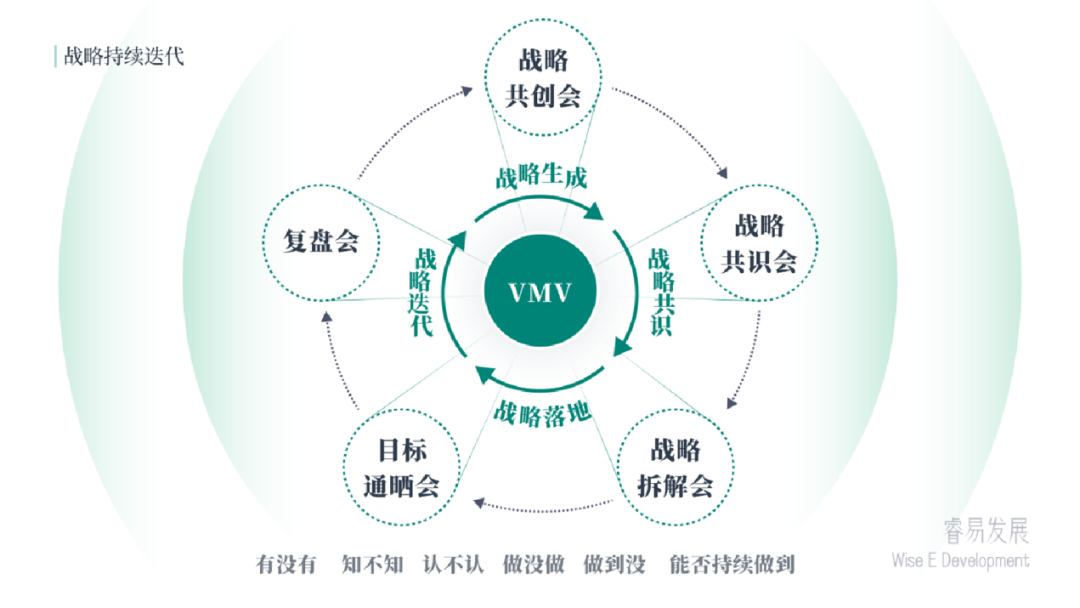
For strategy, I've developed a memorable diagnostic framework: "Have it or not? Know it or not? Buy into it or not? Act on it or not? Achieve it or not? Can you sustain it?" Different companies can assess which stage they're currently at.
"Have it or not" — Many companies lack strategic objectives entirely; they only have sales targets or profit targets. The broader strategic direction has never been aligned across the team. This is why executive teams sometimes fail to gel — it's not interpersonal conflict, but rather everyone operating from local perspectives, maximizing their own interests, and clashing with each other.
"Know it or not" — Often the CEO believes the company has a clear strategy that they've communicated repeatedly, and it's the team's fault for not executing. But dig deeper and you'll find the executive team hasn't even aligned on who the customer is. They lack shared mental models and a common language around "strategy," "customer," and "customer value."
"Buy into it or not" — For any organization, consciously building shared language and thinking frameworks is a prerequisite for consensus. Here, once people understand the company strategy, can they each bring their market knowledge, industry trends, and team realities into an open forum for discussion and alignment? This ensures people grasp not just the how but the why behind it — generating genuine motivation.
"Act on it or not" — Once there's mental alignment, you need to examine the business flow: can your current operations carry strategy execution? Are there gaps or adjustments needed? Then look at organizational design: are there departments, key roles, and key talent in place to support this?
"Achieve it or not" — Continuous retrospection is core to closing the strategy execution loop. We've entered an era of uncertainty; even perfect plans face external challenges and changes during execution. Retrospection is the best correction mechanism, and also the optimal arena for people's energy to be channeled and ignited.
"Can you sustain it" — The first priority of organizational work is "helping the business achieve results efficiently while developing sustainable organizational capabilities." Throughout strategy execution, you must consciously identify and examine what organizational capabilities each business unit needs to build or strengthen.
2
How to Build a Moat for Your Organization
When any organization encounters problems, you can consciously diagnose which link has broken. Take the earlier example of executive teams not gelling: investigation often reveals the team has never had formal strategic discussions or reached genuine consensus — only the CEO's one-way communication, without shared language to support it. So people never truly understood or bought in.
Innovation initiatives fail because the executive team holds fundamentally different views on future industry trends and market conditions — their energy scatters. Revenue targets are missed because strategy was only aligned at the executive level, with no mechanism for cascading downward, leaving frontline execution teams with low strategic awareness, executing blindly without motivation.
Thus, when organizations face problems, you need the courage to pursue the real problem. Surface problems are relatively simple and short-lived; solving problems at face value only consumes massive time and energy, leaving you exhausted from constantly firefighting.
Seeing through appearances to the essence, sinking from above the iceberg to the structural and mechanistic levels below for fundamental construction — that's the real solution. And the strategy thread has pulling power for every department in the organization. Using it to guide the organization down a "well-digging" path is what truly builds a moat.
3
Meetings Are the "Microworld" of Organizational Life
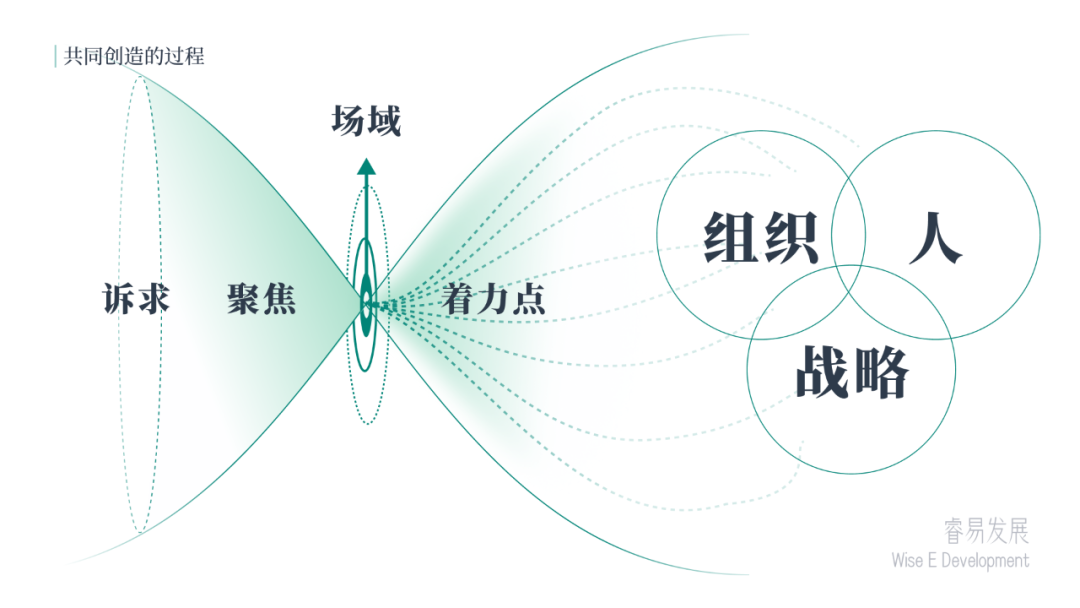
Organization is a process of co-creation. With limited organizational resources, to effectively stimulate co-creative energy, building the right field is critical. Through field-based connection, you can focus the organization's demands, challenges, and problems, find leverage points, and simultaneously work on strategy, organization, and people — and meetings are the most important field in every company.
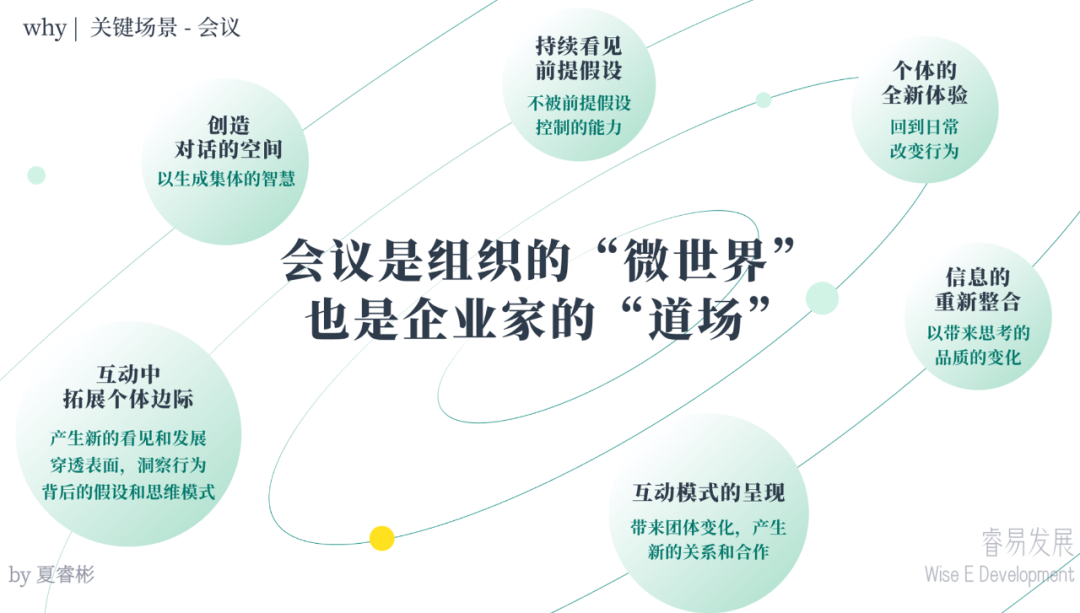
Meetings are the "microworld" of organizations, and the "dojo" of entrepreneurs. People often discuss "how's the organization," but no one has a God's-eye view of the whole organization in all its detail. Meetings are different — they occur in a unified scene where everyone's actions and behaviors are simultaneously visible, and individual patterns and interaction patterns between people are all on display.
To some degree, meetings concentrate the organization's daily operations, hence "microworld." For the CEO, meetings are a critical arena for managerial work; the quality of meetings you run directly impacts management effectiveness.
A truly valuable meeting addresses strategy, organization, and people simultaneously. It creates new conversational space, breaks existing interaction patterns, surfaces new raw data, and continuously examines underlying assumptions. Through reintegration of information, it elevates the quality of thinking and expands individual boundaries through interaction. On one hand, it creates new individual experiences that translate into changed daily behavior; on the other, it generates group change, producing new relationships and collaboration. This co-creation process ultimately advances strategy execution.
Especially for early-stage and growth-stage companies with very limited organizational resources, whether people can operate effectively at key leverage points is critical to organizational effectiveness.
On strategy, we need to walk through the full loop: strategy generation, strategic consensus, strategy execution, and strategy iteration. On organization, we must return to fundamentals: the executive team needs steadiness, continuously investing energy around important and difficult matters. Run your strategy co-creation sessions, alignment sessions, decomposition sessions, review sessions, and retrospection sessions well. Use meetings as a leverage point to firmly grasp your annual strategy.
Build organizational capability around this main thread — build while you fight. The organizational systems, mechanisms, and processes that gradually take shape through your unique strategy execution journey will truly fit your company's characteristics and rhythm. Organizational building can't be accomplished overnight; it proceeds step by step.