Code Brain | To Build a Strong Overseas "Vanguard," You Must First Understand Human Nature

Code Brain: Ecosystem Connections, Cognitive Resonance
For Chinese companies going global, the first hurdle is recruiting a "vanguard" team. Facing entirely different market environments, cultural characteristics, and consumer habits, how can this team win its first battle?
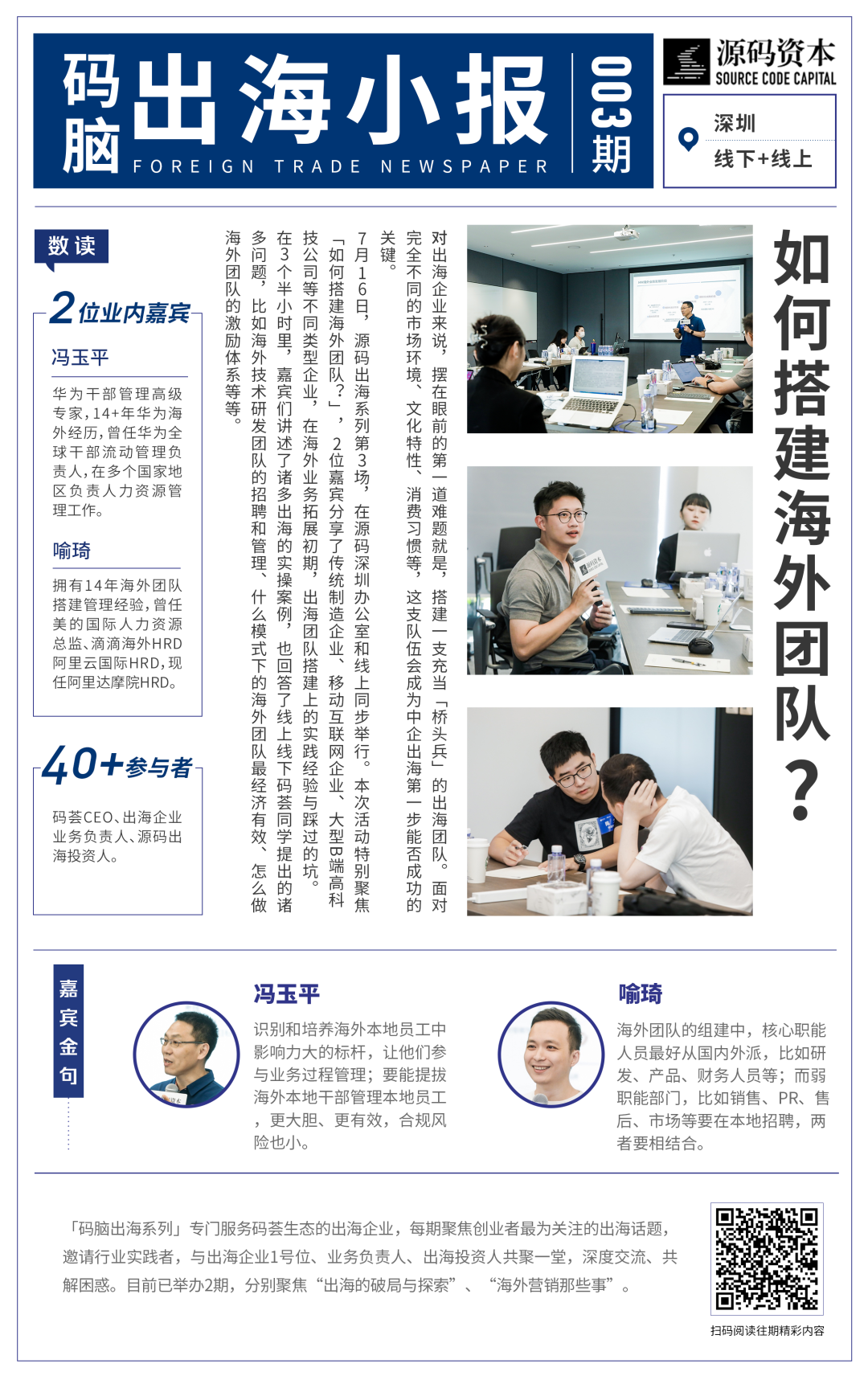
On July 16, the third installment of Source Code Capital's Going Global series — "How to Build an Overseas Team?" — was held in Shenzhen. We specially invited two guests with extensive experience managing international teams: Feng Yuping, who spent 14 years working overseas and previously served as Huawei's global head of executive mobility; and Yu Qi, former HR director for Midea International, DiDi's overseas operations, and Alibaba Cloud International, and current HR director at DAMO Academy.
Drawing from their own experiences, they shared mature practices and hard-won lessons from R&D-driven enterprises, traditional manufacturers, and internet companies, engaging in deep discussion with more than 40 founders and investors attending both online and offline. This article excerpts Yu Qi's responses.
Q1: What common patterns have emerged in Chinese companies' globalization paths over the past few decades?
Having experienced the international expansion of both traditional Chinese manufacturers and mobile internet companies, I've tried to summarize their respective strengths and weaknesses. My preliminary conclusion: regardless of industry, 80% of Chinese companies go through three phases — rush out, pull back, and walk out; the remaining 20% depends on the decision-maker's psychological judgment, which determines how many detours the company takes and whether it ultimately succeeds.
1. Rush Out
Companies going global first rush out in a hurry. They may have strong resources or capabilities, and the process often involves little deep thinking — just copy-pasting their China business model, simple and straightforward. Yet China's market differs substantially from overseas markets.
China is essentially its own category of market with significant peculiarities. Success at home doesn't guarantee replicability abroad. To date, I haven't seen a successful case of direct replication. Perhaps it works in one or two countries, but broadly it's difficult. South Korea offers a useful comparison: even Samsung, as a successful global company, employed fundamentally different strategies inside and outside Korea.
2. Pull Back
When companies' approaches don't fit local conditions, they get battered and start thinking about retreat. The decision to pull back tests the decision-maker's resolve.
I've seen some leaders take five to seven years to get past this psychological barrier. Others keep resource commitments minimal, sending small trial teams to test the waters like lottery tickets, scaling up international efforts only after success. Still others adjust immediately after pulling back. These are all oscillation processes, and their duration determines how long internationalization takes.
3. Walk Out
What's the measure of success? I believe it's when 30% of revenue comes from overseas — that's truly taking the first step. The path runs through greenfield investment, joint ventures, and M&A. My first company took ten years for overseas revenue to exceed 30%. Fortunately, my second company did it in one year: greenfield investment in the first half, joint ventures and M&A in the second half. Though year-end related revenue was under 5%, the decision-maker's resolve was remarkably strong. With internationalization as the strategic goal, you must maintain conviction in your future possibilities.
From another angle, the ideal scenario for Chinese companies going global is capability overflow — three types: product capability, operational capability, and brand capability. Chinese manufacturers typically start with OEM (Original Equipment Manufacture), making products acceptable in every country while gradually building brands. Thus brand-building is the core challenge for OEM manufacturers going global. Chinese internet companies face a harder path because their brand succeeds before their product — the brand goes out first. Since user habits differ domestically and internationally, the more successful a company is in China, the harder internationalization may be.
When companies feel their product and brand capabilities are overflowing, they can choose internationalization; operational capability always requires exploration before actual execution. Therefore, the decision-maker's resolve and whether relevant capabilities have overflowed are the two most critical elements in Chinese companies' globalization.
Q2: What are the significant differences between manufacturing and internet companies in their globalization processes?
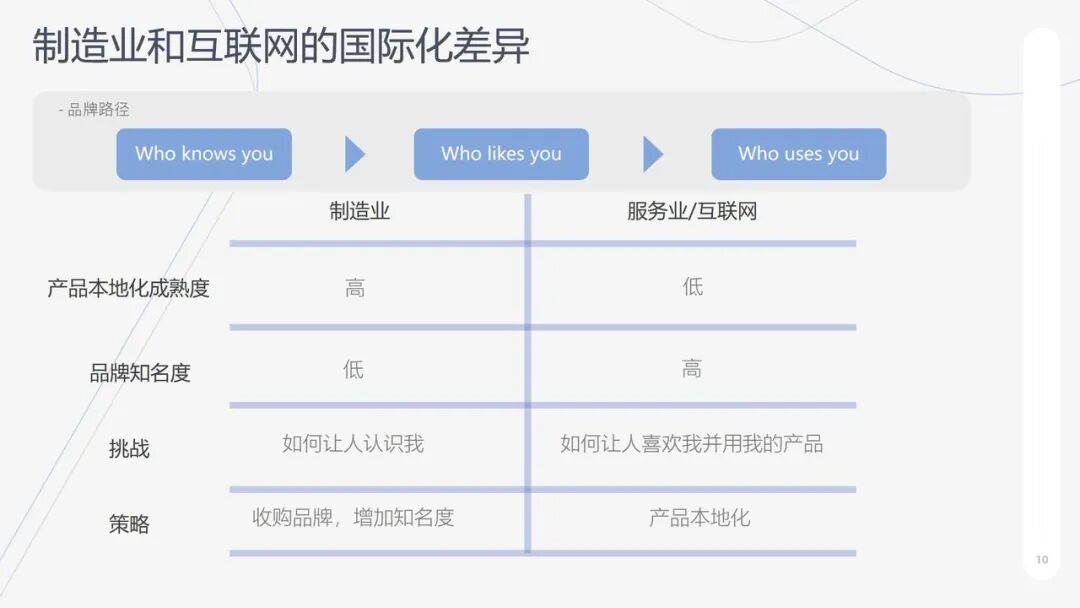
This is the brand mind model for companies going global: phase one is "who knows me," phase two is "who likes me," phase three is "who uses me."
Chinese manufacturing companies started with phase three, "who uses me." Many Chinese products are widely used in Europe, America, Southeast Asia, and elsewhere — over 90% of home appliances in North America are made in China, North American branded. When foreign consumers use products first, they provide direct feedback, laying good groundwork for subsequent development like overseas brand acquisitions and patent purchases.
Internet companies going global follow the opposite pattern. Because they list in the United States and Hong Kong and grow their market capitalization, their brands rise first, yet overseas consumers often have little actual product awareness. So internet companies going global must solve the latter two key problems — who likes me and who uses me.
Brand recognition can happen in an instant, but making a product something overseas consumers need and like requires accumulated time (the simpler and more intuitive, the more it fits existing consumer habits, the shorter the accumulation — like TikTok and DiDi's overseas versions). For internet companies, building products quickly and gaining market recognition under such pressure is a major challenge. Some companies increase visibility by directly acquiring brands.
Additionally, internet products have lower stability and maturity. The challenge is "how do I get others to like me and use my product?" McKinsey surveyed Chinese and American consumers with the same questions: How interested are you in future AI applications? China: 30%+, US: 10%+. Second question: How interested do you think you'll be in five years? China: 60%+, US: only up 10%+. China is a market exceptionally willing to experiment; companies can constantly try new products. Chinese consumers are probably the most open-minded in the world — we accept extensive trial and error, and we like more and more functions concentrated in one product. Overseas markets tend to prefer simple, direct products. Chinese companies are relatively poor at subtraction. Products successful in China have very low probability of succeeding elsewhere. Compare WeChat with WhatsApp and Snapchat, or Alipay with PayPal, and the difference is clear.
Q3: When a globalizing company reaches a certain stage, what's the most effective arrangement between China headquarters and overseas operations?
There are two models: headquarters centralization and regional autonomy.
Most companies choose the former. A major challenge of headquarters centralization is achieving genuine internationalization at headquarters and abroad — can anyone headquarters sends overseas actually command respect from corresponding line managers?
In my career, one group's management actually resisted internationalization. For many, internationalization isn't transformation but revolution. Because they don't speak English, they worry that if internationalization succeeds, they'll lose their jobs — this is basic human nature. Thus, grasping human nature is crucial in internationalization. For example, in talent expectations, overseas companies emphasize professionalism as the baseline, while domestic discussions may center on power and seniority. Unknown markets, unknown management approaches, unknown cultures — all heavily influence leadership decisions, placing greater demands on headquarters managers' capabilities.
How to build "headquarters internationalization" capability? Essentially: cultivate internally or bring in external talent. Bringing in foreigners typically requires two to three waves of磨合 before it works — there will definitely be casualties, that's reality. Foreign executives probably won't speak Chinese, and they'll冲击 company culture. You want them to fight immediately, but they may start with process — this requires磨合.
How to achieve genuine overseas internationalization? Empower overseas executives. Regional management means splitting business modules independently — dedicated teams in China handling overseas technology, product, R&D, managing themselves, with headquarters only setting targets. This management model resembles how Procter & Gamble initially operated European subsidiaries separately from the US. Lower risk, but the longer the trial period, the more divergent the two entities become, creating bigger future problems.
I'll give another example related to expatriation: whether to send domestic staff or hire locally. My first company operated in 25 countries with 40,000 people overseas, yet we only sent 80 people abroad. My second company had only 600 local overseas staff, yet we sent 200 from China — extremely different staffing ratios. Why send so many core technical personnel? Essentially, distrust. This too relates to the decision-maker's judgment.
Q4: How should globalizing companies cultivate international talent?
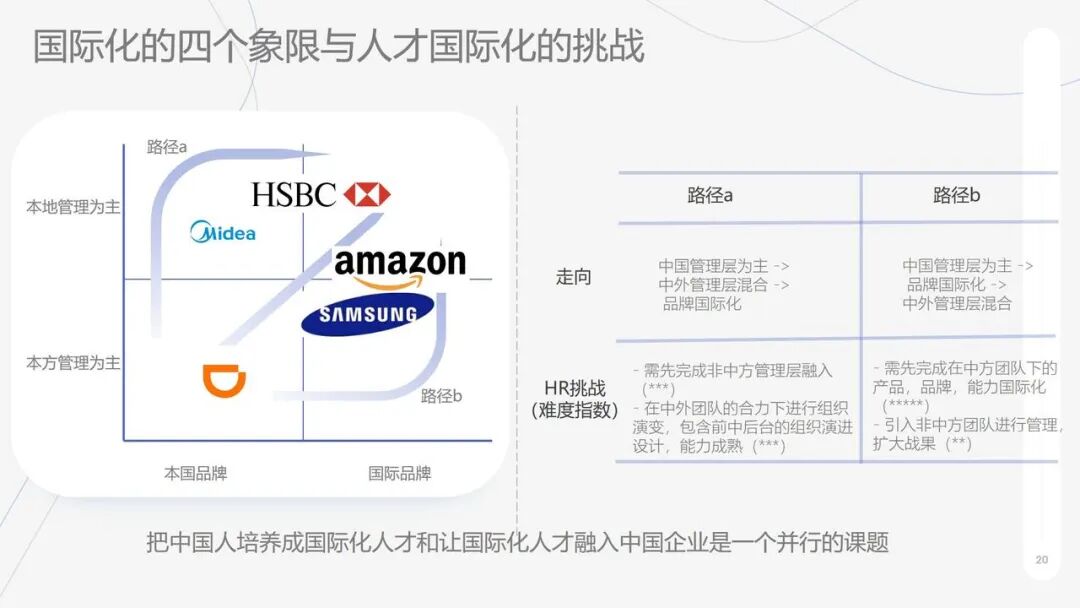
I've roughly drawn an organizational quadrant to help explore what kind of company you want to become and where that company ultimately goes. If your goal is to build an international brand managed by local staff, you can't get there directly — it won't work. But you have two indirect paths, a and b.
Either start Chinese-brand-centric with local staff gradually cultivated; or start with an international brand and overseas staff management, gradually building Chinese capabilities — Lenovo took the latter path.
If you take path a, Chinese management must dominate initially, gradually transitioning to a mixed Chinese-international management layer, then evolving into an international brand. If you take path b, Chinese management dominates initially, gradually switching to an international brand, then mixing Chinese and international management together.
Path a's first challenge: can non-Chinese staff integrate? Southeast Asia is relatively easier; Europe and America may be challenging. Second challenge: organizational evolution under Chinese-international team collaboration, including middle and back offices. They'll help with organizational design and change, mostly for B2C; B2B approaches differ, likely still headquarters-led.
Path b faces a very difficult problem: how do Chinese people build international product and operational capabilities? Send a group of Chinese to America, and lacking fundamental understanding of American products, gradually evolving into a locally managed American brand is extremely hard. Toyota has a case study: initially they couldn't sell cars in America and didn't know why. Later they sent Toyota engineers to America for a period, and the designers realized Americans live in large houses with huge garages — Japanese cars were too small, looking stingy parked inside. Wrong vehicle class.
Many car manufacturers expanding to Southeast Asia found Southeast Asian cars were all SUVs, not sedans. It wasn't that people preferred SUVs, but Southeast Asia has long rainy seasons, poor drainage, easy flooding — vehicles need high ground clearance. Without living locally or being local, such details are hard to know. So whether Chinese companies succeed abroad today depends on understanding overseas local markets; much product design must localize. If your product is China-oriented, standardized without need for modification, promotion still requires local people.
Another question: how to motivate foreign employees? Foreign employees vary — frontline, middle management, senior management. Motivating frontline employees works poorly, unlike in China. So target middle and senior management — if you triple performance today, what's the payoff? Very clear results; overseas senior management is easier and more effective to motivate than frontline.
Q5: In building global teams, which roles should be expatriated and which hired locally?
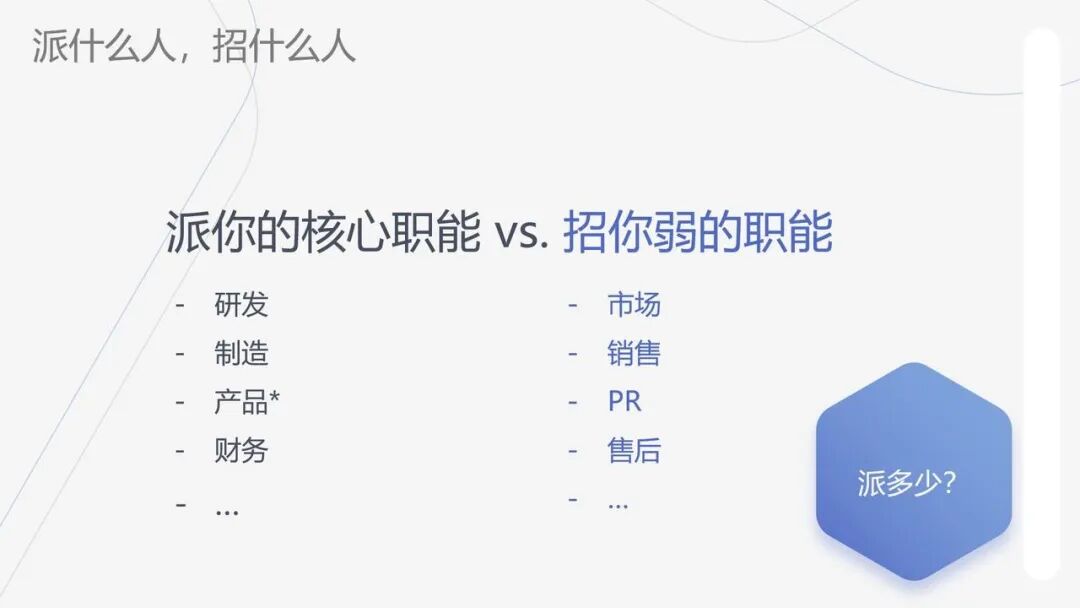
Every company differs. As I mentioned, one traditional manufacturer going global sent only 80 people overseas total: for sales companies, directly expatriate the finance director and deputy general manager — these should definitely be Chinese; for manufacturing with factories, the number two and R&D head should be Chinese. So even with operations spanning 20+ countries and regions, sending 2 people per country/region for sales companies and 3-5 for manufacturing locations with factories is sufficient. Other staff basically needn't be expatriated, because long-term expatriate management costs exceed localization difficulty.
But HR is best localized — Chinese HR expatriation is difficult, assuming your headquarters can achieve genuine internationalization, meaning it can actually manage overseas HR teams. I once sent a Chinese HR person to America and discovered something interesting: most Chinese companies' HR lacks sufficient professionalism, so our people are somewhat intimidated when discussing professionalism with them. My HR person was very assertive domestically but changed abroad.
Chinese expatriate HR, understanding more about domestic cards, can反而 become problematic, and local HR management may also suffer, possibly全面偏心 local employees. So this specific choice depends on headquarters capability — whether you can驾驭 local HR. If yes, locals managing locals is optimal.
Therefore, localized hiring focuses mainly on marketing, sales, PR, after-sales service — roles requiring deep local market understanding and accumulation, inherently weak areas for Chinese companies going global. Expatriation here反而 significantly harms overseas market development.
For core functions including the aforementioned finance, manufacturing, R&D, expatriation from China is preferable — these concern the company's core competitiveness and critical business continuity.
Product roles are exceptional. For consumer goods companies where products already have overseas competitiveness and influence, technical personnel can be expatriated. But for software services companies, sending Chinese product people abroad may not work well — local talent is recommended.
Overall: expatriate the most core personnel. Whether product or marketing staff, if core capabilities originate from China, send them out. Long-term, Chinese companies going global will see lowest costs with talent localization, and localization is the long-term trend. Pure reliance on Chinese employee expatriation to sustain internationalization is difficult to maintain. Reasonably leverage the expatriation杠杆 — ensuring core capability competitiveness while effectively motivating local employee积极性.


Code Brain Issue 27 | Where Carbon Comes From and Where It Goes
Code Brain Issue 26 | Overseas Marketing Matters
Code Brain Issue 25 | Decoding Liu Genghong's Traffic Formula
Code Brain Issue 24 | Equity Financing: What Changes and What Doesn't
Code Brain Issue 23 | Eight Questions on Going Global: Where Are the New Opportunities?
Code Brain Issue 22 | Navigating Supply Chain "Volatility"
Code Brain Issue 21 | Clear Despair Beats Vague Hope: On B2B Sales Amid the Pandemic
Code Brain Issue 20 | Is Your Cash Flow Healthy During the Pandemic?
More MaHui members can click "Read Original" to view