Code Brain | Traffic Hyper-Competition vs. Growth Pressure—Companies Must Rediscover the Key to Growth

MaHui Members Visit Super Inovance, Alibaba's Platform, to Explore Digital Operations for Growing Enterprises
After a three-year pause, the market reboot officially began in 2023. The river warms before spring arrives — the harsh winter has passed. Looking at the big picture, the market has largely moved on from the question of "how to survive the cold," and is actively seeking new opportunities for business growth. Product, traffic, users, growth... where do future opportunities lie for companies? Internet user growth is slowing, traffic is caught in an involution spiral, and enterprise digital transformation is steadily moving toward higher quality and greater precision, presenting an entirely new landscape and a fundamentally different competitive dynamic. Three years on, the market has changed, users have changed, and the underlying logic of business growth has changed too. How do you acquire new users at lower cost? How do you uncover hidden blue oceans in traffic?
This time, we're examining these questions more deeply and explaining them more thoroughly.
Recently, the Chaohuichuan Advertising Platform partnered with Source Code Capital's "Growth Academy" to host the "Code Brain" growth series event, "Seizing New Opportunities in Traffic Growth." The event brought together nearly 30 business leaders from industries spanning new consumer brands, intelligent manufacturing, and retail — including Sibionics, Chapter Home, Js.Design, and Zhangshang Fucai — to Alibaba's Xixi Campus in Hangzhou for a deep dive into digital operations for growth-stage companies.
The Chaohuichuan Advertising Platform draws on Alibaba's ecosystem and technology, with years of deep cultivation in marketing, giving it the most current and comprehensive full-funnel marketing resources. Source Code Capital has also been continuously building out its entrepreneurship services system, developing reusable curricula and resource frameworks based on real enterprise needs.
From "How to Leverage Digital Marketing Platforms for Business Growth," to "Quark's Path from 0 to 1 to 10," to "Growth Strategies and System Building at Different Stages," Yang Huaiyuan, General Manager of the Chaohuichuan Advertising Platform; Yan Kai, General Manager of Alibaba Intelligent Information Marketing; and Pan Lan, General Manager of Marketing Strategy and Promotion at Chaohuichuan — three Alibaba heavyweights — used "business growth" and traffic topics as entry points to deliver a powerful session on "incremental growth," joining industry elites to explore new opportunities for brand expansion.
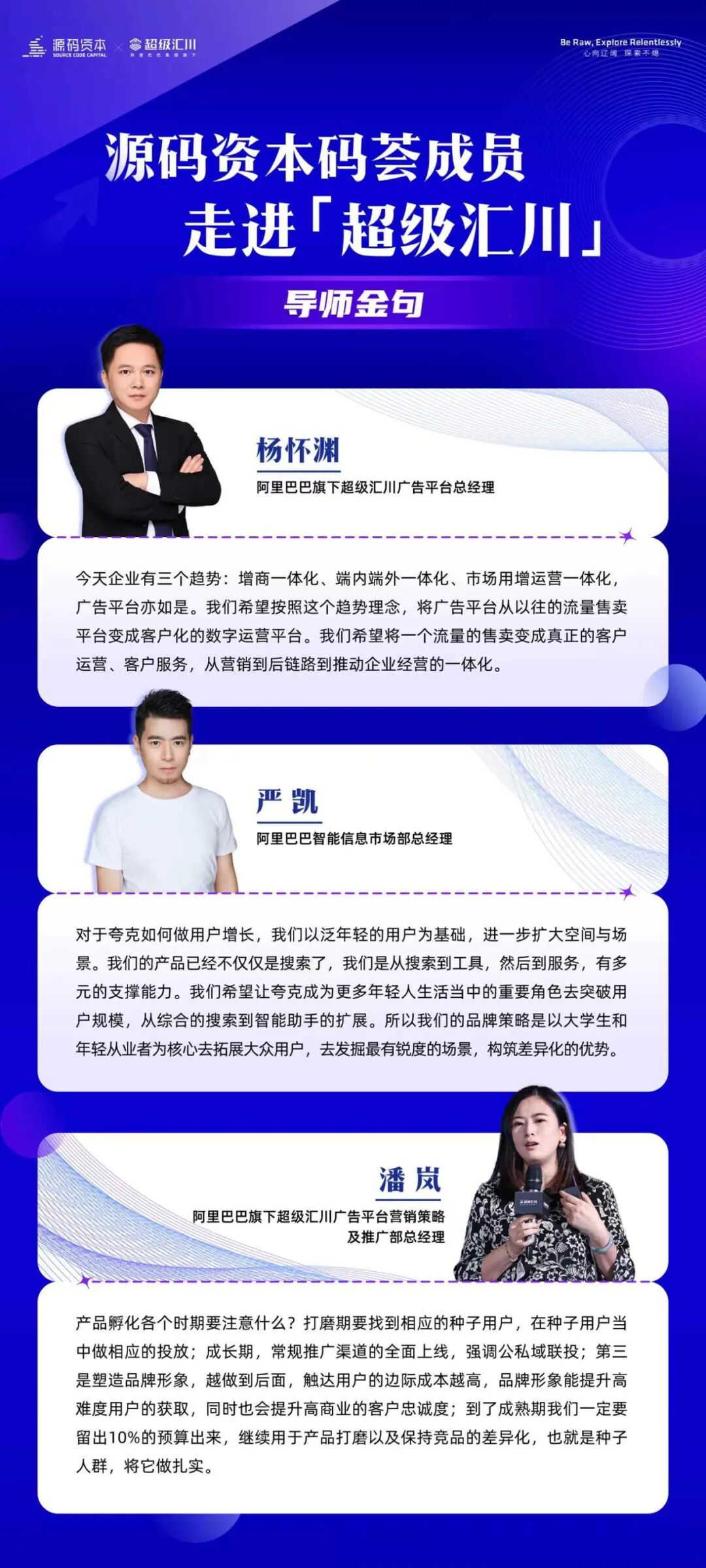
Selected highlights from the presentations

After more than a decade of development, Mobile Internet has entered the stock era. Three years after the pandemic, where do future opportunities for business growth lie?
-
The odds of succeeding simply by getting big are shrinking. Direction needs to be more focused on niche markets.
-
Cost reduction and efficiency improvement matter enormously in the stock era. Maximizing efficiency through digital means can also give you first-mover advantage in market competition.
-
Innovation remains the trump card for winning.
Today's business growth or user growth isn't just one link in the chain — it's an integrated, all-in-one strategy encompassing brand, product, marketing, operations, and consumer service. It's the integration of market growth and operations, of growth and commerce, of in-app and out-of-app.
● Market Growth and Operations Integration: In the process of acquiring users, market branding, sales, and user growth tactics must be three-in-one with internal consumer operations.
● Growth-Commerce Integration: Unify user and traffic growth into a single, seamless whole.
● In-App and Out-of-App Integration: Growth and operations teams should operate under the same mechanism.

01
The Role of Advertising Platforms in Integrated Value Growth Strategy
Whether operating a product or service, planning market branding, or managing post-acquisition user behavior like retention and activity, companies need the right tools at every stage.
-
Advertising platforms provide the marketing, operations, and sales tools that enterprises need.
-
Through their native digital capabilities, advertising platforms can string these tools together into an integrated chain, using digital means to boost operational efficiency.
02
How Digital Marketing Platforms Drive Growth
-
Advertising platforms are a critical digital tool for market research, supporting product and market decisions. Compared to traditional market research methods — macroeconomic data, street interviews, and other high-latency approaches — platform insights are more comprehensive and can go deeper.
-
Don't neglect soft advertising while running hard ads. Today, new-category advertising has become an out-of-app extension of in-app operations, incorporating more content ecosystem components. It not only helps build connections between brands and consumers, but turns consumers themselves into product ambassadors and evangelists.
-
Service matters in marketing. Service can be a product or virtual, like SaaS. Marketing is a process of providing service; serving consumers ads can itself be useful service. If you turn your product into a service and embed it across search and various media scenarios, that's powerful marketing.
-
Marketing touchpoints and content are crucial. When marketing integrates with scenarios, it can ferment continuously and create sustained marketing effects. At certain nodes, when events and opportunities align, it can even produce explosive results.
-
Digital methods are the endgame for all efficiency. Advertising platforms connect consumer decision-making with post-acquisition tracking. As content becomes increasingly important, advertising can digitize traditional private-domain operations.
03
Implementing Digital Marketing Platforms
Compared to traditional marketing, digital marketing platforms connect marketing performance with marketing results, giving companies data to follow for continuous optimization.
-
During campaigns: nail the creative, find the right target audience, let the platform automate targeting, and provide post-acquisition tools to improve operational efficiency.
-
With content + industrial belt capabilities, leverage the platform's content capabilities, livestreaming capabilities, and market expansion capabilities to make execution more efficient.
-
Digital marketing is about auction ads and performance ads. While planning creative, performance ad platforms can also provide full-suite intelligent creative tools.
-
Private-domain operations in three stages:
-
Stage one: Bring in KOLs to tailor stories to product features — same story in-app and out-of-app — reaching all of the KOL's followers in the process.
-
Stage two: Run corresponding soft ad amplification to reach relevant community fans and build word-of-mouth within the circle.
-
Stage three: Once word-of-mouth forms, consider hard ad placements. Scale up gradually, adjusting and iterating. If early audience targeting underperforms, go back and iterate until results improve, then amplify with hard ads and scale up.

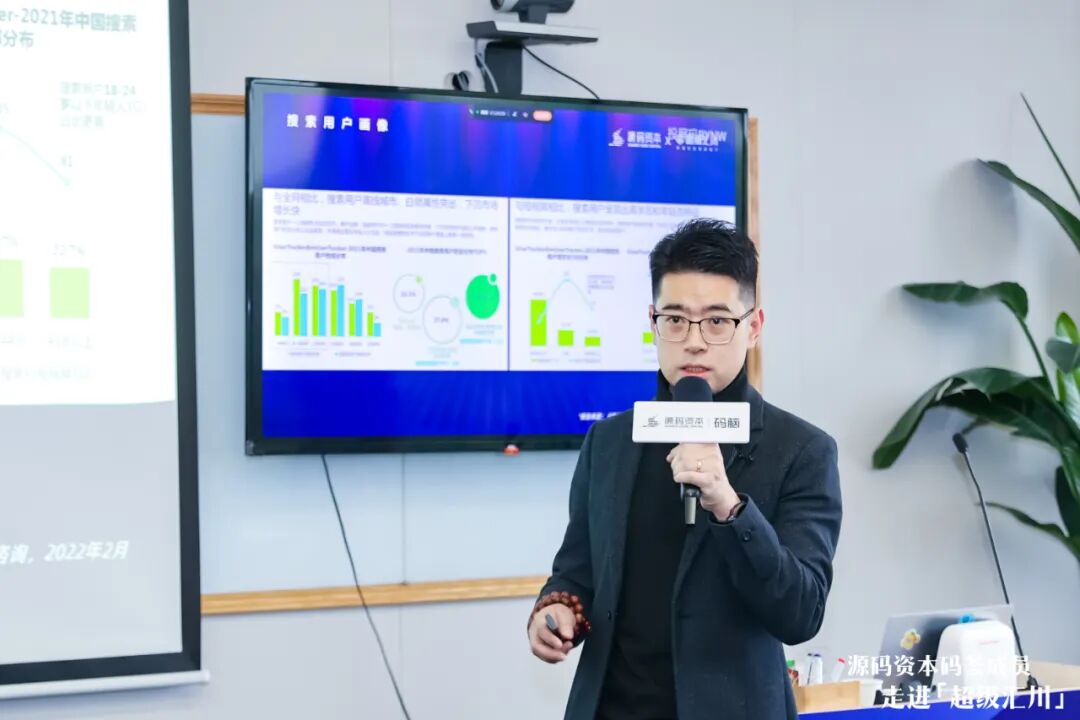
Quark is an intelligent search app that provides young people with a rich suite of smart tools: search, scanning, photo problem-solving, cloud storage, web tools, and more. Core users include K-12 students, college students, Gen Z, new professionals in their 30s-40s, and specialists.
01
Quark's Insights and Thinking on Young Audiences
The first step in community marketing is to enter the community. Only by standing with users can you break out of it. Three things Quark consistently adheres to: wanting to be a youth brand, continuously communicating with young people broadly defined, and maintaining edge with young audiences.
Gen Z differs significantly from previous generations: because of national strength and rapid era development, they're more confident economically and culturally. Search users also have more distinctive characteristics compared to users of other platforms: higher education levels, more youthful information preferences and interests. Compared to users who randomly browse feeds and short videos, they have clearer problems and needs that demand immediate verification and solutions — so we call them "action-oriented" efficiency seekers. This is the universal trait of young people who use search and smart tools to solve problems.
Young audiences have strong IP attachments to content, themes, and brands they love, projecting emotional preferences onto stories and characters they favor. They also have fresher brand preferences — for instance, they tend to be more receptive to novel, trendy domestic brands.
At the same time, their touchpoints for information and entertainment are more diverse. Consumption, socializing, and entertainment are often integrated, with a clearer trend from online to offline. IP-themed escape rooms and murder mystery games where they can play together, and products that create more emotional exchange and interaction between brands and users, are more likely to win over this community.
Additionally, they're more receptive to marketing and advertising in general, but have unique preferences and higher demands for ad quality, fun, and meme-worthiness.
02
How to Build a Youth Brand?
For a brand to keep communicating with young people broadly defined and maintain edge with them, it needs to:
-
Stand with young people, become their companion, not their mentor.
-
Drive empathy through shared passion — do things they love together, and provide valuable service.
-
Grow together always, providing matched products and services at different user life stages, growing up alongside young users.
Three keywords for Quark's journey from 0 to 1: awareness, mindshare, reputation.
We need to find precise targets to切入, strong points to amplify, scenes that move users to purchase and use, and opportunities for repeat usage — that's mindshare.
For ultimate reputation, we need to create a brand texture. Every product is different from others. What users, what reasons for choosing it? Why is this product edgy? Why is Quark for young people?
Simply put, if we translate this for general industry: we want to create brand premium across these three dimensions, telling people what the selling point is, what the buying point is, and finding the word-of-mouth point.
Selling point: tell people who I am, the most direct and simple one-sentence description of what business and value I provide.
Buying point: what our relationship is, what scenes you as a consumer use this product and business in? This is our incidental relationship — what scenes make you think of our business? That's the corresponding buying point.
Word-of-mouth point: this person is pretty good, the feeling is decent, others will say he's good, you won't think of him negatively, and you can create opportunities and usage scenarios for using him.
From a user development perspective, we divide actions affecting user scale into two parts: one is "heart power," or brand building — achieved through brand awareness, brand reputation, brand image, mindshare, and other dimensions. The second is "action power," new user acquisition and activation through events and promotions.
Every business should find the connection between its brand communication and users, then acquire and activate through brand events and activities. For brand exposure, track changes in social media brand mention rates and search platform query volumes influenced by exposure, finding conversion metrics from heart power to action power. Based on these metrics, we've built a complex but highly effective internal model for market investment strategy support and performance optimization feedback.
With influencing user behavior as the end goal, we continuously deepen our understanding of these users and review performance. We also monitor brand assets through a series of monitoring tools and methods, measuring the effects of our user and market actions, constantly adjusting selling points, creative materials, and market strategy moves to see whether heart power and action power are achieving their goals and influencing each other.
Quark didn't become so influential among young users overnight. It advanced through three stages:
Stage one: We positioned Quark as a browser product for geeks (a micro-niche community), crafting it with a tech streetwear feel — something technological, cool, a product that spares you the cluttered burdens others impose. The stage one approach was simple: benchmark against the strongest, most urgent competitor, and partner with many tech communities, tech accounts, tech businesses, and tech KOLs. We distilled what these people saw as a minimalist,极致 product, put the selling points into different channels to test, and built a content-driven breakout method. Through this strategy, we launched the first brand wave, formed the first口碑 wave, and won over the first cohort of young geeks.
Stage two: We wanted to expand to broader young audiences. Building on the original geek community, Quark gradually evolved its business form into a new-generation intelligent search, expanding new usage scenarios to help people understand what new search is. We went deep with IPs that young people love and that influence them, binding with IPs to acquire users at scale through vertical features.
Stage three: We want Quark to become a more important character in more young people's lives. Our brand strategy expands from college students and young professionals to mass users, redefining ourselves and building differentiated advantages. As we've grown with young people and solved more problems for them, facing a larger market, Quark's positioning statement is "Your Efficiency Partner" — telling people Quark is a younger, smarter partner that can help you solve more problems.

As a startup with very few resources, how should you approach marketing? At startups, what the boss cares most about is whether you've misspent a single penny. For startups, marketing and growth are no longer cleanly separated — the boss cares more about how much sales revenue you can actually bring in.
Given this situation, the overall Marketing function has often become a G function today. If you want to be a good CGO, what capabilities do you fundamentally need? Break it down into S-M-D: S is strategy — when doing growth, you must have clear strategic insight, and the core premise for a product's survival is who you're solving what problem for. M addresses deep market insight — the stronger your market insight, the more focused you are. Achieving this isn't hard, but the question is who exactly you want to reach, and is your post-reach conversion rate high enough? D is data — anyone doing marketing or growth without closed-loop data thinking, whether using external or internal tools, can't be a good CGO.
Under the CGO positioning for growth, the core task is building yourself a capability model, which is the SMD trinity: strategy, market, and data. On this foundation, lead the team and drive growth.

To truly be a good CGO, you need to nail these core things:
01 Organizational Foundation
-
An agile growth organization is like a "wheel" — centered around the CGO or PMs under them, bringing together product operations, marketing, data,投放 BD, and growth PM teams to operate toward core audiences and core selling points.
-
On the foundation of collaborative operations, cultivate PMs into backup leaders (B roles), use the leader's influence to fight one or two campaigns, and after achieving good results, have the B role gradually diffuse this model outward — only then can you achieve agility.
-
Define the growth organization's core missions: first set targets, second track process, third deliver performance.
02 Growth Strategies at Different Stages
Under different growth models, products have four distinct stages: polishing, growth, maturity, and incubation.
1. Product Polishing Stage
The core goal in polishing is strengthening user experience and refining product selling points. The core process is finding seed users — the more precise the better — and running targeted campaigns toward them.
2. Product Growth Stage
Once growth-stage campaigns reach volume, you can leverage tools from platforms like Chaohuichuan for combined public and private domain campaigns to amplify voice, shape preliminary brand image, and continue product polishing while maintaining differentiation from competitors.
3. Product Maturity Stage
Target user scale, expand the pie — pre-installs, major events, billboards, optimized投放 on less precise channels, further covering peripheral audiences.
4. Product Incubation Stage
When a product generates cash flow and stable revenue, companies generally need a second growth curve, and must continuously incubate products. For example, UC originally had UC Browser, and with UC Browser stably generating profit, launched UC Lite and UC Large-Text versions.
The most critical point for many products in incubation is leveraging the mother app's势能. This is extremely important. How to use the mother app to provide users, accounts, and data support, achieving traffic倾斜 to help new products survive their own polishing stage — this is crucial.
In summary, selecting differentiated audiences and channel emphases based on product selling points at different stages is vital. While communicating with your product's existing user base, cover more and broader traffic入口 to gain more potential users. For example, search shouldn't be on a single media property — the more and more comprehensively you cover search channels, the better, making it easy for users to self-search and find needed potential audiences.